



CCSD code G5100: Bypass of duodenum billing guide
CCSD code G5100 bills a bypass that leaves the duodenum in place CCSD code G5100...

Last Updated: Oct 16, 2026
CPT code 67228 is the procedure code for treatment of extensive or progressive retinopathy by photocoagulation, the panretinal scatter laser used in proliferative diabetic retinopathy. Medicare pays it once per eye per 10-day global period, at roughly $341 in the office and $254 in a facility.
Missing laterality modifiers, repeat sessions billed inside the global period, and unsupported ICD-10 pairings are the three most common reasons ophthalmology practices see 67228 denied. This guide covers the current descriptor, 2026 Medicare rates, modifiers, the 10-day global period, covered diagnoses, documentation, denials, and related retina codes.
This reference is written for ophthalmology and retina coders, billing managers, and practice owners. Reimbursement figures come from the 2026 Medicare Physician Fee Schedule (MPFS). Coverage rules follow Local Coverage Determination L33628 and its billing and coding article, A56550.

CPT code 67228 covers panretinal scatter photocoagulation for extensive or progressive retinopathy, such as proliferative diabetic retinopathy.
The code carries a 10-day global period, not 90 days. Medicare pays it once per eye per global period, however many sittings the course takes.
Every claim needs RT, LT, or 50. Claims without one are returned as unprocessable rather than denied.
The 2026 national Medicare rate is roughly $341 to $343 in the office and $254 to $255 in a facility, before any locality adjustment.
Practice management software like Pabau prompts for the laterality modifier and the paired ICD-10 code before the claim goes out.
CPT code 67228 is defined by the American Medical Association (AMA) as “Treatment of extensive or progressive retinopathy (eg, diabetic retinopathy), photocoagulation.” The code sits in the Retina or Choroid Procedures subsection of the Surgery section, CPT 67000-67299. It covers panretinal photocoagulation (PRP), the scatter laser used to slow neovascularization in eyes with extensive or progressive retinopathy.
The descriptor changed on January 1, 2016. The phrase “one or more sessions” came out, and the global period dropped from 90 days to 10.
Older billing guides that treat 67228 as a 90-day major procedure describe rules retired a decade ago. The wording change did not loosen payment, though. Medicare still pays the code once per global period per eye.
Medicare coverage for CPT code 67228 is governed by Local Coverage Determination L33628 and its companion billing and coding article, A56550. The LCD covers PRP for proliferative and pre-proliferative retinopathies, and for severe diabetic macular edema associated with pre-proliferative disease.
Article A56550 carries the covered diagnosis list, which runs to roughly 275 ICD-10-CM codes. Check the pairing against our ICD-10-CM code reference before the claim is submitted.
The codes below are among those commonly used to support medical necessity for 67228. Each one is billable at full character length. Category-level codes such as E11.35 or H35.05 are not, and a claim built on one will reject. Check your own MAC article, since local lists differ.
Specificity matters on both halves of the claim. The diabetic retinopathy codes take a sixth character for laterality: 1 for right, 2 for left, 3 for bilateral, and 9 for unspecified. Pick the character that matches the eye named in the procedure note. Submitting a right-eye diagnosis against an LT line item is a routine denial trigger.
The 2026 Medicare Physician Fee Schedule pays CPT code 67228 on relative value units (RVUs) multiplied by the CMS conversion factor. That national figure is then adjusted by the Geographic Practice Cost Index (GPCI) for the locality. Practices can pull locality figures from the CMS Physician Fee Schedule search tool.
CY2026 is the first year with two conversion factors. Clinicians in a qualifying alternative payment model are paid at $33.5675, and everyone else at $33.4009. Multiplying the code’s total RVUs by the applicable factor gives the national rate, before the GPCI adjustment. The figures below reconcile directly to the CMS RVU file, so you can check them yourself.
Where the laser is delivered changes what the practice collects. The non-facility rate applies in the physician’s office, where the practice carries the equipment and staffing cost. The facility rate applies at an ambulatory surgery center or hospital outpatient department, because the facility bills separately for room, equipment, and clinical staff.
Both figures are national averages and shift with locality. Use your MAC’s GPCI adjustment when projecting collections. Place of service decides which column applies, so the POS code on the encounter has to match where the laser was delivered.
Run eligibility verification on every 67228 patient before the procedure date. Confirm whether the plan requires prior authorization for panretinal photocoagulation, and whether a referral from the ordering physician is on file. Missing either is the fastest route to a post-service denial you cannot appeal on clinical grounds.
CPT code 67228 takes a small set of modifiers, and two of them are mandatory. Article A56550 states that claims submitted without RT, LT, or 50 are returned as unprocessable under section 1833(e). A returned claim carries no appeal rights, so the practice corrects the line and resubmits. Solid denial management workflows catch these before they age.
Payer rules for bilateral PRP differ. Medicare generally accepts modifier 50 on a single 67228 line and pays 150% of the unilateral rate. Many commercial payers want two line items instead: one with LT and one with RT, each at 100%. PRP is usually staged one eye at a time, so same-session bilateral treatment is the exception.
Confirming bilateral coverage before the procedure date, and capturing the authorization number for each eye, prevents the most common denial pattern on bilateral 67228 claims.
CPT code 67228 carries a 10-day global period under Medicare, shown as global indicator 010 in the Physician Fee Schedule. CMS reclassified 67228 as a minor procedure at the start of 2016, retiring the 90-day period that older guides still quote.
For 10 days from the date of service, related follow-up care for that eye is included in the original payment. Commercial and Medicare Advantage plans can set their own period, so confirm the term in each contract rather than assuming 10 days everywhere.
The short window has a practical consequence for retina practices. Post-laser checks inside those 10 days are not separately billable for the treated eye. An unrelated visit in the same window can still be billed with modifier 24 if the note supports it.
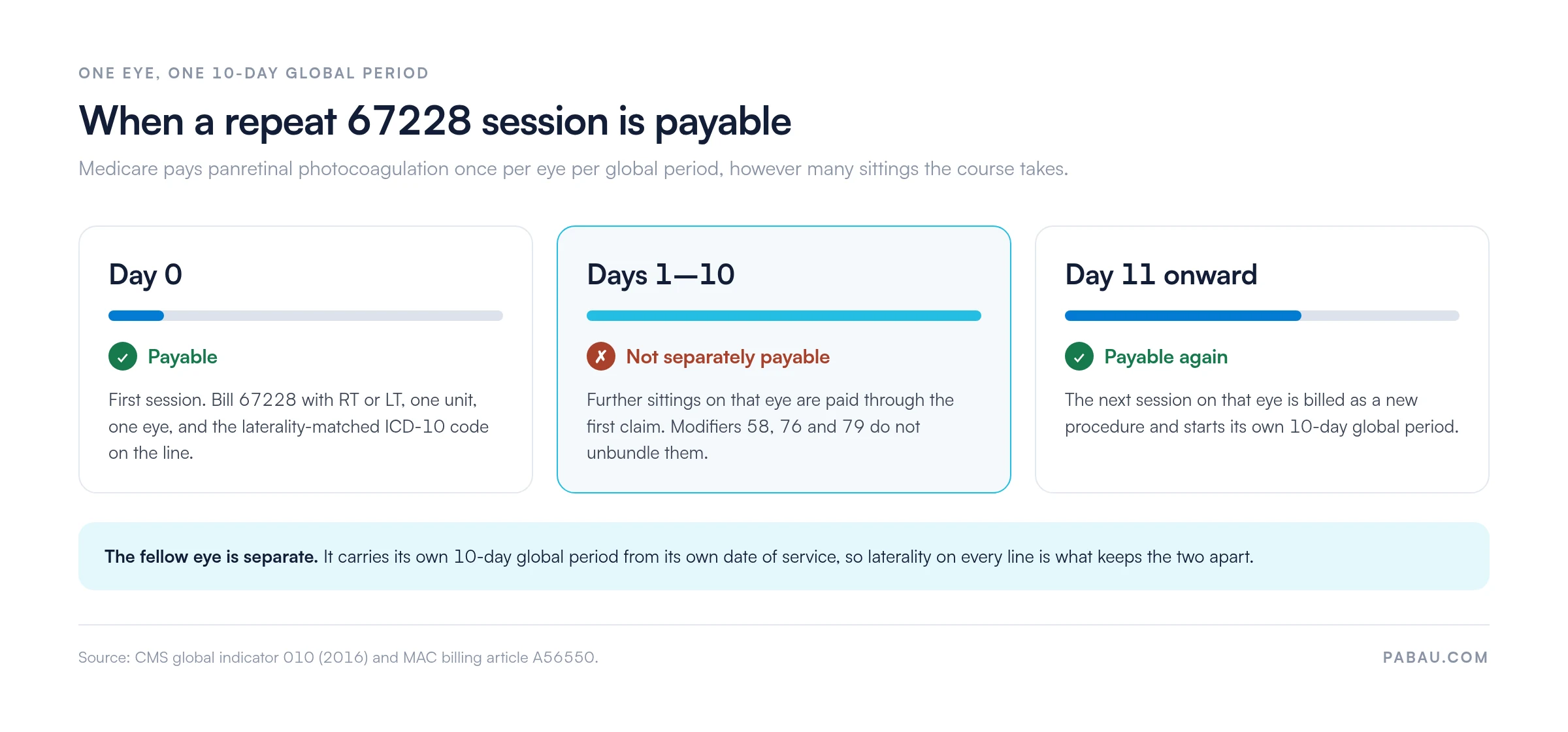
A full PRP course runs to roughly 1,500 to 2,000 laser spots per eye and is often delivered over two or more sittings. Only the first of those sittings is separately payable inside the global period. Article A56550 puts it plainly. Payment may be made only once during the global period of the initial procedure.
There is no modifier that changes this. Appending 58, 76, or 79 to a second same-diagnosis 67228 on the same eye inside the 10 days does not make it payable. Billing it that way invites a refund request on audit. The timeline below shows which sittings survive that rule.
LCD L33628 sets out the clinical documentation a retina practice needs to support medical necessity for CPT code 67228. MAC auditors review these claims regularly, and high-volume retina practices see the most scrutiny. Every 67228 chart should carry each element below.
A missing element turns a clean claim into an appeal or a write-off. Practices that use structured note templates for PRP see fewer pre-payment review requests.
Most 67228 rejections trace back to five causes, and four of them are fixable at the point of charge entry. The table pairs each one with the trigger and the correction.
Stale rules cause the sixth problem, and it is the expensive one. A practice still working from 90-day global period guidance will hold legitimate day-15 sessions it could have billed, and will submit day-5 sessions it cannot. Both errors cost money in opposite directions.
Choosing 67228 over a neighboring code, or missing a legitimate companion code, drives both undercoding and overcoding in retina practices. The table compares 67228 with the codes coders weigh against it most often. The AAPC Codify CPT lookup is a useful reference for adjacent ranges.
The 67210 comparison is the one that trips coders up. Both codes describe retinal photocoagulation, but 67210 still bundles repeat sittings across a 90-day window, while 67228 bundles them across 10 days.
The 67145 line matters too. Prophylactic treatment does not meet the extensive or progressive threshold that defines 67228. Documenting the stage and severity at the time of treatment is what supports the code you pick.
Flag same-date 67028 and 67228 billing for documentation review before submission. Both codes are separately payable when the injection and the laser are clinically independent treatments on the same date. The note must document each service on its own terms. A combined or ambiguous note is the leading cause of bundling denials on this pair.
Retina practices billing CPT code 67228 work with a narrow margin for error. A 10-day global period, mandatory laterality modifiers, six-character ICD-10 requirements, and same-day injection rules all land on one claim. A single overlooked field becomes a denial or an audit finding.
Pabau is practice management software with claims handling built in. Its billing tools for ophthalmology replace manual code entry with a structured charge screen, so the laterality modifier is prompted rather than remembered.
Claims reach US payers through Claim.MD, our clearinghouse partner, and eligibility checks run before the procedure date. ERA processing then posts payments against open claims, so nobody is matching remittances to invoices by hand.
The built-in CPT and ICD-10-CM catalogues let a coder pick 67228, its laterality modifier, and the matching retinopathy code from one encounter screen. Past procedures stay on the patient record with their dates, so the team can see whether a second PRP session falls inside the 10-day window.

Pabau’s claims management tools help retina and ophthalmology practices submit CPT code 67228 correctly the first time. The right modifiers, paired ICD-10 codes, and documentation are all in place before the claim goes out. Fewer denials. Faster collections.

CPT code 67228 changed in 2016, and a lot of billing guidance never caught up. The descriptor no longer says “one or more sessions.” The global period is 10 days rather than 90, and the national office rate sits near $341.
Payment still lands once per eye per global period, and no modifier moves that line. Four habits clear most 67228 denials. Put laterality on every claim and use a billable six-character diagnosis. Document the spot count and treated area, then hold any repeat session until the 10 days close.
To see how Pabau builds retina claims with modifier prompts and paired ICD-10 codes, book a demo with the team.

Need to understand how claims reach payers? Medical claims clearinghouse guide explains how electronic claim routing works and what to look for in a clearinghouse partner.
Want to reduce claim rejections before they happen? Claim.MD clearinghouse overview covers how Pabau’s integrated clearinghouse handles 837P submissions, eligibility checks, and ERA processing.
Billing the imaging that documents the retinopathy? CPT code 92134 covers retinal OCT, the scan retina practices run alongside laser treatment.
CPT code 67228 is the billing code for panretinal scatter laser photocoagulation, used to treat extensive or progressive retinopathy. It is applied most often in proliferative diabetic retinopathy, and also covers sickle cell retinopathy and other proliferative retinopathies. The code is reported per eye and paid once per global period, no matter how many laser sittings the course takes.
The 2026 national Medicare rate for CPT 67228 is roughly $341 to $343 in the office and $254 to $255 in a facility. Those figures come from total RVUs of 10.21 non-facility and 7.60 facility, multiplied by the CY2026 conversion factor. CY2026 has two factors: $33.5675 for qualifying APM participants and $33.4009 for everyone else. Actual payment varies by locality, so verify your MAC rate in the CMS Physician Fee Schedule search tool.
CPT 67228 has a 10-day global period under Medicare, carried as global indicator 010 since 2016. The 90-day figure quoted in older guides is out of date. Related follow-up care for the treated eye is bundled into the original payment for those 10 days. Commercial and Medicare Advantage plans can set a different period, so check each contract.
Not within the global period. Medicare pays 67228 once per eye per global period, and later sessions in that postoperative window are included in the first payment. No modifier changes that, including 58, 76, and 79. Once the 10 days have passed, a further session on the same eye is billed as a new procedure with its own RT or LT. The fellow eye runs on its own global period, so it can be treated and billed independently.



