CPT code 93503: Swan-Ganz catheter billing and modifiers
CPT code 93503: Official descriptor and procedure overview In the AMA CPT code s...

Last Updated: Oct 23, 2026
Replacing an intraocular lens that has slipped, broken or missed its target power is billed with CPT code 66986, not as another cataract surgery. The code describes exchange of intraocular lens. The surgeon removes an IOL placed in an earlier surgery and inserts a new one in the same eye.
If the eye has no lens yet, the secondary implant is 66985 instead. Bill an exchange as routine cataract surgery (66984) and you under-report the work or invite a denial once the payer sees the earlier IOL. The checklist below covers what to confirm before you submit.
Let Pabau's smart automation suggest the right codes, reduce claim denials, and keep your practice compliant—effortlessly.
Automate repetitive tasks and focus on what matters most—your patients.
Reduce coding errors and ensure compliance with the latest regulations.
Clean claims, fewer denials, and faster reimbursements.
Powerful insights and reporting to help your practice thrive.
HIPAA compliant SOC 2 certified GDPR-compliant Trusted by 4,000+ clinics worldwide

CPT code 66986 is for IOL exchange, which means removing a lens implanted in an earlier surgery and inserting a new one.
An IOL placed in an aphakic eye with no existing lens is a secondary implant, coded 66985 rather than 66986.
Billing 66984 for a lens swap under-reports the work, because 66986 carries far higher RVUs than routine cataract surgery.
Every 66986 line needs -RT or -LT, plus -78 or -79 when it falls inside another surgery’s 90-day global period.
The operative note must name the prior IOL and the reason for the exchange, or the claim struggles on review.
CPT code 66986 covers one procedure: exchange of intraocular lens. The surgeon removes an IOL that was implanted in an earlier operation and inserts a new IOL in the same eye. The American Medical Association (AMA) maintains the CPT code set and publishes the official descriptor below.
Three points decide whether a procedure belongs under 66986:
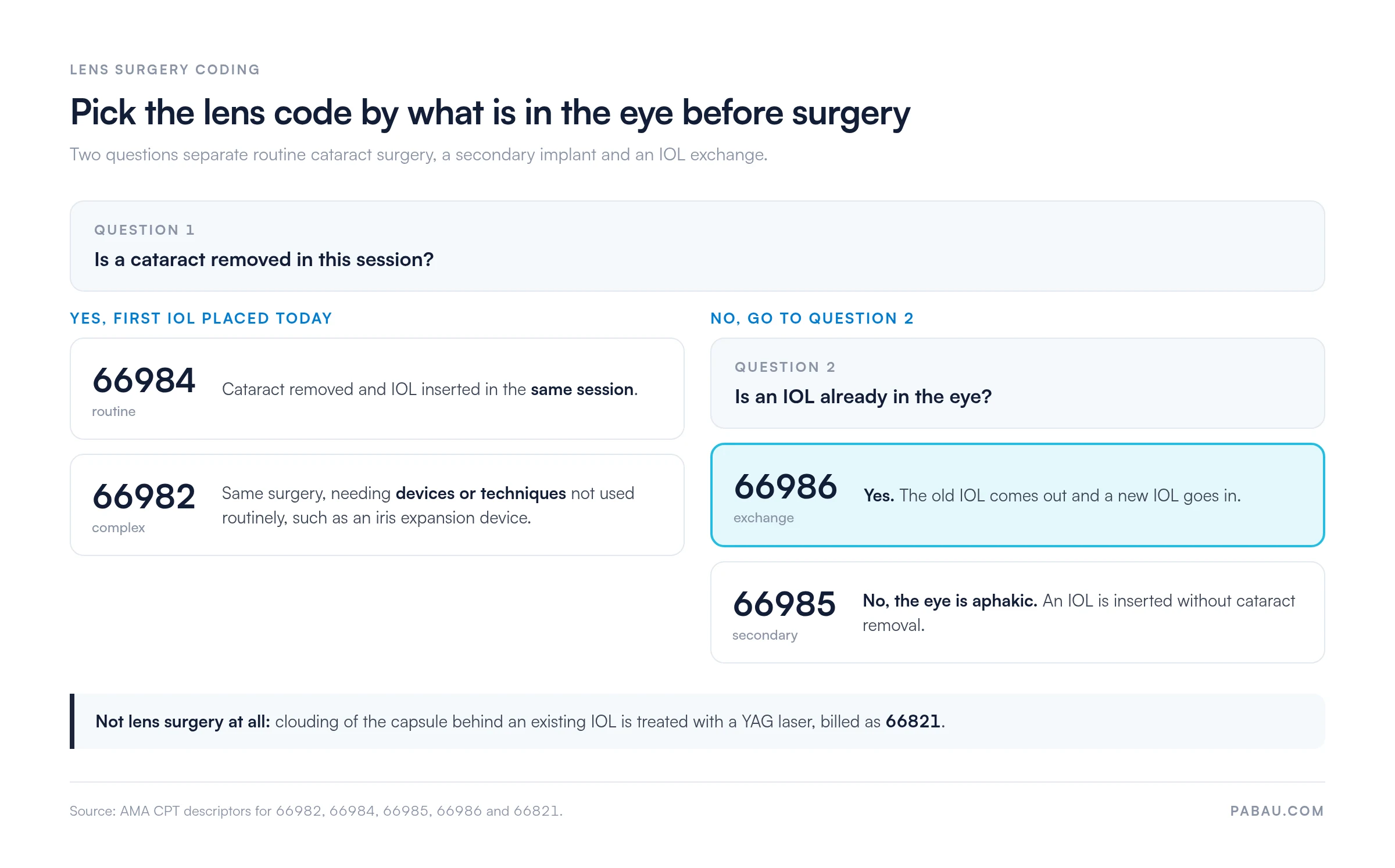
So the trigger for 66986 is an IOL that is already in the eye. If the cataract comes out and the first lens goes in at the same sitting, the code is 66984.
Three codes describe putting a lens into an eye, and each one depends on what is there before the surgeon starts. Routine cataract surgery with a first IOL is 66984. A secondary implant into an aphakic eye is 66985.
Swapping an existing IOL is 66986. It carries noticeably more relative value units (RVUs), because the surgeon re-enters an eye that has already been operated on. The two questions in the diagram below settle which code applies.
Before you submit 66986, confirm that today’s operative note states an IOL was implanted earlier. A line in an old op report isn’t enough if the current note never mentions it. Where you know them, record the prior IOL’s model, power and implant date in today’s report.
66986 sits in a tight family of lens codes. Coders need to know which ones replace it, which bundle into it, and which stay separately reportable, such as YAG capsulotomy, 66821.
For current bundling rules, check the CMS NCCI edits. CMS updates them every quarter, so a pairing that bundled in Q1 may change by Q3.
The diagnosis on a 66986 claim has to explain why the old lens came out. Payers with Local Coverage Determinations (LCDs) for lens surgery may limit the covered diagnoses. Check your Medicare Administrative Contractor (MAC) before you submit.
Two diagnoses steer you away from 66986. Aphakia (H27.0-) with no lens in the eye points to a 66985 secondary implant. Secondary cataract behind an IOL (H26.4-) usually points to a YAG capsulotomy instead.
Code from the operative report, not from a template. If the exchange is elective for refractive reasons rather than a documented complication, expect closer payer review and a possible medical necessity denial.
Laterality is mandatory on every 66986 line, because the code describes surgery on one eye. A claim without -RT or -LT is rejected at the front end by most MACs.
In an ambulatory surgery center (ASC), the facility bills its own claim for 66986 with the same laterality modifier. The surgeon’s professional claim and the facility claim are coordinated but submitted separately.
Traditional Medicare (Parts A and B) doesn’t require prior authorization for 66986. Medicare Advantage (MA) plans and commercial insurers vary, and many of them do.
Never assume one plan’s policy carries over to another. The prior authorization process runs differently at each payer, and a missed auth is hard to appeal once the surgery is done.
A clean claim for 66986 starts with an operative report that confirms a few specific facts. When one of them is missing, the claim is easy for a payer to deny.
Five checks cover the errors that sink most exchange claims. Run them on every 66986 claim before it leaves the practice.
Here’s how the claim moves after surgery. The surgeon signs the operative note, and the coder assigns 66986, the diagnosis and the modifiers. The claim then goes to the payer as an electronic 837P, usually through a clearinghouse.
The payer replies with an 835, the electronic remittance advice, which shows the payment or the denial reason. A denial goes back to the coder, who corrects and resubmits it or prepares an appeal.
Payers review re-operative lens surgery more closely than first-time cataract surgery. Each trigger below has a specific fix, which is why denial management workflows matter for teams that bill IOL exchanges.
66986 carries a 90-day global period under the Medicare Physician Fee Schedule (MPFS). Routine post-op care in that window is included in the surgical payment.
Rates change every year and vary by locality through the Geographic Practice Cost Index (GPCI). Check the current figures in the CMS Physician Fee Schedule lookup.
YAG capsulotomy (CPT 66821) is one of the most common procedures after lens surgery. Inside the 66986 global, report it with -79 when it is unrelated to the exchange. Use -78 for a related return to the operating or laser suite. Once the global ends, 66821 needs only the laterality modifier.
Many ophthalmology billing teams switch between the operative note, the payer portal and a clearinghouse login to get one exchange claim paid. Each handoff is another place for a stale auth or a missing modifier to slip through.
Pabau, the practice management platform we build, keeps the patient record, the claim and the payment in one system. Its ophthalmology claims management software sends 837P claims electronically through the Claim.MD clearinghouse and checks eligibility before the visit.
When the 835 comes back, the ERA posts against the claim. An underpaid or denied 66986 line shows up the day it arrives, so your billing team can work it while the details are fresh.
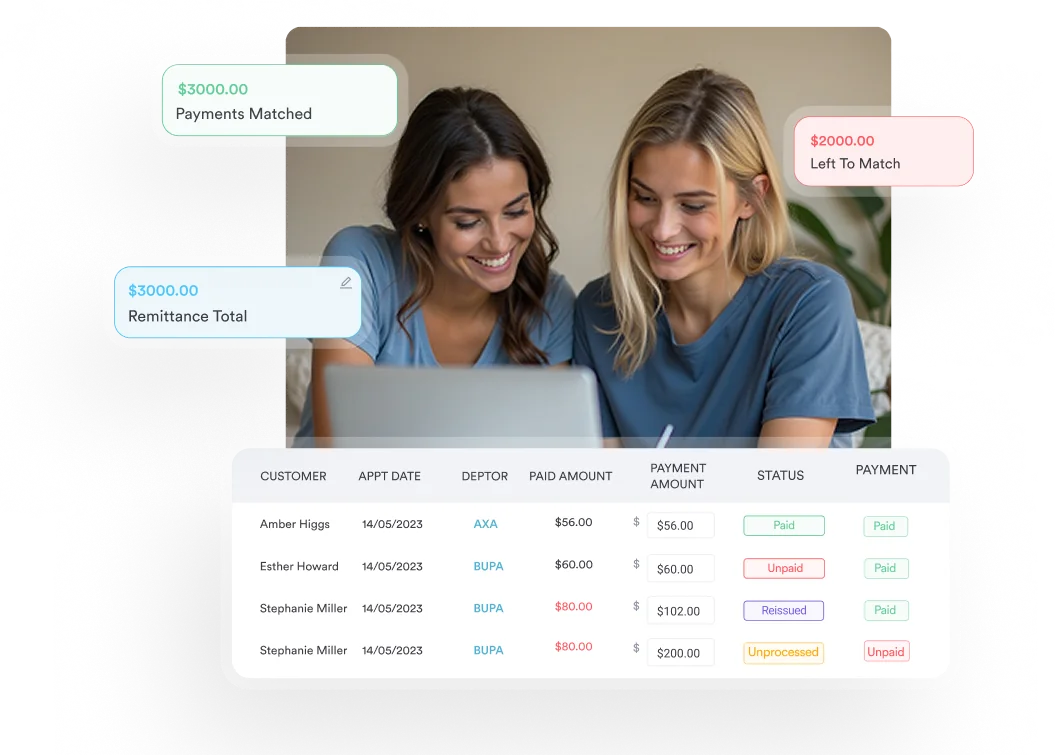

Pabau sends 837P claims through Claim.MD, checks eligibility before surgery, and posts ERAs against each claim. Your team sees a denied 66986 line the day it lands.

A 66986 claim is won or lost before anyone opens the claim form. When the operative note proves an IOL was already in the eye and says why it came out, the code choice follows.
Make prior IOL status the first question your coders ask on any lens surgery. It separates 66986 from 66984 and 66985 in seconds, and it protects the higher payment the exchange earns. The trade-off is a little more writing for surgeons, which costs far less than an appeal.
Want electronic claims, eligibility checks and ERA posting in the same system as the chart? Book a demo to see how Pabau handles 66986 claims from surgery to payment.

Coding a first-time cataract case with extra devices? CPT code 66982 explains when complex cataract surgery applies instead of 66984.
Need guidance on clearinghouse submissions? Medical claims clearinghouse guide explains how 837P claims reach payers and how to resolve submission errors.
Using Claim.MD for ophthalmic claims? Claim.MD clearinghouse overview covers how claims are routed and tracked through the clearinghouse.
Want superbills that match the operative note? Superbill guide shows which fields a superbill needs before a claim is built from it.
Looking at the whole billing cycle? Revenue cycle management guide covers the workflow from patient scheduling through payment posting.
No. 66984 removes a cataract and places the first IOL in one session. 66986 removes an IOL that is already in the eye and inserts a new one.
That is 66985, a secondary implant not associated with concurrent cataract removal. 66986 only applies when an existing IOL is removed and replaced.
Medicare assigns 66986 a 90-day global period. Routine post-op visits in that window are included in the surgical payment. Bill an unrelated new problem with modifier -24.
Yes, when the exchange is medically necessary, such as for a dislocated or broken IOL. Traditional Medicare needs no prior authorization for it. Exchanges done only for refractive preference face closer review.
The original operative report is the strongest proof. Back it up with the patient’s IOL implant card if there is one. Then restate the lens model and power in today’s note.
Usually not. NCCI edits bundle 67005 and 67010 into 66986 in the same session. Separate reporting needs a modifier and a distinct, documented service, so check the current quarter’s edits first.