CPT code 93503: Swan-Ganz catheter billing and modifiers
CPT code 93503: Official descriptor and procedure overview In the AMA CPT code s...

Last Updated: Oct 23, 2026
D2030 is the CCSD code for removal of grommets, the small ventilation tubes set into the eardrum. It is a minor ear, nose and throat procedure in the middle ear and mastoid section of the CCSD schedule.
Most grommets fall out on their own as the eardrum heals. D2030 covers the cases where a surgeon has to take one out. Typical examples are a tube that stays in too long or one that keeps the ear discharging. A clean claim rests on an operative note that names the ear, the tube and the state of the eardrum afterward.
Let Pabau's smart automation suggest the right codes, reduce claim denials, and keep your practice compliant—effortlessly.
Automate repetitive tasks and focus on what matters most—your patients.
Reduce coding errors and ensure compliance with the latest regulations.
Clean claims, fewer denials, and faster reimbursements.
Powerful insights and reporting to help your practice thrive.
HIPAA compliant SOC 2 certified GDPR-compliant Trusted by 4,000+ clinics worldwide

CCSD code D2030 covers removal of grommets, the ventilation tubes set into the eardrum, in the ear, nose and throat chapter.
Published schedules place D2030 in the MINOR 5 complexity band, but each insurer sets its own fee and authorization rules.
Surgeons remove grommets that stay in too long, keep an ear discharging, or block, since most tubes fall out unaided.
The operative note should record the side, the tube type, the anesthesia used and the state of the eardrum afterward.
If a new tube goes in at the same sitting, check the CCSD schedule’s combination rules before billing D2030 with D1510.
CCSD code D2030 is the UK private billing code for removal of grommets from the eardrum. Grommets are the small ventilation tubes that let air into the middle ear. The code sits in Chapter 5, ear, nose and throat, within the middle ear and mastoid section.
Published fee schedules place D2030 in the MINOR 5 complexity band. It is a short procedure, yet the claim still needs care. Most grommets leave the ear without help, so an insurer wants to see why this one needed a surgeon.
Three facts carry the claim: which ear, which tube, and how the eardrum looked afterward. Put those in the note, and D2030 becomes one of the simpler ENT codes to bill.
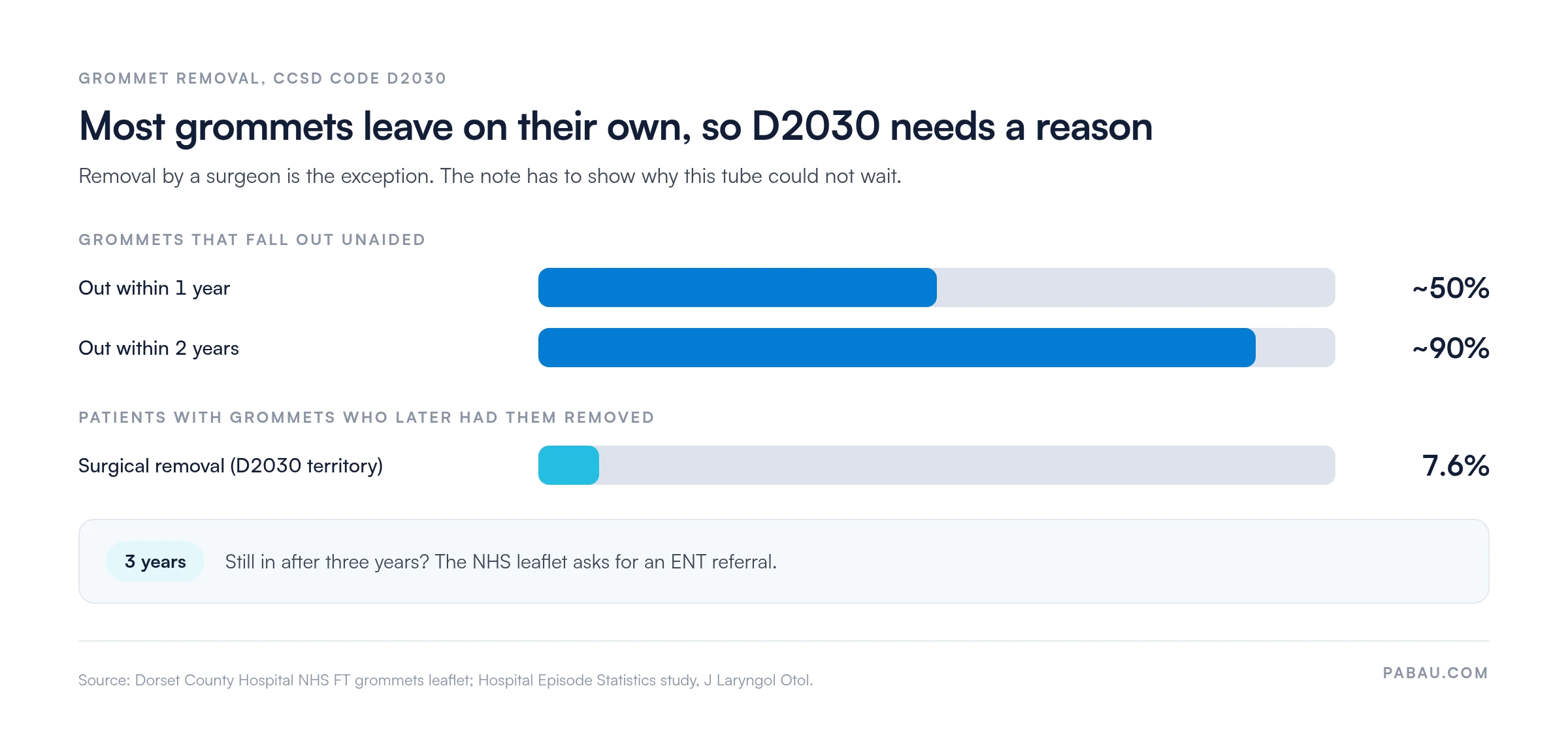
Grommets usually work their way out as the eardrum heals. One NHS trust’s grommets leaflet says about half are out within a year, and 90% within two years. The same leaflet asks for an ENT referral if they are still in after three years.
Removal is therefore the exception. A UK study of Hospital Episode Statistics found that 7.6% of patients with grommets later had them removed. It appeared in The Journal of Laryngology & Otology. Set side by side, the numbers show how rare surgical removal is.
When a surgeon does step in, the reason usually falls into one of these groups.
Write down which of these applied. The indication is what turns a routine follow-up into a billable procedure.
The operation itself is short. Here is the usual sequence, step by step.
Some adults have the tube removed at an outpatient appointment, with or without local anesthetic. Children usually need a short general anesthetic. Some surgeons also freshen the edges of the hole or place a patch to help it close. Record that step, and ask the insurer whether it affects the code.
The hole normally heals by itself. If it stays open, a later repair is a separate operation, myringoplasty, which has its own code (D1420).
The middle ear codes around D2030 describe related work on the same eardrum. What happened to the tube usually settles the choice.
Two situations need a second look. A tube that has already fallen into the ear canal is no longer in the drum. Lifting it out during microsuction may not match the D2030 descriptor, so check with the insurer first.
A grommet change is the other one. The surgeon removes an old tube and inserts a new one at the same sitting. Before both D2030 and D1510 go on one claim, check the code principles in the CCSD schedule.
Insurers query a D2030 claim when the note leaves them guessing. Before the claim goes anywhere, make sure the record covers each of these points.
Give the outcome line extra care. A note that ends at “tube removed” leaves the insurer unsure whether the drum needs further treatment.
A nine-year-old had grommets placed in both ears three years ago. The left tube came out on its own. The right one is still in, and that ear has discharged for two months despite drops.
At review, the surgeon lists the child for removal under general anesthetic. In the operating room, the right tube comes out intact, with granulation around it. A small hole remains, and a swab goes to the lab.
The note records the right ear, the tube type, the persistent discharge, the granulation and the hole left behind. It also books an outpatient review. The invoice then carries one D2030, the matching diagnosis code and the authorization reference. The anesthetist bills separately under their own code.
That split holds across the ear chapter of the CCSD schedule. Removal of multiple bony exostoses from the ear canal bills as CCSD code D0280, and the anesthetist again claims under a separate code.
Ask the insurer at the authorization stage whether a new tube might be needed. If the surgeon changes plan in the operating room, you already know how the insurer handles the extra code.
With a complete note in hand, billing becomes a fixed routine. Each of these six steps can trip up a grommet removal if it is rushed.
The CCSD (Clinical Coding & Schedule Development) group maintains the CCSD codes specialists bill, but it does not set fees. The MINOR 5 band tells you where D2030 sits in the complexity scale. The fee itself depends on the insurer and the patient’s plan.
A fee quoted on a forum or an old invoice is only a guide. Check the insurer’s current schedule before the procedure. Our guide to the Bupa fee schedule shows how one insurer groups its fees.
A two-minute check catches most of the problems above. Run it on every grommet removal invoice before it leaves the practice.
Most queried grommet removal claims trace back to a short list of errors. Each one has a simple fix.
In many ENT practices, the review note lives in one system and the invoice in another. Someone then copies the side, the code and the authorization number across by hand.
Pabau, the practice management and billing platform we build, keeps the note and the claim on one patient record. You can build an operative note form with required fields for side, tube type and outcome. With claims management, the CCSD code, membership number and authorization reference carry into the claim.
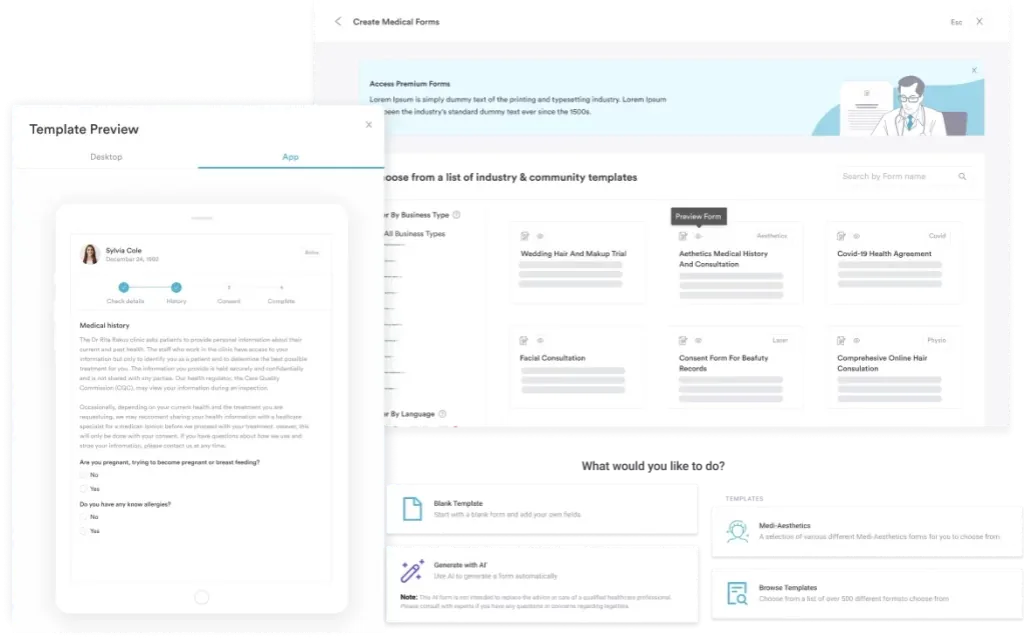
Because side, tube and outcome are required fields on the form, the note is complete before billing starts. Pabau sends the invoice to Healthcode. Each claim’s status then sits in one list, so a queried D2030 surfaces before it ages.

Pabau builds the claim from the patient record, so a D2030 invoice carries the code and authorization reference without retyping. You then track every claim’s status in one place.

D2030 is a small procedure with a simple test. Was a grommet still in the eardrum, and did the surgeon take it out? If so, the code fits.
Most of the effort goes into the note. Name the ear, the tube, the reason and the state of the drum afterward. Then check the insurer’s fee and authorization rules before the patient is listed, rather than after the invoice comes back.
Book a demo to see how Pabau carries a D2030 claim from the review note to Healthcode without retyping.

Billing the grommet going in? CCSD code D1510 covers myringotomy with insertion of a ventilation tube.
Was the drum opened with no tube left in? CCSD code D1530 explains how to bill a myringotomy on its own.
Only suction clearance done? CCSD code D1520 covers suction clearance of the middle ear as a sole procedure.
Want every Bupa code in one place? Bupa CCSD codes sets out the schedule and how its codes are organized.
Worried about audit risk? Medical billing compliance shows how to keep coding defensible across every claim.
No. A working grommet equalizes pressure in the middle ear, so flying is usually comfortable with one in place. One NHS trust leaflet makes this point for children. Removal is planned for clinical reasons, not for travel.
A T-tube is a long-stay ventilation tube with flanges that hold it in the eardrum longer than a standard grommet. Surgeons use it when fluid keeps coming back. Because it rarely falls out by itself, it is more likely to need removing.
It can, while the hole in the eardrum heals. One NHS trust’s adult advice sheet suggests plugging the outer ear with cotton wool and petroleum jelly when washing hair, for about two weeks. Ask the surgeon before swimming.
Usually, yes. One NHS trust estimates that about 2% of children are left with a small hole once the grommet is out. The surgeon checks the drum at review and discusses repair if it has not closed.