CPT code 93503: Swan-Ganz catheter billing and modifiers
CPT code 93503: Official descriptor and procedure overview In the AMA CPT code s...

Last Updated: Oct 23, 2026
E1260 is the CCSD code for image-guided endoscopic surgery on the frontal, sphenoid and/or ethmoid sinuses, known as FESS. The surgeon uses a navigation system to track instruments against the patient's scan.
It is a major-complexity ear, nose and throat code, filed under Chapter 5, Nasal sinuses, in the CCSD schedule. The "and bilateral" wording means one E1260 covers surgery on one side or both sides.
Let Pabau's smart automation suggest the right codes, reduce claim denials, and keep your practice compliant—effortlessly.
Automate repetitive tasks and focus on what matters most—your patients.
Reduce coding errors and ensure compliance with the latest regulations.
Clean claims, fewer denials, and faster reimbursements.
Powerful insights and reporting to help your practice thrive.
HIPAA compliant SOC 2 certified GDPR-compliant Trusted by 4,000+ clinics worldwide

CCSD code E1260 covers image-guided endoscopic sinus surgery (FESS) on the frontal, sphenoid and/or ethmoid sinuses, and one code covers one or both sides.
The CCSD schedule lists E1260 in Chapter 5, Ear, nose and throat, as a major-complexity nasal sinus procedure.
Fees differ by insurer, and Freedom Health Insurance’s May 2026 schedule pays £650 to the surgeon and £285 to the anesthetist.
Polyp removal, antrostomy and turbinate reduction are part of FESS on that schedule, so billing them separately is an unbundling error.
Pabau’s claims management tools keep the insurer, the price list and the Healthcode claim on one patient record, which cuts re-keying errors.
CCSD code E1260 is the procedure code UK private medical insurers use for image-guided endoscopic surgery on the frontal, sphenoid and/or ethmoid sinuses. This is functional endoscopic sinus surgery, known as FESS, done with a navigation system that tracks the instruments against the patient’s scan.
The CCSD Group, which publishes the schedule, places E1260 in Chapter 5, Ear, nose and throat, under the nasal sinuses section. The schedule grades it as a major-complexity procedure. The “and bilateral” in its descriptor means a single E1260 covers surgery on one side or both.
E1260 is one of the ENT entries in the full list of CCSD codes. The CCSD Group updates descriptors and inclusion rules each year. Check the wording against the current edition of the CCSD official schedule before you submit.
E1260 covers the whole image-guided operation on the frontal, sphenoid or ethmoid sinuses, on one or both sides. CCSD codes are bundled. Each one pays for the preparatory steps, the procedure itself and the immediate post-operative care that normally goes with it.
Insurers spell out what that means for sinus surgery. Freedom Health Insurance’s ENT schedule states that FESS includes removal of nasal polyps, antrostomy and turbinate reduction. It says these should not be charged as additional procedures, and it bars separate fees for nasal packing too.
Common unbundling errors to avoid with E1260:
Where an insurer’s rules are stricter than the CCSD standard, the insurer’s rules govern the claim. Check both before you add a second code to an E1260 claim.
In image-guided FESS, the surgeon registers the patient’s preoperative scan to a navigation system. They then operate endoscopically while the system shows where each instrument sits. Surgeons tend to use it where the anatomy is hard to read, such as revision surgery, distorted anatomy or extensive polyps.
Insurers review the operation note against the billed code. A note that never mentions image guidance reads as standard FESS, so the claim is open to a query or to recoding as E1432.
Structured digital forms make that note easier to get right. Pabau, the practice management platform we build, offers procedure note templates for this. The template prompts the surgeon for the sinuses treated, the navigation used and the reason for it.
Documentation elements that support an E1260 claim:
UK GDPR and the Information Commissioner’s Office (ICO) require clinical records to be held securely. Private practice records don’t follow NHS retention schedules, but most indemnity providers recommend keeping adult records for at least eight years.
Most E1260 coding errors happen at the border with three neighboring nasal sinus codes. The operation note decides which one applies, and the fee difference is large enough for insurers to check.
The fees come from Freedom Health Insurance’s ENT schedule, and they show how much rides on the choice.
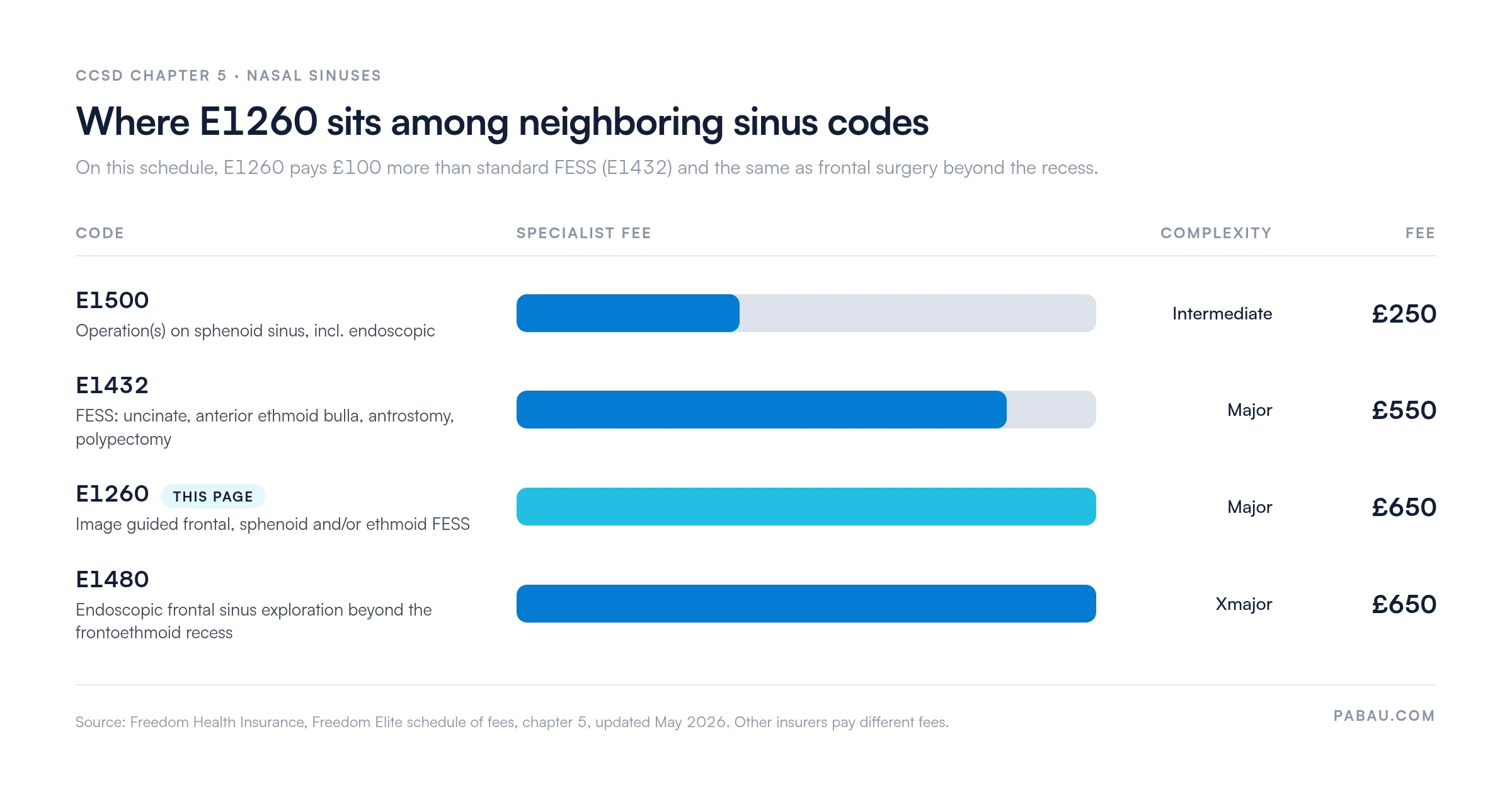
If the operation was less extensive than E1260 describes, code it lower. Surgery limited to the sphenoid sinus, including endoscopic work, belongs under E1500. Never upcode to E1260 when the note doesn’t support image-guided surgery. Where the note is unclear, ask the surgeon to amend it before you submit.
E1260 names only the frontal, sphenoid and ethmoid sinuses, so maxillary work sits outside its descriptor. An open approach to the maxillary sinus, through the upper lip and the canine fossa, is coded E1220.
The major UK private medical insurers (PMIs) all use the CCSD schedule as the basis for procedure reimbursement. Each one sets its own fee for E1260, so the same claim pays differently across insurers. For Bupa’s insurer-specific rules, see the guide to Bupa CCSD codes.
The table below lists where each insurer publishes its fees for CCSD codes. Use the insurer’s own portal for current figures, because fee schedules change each year and third-party summaries lag behind.
Pre-authorization (pre-auth) rules for CCSD code E1260 vary by insurer and by the member’s policy. There is no blanket rule across UK PMIs. Some insurers require pre-auth for all elective procedures, while others apply it only above a cost threshold or in certain clinical categories.
Before operating on any PMI patient under E1260, verify the following:
Operating without pre-auth when it is required is the simplest denial trigger in UK PMI billing, and it’s rarely recoverable afterward. Build a pre-auth check into the booking workflow for every sinus surgery referral.
Healthcode is the main electronic billing platform for UK private practice, and most major PMIs receive claims through it. Practice software that connects to Healthcode removes manual re-entry and the transcription errors that come with it. Pabau’s claims management software sends the claim to Healthcode straight from the invoice.
Claim submission steps for CCSD code E1260:
Set a 14-day calendar reminder from the claim submission date. If Healthcode has not returned an accepted status within that window, contact the insurer’s provider helpline directly. Most UK PMIs have a claims query line specifically for billing administrators. Early follow-up stops the claim from aging past the insurer’s resubmission deadline.
Denials for CCSD code E1260 fall into the same broad categories as other surgical CCSD codes. Knowing the common causes lets billing teams fix them at submission rather than in the appeals queue.
Surgeons moving from NHS work into private practice often meet this for the first time. NHS-standard notes don’t always satisfy a PMI audit, so the note has to justify the specific CCSD code billed.
Complex sinus cases often raise the question of which codes can share a claim. The CCSD schedule and each insurer’s rules both govern this. Under-billing loses revenue, while unbundling or upcoding triggers audit flags and potential clawback.
General principles for billing E1260 alongside other CCSD codes:
When the surgeon also corrects the septum in the same session, that work carries its own code, such as E0310. An orbital abscess drained in the same session is coded separately too, under C0620 in chapter 4 of the schedule. The insurer’s multiple-procedure rules then decide how much of each fee is paid.
When the surgeon also divides the vidian nerve to reduce heavy watery discharge, that work is billed under E1240. The extra code needs its own pre-authorization, so get that reference before surgery.
The CCSD technical guide sets out the bundling rules that apply across the schedule. Where doubt remains, call the insurer’s provider helpline before you submit, not after a denial arrives.
Review your practice’s CCSD code list at least once a year, when the CCSD Group publishes its annual schedule update. Codes that have been revised, retired or split need updating in your billing system before the new schedule year begins. A claim under a retired descriptor is an easy denial that takes time to resolve.
In many private ENT practices, the operation note lives in one system, the invoice in another and claim status in a spreadsheet. Each hand-off is a chance to key the wrong code or miss a filing deadline.
Pabau keeps that work on one patient record. Add the patient’s insurer and policy to the client card, and invoices go to the right insurer at its own price list. When the invoice is ready, Pabau pre-fills the claim and sends it to Healthcode, or by email for insurers that aren’t on Healthcode.
Every claim then moves through clear stages: Pending, Submitted, Processing, Paid or Error. Your billing team can filter by insurer and chase a queried E1260 claim before it ages past the resubmission deadline.

Pabau links each E1260 invoice to the patient’s insurer and operation note, then sends the claim to Healthcode. Your team tracks every claim to payment from one dashboard.

The deciding detail for E1260 is image guidance. If the operation note records it, along with the sinuses treated, E1260 is defensible. If it doesn’t, the claim belongs under E1432 or another neighboring code.
Get pre-authorization before surgery, keep bundled polyp and turbinate work off the claim, and check each insurer’s own fee. Those three checks stop most of the denials above before a claim leaves the practice.
Book a demo to see how Pabau sends E1260 claims to Healthcode with the operation note and insurer details already attached.

Need insurer-specific guidance on Bupa CCSD codes? Bupa CCSD codes billing guide covers Bupa’s procedure code rules, fee schedules, and submission requirements for UK private practice.
Billing septal surgery in the same session? CCSD code E0310 explains how to bill submucous resection of the nasal septum.
Coding other ENT surgery? CCSD code D1060 covers billing for revision mastoidectomy in UK private practice.
Billing ear procedures as well? CCSD code D1510 walks through myringotomy and tube insertion claims.
CCSD code E1260 is the UK private billing code for image-guided endoscopic sinus surgery (FESS) on the frontal, sphenoid and/or ethmoid sinuses. It’s a major-complexity ENT procedure, and one code covers one or both sides.
The major UK private medical insurers, including Bupa, AXA Health, Aviva, Vitality, Healix and WPA, use CCSD codes for procedure reimbursement. Confirm the E1260 fee with each insurer’s own fee schedule, because rates differ between insurers and change each year.
The operation note should give the date of service, the surgeon’s GMC number and the indication for surgery. It should also name the sinuses treated and record why image guidance was used. Add the consent record and any pre-authorization reference number the insurer issued.
Common reasons are missing pre-authorization, a note that doesn’t mention image guidance, or a wrong neighboring code such as E1432. Others are unbundled polyp or turbinate work, out-of-date consultant details and late filing. Checking pre-auth and the note before submission prevents most of them.
Verify the patient’s PMI membership and pre-auth status, then complete the operation note. Create the invoice with E1260 and the consultant’s details, and send the claim through Healthcode. Follow up promptly if the insurer queries or returns it.
Yes, but only for separate work that E1260 doesn’t already include. Septal surgery under a code such as E0310 can share the claim, subject to the insurer’s multiple-procedure rules. Polyp removal, antrostomy and turbinate reduction are part of FESS, so billing them separately is an unbundling error.