CCSD code F5010: Parotid duct transposition billing guide
CCSD code F5010 covers parotid duct transposition, one side or both CCSD code F5...

Last Updated: Oct 9, 2026
31536 is the CPT code for laryngoscopy, direct, operative, with biopsy; with operating microscope or telescope. It covers a rigid laryngoscopy under general anesthesia in which the surgeon biopsies a laryngeal lesion under magnification.
It is the microscope version of CPT 31535, and both codes carry a 000-day global. The operative note has to name the microscope or telescope, or payers downcode the claim to 31535.
Let Pabau's smart automation suggest the right codes, reduce claim denials, and keep your practice compliant—effortlessly.
Automate repetitive tasks and focus on what matters most—your patients.
Reduce coding errors and ensure compliance with the latest regulations.
Clean claims, fewer denials, and faster reimbursements.
Powerful insights and reporting to help your practice thrive.
HIPAA compliant SOC 2 certified GDPR-compliant Trusted by 4,000+ clinics worldwide

CPT 31536 covers direct operative laryngoscopy with biopsy plus an operating microscope or telescope, the one feature that separates it from CPT 31535.
The operative note must state that an operating microscope or telescope was used. Without that line, payers downcode the claim to 31535.
Both 31535 and 31536 carry a 000-day global, so no postoperative visits are bundled. A same-day, separately identifiable E/M needs modifier 25.
Pabau, the practice management platform we build, submits claims through a Claim.MD integration and checks CPT and ICD-10 pairings against built-in code catalogs.
CPT code 31536 describes “Laryngoscopy, direct, operative, with biopsy; with operating microscope or telescope,” as published in the AMA’s CPT code set. The semicolon separates the base procedure (direct operative laryngoscopy with biopsy) from the equipment qualifier (operating microscope or telescope).
The procedure is always performed under general anesthesia. An otolaryngologist or head and neck surgeon passes a rigid laryngoscope through the mouth with the patient supine. The scope is suspended against the chest wall, then an operating microscope or surgical telescope magnifies the laryngeal field. Biopsy forceps remove tissue from the target lesion, and the specimen goes to pathology.
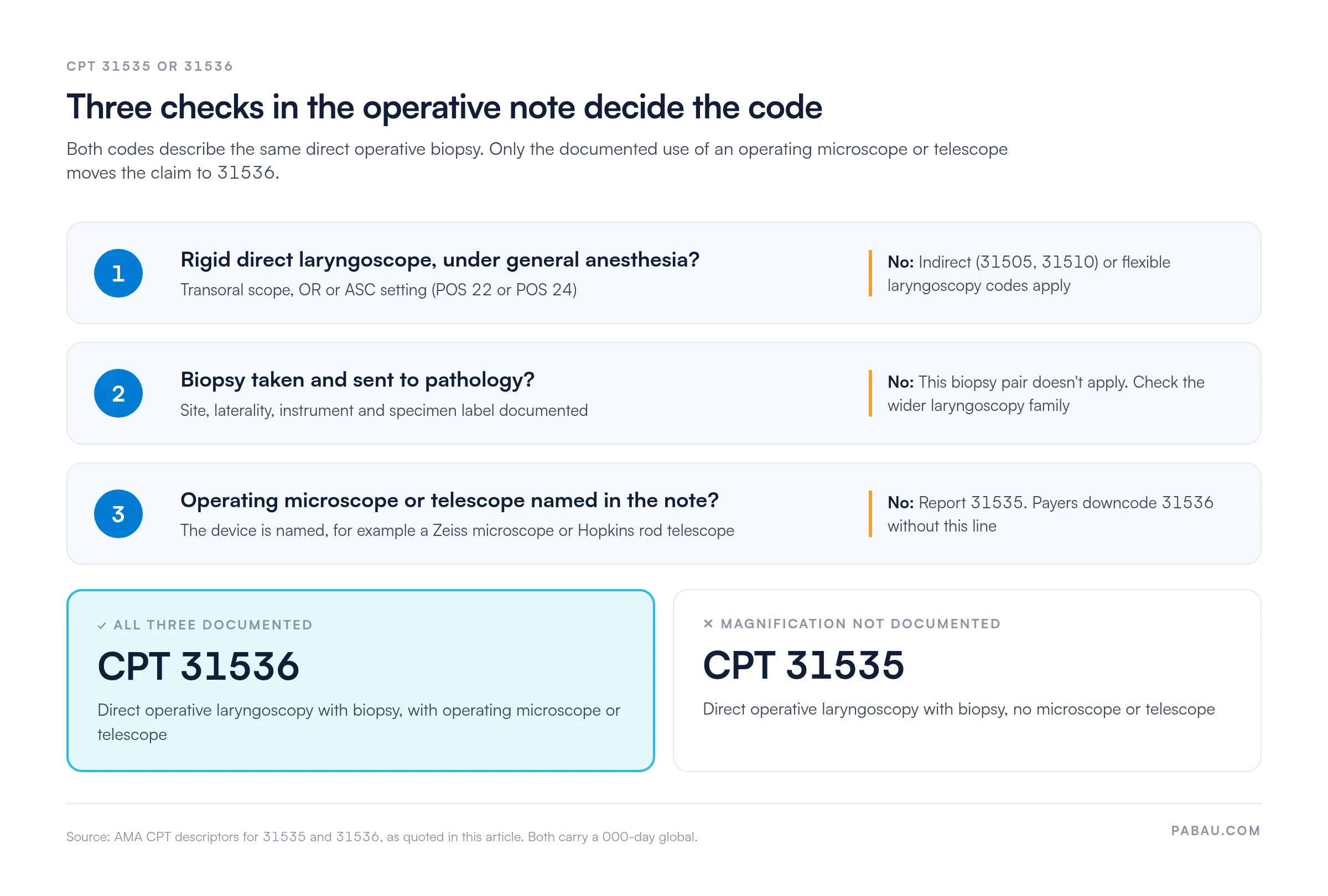
The code needs three elements: A direct (rigid) laryngoscope, an operating microscope or telescope, and a biopsy sent to pathology. Flexible nasopharyngoscopy belongs to a different code family and never supports 31536.
Direct laryngoscopy uses a rigid metal laryngoscope passed through the mouth, so the surgeon sees the larynx by direct line of sight. “Operative” means the procedure is performed under general anesthesia, in an operating room or ambulatory surgery center (ASC). That separates it from indirect or office-based flexible laryngoscopy. Place-of-service codes 22 (outpatient hospital) and 24 (ASC) are the usual settings for a 31536 claim.
The only billing differentiator between 31535 and 31536 is the use of an operating microscope or telescope. Patient positioning, rigid scope insertion, biopsy, anesthesia and the OR setting are identical for both codes.
In practice, the choice comes down to three checks in the operative note, run in order.
The CPT subsection for endoscopy procedures on the larynx runs from 31505 through 31579. When the procedure goes beyond a biopsy, such as tumor excision, therapeutic vocal cord injection or stroboscopy, different codes apply. Reporting 31536 alongside those codes may trigger National Correct Coding Initiative (NCCI) bundling edits.
Use the AAPC Codify CPT lookup to cross-reference the full laryngoscopy family before you pick the final code. That matters most when one session includes a biopsy and an excision at a different lesion site.
If the surgeon moved from biopsy to excision, our guide to CPT 31541 covers what that note needs. For a voice evaluation with stroboscopy, CPT 31579 is the code to read up on.
A biopsy implies that a lesion requiring histologic confirmation was identified. The ICD-10-CM diagnosis code must reflect a lesion or pathology that clinically justifies tissue removal. Payers scrutinize this pairing closely. A diagnosis of simple hoarseness without a documented laryngeal abnormality rarely supports medical necessity for an operative biopsy.
Modifier selection affects whether 31536 pays at full rate, reduced rate, or triggers a review. The wrong modifier, or a missing modifier 25 on a same-day E/M, is one of the most common reasons ENT claims reopen after initial adjudication.
Modifier 22 requires a supporting letter or operative note excerpt submitted with the claim. Without it, most payers deny the additional complexity payment on first pass.
The Centers for Medicare and Medicaid Services (CMS) sets CPT code 31536 reimbursement under the Medicare Physician Fee Schedule. CMS adjusts it annually through the RBRVS process. Rates differ between facility and non-facility settings. Because 31536 is an operative procedure performed under general anesthesia, it virtually always occurs in a facility setting. The table shows the 2026 Medicare Physician Fee Schedule values.
Use the CMS Physician Fee Schedule lookup tool to confirm the current-year facility and non-facility rates for your geographic locality. The Geographic Practice Cost Index (GPCI) adjusts all three RVU components by locality, so Medicare pays a Manhattan practice differently from a rural Arkansas one. Commercial payer rates commonly exceed Medicare rates, though contract terms vary.
For each component on its own, FastRVU’s 2026 entry for 31536 lists the work, practice expense and malpractice RVUs.
Many commercial plans and Medicare Advantage plans require prior authorization for elective operative laryngoscopy under CPT 31536. Traditional Medicare does not require prior authorization for this code, but Medicare Advantage plans vary by carrier and region. Verify authorization requirements at the individual plan level before scheduling.
A prior authorization request for 31536 should include these five items:
Emergent and urgent procedures may proceed without prior authorization but typically require retrospective review within 24 to 72 hours of the procedure. Document the clinical urgency clearly in the operative note to support retrospective approval.
The operative note is the audit-facing document for CPT code 31536. Every element that distinguishes 31536 from 31535 must appear in plain language. Missing one item triggers a downcode or denial on review. Capture them during the procedure or immediately after it, while the details are fresh.
Six elements must be present in the operative report:
Sometimes the microscope or telescope is set up but never used, because the lesion was reachable without magnification. In that case it cannot be documented as used. The code must reflect what happened during the case.
Flag operative notes that lack the phrase ‘operating microscope’ or ‘telescope’ before claims submission. A quick pre-billing review of the operative note against a 31536 documentation checklist catches the most common downcode trigger before it reaches the payer.
CPT 31536 is always performed under general anesthesia. The surgeon bills 31536. The anesthesiologist separately bills CPT 00320 (anesthesia for procedures on structures of the larynx). These two codes are not bundled and are submitted independently on separate claims.
Anesthesia units for 00320 are calculated as base units plus time units (1 unit per 15 minutes). The anesthesia record must document induction type, total anesthesia time, and any airway management considerations such as a laser-resistant endotracheal tube or jet ventilation. Monitored anesthesia care (MAC) is not appropriate for rigid direct laryngoscopy. The procedure requires complete airway control, which means general endotracheal anesthesia.
Most 31536 denials are preventable. Each one has a specific documentation or workflow root cause. An effective denial management workflow for ENT practices addresses these six scenarios before claims are submitted. If one slips through, the claim adjustment reason code on the remittance shows which row applies, and our guide to denial codes explains each one.
Follow this pre-submission checklist to reduce the chance of denial on first pass. A clean claim submission for 31536 depends on verifying all seven elements before hitting send. ENT practices that generate a superbill for ENT procedures at the point of service can use it to cross-reference the operative note before claim creation.
Many ENT billing teams still check 31536 claims by hand. A coder reads the operative note, keys the codes into a separate billing system, then waits to see whether the payer downcodes the claim.
Pabau, the practice management platform we build, keeps the operative note, the codes and the claim in the same patient record. Its claims management software checks CPT and ICD-10 pairings against built-in code catalogs, then sends CMS-1500 and 837P claims electronically.
Pabau also connects to the Claim.MD clearinghouse, so your team can check eligibility and post electronic remittance advice without retyping it. The result is less manual reconciliation and fewer claims returned for a mismatched diagnosis.
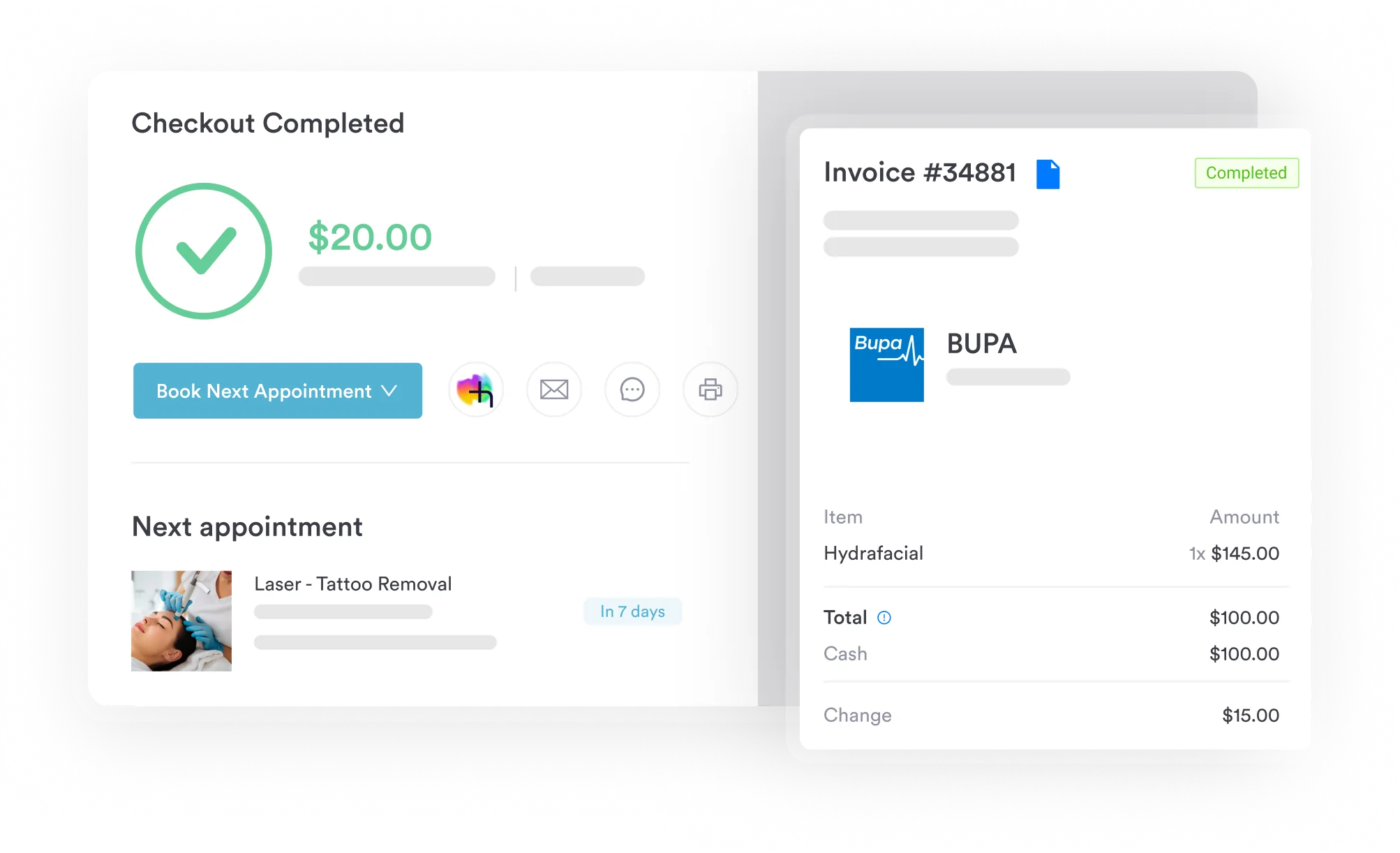

Pabau checks CPT and ICD-10 pairings before claims leave your practice, then submits them through its Claim.MD integration. Eligibility checks and ERA posting keep your laryngoscopy claims clean from the start.

CPT 31536 pays for one addition to 31535, and that addition is magnification. If the operative note doesn’t name the operating microscope or telescope, the extra work never reaches the claim.
So the fix sits upstream of billing. Add a microscope or telescope line to the surgeon’s operative note template. Then check each note against the six documentation elements before the claim is built. With a 000-day global, the only timing question left is a same-day E/M, which needs modifier 25.
Book a demo to see how Pabau checks the code pairing on every laryngoscopy claim before it reaches the payer.

Need to understand how claims move from code to payment? Revenue cycle management guide covers the end-to-end process from eligibility through ERA posting.
Concerned about NCCI bundling edits on ENT claims? Denial codes in medical billing explains CARC and RARC codes returned when bundling edits trigger.
Working with a clearinghouse for the first time? Medical claims clearinghouse guide explains how 837P files, ERAs, and payer enrollment work together.
Billing an excision in the same session? CPT code 31541 covers operative laryngoscopy with tumor excision under the microscope.
Evaluating voice with stroboscopy? CPT code 31579 explains when a stroboscopy claim stands on its own.
CPT code 31536 covers direct operative laryngoscopy with biopsy performed using an operating microscope or telescope. The procedure requires a rigid laryngoscope and general anesthesia in an OR or ASC. It also needs a tissue biopsy sent to pathology and explicit use of magnification equipment.
CPT 31536 is CPT 31535 plus an operating microscope or telescope. Both codes require a direct rigid laryngoscope, operative setting, and biopsy. The only billing differentiator is the microscope or telescope. Without documented use of that equipment, the claim must be reported as 31535.
Three modifiers come up most often with 31536. Modifier 22 flags increased procedural complexity, and modifier 51 applies when another procedure is performed in the same session. Modifier 59 marks the biopsy as a distinct service.
The operative report must document: Direct rigid laryngoscope use, the operating microscope or telescope by name, and the biopsy site with laterality. It must also record that the specimen went to pathology, a clinical indication consistent with biopsy, and the anesthesia type. Omitting the microscope or telescope documentation results in a downcode to 31535.
CPT 31536 has a 000-day global: No postoperative period is bundled into the procedure payment. A same-day significant, separately identifiable E/M needs modifier 25.
Six denials come up most often. The first three are: Missing prior authorization, a downcode to 31535 when the note omits the microscope or telescope, and a non-specific ICD-10 code. The other three are a wrong place-of-service code, a same-day E/M billed without modifier 25, and NCCI bundling edits from concurrent laryngoscopy codes.
Medicare reimbursement for CPT 31536 is set by the current-year Physician Fee Schedule and adjusted by the Geographic Practice Cost Index for your locality. In 2026 the facility RVUs are 3.46 work, 1.41 practice expense and 0.49 malpractice. Because the procedure needs an OR or ASC, the facility rate applies in virtually all cases. Use the CMS Physician Fee Schedule lookup tool or FastRVU to confirm the rate for your locality.