



CCSD code G5100: Bypass of duodenum billing guide
CCSD code G5100 bills a bypass that leaves the duodenum in place CCSD code G5100...

Last Updated: Oct 16, 2026

CPT Code 64636 covers destruction by neurolytic agent of a paravertebral facet joint nerve, lumbar or sacral, for each additional facet joint.
64636 is an add-on code, so it cannot be billed without CPT 64635 as the primary code on the same claim.
Bilateral lumbar RFA takes Modifier 50 on both 64635 and 64636. Medicare typically reimburses bilateral procedures at 150% of the single-side rate.
Under-reporting one level costs roughly $51 in Medicare facility payment and never triggers a denial, so only an internal audit catches it.
Pabau carries the level count from the procedure note into the claim, which Claim.MD then submits and tracks electronically.
CPT Code 64636 is the add-on code for destruction by neurolytic agent of a paravertebral facet joint nerve, lumbar or sacral. It covers each additional facet joint treated. It is reported only alongside CPT 64635, which covers the first joint treated during that session.
This reference covers the official descriptor and the primary/add-on relationship with 64635. It also sets out level-counting rules, modifier usage, 2026 Medicare reimbursement rates, and LCD coverage criteria. Documentation requirements and the errors that drive denials follow after that.
CPT Code 64636 is the American Medical Association’s add-on code for lumbar and sacral facet nerve destruction. The official long descriptor specifies imaging guidance by fluoroscopy or CT, and it counts each additional facet joint rather than each additional nerve. The full wording sits in the table below.
The anatomical target is the medial branch nerve, also called the facet joint nerve, at lumbar or sacral vertebral levels. Radiofrequency ablation (RFA) uses heat generated by radio waves to disrupt nerve conduction and reduce facet-mediated pain. Coders report one 64636 unit for each joint treated beyond the first, which is billed under the primary code 64635.
CPT 64635 and CPT Code 64636 form a paired billing structure for lumbar and sacral radiofrequency ablation. The primary code covers the first joint treated. The add-on code captures each joint after that. Both codes describe the same procedure but serve different billing roles on the same claim.
A three-level unilateral session is billed as 64635 x1 for the first level plus 64636 x2 for the second and third. A two-level bilateral session becomes 64635-50 x1 plus 64636-50 x1. The pairing rule is absolute, as confirmed by the AMA CPT coding resources. CPT Code 64636 submitted without 64635 will be denied, so the 64635 reference is worth reading alongside this one.
Level counting is the most common source of billing errors for lumbar RFA. Each vertebral level where the medial branch nerve is treated counts as one level, per side. The facet joint between two vertebrae is innervated by two medial branch nerves. Coders need to read the anatomical convention used in the procedure note.
The worked example below turns level count and side into code units, one row per scenario a pain management practice sees in a typical week.
Levels are counted per side. Treating L3-L4, L4-L5, and L5-S1 on the right gives three levels on the right, which is one 64635 plus two 64636 units. Treating the same three levels bilaterally adds Modifier 50 to each line but does not double the number of 64636 units.
When the physician performs the same RFA procedure on both sides of the spine at one session, bilateral coding applies. Medicare and most commercial payers follow a standard convention. Append Modifier 50 to both the primary code and the add-on code when the procedure is bilateral.
CPT Code 64636 carries add-on code restrictions that limit which modifiers apply. The table below summarizes the modifiers a pain management coder needs most often, and the usage rule attached to each.
Add-on codes are exempt from certain modifier conventions. Modifier 51 for multiple procedures does not apply to add-on codes by definition. Modifier 22 for increased procedural services can apply in theory, but it needs robust documentation and rarely succeeds for routine multi-level RFA.
The long descriptor of CPT Code 64636 reads “with imaging guidance (fluoroscopy or CT)”. That language bundles imaging into the procedure code, so a separate imaging code cannot be reported alongside it. Ultrasound guidance does not satisfy the descriptor for this code family.
Verify your NCCI edit pairs at the start of each calendar quarter. CMS updates these edits four times per year, and a bundling rule that allowed a separate imaging code last quarter may no longer apply. Run a quick check in your billing system before submitting any claim that pairs 64636 with a fluoroscopy or supervision code.
Medicare reimbursement for CPT Code 64636 is calculated from work RVUs, practice expense RVUs, and malpractice RVUs. Those totals are multiplied by the annual conversion factor published in the Medicare Physician Fee Schedule (MPFS). Rates then vary by location through Geographic Practice Cost Index (GPCI) adjustments. Confirm live rates with the CMS MPFS lookup tool before billing.
The table below reflects CY2026 national figures at the non-qualifying conversion factor of $33.4009. Facility rates apply in a hospital outpatient department or ambulatory surgery center. Non-facility rates apply in office-based settings, where the practice carries the equipment cost.
Those two rows compound quickly across a session. In a facility setting, one level unilaterally pays about $173, two levels about $224, and three levels about $275. Adding Modifier 50 lifts each line to 150%, so a two-level bilateral session pays roughly $336 and a three-level bilateral session roughly $413.
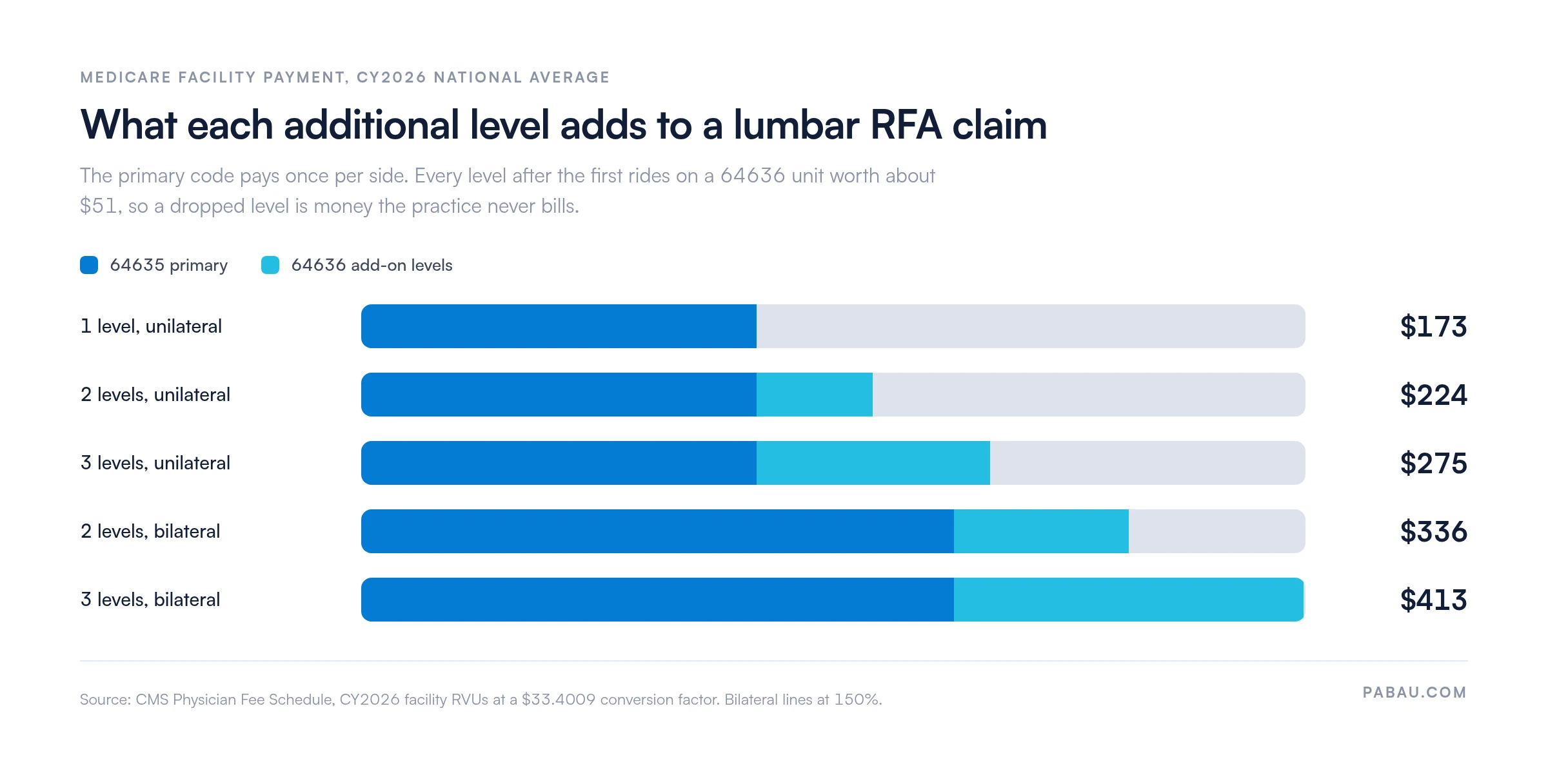
RVU values and conversion factors change each January with the MPFS final rule. Treat the figures above as national benchmarks rather than the amount your MAC will pay. Confirm GPCI-adjusted amounts for your own locality with the CMS tool, and reconcile any rate your billing system quotes back to the published RVUs.
Medicare coverage for lumbar and sacral RFA is governed by Local Coverage Determinations (LCDs) issued by individual Medicare Administrative Contractors (MACs). The LCD for facet joint interventions sets out the diagnostic and treatment prerequisites a patient must meet before 64636 can be billed. Article numbers and version IDs change, so retrieve the current policy from the CMS Medicare Coverage Database or your MAC’s website. The CGS Medicare coding guidance gives useful context for CGS jurisdictions.
Standard LCD criteria for lumbar and sacral RFA typically require all of the following before 64636 is billable:
LCD criteria vary by MAC jurisdiction. CGS, Novitas, Palmetto, WPS, and other contractors set slightly different thresholds. Review your own MAC’s LCD before billing, because meeting the criteria at the point of documentation costs far less than appealing a denied claim afterwards.
A complete procedure note is the primary defense against an audit denial for CPT Code 64636. The note must establish medical necessity, describe the procedure performed, and support the number of levels reported on the claim. Vague documentation is the element auditors challenge first in lumbar RFA billing.
Structured procedure templates help a practice capture every required data point at the time of service, rather than reconstructing the note days later. The checklist below covers the elements most often needed to support medical necessity and pass a payer audit.
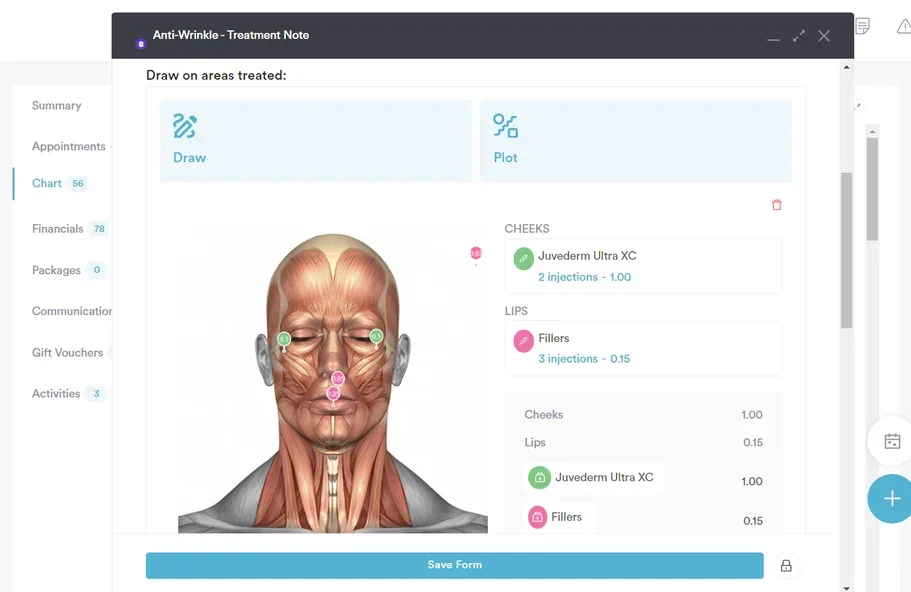
A note that already contains all seven elements produces a clean claim on the first pass. That is what keeps post-payment audit exposure low and the accounts receivable cycle tight.
Build a level-count verification step into your pre-billing checklist. Before submitting any 64635 or 64636 claim, confirm that the number of 64636 units matches the number of additional levels documented in the procedure note. A three-level unilateral note that generates a claim with only one 64636 unit never triggers a denial. The practice simply never gets paid for the work it did.
Hard denials are the visible failures for this code, and they get fixed because someone chases them. The costlier errors are the silent ones that under-pay a correctly performed procedure, because no claim fails and nobody investigates. Catching those takes a scheduled internal audit of level counts against procedure notes.
CPT Code 64636 sits within a family of facet joint intervention codes. Knowing the full set helps a coder pick the right primary code for each anatomical region. It also prevents lumbar or sacral codes landing on cervical work. Pain management practices should also know the 64490 to 64495 injection codes, which cover diagnostic blocks rather than ablation.
Facet joint ablation is not the only lumbar nerve destruction family in this code range. Basivertebral nerve ablation runs on CPT Code 64628, which covers the first two vertebral bodies treated, with add-on 64629 from the third onward. The facet joint codes above do not apply to that procedure.
Do not mix cervical and thoracic codes such as 64634 with lumbar and sacral codes for the same session. Each pair is region-specific and the two are not interchangeable. Review quarterly how this code family performs across your patient population. That review shows whether the level counts on your claims match the notes behind them.
Manual add-on code pairing is where most CPT Code 64636 errors start. The coder has to remember that 64636 cannot stand alone. They then count levels from the note, apply the right bilateral modifier, and leave imaging off the claim. Each step is a decision point where a distraction produces a denial or a quiet under-payment.
Practice management software like Pabau attacks that at the source, by keeping the clinical note and the claim in one system. Pabau’s software for billing teams pulls the level count and laterality your clinician recorded straight through to the claim. Nobody re-keys them from a printout. The coder still selects the codes and modifiers, but they are working from the note rather than from memory.
For US practices, Pabau submits and tracks those claims electronically through Claim.MD. The integration moves the data your records already hold and reports back on status and rejections. It does not choose diagnoses, determine codes, or fill in modifiers for you, so the coding judgment stays with your billing team where it belongs.

Pabau keeps procedure notes and billing in one record. The levels and laterality your clinician documented are what your coder sees at the claim line. Claim.MD then submits and tracks the claim electronically. See how pain management practices run multi-level RFA billing on Pabau.

CPT Code 64636 has one rigid rule and one expensive habit. The rule is that it never travels without 64635. The habit is under-counting levels, which costs about $51 a level in facility payment. It never announces itself, because the claim pays and nobody looks again.
So the work worth doing is upstream of the claim. Get the levels, the laterality, and the imaging method into the procedure note. Keep that note and the claim in one system. Then audit the two against each other on a schedule. Book a demo to see how Pabau keeps documented level counts and multi-level RFA claims in step.

Need to understand the broader medical billing process? What is medical billing covers the end-to-end claim lifecycle from documentation to payment.
Seeing repeated denials on pain management claims? Denial management in healthcare outlines the workflows that identify root causes and prevent recurrence.
Want to understand how clearinghouse submission works? Medical claims clearinghouse guide explains how electronic claims are validated and routed to payers.
Want the first submission to pay? What is a clean claim sets out the fields a payer needs before a claim can adjudicate on the first pass.
Worried about an audit of your coding? Medical billing compliance explains the documentation standards that hold up under payer review.
CPT Code 64636 is the add-on code for destruction by neurolytic agent of a paravertebral facet joint nerve, lumbar or sacral. It covers each additional facet joint beyond the first. It is always reported alongside CPT 64635 and cannot be submitted alone.
Yes. CPT Code 64636 carries the add-on designation (+64636) and must always be listed in addition to CPT 64635 on the same claim. Submitting 64636 without 64635 results in a denial.
Append Modifier 50 to both CPT 64635 and each unit of CPT Code 64636 when the same spinal levels are treated bilaterally in one session. Medicare typically pays bilateral procedures at 150% of the unilateral fee schedule rate. Some payers prefer LT and RT modifiers on separate lines instead, so verify payer requirements before billing.
Yes. The official CPT long descriptor for 64636 specifies imaging guidance by fluoroscopy or CT, which bundles that guidance into the code. Billing a separate fluoroscopy or radiological supervision code alongside 64636 will typically be denied under NCCI bundling edits. Ultrasound guidance does not satisfy the descriptor.
For CY2026, 64636 carries a work RVU of 1.13 and a total facility RVU of 1.52. That pays roughly $51 nationally at the $33.4009 conversion factor. The non-facility rate is roughly $252, because the office setting carries the equipment cost. GPCI adjustments move both figures by locality.



