HCPCS Code G0163: Skilled nursing observation and assessment
What is HCPCS Code G0163? HCPCS Code G0163 is a deleted Level II code for skille...

Last Updated: Oct 15, 2026
Billable Code
64634 is the CPT code for destruction by neurolytic agent, with imaging guidance, of the paravertebral nerves to each additional cervical or thoracic facet joint. It is an add-on code, so it is always reported with primary code 64633 and never on its own.
Most denials on this code trace back to three preventable errors. The first is billing 64634 without 64633 on the same claim. The others are using it for a lumbar or sacral joint, which takes 64636, and counting nerves instead of joints.
Let Pabau's smart automation suggest the right codes, reduce claim denials, and keep your practice compliant—effortlessly.
Automate repetitive tasks and focus on what matters most—your patients.
Reduce coding errors and ensure compliance with the latest regulations.
Clean claims, fewer denials, and faster reimbursements.
Powerful insights and reporting to help your practice thrive.
HIPAA compliant SOC 2 certified GDPR-compliant Trusted by 4,000+ clinics worldwide

CPT code 64634 is an add-on code for neurolytic destruction of each additional cervical or thoracic facet joint, reported only with primary code 64633.
The code is counted per facet joint, not per nerve, so ablating both medial branches at one joint is still one unit.
Lumbar and sacral joints use 64635 and 64636 instead, and facet joint injections use 64490 to 64495, not this code family.
Medicare’s facet joint LCDs require two diagnostic medial branch blocks with at least 80% relief and allow one or two levels per session.
Practice management software like Pabau keeps block results, joint levels, and authorization numbers together before a 64633 and 64634 claim goes out.
CPT code 64634 reports neurolytic destruction of the nerves that supply each additional cervical or thoracic facet joint treated in one session. It is an add-on code, marked with a plus sign (+64634) in the CPT manual, and it is always billed with primary code 64633.
The procedure is usually radiofrequency ablation (RFA) of the medial branch nerves, the small nerves that carry pain signals from the facet (zygapophyseal) joint. Code 64633 covers the first cervical or thoracic joint. Code 64634 is added once for each further joint at a different vertebral level. A two-joint cervical ablation therefore bills as 64633 plus one unit of 64634.
Pain management physicians, anesthesiologists, and interventional radiologists with spine training perform the procedure. Scope-of-practice rules for RFA vary by state, so confirm credentialing before billing. According to the American Medical Association (AMA), the 64633-64636 family sits in the Surgery section, under destruction by neurolytic agent procedures on the somatic nerves.
Fluoroscopy or CT guidance is part of the code and is not reported separately, so 77003 and 77012 stay off the claim. CPT also makes the guidance mandatory. A facet denervation done without imaging is reported with unlisted code 64999 instead.
Knowing where 64634 stops prevents most of the region, level, and technique errors that drive denials on this code family.
A worked example: A right-sided cervical RFA at the C4-5 and C5-6 facet joints bills as 64633 plus one unit of 64634. Billing 64633 twice, or sending 64634 without 64633, triggers edit denials. Bilateral work adds a modifier, covered in the modifier section below.
The four codes in this family split on two factors: The spinal region treated, and whether the joint is the first or an additional one.
The critical distinction is the pairing. 64634 only ever follows 64633, and 64636 only ever follows 64635. When one session treats both regions, each region takes its own primary code before any add-on.
All four are neurotomy codes. Facet joint injections and medial branch blocks, including the diagnostic blocks done before an ablation, are reported with 64490 to 64495. Check the operative report before you pick a code. “Ablation,” “neurotomy,” or “destruction” supports this family, while “injection” or “block” points to 64490-64495.
Before you submit a claim with CPT code 64634, count the facet joints named in the operative report, not the nerves. Each joint beyond the first cervical or thoracic joint is one unit of 64634, however many medial branches were lesioned. Pabau’s digital forms let you build RFA procedure note templates that prompt physicians to record each joint, level, and side before signing.
Add-on status sets four billing rules for this code, and each one maps to a common denial.
The four scenarios below show how those rules turn the joints in an operative report into claim lines.
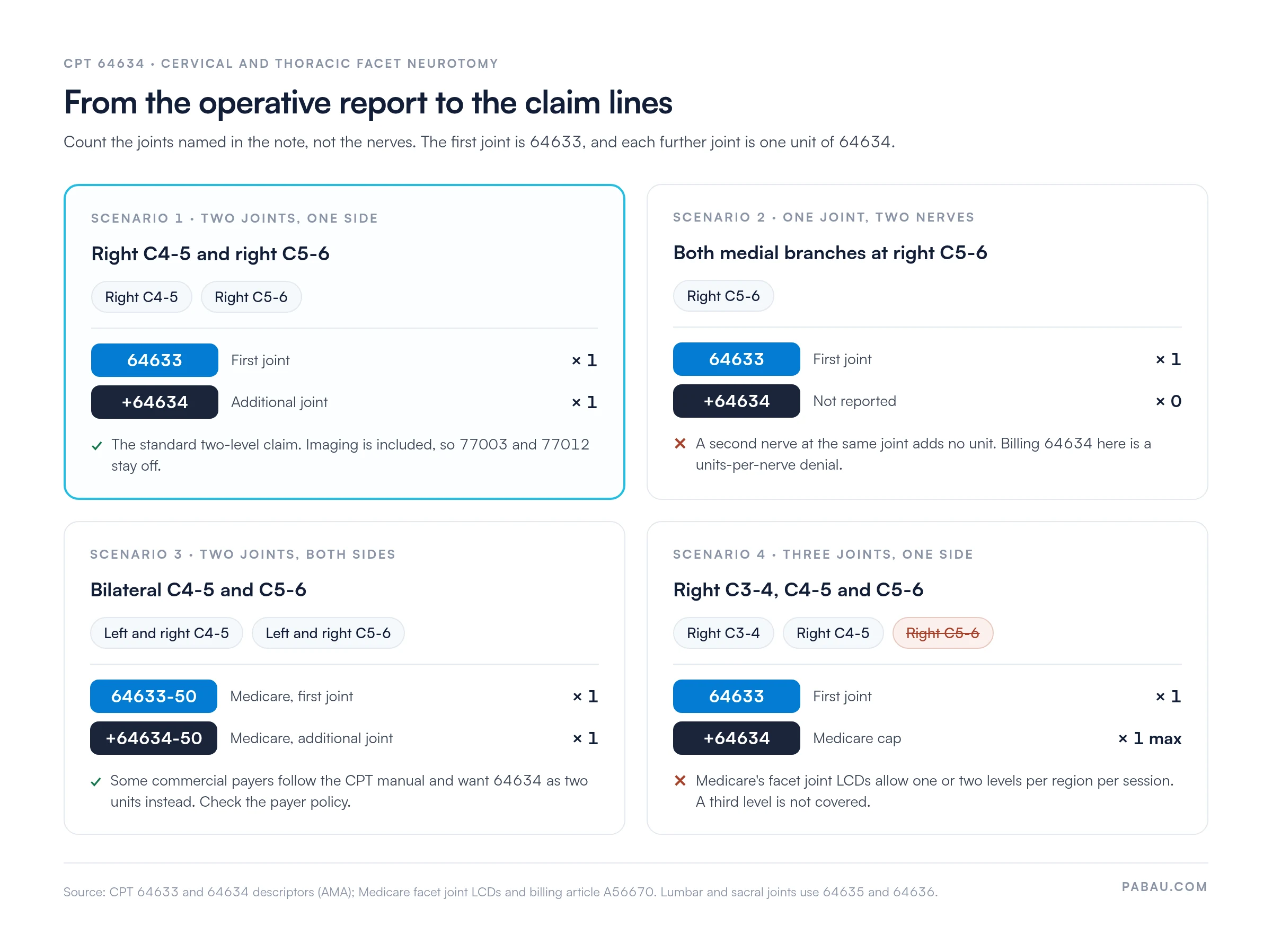
Check the level cap during insurance eligibility verification and prior authorization, before a multi-level ablation. Commercial caps vary, and an authorization that approves two levels will not cover a third, even when it is medically justified.
Medicare pays the physician for CPT code 64634 under the Physician Fee Schedule (MPFS), with non-facility and facility rates that vary by locality. As an add-on code, 64634 carries a ZZZ global period, which means it falls inside the global period of 64633.
Add-on codes are also exempt from the multiple procedure payment reduction. The physician line for 64634 therefore pays its full fee schedule amount, not the reduced rate applied to a second procedure. Verify current rates for your MAC jurisdiction in the CMS Physician Fee Schedule Look-Up Tool, using the steps below, before quoting reimbursement.
MPFS rates change every January and vary by locality, so any dollar figure in a reference article dates quickly. Use the FastRVU 2026 lookup tool to view current Work, Practice Expense, and Malpractice RVU values for 64634. Multiply total RVUs by the current CMS conversion factor to estimate reimbursement.
After adjudication, the payer sends payment and adjustment data as electronic remittance advice (ERA/835 files). Reconciling ERA data line by line shows whether 64634 was paid in full or wrongly reduced as a secondary procedure.
Medicare covers 64634 under the Facet Joint Interventions for Pain Management LCDs, with billing guidance in articles A56670, A57787, and A58364. Because 64634 is an add-on, it is only payable when the 64633 service it follows meets the coverage criteria.
Prior authorization depends on the setting. Since July 1, 2023, Medicare has required prior authorization for facet joint interventions, including 64633 through 64636, on hospital outpatient department claims. Most commercial payers require authorization as well, and some set their own relief thresholds or block counts.
Document authorization numbers and approval dates in the patient record before scheduling the ablation. A claim submitted without the required reference number will deny on the first pass, and retro-authorization is rarely granted for planned procedures.
Each MAC publishes its own version of the LCD, so check the active policy for your jurisdiction. Use the CrossCoder LCD/LCA policy tool to find the current LCD and billing article for CPT code 64634 under your MAC.
Billing article A56670 lists the ICD-10-CM codes that support medical necessity for this code family. The main cervical and thoracic codes are listed below.
Code the diagnosis to the highest specificity the record supports, and match its region to the joints treated. For the right C4-5 and C5-6 example above, cervical spondylosis without myelopathy or radiculopathy is coded M47.812. A lumbar spondylosis code on a 64633 and 64634 claim invites a medical necessity denial.
Modifier choice on 64634 decides whether bilateral work pays and whether same-day procedures clear NCCI edits. Payers disagree more on bilateral add-ons than on any other rule in this code family.
Incorrect modifier use is one of the fastest paths to a post-payment audit. A pattern of modifier 50 claims that do not match bilateral operative notes flags practices for medical review. Keep laterality documentation in every procedure report.
Run a quarterly audit of CPT 64634 claims billed with modifier 50 or two units. Pull the operative notes and confirm each one documents bilateral lesioning at the same additional joint. A mismatch between the modifier and the note is the trigger most MAC reviewers flag first in a targeted probe audit of RFA practices.
Payers review a 64634 claim joint by joint, so the record needs each element below for every joint billed.
A clean claim for CPT code 64634 has every element above in the medical record before it reaches the clearinghouse. Hunting for diagnostic block notes after a denial adds days to the cycle and lowers the odds of a successful appeal.
Most CPT code 64634 denials come from add-on pairing and documentation errors that a pre-submission checklist catches. The table maps each one to its root cause and the fix.
When a CPT 64634 line comes back denied, the CARC code on the remittance names the reason. Our guide to fixing denial codes maps each common adjustment reason code to its corrective action.
MPFS rates for CPT code 64634 update annually. Follow these steps to retrieve the current national and locality-specific rates directly from CMS.
Knowing how RVUs translate to allowed amounts helps pain practices forecast revenue by procedure volume. Medicare’s RBRVS methodology sets those amounts for every CPT code family. Review payer contracts annually to confirm contracted rates for 64634 keep pace with MPFS updates.
A single RFA session produces a 64633 line, one or more 64634 lines, modifiers, and an authorization number. Pulling those from the operative note, block records, and payer portal by hand is where claims go wrong.
Pabau’s denial-preventing claims software tracks prior authorization status for procedures like CPT code 64634. It flags incomplete documentation before claims leave the practice, so your team can complete the record while the patient file is still open.
Claims then route through Claim.MD, Pabau’s US clearinghouse partner, which sends 837P files to 4,000+ payers, including Medicare MACs. It runs real-time eligibility checks and flags payer-specific edits before each file goes out. The result is a lower first-pass denial rate on add-on codes like 64634 that carry complex coverage requirements.

Pabau tracks prior authorization status, flags missing documentation, and routes claims through Claim.MD to 4,000+ US payers. Your RFA claims can then clear on the first pass.

Build every CPT code 64634 claim from the operative report outward. Count the joints it names, pair each add-on line with 64633, and send lumbar or sacral work to 64635 and 64636.
Coverage rests on the 64633 service, so settle the block notes, the level cap, and the authorization before the session rather than after a denial. Payers split most on bilateral add-ons. Record each payer’s choice between modifier 50 and two units once, and your team stops guessing on every claim.
Book a demo to see how Pabau catches pairing, unit, and authorization errors on your RFA claims before they reach the payer.

Treating lumbar or sacral joints in the same session? CPT code 64635 covers the first lumbar or sacral facet joint and pairs with add-on code 64636.
Billing the diagnostic blocks that come before the ablation? CPT code 64490 covers the first cervical or thoracic facet joint injection or medial branch block.
Need to understand how denials are categorized and resolved? Denial codes in medical billing maps common CARC and RARC codes to corrective actions for RCM teams.
Building the billing record for an RFA session? Superbill documentation covers how to assemble a compliant billing record for code families like 64633 and 64634.
Evaluating clearinghouse options for high-volume interventional pain billing? Claim.MD vs Office Ally compares two major US clearinghouses on payer reach, real-time eligibility, and denial reporting.
CPT code 64634 covers neurolytic destruction of the nerves to each additional cervical or thoracic facet joint, after the first joint billed with 64633. Radiofrequency ablation is the usual technique. Fluoroscopy or CT guidance is included in the code and is not billed separately.
Yes, CPT 64634 is an add-on code and is never billed on its own. It must appear with primary code 64633 on the same claim, for the same date and provider. Report one unit for each additional cervical or thoracic facet joint treated.
Both are add-on codes, but they cover different spinal regions. CPT 64634 reports each additional cervical or thoracic facet joint and follows 64633. CPT 64636 reports each additional lumbar or sacral facet joint and follows 64635.
Medicare’s facet joint LCDs require at least two diagnostic medial branch blocks, each giving a consistent minimum of 80% relief. Commercial payers set their own thresholds. Because 64634 is an add-on, it is only covered when the 64633 service meets these criteria.
For Medicare, append modifier 50 to each bilateral line, so a bilateral two-level cervical ablation bills as 64633-50 and 64634-50. The CPT manual reports the add-on twice instead, and some commercial payers follow that convention. Check each payer’s policy before submitting.
Yes, in hospital outpatient departments and with most commercial payers. Since July 2023, Medicare has required prior authorization for 64633 through 64636 on hospital outpatient department claims. Confirm the authorization covers each joint and side before scheduling.
The most common triggers are billing 64634 without 64633, pairing it with lumbar code 64635, and counting nerves instead of joints. Missing block documentation, too many levels per session, and bilateral modifier errors follow close behind.