

CCSD code G5100: Bypass of duodenum billing guide
CCSD code G5100 bills a bypass that leaves the duodenum in place CCSD code G5100...

Last Updated: Oct 16, 2026
64628 is the CPT code for thermal destruction of intraosseous basivertebral nerve, including all imaging guidance; first 2 vertebral bodies, lumbar or sacral.
One unit covers a standard two-level session, and add-on code 64629 applies only from the third vertebral body. Most denials come from missing prior authorization, thin conservative care records, and miscounted 64629 units.
Let Pabau's smart automation suggest the right codes, reduce claim denials, and keep your practice compliant—effortlessly.
Automate repetitive tasks and focus on what matters most—your patients.
Reduce coding errors and ensure compliance with the latest regulations.
Clean claims, fewer denials, and faster reimbursements.
Powerful insights and reporting to help your practice thrive.
HIPAA compliant SOC 2 certified GDPR-compliant Trusted by 4,000+ clinics worldwide

CPT code 64628 reports thermal destruction of the basivertebral nerve for the first 2 lumbar or sacral vertebral bodies, including all imaging guidance.
Add-on code 64629 starts at the third vertebral body, so a two-level L4 and L5 procedure is billed as 64628 alone.
Medicare coverage runs through LCDs such as L39642 (Noridian) and L39420 (Palmetto GBA), which require Modic type 1 or 2 changes and failed conservative care.
The 2026 national Medicare physician payment is about $365 for 64628 in a facility, and neither code has an office (non-facility) rate.
Practice management software like Pabau pre-fills 64628 claims from invoices and checks required fields, such as the authorization code, before submission through Claim.MD.
CPT code 64628 reports radiofrequency ablation of the basivertebral nerve in the first two lumbar or sacral vertebral bodies, with all imaging guidance included. It sits in the nervous system surgery section of the AMA code set, among the codes for destruction of nerves by neurolytic agents. The table below summarizes the code.
Imaging guidance is bundled into 64628 by design. Reporting fluoroscopy separately triggers an edit and is a common reason for claims to be returned.
CPT code 64628 covers thermal (radiofrequency) ablation of the basivertebral nerve (BVN) in up to two lumbar or sacral vertebral bodies in one session. The BVN runs inside the vertebral body and carries pain signals from the vertebral endplate. The procedure treats vertebrogenic chronic low back pain, which is driven by endplate damage rather than disc herniation or facet arthropathy.
One unit of 64628 covers the first 2 lumbar or sacral vertebral bodies treated, so a standard two-level session needs no add-on code. When only one vertebral body is treated, report 64628 with modifier 52. The clinical elements that must be present for the code to apply are:
Randomized controlled trials of basivertebral nerve ablation underpin the payer criteria for this code, so anatomical detail in the operative note matters. A report that describes facet nerve destruction or medial branch ablation will not support a 64628 claim, even in the same spinal region. Pain management and spine practices that bill this procedure should use operative note templates that name each vertebral body treated.
CPT code 64629 is the add-on code for each additional lumbar or sacral vertebral body treated after the first two. It is never billed alone, and it needs 64628 as the primary code on the same claim.
A session that treats L4 and L5 is billed as one unit of 64628 and nothing else. A session that treats L3, L4, and L5 is one unit of 64628 plus one unit of 64629. Treating L3 through S1 in one session would be 64628 plus two units of 64629.
Check the payer policy before planning more than two levels in one session. Noridian’s LCD L39642 allows no more than two vertebral bodies per session, so a three-level session is not covered in its jurisdictions. Palmetto GBA’s LCD L39420 allows up to four vertebral bodies per procedure. The grid below sets the codes, payment, and session limits for each level count side by side.
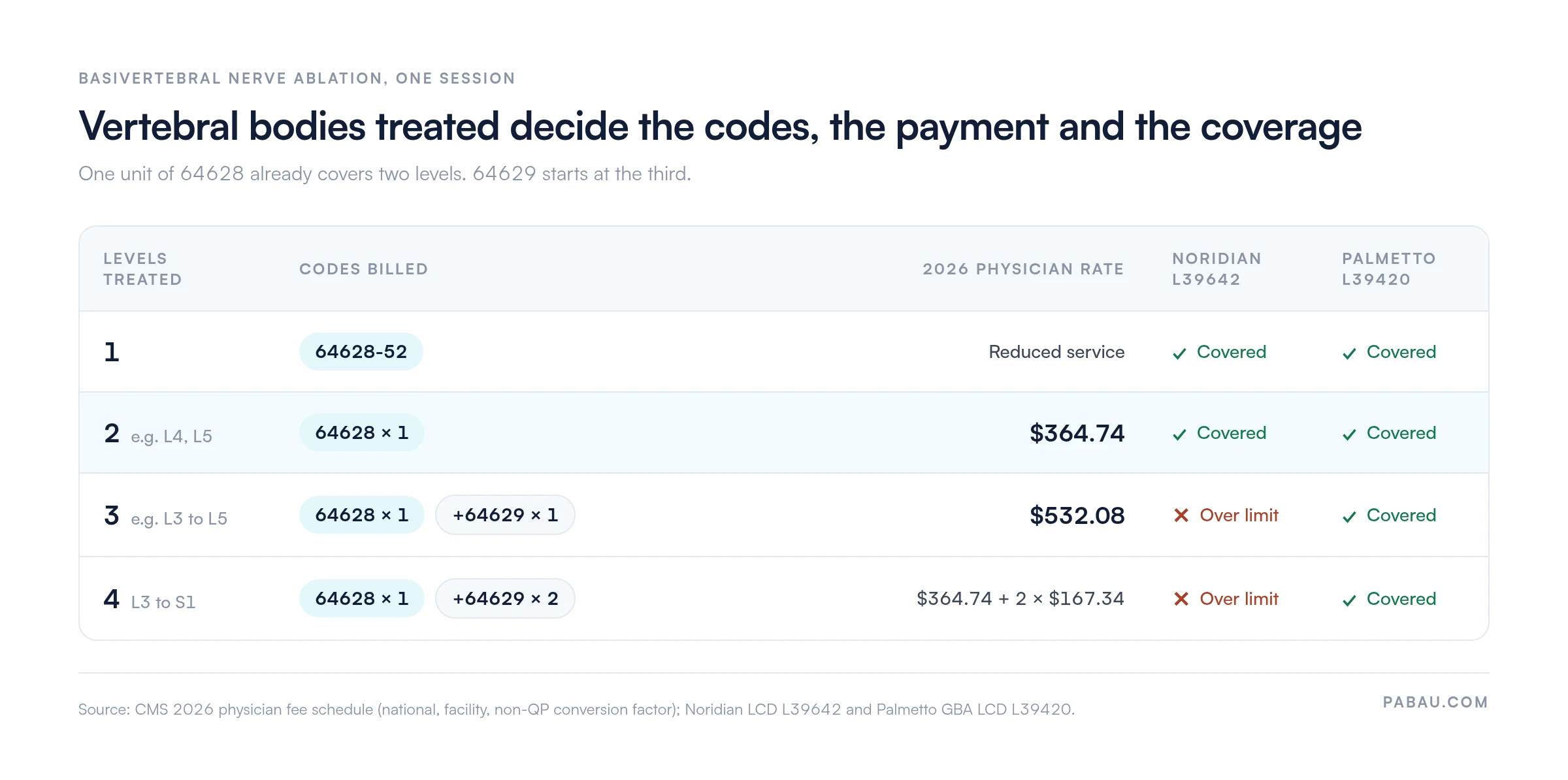
Modifier 50 does not apply to either code, because the basivertebral nerve is a midline structure within each vertebral body. Reporting modifier 50 with 64628 is a known billing error that triggers denials.
The INTRACEPT procedure is an image-guided, minimally invasive outpatient intervention from Boston Scientific. Coders need to understand the clinical steps, since post-payment audits deny many 64628 claims when the operative report skips one of them. The claim for this procedure should be backed by an operative note covering each step below.
Before the claim goes out, check that the record documents each of these points:
Claims without vertebral level detail are routinely downcoded or denied on audit. For practices with several providers, a shared compliance checklist standardizes operative note content before a claim is submitted.
Only a few modifiers apply to 64628, and using the wrong one is a fast route to a denial. The list below covers the ones coders meet most often.
Medicare’s billing articles and most commercial payer policies require a covered ICD-10-CM diagnosis code on every 64628 claim. Both Noridian’s article A59466 (linked to LCD L39642) and Palmetto GBA’s article A59205 list the same three covered codes. Submitting without one of them brings a medical necessity denial, however appropriate the procedure was.
When the MRI and the history tie the pain to the vertebral endplate, M54.51 is the diagnosis that carries the claim. Codes that describe radiculopathy, such as the M51.1- disc disorder codes, point away from coverage, because both LCDs exclude patients with radicular pain. Commercial payer code lists can differ from the Medicare articles. A code Medicare accepts may still be denied by a plan with its own policy. Checking eligibility and coverage before the procedure date prevents many of these post-service denials.
Medicare covers CPT code 64628 through Local Coverage Determinations for intraosseous basivertebral nerve ablation. Noridian’s LCD L39642 now covers both its JE and JF jurisdictions, after L39644 was retired and merged into it in March 2026. Palmetto GBA’s LCD L39420 applies in its JJ and JM jurisdictions.
LCDs are revised over time, so pull the current version from the CMS Medicare Coverage Database before building a coverage argument for an appeal.
Most commercial payers require prior authorization before basivertebral nerve ablation. Payers use it to confirm that conservative care was exhausted before approving a higher-cost interventional procedure.
PA requirements vary by payer and plan year. A practice that learns the rules after scheduling faces a delayed procedure or an unpaid one. Recording PA status in the scheduling workflow prevents both outcomes. Payers issue authorizations only to credentialed providers, so confirm credentialing with each plan before the first 64628 request.
In 2026, Medicare pays physicians a national facility rate of about $364.74 for 64628 and $167.34 for each unit of +64629. These figures come from the CMS 2026 physician fee schedule relative value file, before geographic adjustment. Neither code has a non-facility (office) rate, because CMS assigns no office practice expense to this device-intensive procedure.
Applied to the worked examples, a two-level session pays the physician about $364.74 nationally. A three-level session, where the payer covers it, adds one unit of 64629 for about $532.08 in total. For comparison, Boston Scientific’s 2025 INTRACEPT Reimbursement Guide listed 2025 physician facility rates of $399.16 for 64628 and $188.26 for +64629.
Local payment differs by MAC locality, so check the CMS Physician Fee Schedule lookup tool for your area.
Run a fee schedule variance report quarterly. Compare your posted payments for 64628 against expected Medicare rates by MAC locality. Practices billing primarily in facility settings often discover geographic adjustment shortfalls that add up to thousands of dollars annually across a high-volume spine program.
CPT 64628 carries a 10-day global period, and +64629 takes on the global period of 64628. Routine follow-up visits within those 10 days are included in the surgical payment and are not billed separately.
CPT code 64628 is often confused with the facet joint nerve destruction codes, because all of them use radiofrequency energy near the spine. The anatomical target separates them. Using the wrong code triggers bundling edits, payer audits, and overpayment recovery requests.
The split between 64628 and 64635 matters most for pain management practices that perform both. An operative report describing probe insertion into the vertebral body through the pedicle maps to 64628. One describing needle placement along the medial branch at the facet joint maps to 64635. Billing 64635 for an intraosseous procedure is a coding error and an underbilling, since 64628 carries 6.97 work RVUs against 3.24 for 64635.
In facility settings, the INTRACEPT device is reported with a HCPCS Level II device code. It goes on the facility claim (UB-04), not the physician claim (CMS-1500). Physicians billing only the professional component of 64628 do not report device codes.
CMS designates 64628 as device-intensive, so HOPD claims need C1889 alongside the procedure code. Device code rules can change with each quarterly IOCE update. The Boston Scientific INTRACEPT Reimbursement Guide, published annually, is the main reference for facility billing teams, so confirm against it before each billing cycle.
CPT code 64628 is a high-cost procedure with strict, LCD-defined coverage criteria, so payers review it closely. The denial patterns below cause most preventable claim losses on basivertebral nerve ablation.
A clearinghouse with real-time claim edits catches most NCCI violations, modifier errors, and missing diagnosis codes before the payer sees them. When a 64628 claim still comes back, the adjustment reason codes on the remittance point to the fix. This guide to denial codes explains the common ones.
A single basivertebral nerve ablation claim pulls together a level count, a modifier decision, an authorization number, and an LCD-covered diagnosis code. Gathering those by hand from the operative note, the MRI report, and a payer portal is where 64628 claims go wrong.
Practice management software like Pabau keeps that information in one patient record. Its claims management software pre-fills each claim from the invoice and checks that required fields, such as the authorization code, are complete. Your team can then fix the record while the patient file is still open.
Claims then go out through Pabau’s Claim.MD integration, and your billing team follows the status of every 64628 claim from one list. Fewer claims come back for missing information on a code with tight coverage rules.

Pabau pre-fills CPT code 64628 claims from invoices and checks that required fields, such as the authorization code, are complete. Every claim sent through Claim.MD is then tracked in one place.

Count vertebral bodies before you count codes. One unit of 64628 already pays for two levels, so 64629 appears only when a third level is treated and the payer allows it.
The costly errors on this code happen before the procedure, not on the claim form. Confirm the LCD that applies, the patient’s lifetime level count, and the authorization, and the claim itself becomes routine.
Pabau pre-fills each claim from the invoice and checks that fields such as the authorization code are complete before it goes to Claim.MD. Book a demo to see how your team can track every 64628 claim from submission to payment.

Billing facet joint ablation instead? CPT code 64635 covers lumbar or sacral facet joint nerve destruction, the code most often confused with 64628.
Want to understand the full medical billing workflow? What is medical billing walks through the end-to-end process from charge capture through payment posting, including how clearinghouses fit the cycle.
Managing denial patterns across multiple procedure codes? Denial management in healthcare covers how to structure a post-denial recovery and prevention program for high-scrutiny codes like 64628.
Want fewer claims returned on first pass? What is a clean claim sets out the fields and checks a claim needs before it reaches the payer.
CPT code 64628 covers thermal (radiofrequency) destruction of the intraosseous basivertebral nerve in the first 2 lumbar or sacral vertebral bodies, including all imaging guidance. It is the primary code for basivertebral nerve ablation, such as the INTRACEPT procedure from Boston Scientific. The procedure treats vertebrogenic chronic low back pain by ablating the nerve that carries endplate pain signals.
In the hospital outpatient setting, the device is reported with HCPCS code C1889 on the UB-04 facility claim, with revenue code 0278. Physicians billing only the professional component on a CMS-1500 do not report device codes. Confirm current device coding against the Boston Scientific INTRACEPT Reimbursement Guide and the CMS IOCE quarterly update before each billing cycle.
The most common denial reasons are missing prior authorization, a non-covered diagnosis code, and billing 64629 for the second vertebral body. Others include exceeding LCD level limits, a missing KX modifier in Noridian jurisdictions, and thin conservative care documentation. Separately billed fluoroscopy and modifier 50 also cause denials. Pre-submission claim scrubbing and an LCD-aligned diagnosis code crosswalk prevent most of them.
The 2026 national Medicare physician payment for CPT code 64628 in a facility is about $364.74, and that covers up to two vertebral bodies. A three-level session adds one unit of 64629 at about $167.34, for about $532.08 in total. There is no office rate for either code. The facility is paid separately, under APC 5115 in a hospital outpatient department. Patients generally owe Part B coinsurance, which supplemental coverage may pay.



