

CCSD code G5100: Bypass of duodenum billing guide
CCSD code G5100 bills a bypass that leaves the duodenum in place CCSD code G5100...

Last Updated: Oct 16, 2026
64425 is the CPT code for injection(s) of an anesthetic agent and/or steroid into the ilioinguinal and iliohypogastric nerves.
One unit covers a block of either nerve or both in the same session, and bilateral blocks take modifier 50 on a single line. Use 64425 whenever the procedure note names either nerve, and keep 64450 for peripheral nerves without a dedicated code.
Let Pabau's smart automation suggest the right codes, reduce claim denials, and keep your practice compliant—effortlessly.
Automate repetitive tasks and focus on what matters most—your patients.
Reduce coding errors and ensure compliance with the latest regulations.
Clean claims, fewer denials, and faster reimbursements.
Powerful insights and reporting to help your practice thrive.
HIPAA compliant SOC 2 certified GDPR-compliant Trusted by 4,000+ clinics worldwide

CPT code 64425 covers an injection of anesthetic agent and/or steroid into the ilioinguinal nerve, the iliohypogastric nerve, or both, as one unit per encounter.
Confusing 64425 with CPT 64450 (other peripheral nerve) is a frequent denial trigger, so use 64425 whenever the note names the ilioinguinal or iliohypogastric nerve.
Modifier 50 applies to bilateral blocks on the same date, and Medicare pays 150% of the single-procedure rate for them.
Pabau’s claims management software submits nerve block claims through Claim.MD, checks eligibility in real time, and tracks claim status and remittances in one place.
CPT code 64425 describes an injection of anesthetic agent and/or steroid into the ilioinguinal nerve, the iliohypogastric nerve, or both in one encounter. The American Medical Association’s CPT code set places 64425 in the 64400-64530 nerve block range. That range gives named nerves their own codes and leaves 64450 as the catch-all for the rest.
Both nerves originate from the lumbar plexus (L1, with T12 contribution) and travel through the inguinal canal. They supply sensation to the groin, the upper medial thigh, and the labia majora or scrotum. Blocking them controls pain in hernia repair, orchiopexy, varicocele repair, and chronic post-herniorrhaphy neuralgia. The procedure can be landmark-guided or image-guided. The imaging choice decides whether a separate ultrasound guidance code (CPT 76942) applies.
Because the descriptor reads “ilioinguinal, iliohypogastric nerves,” the single code captures injection of either nerve alone or both nerves in the same session. There is no need to append a second unit of 64425 or substitute 64450 simply because two nerves were targeted. One unit of 64425 with proper documentation of both nerves is the correct approach.
Understanding the code’s bundled scope prevents both over-billing and under-billing. The table below summarizes what is included in a single unit of 64425 versus what requires separate reporting.
CPT code 64450 is the correct code for peripheral nerve blocks of any named nerve that does not have its own dedicated CPT code. Use 64450 only when the targeted nerve is not ilioinguinal or iliohypogastric. The AAPC Codify CPT lookup confirms 64450’s descriptor as “other peripheral nerve or branch.”
The clinical test: if the procedure note explicitly names the ilioinguinal or iliohypogastric nerve, 64425 is correct. If the note says “peripheral nerve” without naming the specific nerve, 64450 may be appropriate but the documentation should be queried before submission.
Several peripheral nerve block codes share the 64400-64530 range and are commonly miscoded against each other. The distinctions between them are anatomical, while the injection technique is the same.
Picking the nerve code is only the first call on a 64425 claim. The decision path below puts the code choice, the bilateral rule, the 76942 check and the neurolytic exception in the order a coder meets them.
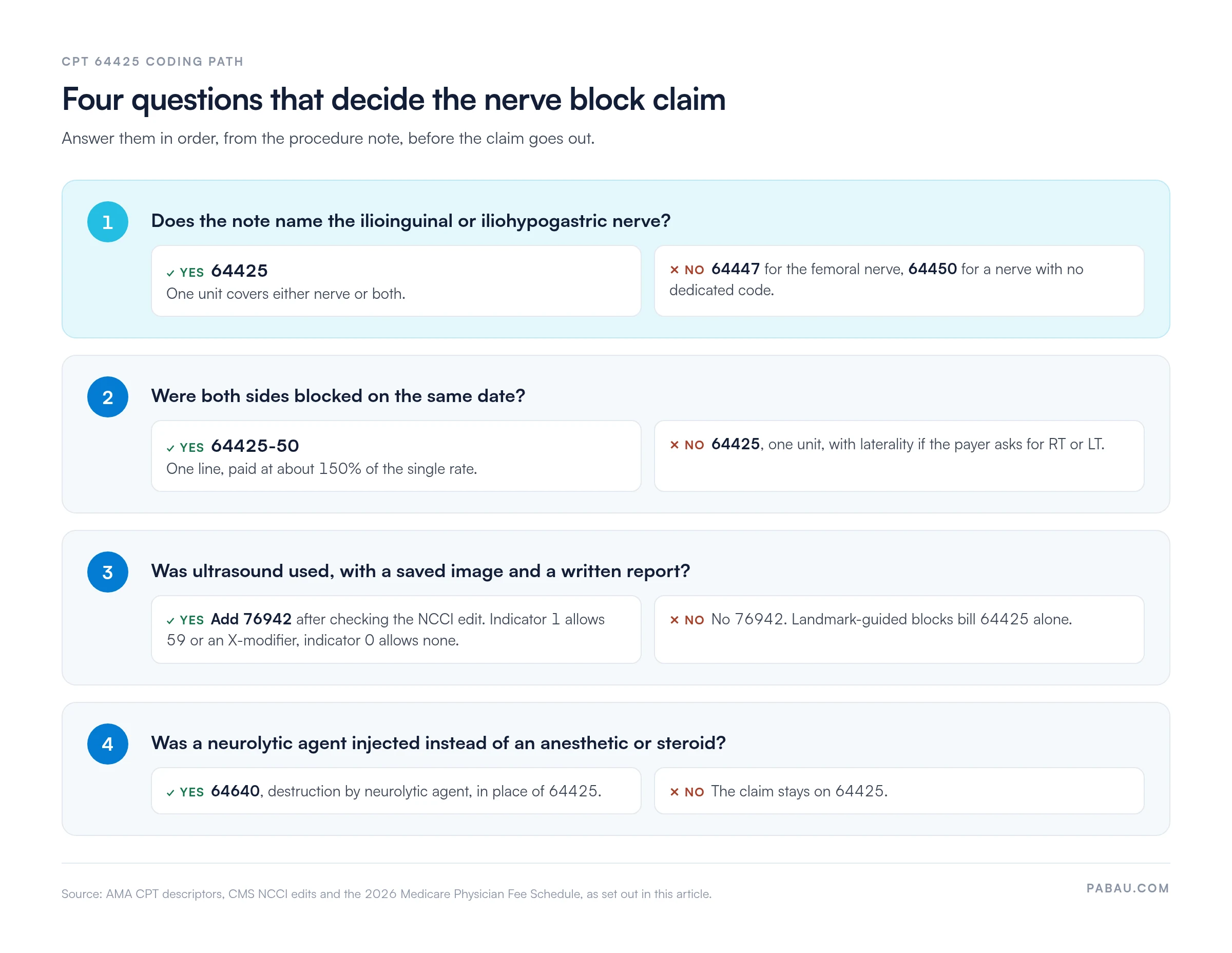
CPT 76942 covers ultrasound guidance for needle placement, with imaging supervision and interpretation. It is separately billable with 64425 when the payer’s local coverage determination (LCD) permits and the documentation holds up. Medicare and most commercial payers want three items on file. They are a permanent image saved in the medical record, a written report describing the guidance, and proof the billing provider interpreted the images.
Before billing 76942 with 64425, pull the NCCI procedure-to-procedure (PTP) edit for this code pair in your MAC jurisdiction. If an indicator of 0 appears, the edit cannot be overridden by any modifier. An indicator of 1 means modifier 59 (or an X-modifier) is an acceptable bypass when the clinical circumstance justifies it.
Modifier selection is where bilateral and repeat-procedure billing for 64425 breaks down most often. The table below covers the four modifiers coders encounter routinely.
Medicare reimbursement for CPT code 64425 is calculated from the relative value units (RVUs) published in the Medicare Physician Fee Schedule (MPFS). Rates change each January 1 and vary by geographic practice cost index (GPCI). The table below shows 2026 national unadjusted values at the $33.4009 conversion factor. Verify your local amount using the CMS Physician Fee Schedule lookup tool or the FastRVU 2026 lookup for your locality.
Submitting 64425 claims through a clearinghouse such as Claim.MD lets the practice check eligibility before the visit and track each claim’s status and remittance afterward. When a bilateral claim pays, compare it against the 150% figure above. A payment at the single-procedure rate means modifier 50 was missed or ignored.
The diagnosis code must establish medical necessity for the nerve block. Payers cross-reference the ICD-10-CM code against any applicable Local Coverage Determination (LCD) for nerve blocks. The following codes appear most often alongside CPT code 64425.
Using an ICD-10 code that is not on the payer’s LCD-approved diagnosis list is a denial trigger. Always review the applicable LCD before submitting.
Incomplete documentation is a frequent denial reason for CPT code 64425. The note is also the evidence an auditor reads, so tight notes are central to medical billing compliance. Every procedure note needs the following elements to support a payable claim.
Structuring procedure notes around these elements is the foundation of building a clean claim that clears pre-payment review without additional development requests.
Traditional Medicare does not require prior authorization for CPT code 64425 as a blanket rule. Many Medicare Advantage and commercial plans do for chronic pain indications. Requirements vary by plan year and payer contract. Common criteria that payers evaluate before approving the procedure:
Solid insurance eligibility verification before each encounter confirms whether the patient’s plan requires prior authorization. It also shows what documentation the payer needs in the PA request. Record the authorization number on the claim itself, because a missing or mismatched number gets the claim denied even after approval. Claims management software that tracks each claim from submission to remittance shows those denials the day they post.
Denials for CPT code 64425 tend to fall into five categories. A strong denial management workflow resolves them quickly, and preventing them is faster still. See how specific denial codes map to the root causes below.
Run a quarterly audit of all CPT 64425 claims denied in the prior 90 days. Group them by denial reason code (CO-4, CO-15, CO-50, CO-97). If one code accounts for more than 30% of denials, fix the workflow behind it before you appeal another claim case by case.
Billing a nerve block often means juggling three systems. The note sits in the EHR, the claim goes out through a clearinghouse portal, and someone logs back in days later to check its status.
Pabau keeps the procedure note, the patient’s insurance details and the claim in one record. Claims go out through Pabau’s Claim.MD integration, which sends them to the payer as an 837 electronic claim file. Eligibility is checked in real time before the patient arrives.
Claim status and remittances come back to the same claims dashboard. A denied 76942 line or a bilateral claim paid at the single rate shows up while the note is still fresh. Your biller can correct it that week.

With Pabau, you submit claims through Claim.MD, check eligibility in real time and track claim status and remittances in one place.

The coding decision for 64425 gets made when the procedure note is written. Name the nerve, state the side, and pair the block with a diagnosis the payer’s LCD accepts, and the claim holds up on review.
Ultrasound guidance is where the trade-off sits. Billing 76942 adds revenue only when the saved image, the separate report and the NCCI indicator all line up. Where one of them is missing, leaving 76942 off costs less than appealing it.
Book a demo to see how Pabau keeps nerve block notes, eligibility checks and claim status in one place.

Blocking the femoral nerve instead? CPT code 64447 covers the femoral nerve block, its modifiers and its 2026 billing rules.
Billing ultrasound guidance with the block? CPT code 76942 explains the image and report requirements behind a payable guidance line.
Moving from a nerve block to a neurolytic procedure? CPT code 64640 covers destruction by neurolytic agent for other peripheral nerves.
Struggling with ERA reconciliation after nerve block payments post? Electronic remittance advice covers how to read and reconcile 835 files so payment posting matches the MPFS allowable.
Want to understand how the full billing cycle works? What is revenue cycle management walks through the end-to-end process from eligibility check to final payment posting.
CPT code 64425 covers an injection of anesthetic agent and/or steroid into the ilioinguinal nerve, the iliohypogastric nerve, or both in one encounter. It does not include ultrasound guidance, neurolytic agents, or blocks of nerves outside this specific anatomical pair.
Yes. When the ilioinguinal or iliohypogastric nerve is blocked on both sides in the same session, bill one unit of 64425 with modifier 50. Medicare applies the bilateral surgery payment formula to 64425, which pays 150% of the single-procedure allowable.
No. Ultrasound guidance is not required to bill 64425, and the code can be submitted for both landmark-guided and image-guided techniques. When ultrasound guidance is used, CPT 76942 may be separately billable. The payer’s LCD has to allow it, and the saved images and written report must be on file.
Medicare’s 2026 national unadjusted allowable for CPT code 64425 is about $121 in an office (non-facility) setting and about $50 in a facility. Local rates shift with the geographic practice cost index. Use the CMS Physician Fee Schedule lookup tool at cms.gov to pull the allowable for your practice address.
Frequent denial reasons are wrong code selection, with 64450 used when 64425 is correct, and a diagnosis the payer’s LCD does not cover. Bilateral billing without modifier 50 and missing prior authorization round out the list. Each denial reason has a corresponding corrective action detailed in the denial prevention section above.



