HCPCS code J3471: Hyaluronidase ovine injection billing guide
HCPCS code J3471: Descriptor, code type, and quick-reference data HCPCS code J34...

Last Updated: Oct 14, 2026

CPT Code 64640 covers neurolytic destruction of peripheral nerve branches that no more specific code in the 64600-64681 range describes.
The code requires destruction of the nerve. Temporary, device-based cryoneurolysis is reported with Category III codes 0440T-0442T instead.
Medical necessity documentation must establish that conservative treatment failed before 64640 is billed.
Modifier 50 covers bilateral same-session procedures. Modifier 59, or XS for Medicare, separates distinct nerve sites billed on one date.
Practice management software like Pabau embeds documentation checklists at the point of care, so 64640 claims go out complete.
CPT Code 64640 is the billable procedure code for destruction by neurolytic agent of a peripheral nerve or branch.
The descriptor comes from the American Medical Association (AMA) CPT code set. Pain management practices report it for chemical, thermal, and cryogenic procedures that permanently interrupt a peripheral pain-signal pathway.
Two conditions decide whether 64640 is the right choice. The nerve has to be destroyed rather than blocked, and it has to be a branch with no dedicated code. This guide covers the clinical indications, documentation requirements, modifiers, ICD-10 crosswalk, 2026 Medicare context, and the denial triggers that follow.
CPT Code 64640 is the AMA-designated code for neurolytic destruction of a peripheral nerve or branch with no more specific code. The codes it defers to run from 64600 through 64681. Destruction may be achieved chemically, thermally, by radiofrequency, or by freezing.
The official descriptor reads Destruction by neurolytic agent, other peripheral nerve or branch. The word “other” carries the rule. If a named nerve has its own code, that code wins.
The intercostal nerve is 64620. Paravertebral facet joint nerves are 64633 through 64636. The intraosseous basivertebral nerve has its own code, CPT 64628, which bundles all imaging guidance into the payment. The genicular nerve branches of the knee are 64624. CPT 64640 applies only when the treated branch falls outside those named categories.
64640 sits in the CPT surgery section for the nervous system, under the heading “Destruction by Neurolytic Agent.” Payers read that heading literally. They expect the operative note to describe destruction, and to show that reversible options were tried and failed.
Medical necessity is the most commonly cited denial reason on 64640 claims. Payers want documented evidence that the targeted nerve transmits pathological pain. They also want proof that conservative treatment failed, and that destruction suits this patient better than a repeatable block.
Accepted clinical indications across most Local Coverage Determination (LCD) policies include:
Cryoneurolysis is where 64640 is most often the wrong code. CMS Medicare Coverage Database article A59753 states that 64640 is not valid for temporary, non-destructive cryoneurolysis devices such as Iovera.
64640 requires destruction of the nerve. Where a device produces only a temporary conduction block, A59753 points to the Category III codes 0440T through 0442T. Coverage rules still vary by Medicare Administrative Contractor (MAC), so confirm the applicable LCD as well.
Three modalities fall within the scope of CPT 64640. Matching the operative note to the right one keeps the documentation consistent with the code on the claim.
Imaging guidance is billed separately with the appropriate guidance code. Use 77002 for fluoroscopy and 76942 for ultrasound. The guidance code and 64640 report distinct clinical services, so they are not bundled together.
Thorough records are the most effective defense against a 64640 denial. Every chart note supporting the claim should carry these elements:
Nerve specificity is where most operative notes fall short. A note reading “neurolytic block performed” without naming the nerve is a near-certain denial.
Build a 64640 procedure note template with mandatory fields for nerve name, agent type, imaging guidance used, and prior diagnostic block date. Completing these fields at the point of care takes 90 seconds and prevents the most common denial trigger before a claim is generated.
Three billing rules cause most of the avoidable 64640 errors, even among experienced pain management coders.
64640 is the “other” code. If a more specific neurolysis code exists for the nerve treated, that code must be used instead. Billing 64640 for a procedure better described by 64620 or 64633 is an unbundling violation and an audit risk.
CPT 64640 may be reported more than once on the same date when distinct nerve sites are treated. Each additional unit must be documented as a separate procedure on a separate branch. Append Modifier 59, or XS for Medicare, to each additional unit. Without it, the claim usually denies as a duplicate.
CPT 64640 carries a 10-day global surgery period under the Medicare Physician Fee Schedule. Follow-up services related to the procedure are included in the payment during that window. Billing a separate E/M service inside the global period requires Modifier 24 or Modifier 25.
Modifier 24 covers an unrelated E/M visit. Modifier 25 covers a significant, separately identifiable E/M on the same day as the procedure.
Flag the global period end date on the claim record so the front desk does not bill a follow-up visit twice. Building that check into the scheduling system beats catching it manually at billing review.
Modifier assignment is the second most common source of 64640 claim errors. The table below covers the modifiers pain management billers apply most often.
Modifier 50 is billed as a single line with the modifier appended, and many payers reimburse it at 150% of the single-side rate. Some commercial payers instead want two lines, one LT and one RT, at 100% each. Check your contracts before defaulting to the Modifier 50 format.
The ICD-10 diagnosis code has to support medical necessity for the destruction. Payers cross-reference it against their LCD to confirm coverage. The pairings below are widely accepted, though necessity is still established per patient and per payer policy.
ICD-10 code M54.5 (Low back pain) was retired on October 1, 2021, and replaced by M54.50, M54.51, and M54.59. Submitting M54.5 now produces an automatic technical denial. Check each pairing against the ICD-10-CM code library, or the CDC/NCHS ICD-10-CM lookup tool, before the claim cycle.
Medicare covers CPT Code 64640 when medical necessity criteria are met under the applicable MAC Local Coverage Determination. Coverage is not uniform across MACs, because peripheral nerve destruction policies differ by jurisdiction. Confirm the applicable LCD before treating Medicare beneficiaries.
Reimbursement for 64640 depends on where the procedure is performed. Facility rates, which apply in ambulatory surgery centers and hospital outpatient departments, sit below non-facility office rates. Verify the 2026 amounts in the CMS Physician Fee Schedule lookup tool, since rates change annually and vary by locality.
As a benchmark, non-facility reimbursement for peripheral nerve destruction codes in this family has typically run from $200 to $450 per nerve site. Treat that as a range, not a rate. Confirm current figures for your own MAC jurisdiction before any revenue projection.
Routing claims through a clearinghouse connected to your practice management platform keeps eligibility checks ahead of the procedure date. Pabau’s Claim.MD integration connects to thousands of US payers and returns electronic remittance advice into the same record. Practices can then reconcile 64640 payments against the expected fee schedule amount.
Prior authorization requirements for 64640 vary by MAC and by commercial payer. Some MACs require prior auth for peripheral nerve destruction, and others do not. Commercial payers often want documentation of failed conservative treatment with the request. Run benefit checks before scheduling, so you know which rule applies to each patient’s plan.
Most 64640 denials fall into a small number of categories. Recognizing the pattern is the first step toward a denial management process that moves the rate.
Review the previous quarter’s denied 64640 claims as a batch. The pattern tells you whether the cause is documentation, modifiers, or prior auth, and each of those needs a different operational fix.
Run a monthly audit of all 64640 claims denied in the prior 90 days. Categorize each denial by root cause: medical necessity, modifier, auth, or code selection. In most practices the denials cluster around one or two causes, which makes a targeted fix worth more than broad retraining.
CPT Code 64640 is the residual “other peripheral nerve” code. Before billing it, confirm that no named-nerve or site-specific code describes the procedure better. The chart below reduces that check to five documented scenarios.
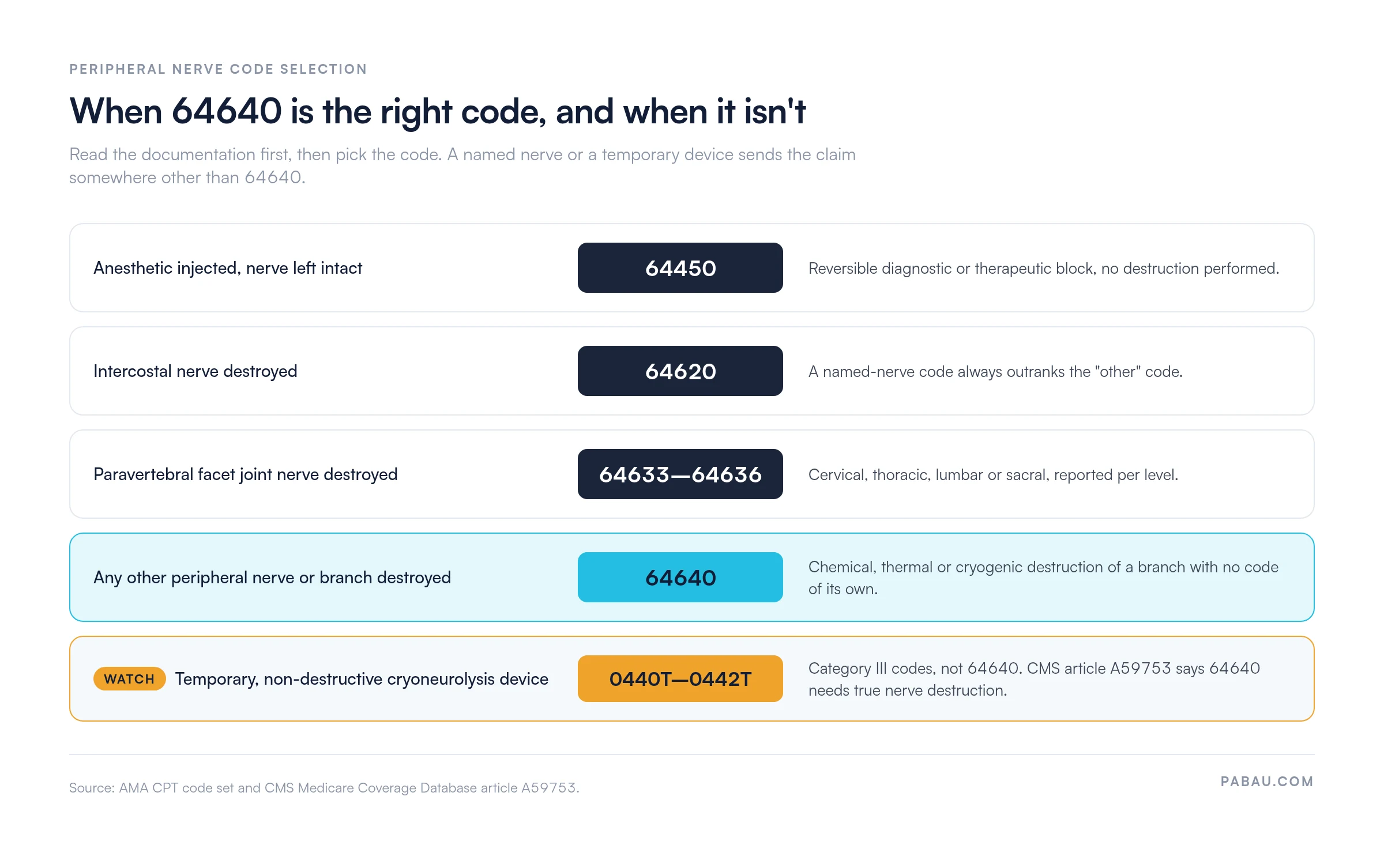
The 64450 versus 64640 line is the one that carries audit risk. Both describe peripheral nerve interventions, but 64450 reports a reversible anesthetic injection while 64640 reports destruction. Billing one when the other was performed is a coding error with audit consequences.
The table below compares 64640 with its closest related codes, sourced from the AAPC Codify CPT reference.
The most effective way to reduce 64640 denials is to move the compliance check upstream, to the point of care. A biller cannot create medical necessity after the visit is over. The chart note is the claim.
Practice management software like Pabau combines documentation templates, modifier logic, and eligibility verification in one workflow. For a pain management practice billing 64640 regularly, Pabau’s claims management software adds four checks:
Practices that build the documentation standard into the clinical workflow spend less time on rework. The denial gets prevented in the treatment room, while the detail is still in front of the clinician.

Pabau embeds documentation checklists, modifier reminders, and automated eligibility checks into your pain management workflow, so claims go out complete the first time.

64640 is a short descriptor sitting on top of four separate judgment calls. Name the nerve, prove conservative care failed, pick the modifier that matches the session, and confirm the note describes destruction.
Get those four right at the point of care and the claim needs no rework. Get one wrong and the appeal costs more staff time than the procedure earned. That trade-off is why the fix belongs in the note template, not the billing queue.
Book a demo to see how Pabau puts the 64640 documentation checklist, modifier prompts, and eligibility check in front of your team.

Want to understand how clearinghouse claim routing works? Medical claims clearinghouse guide explains how claims move from practice to payer and where 64640 submissions can stall.
Need a structured approach to billing errors? Claim.MD clearinghouse overview covers how Pabau routes claims to thousands of US payers with real-time status tracking.
Looking to reduce your denial backlog? Credentialing with insurance companies covers the upstream credentialing steps that prevent eligibility-based denials on pain management claims.
CPT Code 64640 reports destruction by neurolytic agent of a peripheral nerve or branch. It applies when no more specific code in the 64600-64681 range describes the nerve treated. Practices bill it for chemical neurolysis, radiofrequency ablation, and destructive cryoneurolysis in chronic pain, cancer pain, and refractory neuropathic conditions.
Only when the nerve is destroyed. CMS article A59753 states that 64640 is not valid for temporary, non-destructive cryoneurolysis devices such as Iovera. Those procedures are reported with the Category III codes 0440T through 0442T instead. Coverage still varies by MAC, so confirm the applicable LCD before scheduling.
Modifier 50 applies to bilateral same-session procedures. Modifier 59, or XS for Medicare, applies when multiple distinct nerve sites are treated on the same date. LT and RT designate laterality. Modifier 76 applies when the same provider repeats the procedure on the same nerve on the same day.
Medicare covers CPT Code 64640 when medical necessity criteria are met under the applicable MAC Local Coverage Determination. Coverage is not uniform across MACs, and prior authorization requirements vary. Confirm coverage with your own MAC, and check prior auth requirements for each Medicare patient before scheduling.
Commonly paired codes include G89.29 for other chronic pain, M79.2 for neuralgia and neuritis, and G57.81 or G57.82 for mononeuropathies of the lower limb. Cancer pain pairings use G89.3 and C80.1. Note that M54.5 for low back pain was retired in 2021, so use the current M54.5x codes.
Yes, radiofrequency ablation of peripheral nerve branches not described by a more specific CPT code is reportable under 64640. RFA of paravertebral facet joint nerves uses the dedicated 64633-64636 family instead. When RFA targets a peripheral branch with no named code, 64640 is the correct choice.
CPT 64450 describes a reversible anesthetic injection into a peripheral nerve or branch, used for diagnostic blocks or temporary relief. CPT 64640 describes permanent or semi-permanent destruction of the same type of nerve. The two are not interchangeable. Billing the wrong one is a coding error with audit implications.