



CCSD code G5100: Bypass of duodenum billing guide
CCSD code G5100 bills a bypass that leaves the duodenum in place CCSD code G5100...

Last Updated: Oct 16, 2026

CPT Code 63047 covers laminectomy, facetectomy and foraminotomy at a single lumbar vertebral segment, decompressing the spinal cord, cauda equina or nerve roots.
The billing unit is the vertebral segment, not the interspace. Interspaces are the unit for 63030 and its add-on 63035.
In addition, add-on code 63048 reports each additional segment beyond the first, and it pairs with 63045, 63046 or 63047 as the primary code.
A pure laminectomy with no facetectomy or foraminotomy is 63005, not 63047. Therefore, the three components have to be in the operative report.
2026 Medicare payment for 63047 varies by locality, so verify the rate in the CMS Physician Fee Schedule lookup before billing.
Practice management software like Pabau captures CPT codes at the point of care, which cuts post-visit coding errors and supports clean claim submission.
CPT Code 63047 covers laminectomy, facetectomy and foraminotomy at a single lumbar vertebral segment. Namely, the procedure decompresses the spinal cord, the cauda equina or specific nerve roots, usually for stenosis. In fact, the billing unit is the vertebral segment, not the interspace.
This reference covers the official descriptor, how 2026 Medicare payment is built and the modifiers that apply. It also sets 63047 against 63005 and 63030, and lists the documentation a claim needs to survive an audit.
In fact, payers do not all count segments the same way, and that decides how many units you bill. For example, an L2 to L4 laminectomy can support one unit of add-on 63048 or two, depending on the convention applied. The section on counting sets both readings side by side.
CPT Code 63047 describes an open posterior decompression at one lumbar vertebral segment. The American Medical Association (AMA) publishes and maintains the CPT code set. Its official descriptor for the code reads:
Laminectomy, facetectomy and foraminotomy, single vertebral segment; lumbar.
The descriptor’s parenthetical qualifier reads: unilateral or bilateral with decompression of spinal cord, cauda equina and/or nerve root[s], [e.g., spinal or lateral recess stenosis].
Namely, three components sit inside that descriptor: laminectomy, facetectomy and foraminotomy. Indeed, the surgeon removes lamina, resects at least part of a facet joint, and opens the neural foramen. So, all three have to appear in the operative report.
Indeed, that facetectomy and foraminotomy requirement is what separates 63047 from 63005. A report describing lamina removal alone, with no facet or foraminal work, belongs to 63005 instead. Payers check that distinction early, because the two codes pay very differently.
A laminectomy performed only to reach the epidural space for a paddle neurostimulator electrode is coded elsewhere. That open implantation is reported with 63655, since 63047 requires decompression with facetectomy and foraminotomy.
The unit of measure is the vertebral segment, not the interspace. In contrast, interspaces are the unit for 63030 and its add-on 63035. As a result, reading one unit as the other is the most common source of unit errors on these claims.
Clinical indications that typically support 63047 include lumbar spinal stenosis and lateral recess stenosis. Spondylolisthesis with neurogenic claudication and cauda equina syndrome also appear in these operative reports. The pre-operative imaging has to show the compression the surgeon then treats.
Check that the operative report names laminectomy, facetectomy and foraminotomy before assigning 63047. A report describing lamina removal alone points to 63005. Likewise, a report describing disc excision through a hemilaminotomy points to 63030.
CPT uses two different units for spinal work, and they are not interchangeable. A vertebral segment is a single complete vertebral bone with its articular processes and laminae, while an interspace is the non-bony compartment between two adjacent vertebral bodies that holds the disc. Applying the interspace unit to 63047 is how a multi-level laminectomy ends up billed with the wrong number of add-on units.
Counting practice is where these claims still split. Some payers and coding consultants count every vertebral bone whose lamina and facet were resected, while others follow the neurosurgical reading and count the motion segments decompressed.
Take an L2 to L4 laminectomy as the worked example: the two conventions read the same operative report and produce different unit counts.
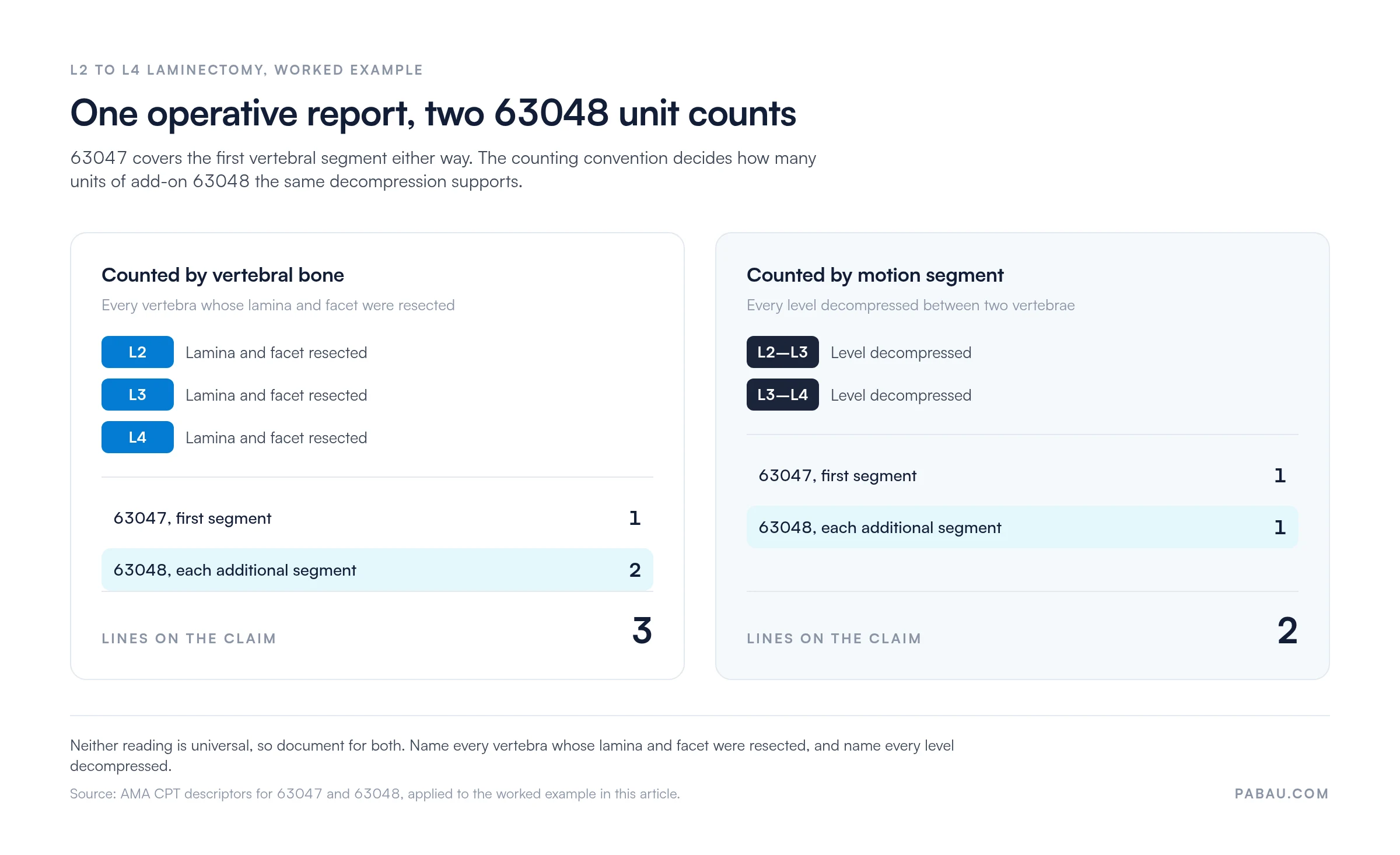
Neither reading is universal, so do not guess. Name every vertebra whose lamina and facet were resected, and name every level decompressed, then confirm the counting convention in the payer’s policy before billing a second unit of 63048.
CPT 63048 is the companion add-on code to 63047. In short, it is reported once for each additional vertebral segment decompressed beyond the first. Its descriptor reads each additional segment, cervical, thoracic, or lumbar, so the same add-on serves 63045, 63046 and 63047.
Because of this, the superbill for a multi-segment procedure should list each segment separately. Then, pair each one with the ICD-10-CM diagnosis code that justifies decompression there. Thus, payers cross-check diagnostic support against the number of 63048 units billed.
Both codes describe posterior lumbar decompression, and both are open procedures. Namely, they differ in scope, in surgical target and in how levels are counted. As a result, choosing the wrong one is an upcoding or undercoding risk that payers are trained to flag.
In the end, the operative report is the deciding document. A report describing laminectomy with facetectomy and foraminotomy for stenosis supports 63047. Instead, a report describing a hemilaminotomy to remove herniated disc material at one interspace supports 63030. In short, picking the higher-paying code without that support is upcoding, with financial and legal consequences.
The diagnosis on the claim has to explain why the segment needed decompressing. Often, payer policies for lumbar decompression ask for imaging evidence and a documented failure of conservative care. Namely, the codes below appear most often on 63047 claims, and each descriptor can be checked against the full ICD-10-CM code index.
Sequence the code that documents the compression first. Often, most stenosis claims sit in the M48.06 subcategory, where the final character records whether neurogenic claudication is documented. Add secondary codes for the symptoms that justify surgery, then check that the diagnoses account for every segment billed.
Medicare pays CPT 63047 under the Medicare Physician Fee Schedule (MPFS). The Centers for Medicare and Medicaid Services sets the rates annually, and you can look them up in the CMS Physician Fee Schedule lookup. Namely, payment differs by place of service and by locality.
The table below shows how the 2026 payment is built, rather than quoting a single national figure. Geographic Practice Cost Indices adjust the amount by locality, so a national average will not match what a specific practice is paid.
Indeed, online submission through a clearinghouse removes the manual rate lookup that produces short payments. Practices that route 63047 claims through Claim.MD receive 835 remittance data with the payment. Then, the paid amount can be checked against the fee schedule before any balance is written off.
Modifier selection depends on the clinical scenario and on payer rules. National Correct Coding Initiative (NCCI) edits govern which modifiers are valid and when they override bundling. The table below lists the modifiers applied most often to this code.
Check the current NCCI PTP edits before applying modifier -59. The edits are updated quarterly, so what was separately billable last year may not be now.
63047 rarely appears alone on a surgical claim. In fact, lumbar decompression is often combined with fusion, instrumentation or bone grafting. When the laminectomy excises or evacuates an extradural intraspinal lesion instead of decompressing, the lumbar code is CPT code 63267. A transpedicular approach to a single lumbar segment, often for a far-lateral disc herniation, is reported with CPT code 63056. The table below covers the codes billed alongside 63047, and the codes billed instead of it.
Payer audits for lumbar decompression claims focus almost entirely on the operative report. Even so, a claim can carry perfect code assignment and still be denied on documentation. The elements below have to appear in the record to support 63047.
Indeed, practices that capture documentation inside the EHR have a structural advantage here. For example, a templated operative note prompts the surgeon for each element before the chart closes. In fact, that is far stronger than amending the note weeks later.
Build a 63047-specific operative note template with separate required fields for approach, the three procedure components, every segment treated and the neural structures decompressed. As a result, a complete note written at the time of surgery is far easier to defend than an amended one.
Lumbar decompression codes draw consistent payer scrutiny. Indeed, the payment is significant and the code distinctions are fine-grained. As a result, these errors turn up again and again in billing audits.
Tracking denials by CPT code shows which of these errors recur in your practice. First, map the CARC codes your clearinghouse returns for 63047 back to the underlying issue. Then fix the one that costs the most, rather than the one that appears first.
Knowing what CPT 63047 covers is one job. Still, getting the segment count and the modifiers onto a clean claim is another. In the end, that depends on how the operative note reaches the billing team.
Practice management software like Pabau closes that handoff. Its claims management software ties the operative note to CPT code capture.
For a neurosurgery or orthopedic practice, 63047, 63048 and any fusion or instrumentation codes are logged inside the encounter form. As a result, nobody retypes them into a separate billing system, which is where segment counts get lost and modifiers get skipped.
Claims flow from Pabau to payers through Claim.MD, which connects to thousands of US payers. In addition, it validates claims against built-in CPT and ICD-10 catalogs before transmission. Eligibility checks, 837P submission and 835 remittances sit in one workflow, so the billing team sees claim status without a second login.
Pabau’s reporting layer tracks claim submission status and denial patterns by CPT code. As a result, administrators can spot 63047-specific issues before they turn into audit exposure across several surgeons or locations.

Pabau embeds CPT code capture into your clinical encounter workflow. Codes like 63047 and 63048 are documented at the point of care, with the segment count taken from the operative note. Connect to Claim.MD for eligibility checks and clean claim submission.

The descriptor decides this code, and the operative report decides the descriptor. Where the note names the laminectomy, the facetectomy and the foraminotomy at each segment treated, 63047 and its 63048 units defend themselves.
Where the counting convention is unsettled, document more than you bill. In short, a note that names every vertebra resected and every level decompressed supports either reading. As a result, that turns a payer’s convention into a billing decision rather than an appeal.
Pabau’s claims management software keeps code capture, modifier selection and claim submission in one connected workflow. Book a demo to see how a neurosurgery or orthopedic practice runs surgical billing on it.

Need a structured approach to managing insurance claims? What is revenue cycle management explains how surgical practices track claim lifecycles from documentation through payment posting.
Want to understand how clearinghouse validation reduces surgical claim denials? Medical claims clearinghouse guide covers how 837P submission and ERA processing work for high-value procedure codes.
Building the charge document for a multi-segment procedure? What is a superbill shows which codes, modifiers and diagnoses a surgical charge sheet has to carry.
Need the paper trail behind a co-surgery or distinct-service claim? Medical billing compliance sets out the documentation standards that keep modifier -59 and -62 lines defensible.
Looking for a framework to audit your current billing compliance? Insurance credentialing guide walks through the payer enrollment requirements that affect reimbursement for lumbar decompression.
CPT Code 63047 covers laminectomy, facetectomy and foraminotomy at a single lumbar vertebral segment for spinal cord, cauda equina or nerve root decompression. All three components must appear in the operative report.
63047 describes laminectomy with facetectomy and foraminotomy to decompress the cord, cauda equina or nerve roots, billed per vertebral segment. 63030 describes a laminotomy or hemilaminectomy that excises a herniated disc, billed per interspace.
Vertebral segments. 63047 and add-on 63048 use the segment; 63030 and 63035 use the interspace. Confirm the payer’s counting convention before billing a second 63048 unit.
CPT 63048 reports each additional vertebral segment decompressed beyond the first, pairing with 63045 for cervical and 63046 for thoracic segments. Every unit needs its own named segment; 63048 is exempt from modifier -51.
Common modifiers include -51 for multiple procedures, -59 for a distinct service, -62 for co-surgery, -80 for an assistant surgeon, and -22 for complex work. Modifier -50 does not apply, since the descriptor already covers bilateral decompression.
The operative report must confirm the posterior extradural approach, name all three components, and identify every segment and neural structure decompressed, plus imaging evidence of stenosis or cauda equina compromise. Missing elements invite denial or post-payment recovery.
Yes. 63047 covers the first segment, and 63048 each additional one, both needing separate segment documentation. Commercial payers may also require prior authorization stating how many levels are approved.



