

CCSD code G5100: Bypass of duodenum billing guide
CCSD code G5100 bills a bypass that leaves the duodenum in place CCSD code G5100...

Last Updated: Oct 16, 2026
63056 is the CPT code for a transpedicular approach with decompression of the spinal cord, cauda equina and/or nerve root(s). It is typically used for a herniated disc and includes laminectomy, facetectomy and foraminotomy at a single lumbar segment. Transfacet and lateral extraforaminal approaches, such as for a far lateral disc herniation, fall under the same code.
Most denials on this code come from one mistake. The coder selects 63056 from the procedure name rather than the approach corridor documented in the operative report. If the surgeon went posterior and removed lamina, that is 63047, not 63056. The transpedicular approach means the surgeon worked lateral to the facet joint, through or alongside the pedicle, to reach a far-lateral or extraforaminal disc herniation. That distinction has to be in the op note, and it has to be in the code selection.
Let Pabau's smart automation suggest the right codes, reduce claim denials, and keep your practice compliant—effortlessly.
Automate repetitive tasks and focus on what matters most—your patients.
Reduce coding errors and ensure compliance with the latest regulations.
Clean claims, fewer denials, and faster reimbursements.
Powerful insights and reporting to help your practice thrive.
HIPAA compliant SOC 2 certified GDPR-compliant Trusted by 4,000+ clinics worldwide

CPT code 63056 covers single-segment lumbar decompression via a transpedicular approach only, not posterior laminectomy.
CPT 63057 is the add-on code for each additional segment and cannot be reported without a primary code such as 63056.
The operative report must explicitly name the approach corridor and spinal level treated to support 63056 over 63047.
Pabau’s claims management software tracks claim status and checks authorization codes for completeness before submission.
The American Medical Association defines CPT code 63056 as a transpedicular approach with decompression of the spinal cord, cauda equina and/or nerve root(s). A herniated disc is the typical example. The code includes laminectomy, facetectomy and foraminotomy, and it covers a single lumbar segment. Transfacet and lateral extraforaminal approaches, such as for a far lateral disc herniation, fall under the same code.
Three details in that descriptor decide whether the code fits. First, the code is lumbar only, and a thoracic transpedicular decompression is reported with 63055. Second, the transfacet and lateral extraforaminal approaches named in the descriptor are variants that 63056 already captures. Third, “single segment” means one spinal level in this session. Each additional level adds CPT 63057.
The transpedicular approach reaches the spinal canal by going lateral to the facet joint and working through or medial to the pedicle. The surgeon does not require a full midline laminectomy to access the target. That lateral corridor is why this approach suits far-lateral and extraforaminal disc herniations. In those cases the offending fragment sits outside the spinal canal, in the foramen or beyond it.
Coders look for the technique in the operative report, and these are the identifiers that point to it:
A costovertebral approach is a different code family. It is reported with 63064 for a single thoracic segment, so an op note describing rib and transverse process removal never supports 63056.
CPT code 63056 bundles the approach, the decompression, and any laminectomy, facetectomy, or foraminotomy performed as part of reaching the neural structures. These components are not separately billable when performed through the same approach at the same level.
Check current CMS Physician Fee Schedule NCCI edits before assuming any add-on is separately billable. Bundling rules change quarterly and a code pair that was unbundled last year may be bundled now.
CPT code 63056 uses a transpedicular approach, while CPT 63047 uses a posterior midline approach with laminectomy. The approach documented in the operative report decides the code, whatever the pathology treated.
Billing 63056 when the operative report describes a standard posterior laminectomy is upcoding. The approach language in the op note is the audit trail. If the coder cannot find the approach named explicitly, the physician must be queried before submission. The decision path below maps each kind of approach language to its primary and add-on codes.
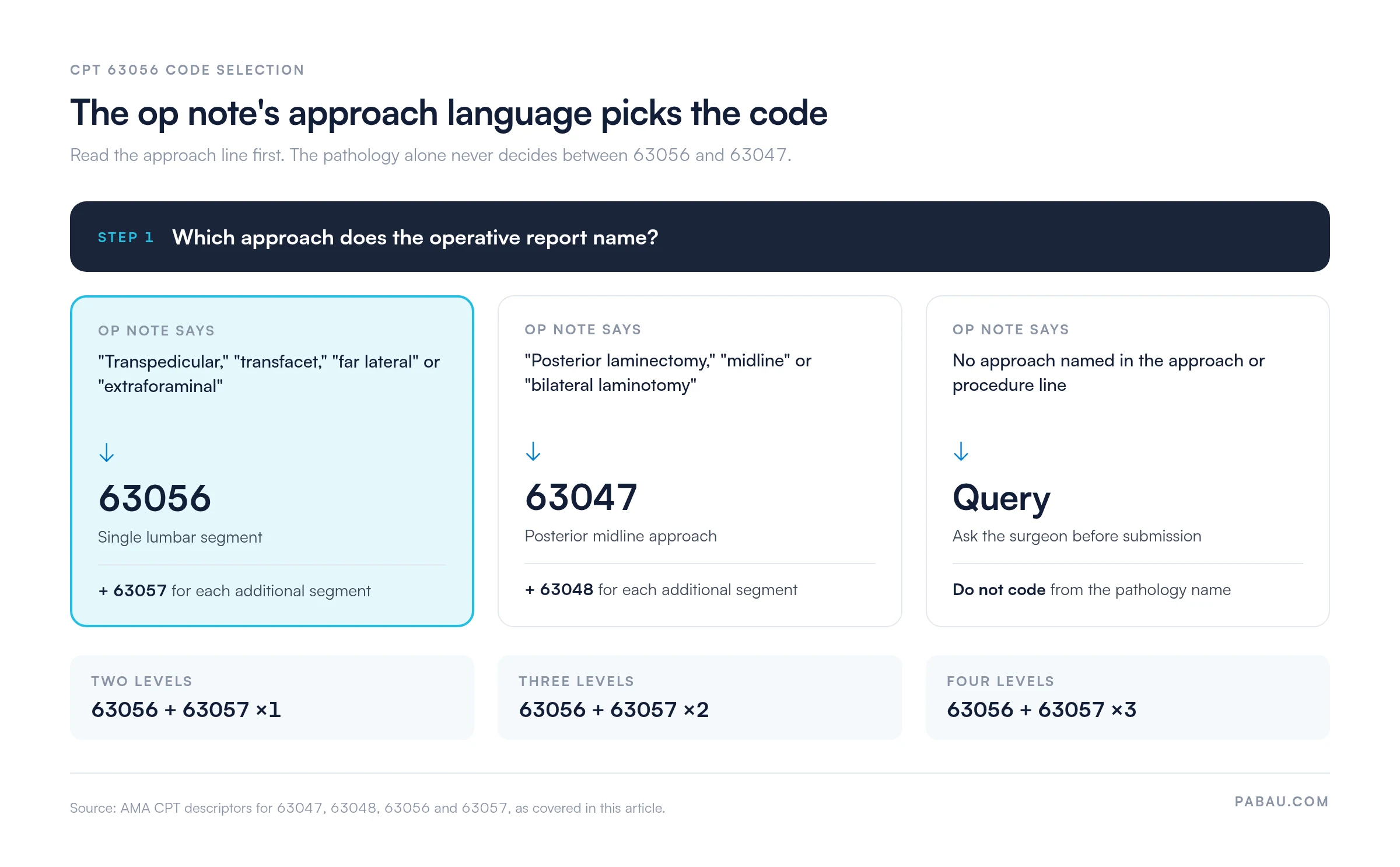
CPT 63057 is the add-on code to CPT code 63056 for each additional spinal segment. The extra segment must be decompressed via the same transpedicular approach in the same operative session. It cannot be reported without a primary code. For lumbar cases that primary is 63056, and for thoracic cases it is 63055.
Common billing error: submitting 63057 without specifying the segment(s) in the documentation. Payers that audit spine surgery claims look for level-specific documentation for every add-on unit reported. A single operative note entry that says “three levels decompressed” without naming each level individually leaves the practice exposed to a recoupment request.
CPT code 63056 accepts several modifiers depending on surgical team composition and bilateral procedure scenarios. The table below lists the most commonly applied, along with conditions for use.
Before submitting 63056 with modifier -62, confirm the payer’s co-surgery policy. Medicare allows co-surgery for select spine codes when medical necessity is documented, but many commercial payers require pre-authorization for co-surgeon arrangements. Pull the payer’s spine surgery LCD and verify before the operative date, not after.
Medical necessity for CPT code 63056 is established through a paired ICD-10-CM diagnosis code that reflects the pathology being decompressed. Payers match the procedure code to the diagnosis to confirm the approach is clinically appropriate. Using a central-canal stenosis code when the operative report documents a far-lateral herniation creates a diagnosis-procedure mismatch that triggers denial. For a lumbar disc herniation with nerve root symptoms, M51.16 is the usual primary pairing.
Coverage for CPT code 63056 is payer-dependent. Medicare Administrative Contractors (MACs) such as Novitas, CGS, and Palmetto GBA publish Local Coverage Determinations (LCDs). Each LCD defines which ICD-10 codes establish medical necessity for transpedicular decompression in that jurisdiction. Review the applicable MAC LCD before submitting, not the generic payer fee schedule.
Medicare reimbursement for CPT code 63056 is calculated from its RVU components multiplied by the annual conversion factor. The result is then adjusted by Geographic Practice Cost Indices (GPCI) for the provider’s locality. The figures below reflect 2026 Medicare Physician Fee Schedule (MPFS) data. Verify current rates with the AAPC CPT reference or the CMS MPFS lookup tool. The conversion factor and GPCI adjustments change the final payment by state.
During the 90-day global period, related E&M or procedural services cannot be billed separately. The only route is a modifier that justifies the exception. Post-op visits billed without a global-period check are a steady source of spine denials. Checking each visit against the operative date before it is billed prevents that loss.
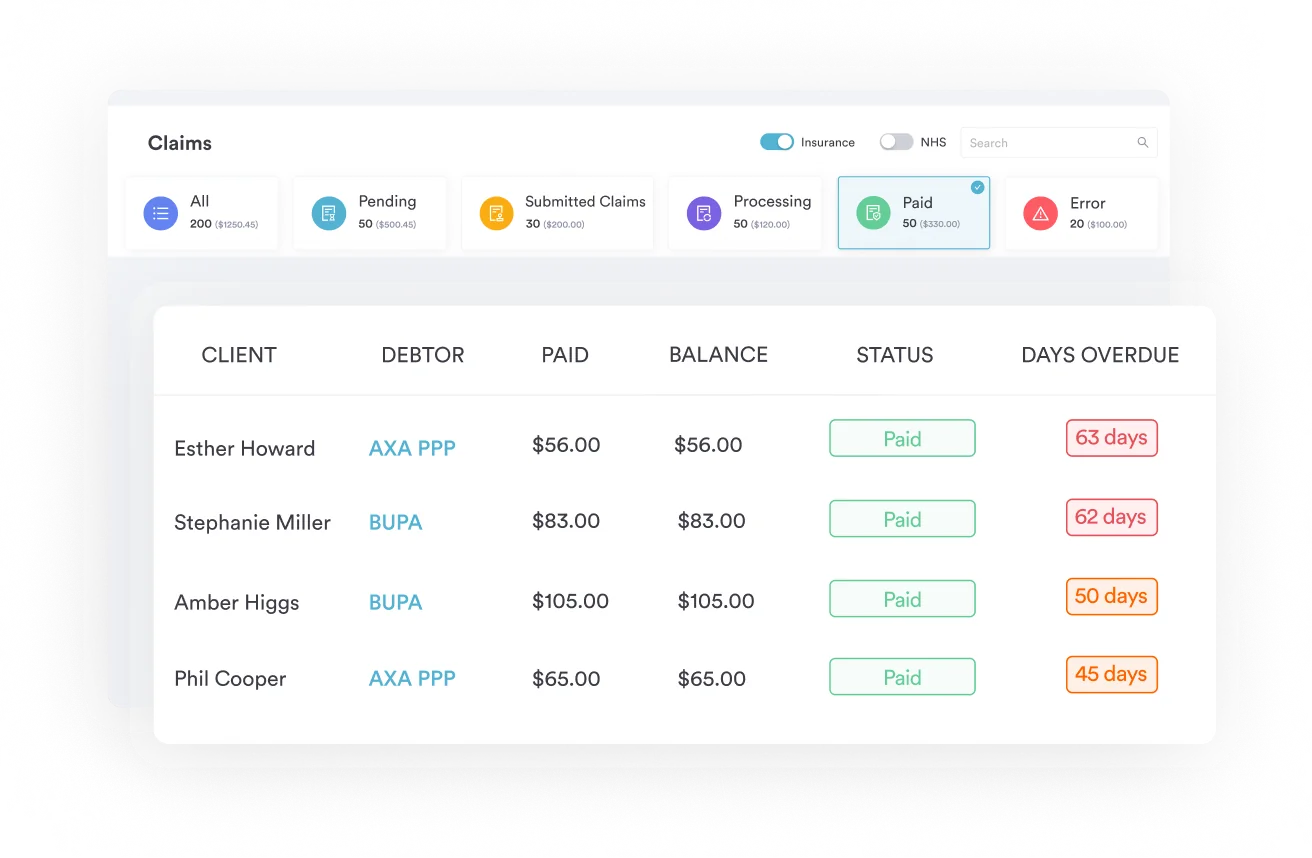
Pabau’s US clearinghouse integration sends electronic claims via Claim.MD. For CPT code 63056 claims, it gives spine billing teams real-time eligibility checks and ERA matching of payments to claims.
The operative report is the single most important document for CPT code 63056 claim adjudication. Payers review spine surgery claims closely. An op report that does not explicitly name the approach will not survive a medical review.
The operative report must include all of the following elements:
When a pre-authorization was obtained, the authorization number must be on the claim form and the operative report’s documented procedure must match what was authorized. Authorization for “lumbar laminectomy” does not automatically cover 63056 if the payer expected 63047.
CPT code 63056 denials cluster around the six issues in the table below. A denial management workflow for spine surgery starts at pre-authorization, well before the remittance arrives.
For appeals, send the operative report with a letter from the surgeon explaining the approach chosen and why it was medically necessary. That pairing resolves most approach-mismatch denials. Attach MAC LCD criteria documentation to show the procedure met coverage standards. A clean claim submission carries the auth number, the correct diagnosis-procedure pairing and approach-specific operative language. That keeps most of these issues from reaching the denial stage.
Prior authorization requirements for CPT code 63056 vary by payer, plan type, and geography. No universal rule applies. The framework below covers the most common payer categories.
When you apply for prior authorization for CPT code 63056, the clinical submission needs four items. Include imaging (MRI or CT) that shows the far-lateral or extraforaminal pathology, plus the conservative treatment history with dates and provider names. Add the operative plan naming the transpedicular approach, and the treating surgeon’s attestation. Submit using the exact CPT code you intend to bill. If the authorization is granted for 63047 but the surgeon performs 63056, the claim will deny.
Run a pre-authorization workflow audit on every CPT 63056 case before the operative date. Confirm the auth number covers this exact code and the authorized level matches the planned surgical level. Also check that the authorization window includes the scheduled date of service. Catching a code mismatch between the authorization and the planned procedure the day before surgery is recoverable. Catching it after the claim is submitted is not.
Spine surgery practices billing CPT code 63056 face a specific operational challenge. Each claim needs approach-level documentation review, a matching authorization and a global-period check. Many teams track those steps in spreadsheets and payer portals, so a missing auth number often surfaces only as a denial weeks later.
Pabau, the practice management platform we build, moves that work into its medical claims management tools. Each claim is checked for a complete authorization code before it goes out. Claim status tracking then shows where every 63056 claim sits, and payments are reconciled against the claims they settle.
The outcome is fewer avoidable denials and a shorter path to payment on high-value spine cases, which shows up across your revenue cycle management. Claims go out through a clearinghouse with eligibility checks, the standard route for medical billing to US commercial payers.

Pabau brings claim submission, claim status tracking and authorization-code checks into one platform, so spine surgery billing teams catch errors before they become denials.

CPT code 63056 rests on one decision: the approach the surgeon names. When the op note says transpedicular, transfacet or far lateral, bill 63056 with 63057 for each extra level. When it says posterior midline laminectomy, bill 63047. When it names no approach, query the surgeon before the claim leaves the building.
Get that call right first, and the authorization, the diagnosis pairing and the add-on units follow from the same op note. The trade-off is time spent on a physician query, which costs far less than an audit recoupment. Book a demo to see how Pabau tracks every spine claim from authorization check to payment.

Coding a posterior midline decompression instead? CPT code 63047 covers lumbar laminectomy billing, its 63048 add-on, modifiers and current rates.
Need to track denial patterns across spine surgery claims? Denial management in healthcare covers the systematic workflow for identifying, appealing, and preventing recurring claim rejections.
Want to understand how clearinghouse submission works for CPT codes? Medical claims clearinghouse explains how electronic claims move from the practice to the payer and what happens when they are scrubbed.
Looking for guidance on the 837 file format for spine surgery claims? 837 file billing format covers the HIPAA-compliant EDI transaction structure required for electronic claim submission.
CPT code 63056 covers a transpedicular approach with decompression of the spinal cord, cauda equina, and/or nerve roots at a single lumbar segment. It includes any laminectomy, facetectomy, or foraminotomy performed as part of the approach. The code also encompasses transfacet and lateral extraforaminal approach variants for far-lateral disc herniations.
Medicare reimbursement for CPT 63056 starts from three RVU components: work, practice expense and malpractice. Their total is multiplied by the annual conversion factor and adjusted by locality-specific GPCI values. Both the conversion factor and GPCI change every year. Verify current-year rates through the CMS Physician Fee Schedule lookup tool or the FastRVU calculator rather than relying on prior-year figures.
CPT 63056 uses a transpedicular approach (lateral to the facet joint) and is used for far-lateral or extraforaminal disc herniations. CPT 63047 uses a posterior midline approach with laminectomy and applies to central or paracentral stenosis and disc herniations. The operative report’s approach description determines which code is correct; the pathology alone is not sufficient.
Yes. CPT 63057 is the add-on code to 63056 for each additional spinal segment decompressed via the same transpedicular approach in the same session. Bill one unit of 63057 for each additional level, with each level documented by name in the operative report. Do not apply modifier -51 to 63057.
The operative report must name the approach (transpedicular, transfacet, or lateral extraforaminal) and identify each spinal level treated. It must also describe the pathology addressed, name the neural structures decompressed, and carry the surgeon’s signature. Prior authorization documentation and evidence of conservative treatment failure are also required by most Medicare Advantage and commercial payers.
CPT 63056 is a primary procedure code. It can be reported as a standalone procedure. CPT 63057 is its companion add-on code and requires a primary code such as 63056 on the same claim.



