

HCPCS code E0198: Water pressure pad billing guide
HCPCS code E0198 is a water pad for a standard mattress HCPCS code E0198 is the ...

Last Updated: Oct 13, 2026
63267 is the CPT code for laminectomy for excision or evacuation of intraspinal lesion other than neoplasm, extradural; lumbar.
Three conditions define the code. The approach must be a laminectomy, not a laminotomy or an endoscopic entry. The lesion must sit outside the dura mater, and the level must be lumbar. Miss one of them in the operative report and the claim is denied for code mismatch. An intradural lumbar lesion is coded 63272, and a lumbar extradural neoplasm is 63277.
Let Pabau's smart automation suggest the right codes, reduce claim denials, and keep your practice compliant—effortlessly.
Automate repetitive tasks and focus on what matters most—your patients.
Reduce coding errors and ensure compliance with the latest regulations.
Clean claims, fewer denials, and faster reimbursements.
Powerful insights and reporting to help your practice thrive.
HIPAA compliant SOC 2 certified GDPR-compliant Trusted by 4,000+ clinics worldwide

CPT code 63267 covers laminectomy for excision of a non-neoplastic extradural intraspinal lesion at the lumbar level only.
Extradural neoplasms at the lumbar level are coded 63277, and an intradural lumbar lesion is coded 63272.
CPT 63047 bundles into 63267 at the same level, so modifier -59 or XS applies only at a distinct level.
The 2026 national Medicare allowance for 63267 is roughly $1,323, calculated from 39.60 total relative value units.
Pabau’s claims management software submits 63267 claims through Claim.MD, verifies eligibility before surgery, and retrieves the ERA after payment.
The American Medical Association officially describes CPT code 63267 as: Laminectomy for excision or evacuation of intraspinal lesion other than neoplasm, extradural; lumbar. Three conditions must all hold before 63267 is the correct code.
The operative report has to confirm all three conditions clearly. Documentation that is silent on any one of them gives the reviewer grounds to deny the claim for unproven medical necessity. Lesion location and spinal level together narrow the wider laminectomy family down to a single code.
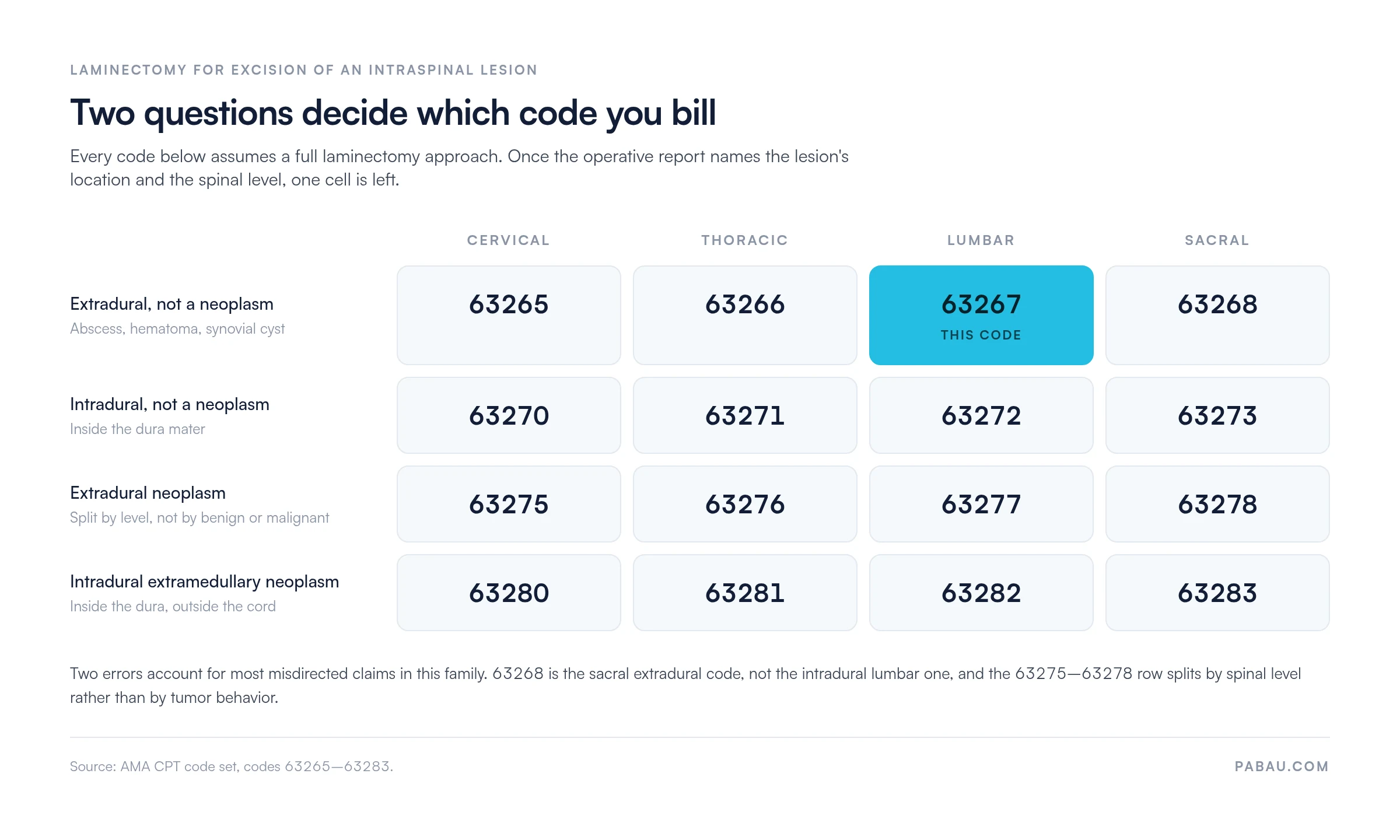
The table below maps the most common clinical scenarios to the correct code family, which cuts down the guesswork that drives misdirected claims.
A payable CPT code 63267 claim depends on the operative report establishing every element of the descriptor before the coder assigns the code. Payers audit these reports at higher rates for complex spine codes, so incomplete documentation is one of the fastest routes to denial.
The operative sequence coders need to verify follows a standard pattern. Per clean claim requirements, every supporting element has to be present before submission.
Most commercial payers also want pre-operative MRI or CT imaging that confirms the extradural lesion. Reference the imaging report when you submit the claim. Catching a missing element at that point costs a few minutes; catching it after the remittance costs an appeal.
The lumbar laminectomy CPT family is dense, and adjacent codes describe procedures that overlap heavily in surgical approach while differing in target or indication. The distinctions below resolve the most common misdirection errors.
The distinction is approach and target. CPT 63030 uses a laminotomy, or partial bone removal, to reach and decompress a herniated disc or a compressed nerve root. CPT code 63267 uses a full laminectomy to excise a discrete non-neoplastic extradural lesion. When the operative report says “laminotomy” or describes disc material as the target, code 63030. When it says “laminectomy” and identifies a distinct extradural mass, code 63267.
CPT 22102 describes partial excision of a posterior vertebral component, so the excised material is bone or a structural vertebral element. CPT code 63267 describes excision of a soft-tissue intraspinal mass in the extradural space. If the report describes removal of a vertebral element or facet rather than a discrete intraspinal lesion, 22102 is correct. If it describes a soft-tissue mass in the epidural space, 63267 applies.
At the same spinal level, no. Where the surgeon performs the laminectomy to reach and excise the lesion, CMS NCCI edits bundle CPT 63047 into 63267 at that level. Coders cannot report it separately.
At a different spinal level the answer changes. If the surgeon performs a distinct laminectomy at a second level purely for decompression, 63047 may be reportable alongside 63267 with modifier -59 or XS. The operative report has to document both levels and the separate indication for the decompression-only laminectomy. Verify the current NCCI edit table through the AAPC Codify CPT lookup before you submit.
Yes, when the surgeon excises lesions at both the thoracic and lumbar levels in the same operative session via separate laminectomies. Each code describes a different anatomical level, so NCCI edits do not inherently bundle them. You may report both with level-distinct modifiers, either -59 or the anatomical modifiers. The operative report must document each level’s laminectomy, lesion identification, and excision separately.
Before you assign any lumbar laminectomy code, find three statements in the operative report: the approach, the lesion location, and the lesion character. All three must appear clearly. If one is missing, query the surgeon before you submit rather than after the denial.
Modifier selection for 63267 follows standard surgical modifier rules. Two of them come up often enough in spine surgery billing to warrant specific guidance, and both carry documentation weight that screening-code modifiers do not.
The 2026 Medicare Physician Fee Schedule assigns CPT code 63267 a total of 39.60 relative value units. That breaks down as 18.96 work RVUs, 13.93 practice expense RVUs, and 6.71 malpractice RVUs. Facility and non-facility totals are identical for this code, so the site of service does not move the allowance.
At the 2026 conversion factors, 39.60 RVUs comes to roughly $1,323 nationally on the $33.4009 factor. Practices paid on the $33.5675 qualifying alternative payment model factor land near $1,329. Geographic practice cost indices then adjust the figure by locality. 63267 also carries a 90-day global period, so the allowance covers post-operative care.
Pull the exact allowed amount for your locality from the CMS Physician Fee Schedule lookup tool. The component RVUs come from the CMS relative value files. Payers negotiate commercial rates for 63267 separately, and those rates usually sit above the Medicare allowance. Reconcile each electronic remittance advice against the contracted rate rather than against the fee schedule.
Coders commonly report one add-on code alongside 63267. Coders also append a second one often enough to be worth ruling out.
Most commercial payers require prior authorization for CPT code 63267 before the procedure. The criteria mirror the documentation requirements above, but payers assess them before the case rather than after it. Payers look for three elements:
Aetna Clinical Policy Bulletin 0743 sets out medical necessity criteria for spinal laminectomy and fusion, including criteria that reach lesion excision cases. Some payers also want a peer-to-peer review call for this code when the record does not show attempted or documented conservative management. Flag any case without a documented failed conservative period as higher denial risk before the request goes out. Payer policies differ, so verify current criteria with each payer before the case date.
The diagnosis code on the claim must confirm a non-neoplastic, extradural, lumbar-region lesion. A neoplasm ICD-10 code paired with 63267 triggers an automatic code mismatch denial, because the descriptor excludes neoplasms. The table below lists the ICD-10-CM codes most commonly used to support 63267 claims, alongside the conditions they represent.
Each diagnosis code has to be billable for the current fiscal year, so confirm validity before submission. Every code in the table above has its own reference page in our ICD-10-CM codes library. Each page sets out the 7th-character rules that decide which encounter code applies.
CPT code 63267 attracts denials across five common categories. Each one has a distinct corrective action, and most carry a specific appeal argument worth making.
In most practices, staff handle a spine claim twice. The coder reads the operative report and picks the code, then someone re-keys the same codes, modifiers, and payer details into a portal. Someone chases status by phone and matches the remittance to the contract by hand weeks later.
Pabau is practice management software with claims management software built in. The operative note, the diagnosis and procedure codes, and the payer record all sit against the same patient. Claims go out online through our Claim.MD integration, and staff verify eligibility before they schedule the surgery. The ERA comes back into the same record after adjudication.
Code selection stays with your coder, where it belongs. What changes is the handling around it. Nobody enters the same claim twice, and nobody phones the payer to learn a claim’s status. CARC denial codes show on the remittance the day it lands, not at the end of the month.

Pabau sends CPT code 63267 claims electronically through Claim.MD and verifies patient eligibility before the case. The ERA lands back in the patient record after adjudication. Fewer manual steps, fewer avoidable denials.

63267 is a high-value surgical code, and almost every denial against it traces to the same three causes. Those are the wrong branch of the code family, ambiguous operative report language, and an NCCI conflict with 63047. The operative report settles all three, not the appeal letter.
So the work that pays is upstream. Agree with your surgeons on wording that names the approach, the lesion location, and the lesion character in every lumbar laminectomy note. The coding question then answers itself. Book a demo to see how Pabau moves a finished 63267 claim to the payer without a second round of data entry.

Need a clearinghouse that handles complex surgical CPT codes? Claim.MD clearinghouse overview explains how electronic submission works for surgical claims including prior auth tracking.
Want to understand denial reason codes on your ERAs? Denial codes in medical billing decodes CARC and RARC codes so your team knows the corrective action before the appeal deadline.
Building a cleaner claim submission process across your practice? Revenue cycle management explained covers the full workflow from eligibility check through payment posting.
CPT code 63267 is the procedure code for laminectomy to excise or evacuate a non-neoplastic extradural intraspinal lesion at the lumbar level. The descriptor comes from the American Medical Association’s CPT code set. It requires a full laminectomy approach, an extradural (epidural space) lesion location, and a lumbar-level procedure. All three conditions must be met simultaneously for the code to apply.
Not at the same spinal level. CMS NCCI edits bundle 63047 (laminectomy for decompression without lesion excision) into 63267 when both are performed at the same vertebral level. At a distinct spinal level, 63047 may be reported alongside CPT code 63267 with modifier -59 or XS. The operative report has to document both levels and a separate clinical indication for each procedure.
Yes. CPT 63266 (thoracic level) and 63267 (lumbar level) describe the same procedure at different spinal levels. When separate laminectomies excise lesions at both levels in the same operative session, both codes may be reported. Each level’s laminectomy approach, lesion identification, and excision must be independently documented. Apply level-distinct modifiers (-59 or XS) and confirm documentation supports both procedures.
No. CPT 63267 is lumbar-level only. Thoracic extradural non-neoplastic lesions use CPT 63266. Cervical extradural non-neoplastic lesions use CPT 63265. Using 63267 for a non-lumbar level is a descriptor mismatch that will be denied on audit. The operative report’s level documentation and the correct level-specific code must align.



