

HCPCS Code L0472: Hyperextension TLSO billing guide
HCPCS code L0472: Official descriptor and device definition HCPCS code L0472 des...

Last Updated: Nov 5, 2026
Billable Code
62370 is the CPT code for electronic analysis of a programmable implanted pump for intrathecal or epidural drug infusion, with reprogramming and refill. It applies when the service requires the skill of a physician or other qualified health care professional.
That skill requirement is what separates it from 62369, which covers the same analysis, reprogramming and refill without needing physician or QHP skill. A visit with reprogramming but no refill is 62368, or 62367 for analysis alone. Accurate billing depends on a chart note that shows who did the work and why it needed that skill.
Let Pabau's smart automation suggest the right codes, reduce claim denials, and keep your practice compliant—effortlessly.
Automate repetitive tasks and focus on what matters most—your patients.
Reduce coding errors and ensure compliance with the latest regulations.
Clean claims, fewer denials, and faster reimbursements.
Powerful insights and reporting to help your practice thrive.
HIPAA compliant SOC 2 certified GDPR-compliant Trusted by 4,000+ clinics worldwide

CPT code 62370 covers analysis, reprogramming and refill of an implanted intrathecal or epidural pump when the service requires physician or QHP skill.
CPT 62369 includes the same refill but applies when the service does not need physician or QHP skill, such as an RN refill.
A visit with no refill is 62368 (analysis and reprogramming) or 62367 (analysis only), and only one of 62367 to 62370 is reported per encounter.
Documentation must record pump settings before and after, drug name, concentration, lot number, both volumes, and why physician or QHP skill was needed.
Billing software such as Pabau checks each pump claim for missing or invalid details before it reaches the payer.
The American Medical Association describes CPT code 62370 as electronic analysis of a programmable implanted pump for intrathecal or epidural infusion, with reprogramming and refill. The analysis includes evaluation of reservoir status, alarm status and drug prescription status. The descriptor ends with a qualifier: the service requires the skill of a physician or other qualified health care professional.
The code is owned by the AMA and sits in the Surgery section of the CPT code set. Within it, 62370 falls in the nervous system range for spinal reservoir and pump services.
Four elements must all be present in the encounter for 62370 to apply. When any one of them is missing, a different code in the family describes the visit.
The drug in the pump is billed separately from the procedure. Office claims report baclofen with J0475 or J0476 and morphine with J2275. Hospital outpatient claims under HOPPS use the applicable C-code. The 62370 line never carries the drug cost, so the drug goes on its own claim line.
A typical intrathecal pump management visit runs 30 to 60 minutes and follows a defined clinical sequence. Knowing the encounter helps coders confirm that documentation captures every billable element before the claim goes out.
Intrathecal baclofen pump programming and morphine infusion for chronic pain represent the two most common clinical contexts for 62370 encounters. Payers require a supported ICD-10 diagnosis that maps to an approved indication in the Medicare contractor’s policy or the commercial payer’s policy. For Noridian’s JE and JF jurisdictions, that is Billing and Coding article A55323 (LCD L33461).
Billing and Coding article A55323, “Implantable Infusion Pumps for Chronic Pain”, is linked to LCD L33461 and published by Noridian for JE and JF. Other Medicare Administrative Contractors (MACs) publish their own. Failure to match the submitted ICD-10 to an LCD-covered indication is one of the most common denial triggers for this code family.
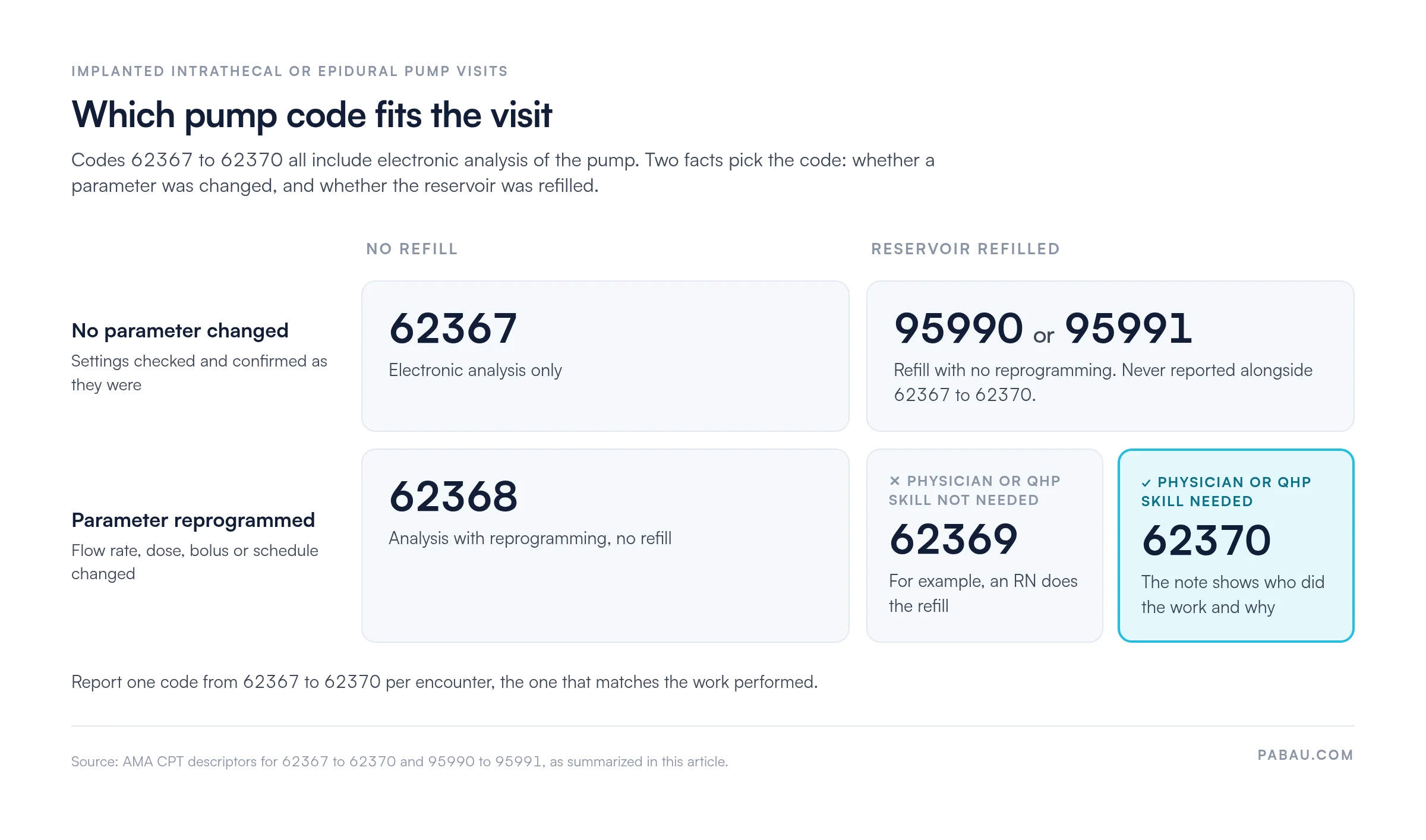
CPT 62369 and 62370 describe the same service: electronic analysis, reprogramming and a reservoir refill. Both codes include the refill. What separates them is whether the service required the skill of a physician or other qualified health care professional.
Report 62370 when it did, and the note shows a physician or QHP doing work that needed that skill. Report 62369 when it did not, for example when an RN or other clinical staff performed the refill. 62369 is a standalone code, not an add-on to any other code.
If the reservoir was not refilled, neither code applies. Report 62368 for analysis with reprogramming, or 62367 for analysis alone. Report only one code from 62367 to 62370 per encounter, the one that matches the work performed. The matrix below maps each combination of work to its code.
62370 belongs to a family of codes covering the full lifecycle of implanted infusion pump management. The pump itself is implanted under 62362, and each later management visit is billed from the analysis codes. The four analysis codes, 62367 to 62370, are mutually exclusive for a single encounter.
Check whether reprogramming changed a parameter. If the device was interrogated and the settings were confirmed without any change or refill, only 62367 is supported. 62368, 62369 and 62370 all need a documented parameter change. A refill with no reprogramming is reported with 95990 or 95991, never alongside 62367 to 62370.
A chart note that supports 62370 billing must show that all four elements occurred and satisfy clean claim requirements before submission. The following elements are required for audit defense and payer compliance.
Auditors most often find the drug lot number or the volumes missing from the note. A superbill documentation checklist built into the visit note catches both at the point of care, before the claim reaches billing review.
The claim must include a supported diagnosis from the ICD-10-CM code set that maps to an approved indication in the payer’s policy. The codes below are common pairings. For Noridian JE/JF claims, check each one against Billing and Coding article A55323 (LCD L33461), since other MACs publish their own lists.
Z96.89 is a supplemental code and should always be paired with a primary clinical diagnosis, not billed alone. MAC-specific policies may expand or restrict this list. Verify it against the current policy for your jurisdiction before submitting.
Medicare pays for 62370 under the Medicare Physician Fee Schedule (MPFS). Use the CMS Physician Fee Schedule lookup tool for current locality-specific rates, which CMS updates each January.
The XXX indicator means the global surgery concept does not apply to 62370. Same-day services follow NCCI edits and the modifier 25 rules instead. These are 2026 CMS values. For locality-adjusted total RVU values and exact dollar amounts, use the FastRVU 2026 RVU lookup tool.
Medicare covers ongoing intrathecal pump management when the original implant met coverage criteria. In Noridian’s JE and JF jurisdictions, the coding rules sit in Billing and Coding article A55323 (LCD L33461), and other MACs publish their own. The patient must also continue to meet the stated clinical indications. Medicare does not typically require prior authorization for the ongoing management visit, as distinct from the implant surgery. Commercial payers frequently do. Confirming insurance eligibility verification and PA status before the appointment prevents same-day denials.
62370 denials cluster around five predictable causes. Each has a specific prevention action that can be built into the pre-claim workflow. Strong denial management workflows fix the step that produced each denial, so the same error stops recurring on the next pump claim.
The National Correct Coding Initiative (NCCI) governs which services can be billed alongside 62370 on the same date of service. Pabau, the practice management platform we build, includes claims management software that scrubs each claim for missing or invalid details before it goes out.
A patient may arrive for a scheduled refill while the physician also addresses a new complaint, such as unrelated shoulder pain. Document that complaint separately, with its own assessment and plan. Only then does modifier 25 on the E&M hold up under audit. A pump management note that incidentally mentions the new complaint is not sufficient documentation to support a separate billable E&M.
For complete and current NCCI edit tables, the AAPC Codify CPT lookup provides NCCI column I/II edit data alongside the code descriptor. Pair this with your clearinghouse’s claim validation to catch edit conflicts before they reach the payer.
Coding errors on pump visits usually start in the chart note. A free-text note rarely says who performed the refill or why it needed a physician, so the coder has to guess between 62369 and 62370.
In Pabau, the pump visit can run on a treatment note template. Its required fields cover the drug, lot number, volumes and who did each step. The coder reads the answer instead of guessing it.
Pabau’s claims management software then scrubs each claim for missing or invalid details before it goes out. In the US, it checks eligibility through Claim.MD before the visit and submits claims to thousands of payers. A rejected pump claim is flagged as needing action, with the reason shown, so your team can correct and resubmit it.
The result is fewer pump claims coded on guesswork, and a record that holds up when a payer asks who did the work.

Pabau scrubs each 62370 claim for missing or invalid details and submits it through Claim.MD to thousands of US payers. Rejected claims come back flagged with the reason, so your team can fix them fast.

Both 62369 and 62370 include a refill. Once the reservoir is filled, the code turns on one fact: whether the visit needed a physician or QHP, as the chart note shows it.
Billing 62370 for every refill, including nurse-run visits, puts each of those claims at audit risk. Defaulting to 62369 when a physician did skilled work under-codes the visit. Both problems share one fix: a pump note that records who did each step and why.
Book a demo to see how Pabau helps pain management and neurosurgery practices document pump visits and bill them correctly.

Need to understand how clearinghouse claim routing works? Medical claims clearinghouse overview explains how EDI claims move from practice to payer and where edits are applied.
Getting denials you can’t identify a pattern for? Denial codes in medical billing maps CARC and RARC codes to their root causes so your team can appeal correctly.
Want to verify 62370 claim status across multiple payers? Electronic remittance advice (ERA) processing covers how 835 ERA files surface payment decisions and denial reasons automatically.
CPT code 62370 covers electronic analysis of a programmable implanted pump for intrathecal or epidural drug infusion, reprogramming of its parameters, and a reservoir refill. It applies when the service requires the skill of a physician or other qualified health care professional. The drug itself is billed separately on its own claim line with the applicable J-code or C-code.
Both codes include electronic analysis, reprogramming and a reservoir refill. CPT 62370 applies when the service requires the skill of a physician or other qualified health care professional. CPT 62369 applies when it does not, for example when an RN or other clinical staff performs it. If no refill was done, report 62368 instead, or 62367 for analysis only.
Yes, Medicare covers CPT code 62370 for ongoing management of an implanted intrathecal infusion pump. In Noridian’s JE and JF jurisdictions, the rules sit in Billing and Coding article A55323 (LCD L33461), and other MACs publish their own. The original implant must have met coverage criteria, and the patient must still meet the stated clinical indications. The claim must include a covered ICD-10 diagnosis. Prior authorization is not typically required for Medicare management visits.
Medicare does not generally require prior authorization for routine 62370 management visits. Most commercial payers, including Aetna and BCBS plans, require prior authorization for the initial pump implant. Whether later management visits need per-visit PA depends on the payer. Verify PA requirements directly with each payer before scheduling, as policies change frequently.
Yes, but only with modifier 25 on the E&M code. The E&M must address a separately identifiable problem beyond the routine pump management visit. The chart note must document the additional problem with its own assessment and plan. Billing an E&M for the pump visit itself alongside 62370 is not permitted and will trigger an NCCI edit denial.
The chart note must include device identification (manufacturer, model, serial number) and the pump settings before and after reprogramming. It must record the drug name, concentration, lot number, expiration date, volume withdrawn and volume injected. It must also name the physician or QHP who did the work, explain why it needed that skill, and carry their signature. Missing lot numbers or volumes are the most common documentation-based denial reasons for this code.



