HCPCS Code Q4175: Billing, coverage, and documentation guide
HCPCS Code Q4175: Code Description and Product Identity HCPCS Code Q4175 is the ...

Last Updated: Nov 20, 2026
S0093 is the HCPCS Level II code for an injection of morphine sulfate, 500 mg, given as the loading dose for an infusion pump. One unit equals 500 mg of morphine loaded into the pump reservoir, usually for intrathecal or epidural pain therapy.
As a temporary national S-code, S0093 is valid for commercial and Medicaid payers that accept it, but Medicare fee-for-service does not pay it. For Medicare patients, practices bill the morphine under J2274 or J2270 per 10 mg instead. Clean claims depend on accurate units, the 11-digit NDC, wastage reporting, and an active prior authorization for pump therapy.
Let Pabau's smart automation suggest the right codes, reduce claim denials, and keep your practice compliant—effortlessly.
Automate repetitive tasks and focus on what matters most—your patients.
Reduce coding errors and ensure compliance with the latest regulations.
Clean claims, fewer denials, and faster reimbursements.
Powerful insights and reporting to help your practice thrive.
HIPAA compliant SOC 2 certified GDPR-compliant Trusted by 4,000+ clinics worldwide

S0093 reports a 500 mg morphine sulfate loading dose for an infusion pump, billed as one unit per 500 mg loaded.
It is a temporary national S-code for commercial and Medicaid payers, and Medicare fee-for-service does not pay it.
For Medicare, crosswalk to J2274 (preservative-free intrathecal or epidural morphine, per 10 mg) or J2270 (morphine, up to 10 mg).
Pump claims hold up when the chart records concentration, volume, total milligrams, route, pump type, NDC and any discarded drug.
HCPCS Code S0093 describes an injection of morphine sulfate, 500 mg, given as the loading dose for an infusion pump.
The CMS HCPCS quarterly update file lists it in the “S” range of temporary national codes for non-Medicare payers.
S-codes were created at the request of private insurers and now sit in the national HCPCS Level II set that CMS publishes. According to the CMS HCPCS overview, Level II codes cover drugs, supplies and services outside CPT. Each payer decides whether to accept an S-code, and Medicare fee-for-service does not pay S0093.
S0093 covers the morphine sulfate drug itself when a practice loads it into an infusion pump reservoir. The typical setting is an implanted intrathecal pump for chronic or cancer pain, or an epidural infusion system. The loading dose is the drug that fills the reservoir at the start of therapy or at a refill.
One unit equals 500 mg of morphine sulfate. A practice that loads 1,000 mg reports 2 units. A 20 mL container at 25 mg/mL holds exactly 500 mg, so it maps to one unit. Its sibling code, S0092, reports a hydromorphone loading dose in 250 mg units.
Within scope: Morphine sulfate in 500 mg increments, loaded into an infusion pump, with a documented pain diagnosis that supports pump therapy.
Excluded from S0093:
Confirm the drug, the concentration and the total milligrams in the clinical record before you code the claim line.
Every S0093 claim needs chart documentation that ties the morphine load to a covered pain diagnosis from the ICD-10-CM diagnosis codes. It also has to prove the quantity loaded and record what payers audit on post-payment review.
Required chart elements for medical billing compliance include:
Payers expect the National Drug Code on professional drug claims in 11-digit format with the N4 qualifier. Packaging often prints the NDC in 10-digit format, so coders must add a leading zero to the right segment first.
Report the NDC unit of measure and quantity as well, such as ML 20 for one 20 mL container. The HCPCS units and the NDC quantity measure different things, so neither one replaces the other.
Check that the HCPCS units and the NDC quantity describe the same load before you submit. A 1,000 mg morphine load is 2 units of S0093, but 100 units of J2274 on the Medicare crosswalk claim. Mixing the two unit bases is the fastest route to an overpayment audit.
Preservative-free morphine for pump use usually comes in single-dose containers. When part of a container is discarded, Medicare requires modifier JW on a separate line for the wasted amount. When nothing is discarded, Medicare requires modifier JZ instead.
Those rules apply to the crosswalked J-code on a Medicare claim. Commercial and Medicaid payers set their own wastage rules for S0093, so check the provider manual before you add either modifier.
Coverage for S0093 depends on payer class. CMS assigns the code coverage status I, so Medicare fee-for-service will not pay it.
Running insurance eligibility verification before the pump fill confirms active coverage. It also shows whether the plan covers intrathecal or epidural drug therapy.
For Medicare patients, bill the morphine under a J-code that the CMS HCPCS file lists as active. For a pump load of preservative-free morphine, that is usually J2274: Injection, morphine sulfate, preservative-free for epidural or intrathecal use, 10 mg.
A 500 mg load equals 50 units of J2274. J2270 covers standard morphine, up to 10 mg, that is not the preservative-free intrathecal product. Do not use J2271 (morphine sulfate, 100 mg), which CMS terminated on December 31, 2014.
The panel below lays out the code and the unit math for each payer class, using the same 500 mg pump load.
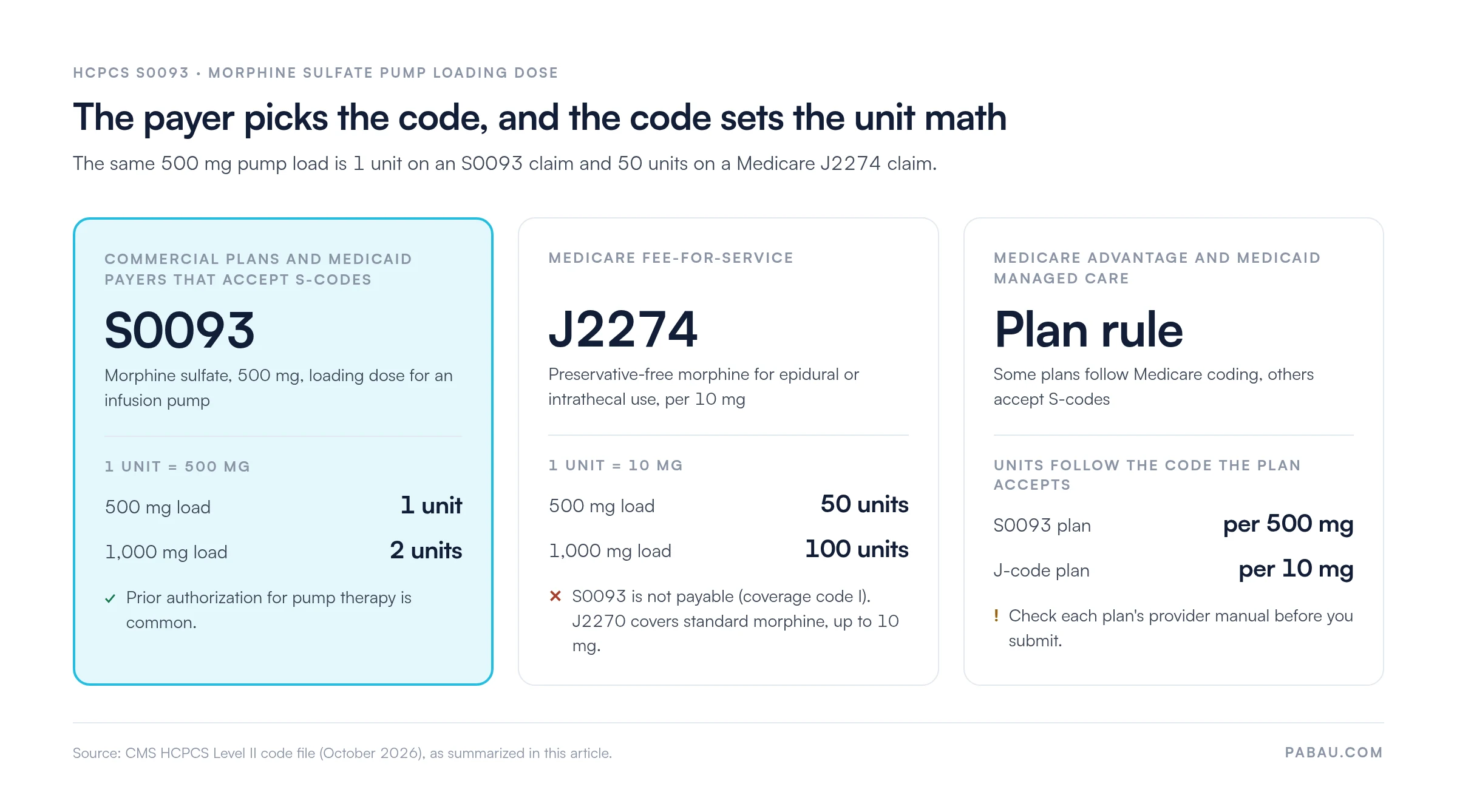
An S0093 line sent to Medicare fee-for-service is denied as a code Medicare does not pay. The fix is a corrected claim with the right J-code and units, not a medical necessity appeal.
Many payers require prior authorization for intrathecal or epidural pump therapy. Approval usually covers the pump and the drug together, so the morphine load needs an active authorization too.
Medicare’s National Coverage Determination for infusion pumps (NCD 280.14) sets the model many plans follow. It covers implanted pumps for intrathecal morphine when other pain treatments have failed and a preliminary trial has worked. Clinical information a PA request typically needs includes:
A claim sent without a required authorization number typically returns CARC 197 (precertification or authorization absent). Many plans refuse retroactive approval, so verify the authorization before the pump is loaded.
Several HCPCS codes describe morphine, other pump drugs, or pump services. Each code below was checked against the October 2026 CMS HCPCS file.
Pump refill and reprogramming services take their own CPT codes, such as 62369 and 62370 for analysis with reprogramming and refill. Cross-check descriptors in the AAPC Codify HCPCS lookup before submission.
Because S0093 is a non-Medicare S-code, CMS publishes no ASP-based payment rate for it. Each accepting payer sets the rate at plan or contract level, so it varies by state and network.
To verify current reimbursement:
For Medicare patients, the crosswalked J2274 or J2270 line is paid from the quarterly ASP pricing file. The CMS Physician Fee Schedule lookup covers the CPT refill and reprogramming services billed alongside it.
Denials on S0093 follow a predictable pattern, and each one has a clear correction path. Systematic denial management workflows cut rework by fixing root causes rather than individual claims.
Avoid modifiers the payer does not ask for. An unrequested modifier on a drug line often triggers manual review and slows payment.
Pain management practices that run pump refill clinics meet the same errors every cycle: missed NDCs, unit slips between S0093 and J2274, and lapsed authorizations. Pabau, a practice management platform with built-in claims management software, keeps the case, its authorization and the claim in one system.
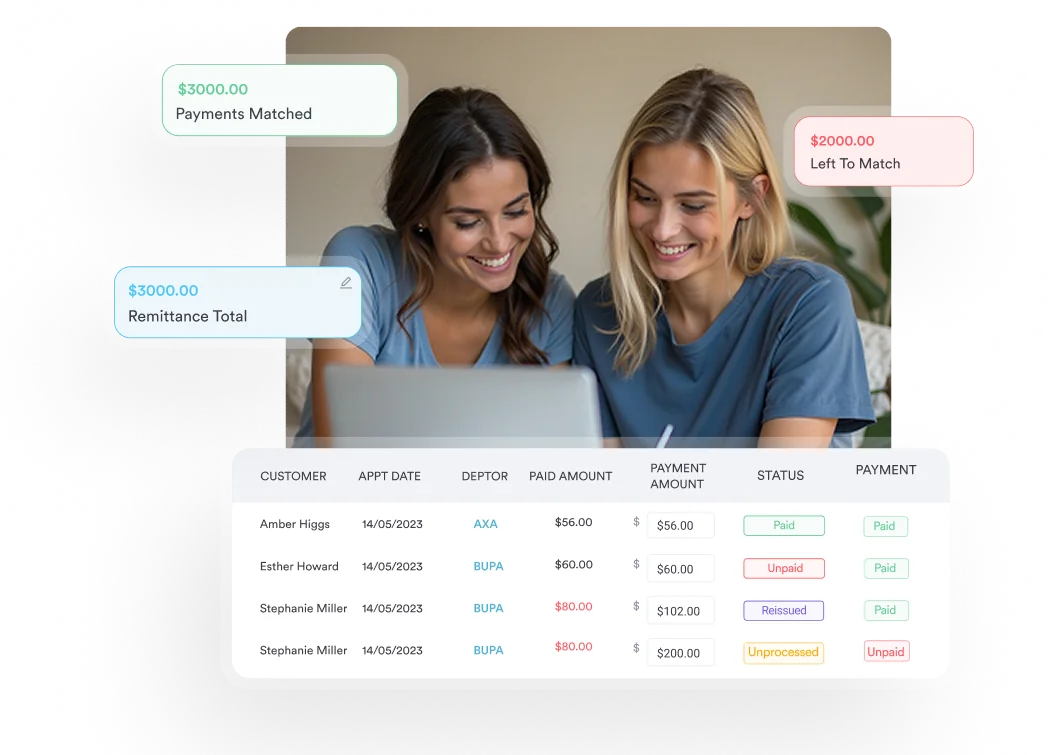
Here is how a practice records and reviews a pump drug claim in Pabau:
Pairing clean claim submission principles with that review keeps pump claims out of the same denial loop every cycle.

Pabau tracks pump therapy authorizations on the case and sends CMS-1500 claims through Claim.MD. Your billing team reviews NDCs, units and codes in one place before each S0093 claim goes out.

S0093 is a narrow code with a clear job: the morphine that fills an infusion pump, billed per 500 mg to payers that accept S-codes. Most denials come from sending it to Medicare, mixing up unit bases, or loading a pump without an active authorization.
Practices that build NDC capture, unit checks and payer-specific code rules into their workflow stop fixing the same claims every refill cycle. To see how Pabau handles pump drug claims from visit to remittance, book a demo.

Need a foundation in HCPCS billing concepts? Medical billing fundamentals covers how payer classes, code sets, and claim submission interact.
Dealing with recurring claim denials? Denial management in healthcare breaks down root-cause analysis and appeal workflows for common CARC codes.
Want to verify coverage before each pump refill? Insurance eligibility verification explains real-time eligibility checks and how to build them into your workflow.
HCPCS Code S0093 describes an injection of morphine sulfate, 500 mg, given as the loading dose for an infusion pump. One unit equals 500 mg loaded into the pump reservoir. Commercial and Medicaid payers that accept S-codes use it for intrathecal or epidural pump therapy.
No. CMS gives S0093 coverage code I, which means Medicare does not pay it. For Medicare patients, bill the morphine under J2274 for the preservative-free intrathecal product, or J2270 for standard morphine. Both are billed per 10 mg, so a 500 mg load is 50 units.
Bill one unit for every 500 mg of morphine sulfate loaded into the pump. A 1,000 mg load is 2 units. Where the load is not a multiple of 500 mg, follow the payer’s rounding rule and document any discarded drug.
Medicare requires JW for discarded drug from a single-dose container and JZ when none is discarded, on the crosswalked J-code. Commercial and Medicaid payers set their own wastage rules for S0093, so check the provider manual.
Many payers require prior authorization for intrathecal or epidural pump therapy, including the drug used to fill the pump. Requests usually need the pain diagnosis, failed prior treatments, and a successful screening trial. A missing authorization typically returns CARC 197.