CPT code 48152: Whipple procedure without pancreatojejunostomy
CPT code 48152: Official description and procedure overview CPT code 48152 descr...

Last Updated: Nov 13, 2026
S0092 is the HCPCS Level II code for injection, hydromorphone hydrochloride, 250 mg (loading dose for infusion pump). It reports the opioid used to load a pain pump, and each unit equals 250 mg.
S0092 is a temporary national S-code for non-Medicare payers, so Medicare does not pay it. Commercial plans and some Medicaid programs set their own coverage, authorization and unit rules for it.
Let Pabau's smart automation suggest the right codes, reduce claim denials, and keep your practice compliant—effortlessly.
Automate repetitive tasks and focus on what matters most—your patients.
Reduce coding errors and ensure compliance with the latest regulations.
Clean claims, fewer denials, and faster reimbursements.
Powerful insights and reporting to help your practice thrive.
HIPAA compliant SOC 2 certified GDPR-compliant Trusted by 4,000+ clinics worldwide

S0092 reports an injection of hydromorphone hydrochloride, 250 mg, given as the loading dose for an infusion pump. One unit equals 250 mg.
S0092 is a temporary non-Medicare S-code with CMS coverage indicator I, so Medicare does not pay it. Medicare reports hydromorphone with J1171 instead.
Pair S0092 with the pain diagnosis behind the pump, such as G89.3 or G89.4, and add Z45.1 when the visit is for pump management.
Most S0092 denials trace back to a missing authorization, wrong units, a missing NDC or a diagnosis that does not support opioid pump therapy.
HCPCS code S0092 is the code for “Injection, hydromorphone hydrochloride, 250 mg (loading dose for infusion pump)”. The code is listed, with that exact descriptor, in the CMS quarterly HCPCS file. It reports the opioid dose used to fill and start an infusion pump for pain control. One unit of S0092 equals 250 mg of hydromorphone.
S0092 sits in the S-series of HCPCS codes, the temporary national codes that CMS maintains for non-Medicare payers. CMS assigns it coverage indicator I, meaning Medicare does not pay it. Commercial insurers, managed care plans and some state Medicaid programs set their own rules for it. Oral drugs in the same series follow those rules too, such as S-code S0090 for sildenafil citrate.
S0092 covers the drug only: hydromorphone hydrochloride given as the loading dose for an infusion pump. Hydromorphone is a Schedule II opioid. Practices use pumps to deliver it for cancer pain, chronic pain syndromes and palliative care.
Typically reported with S0092:
Not included and billed separately:
Do not confuse S0092 with S0592. S0592 is the comprehensive contact lens evaluation code and has no link to drug billing.
A clean S0092 claim starts with a note that shows why this patient needed an opioid pump loading dose on this date. Meeting medical billing compliance requirements for a controlled drug means recording the dose, the device and the clinical reason together.
S0092 claims need an ICD-10-CM code that supports opioid pump therapy. The codes below, all valid in the 2026 ICD-10-CM code set, are the ones most often seen on pain pump drug claims. Confirm each one against the patient’s record and the payer’s policy.
List the condition first and the encounter or status code after it. When cancer drives the pain, payers usually also expect the cancer code itself, such as C79.51 for a secondary bone malignancy. For long-standing pain with no cancer behind it, G89.4 is a common primary code.
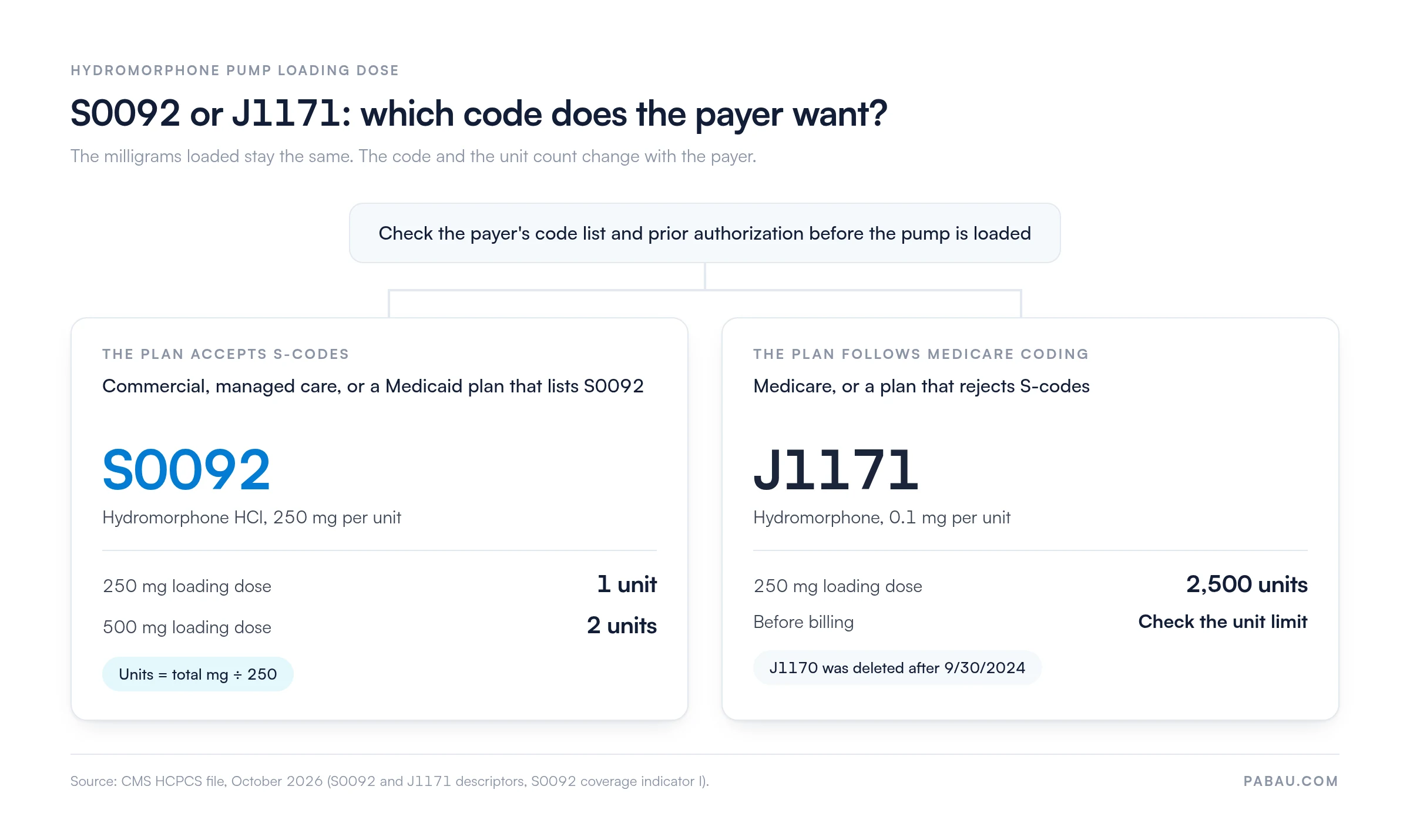
Medicare does not pay S0092. CMS gives it coverage indicator I, which tells Medicare billers to use another code. Insurance eligibility verification before the pump is loaded is the fastest way to learn whether the plan pays S0092 or wants a different code.
Where a plan rejects S0092, the same 250 mg loading dose is usually rebilled as J1171. At 0.1 mg per unit, that is 2,500 units of J1171. Check the payer’s unit limit before billing, because the two codes count the same dose very differently.
Most commercial plans require prior authorization for an opioid pump loading dose. Rules differ by plan, so check the payer portal before the appointment rather than after the dose is given.
S0092 rarely travels alone. The codes below cover the device, the refill service and the Medicare alternative.
Most S0092 denials repeat the same few patterns. Denial management workflows should map each claim adjustment reason code (CARC) to a cause and a fix before the appeal deadline.
A denied S0092 claim can often be recovered. Most commercial payers allow at least one internal appeal before external review.
Most S0092 billing errors come from unit math and missing drug identifiers. Claims management software that checks units and required fields before submission catches these errors before the payer does.
Before every pump loading appointment, check the authorization for the code the plan wants (S0092 or J1171). Confirm the approved milligrams and the date range too. A loading dose given outside any of them is the most common reason a clean-looking claim still denies.
S0092 has no Medicare fee schedule rate. CMS publishes no allowed amount for it, so every payment comes from the payer contract or the state Medicaid fee schedule.
To find the rate, check the fee schedule attached to your payer contract, the payer’s provider portal or provider relations. Rates usually differ between HMO, PPO and Medicaid managed care plans, even within one insurer.
Track paid S0092 claims against the contract rate. A payment below contract is a contract compliance issue, so raise it with provider relations rather than filing a coding appeal. The AAPC HCPCS code lookup and the PGM Billing HCPCS lookup tool help confirm descriptors. The CMS HCPCS overview explains how the code set is updated each quarter.
Pain management teams billing S0092 often track authorizations in a spreadsheet, check eligibility by phone and log drug lots on paper. Each handoff is a place where units, dates or the authorization number go missing.
In Pabau, the practice management platform we build, those steps stay on the patient record. The authorization code, its dates and sessions sit on the case, and Pabau warns the team when one is missing. Batch numbers and expiry dates are recorded against the patient and the appointment.
US practices send CMS-1500 and 837P claims through Claim.MD from Pabau’s claims screen, with eligibility checks before the visit. ERA remittances come back to the same screen, so a CO-197 or CO-16 denial is fixed and resubmitted quickly. The outcome is a clean claim on the first submission.

Pabau tracks the authorization on the case, checks eligibility before the visit and sends S0092 claims through Claim.MD. Your team sees denials and remittances next to the original claim.

S0092 gets paid when the payer accepts the S-code, the authorization covers the milligrams given and the diagnosis justifies pump therapy. Confirm all three before the pump is loaded.
When a plan follows Medicare coding, switch to J1171 rather than fighting the denial. Book a demo to see how Pabau keeps authorizations, drug lots and claims for pain pump therapy in one place.

Need a denial workflow your billing team can follow consistently? Denial codes in medical billing explains the most common CARC codes and the corrective steps for each one.
Confused about how HCPCS fits into the broader billing picture? What is revenue cycle management walks through the full claim lifecycle from eligibility check to payment posting.
Billing both HCPCS codes and standard CPT services for the same patient? The superbill guide covers how to structure charge capture so HCPCS and CPT codes appear on the correct claim lines.
HCPCS code S0092 covers an injection of hydromorphone hydrochloride, 250 mg, given as the loading dose for an infusion pump. Each unit equals 250 mg. The code covers the drug only, so the pump refill service and supplies are billed separately.
No. S0092 is a temporary non-Medicare S-code with CMS coverage indicator I, so Medicare does not pay it. Medicare claims report hydromorphone with J1171, hydromorphone 0.1 mg per unit.
Divide the total milligrams of hydromorphone loaded by 250. A 250 mg loading dose is one unit and a 500 mg loading dose is two units. The units must match the dose in the clinical record.
Both codes report an opioid loading dose for an infusion pump. S0092 is hydromorphone hydrochloride, 250 mg per unit. S0093 is morphine sulfate, 500 mg per unit.
Most commercial plans require prior authorization for opioid pump therapy, including the S0092 loading dose. Submit the pain diagnosis, prior treatments, planned dose and units, then enter the authorization number in Box 23 of the CMS-1500.
No. S0592 is the comprehensive contact lens evaluation code. S0092 is a hydromorphone loading dose for an infusion pump, and the two codes have no clinical or billing link.