

HCPCS code E0198: Water pressure pad billing guide
HCPCS code E0198 is a water pad for a standard mattress HCPCS code E0198 is the ...

Last Updated: Oct 13, 2026
62322 is the CPT code for an interlaminar epidural or subarachnoid injection, lumbar or sacral (caudal), without imaging guidance. It covers diagnostic or therapeutic substances such as an anesthetic, antispasmodic, opioid, steroid or other solution, not including neurolytic substances. Needle or catheter placement is included.
It is a widely used interlaminar epidural code, and it sits in a tightly related family where the wrong pick (62323, 64483) triggers a denial. Imaging guidance and approach decide the code, so the procedure note has to state both.
Let Pabau's smart automation suggest the right codes, reduce claim denials, and keep your practice compliant—effortlessly.
Automate repetitive tasks and focus on what matters most—your patients.
Reduce coding errors and ensure compliance with the latest regulations.
Clean claims, fewer denials, and faster reimbursements.
Powerful insights and reporting to help your practice thrive.
HIPAA compliant SOC 2 certified GDPR-compliant Trusted by 4,000+ clinics worldwide

CPT Code 62322 covers a lumbar or sacral interlaminar epidural injection without imaging guidance. Cervical, transforaminal and image-guided injections take other codes.
Using imaging guidance switches the correct code to 62323, the paired with-guidance code. You can’t bill 62322 plus a separate imaging add-on.
A procedure note that leaves out the spinal level or the approach is a common denial trigger for this code family.
Medicare pays about $146 for 62322 in a non-facility setting in 2026. Verify your local rate with the CMS Physician Fee Schedule lookup before billing.
Pabau, the practice management platform we build, submits and tracks 62322 claims through its Claim.MD clearinghouse integration.
CPT Code 62322 is the AMA’s designated code for a lumbar or sacral interlaminar epidural injection without imaging guidance. The substance can be an anesthetic, antispasmodic, opioid, steroid or other solution, and the code applies whether the intent is diagnostic or therapeutic.
Three clinical parameters define eligibility for this code:
Read those three facts off the note in that order, and the code follows from them, as the grid below shows.
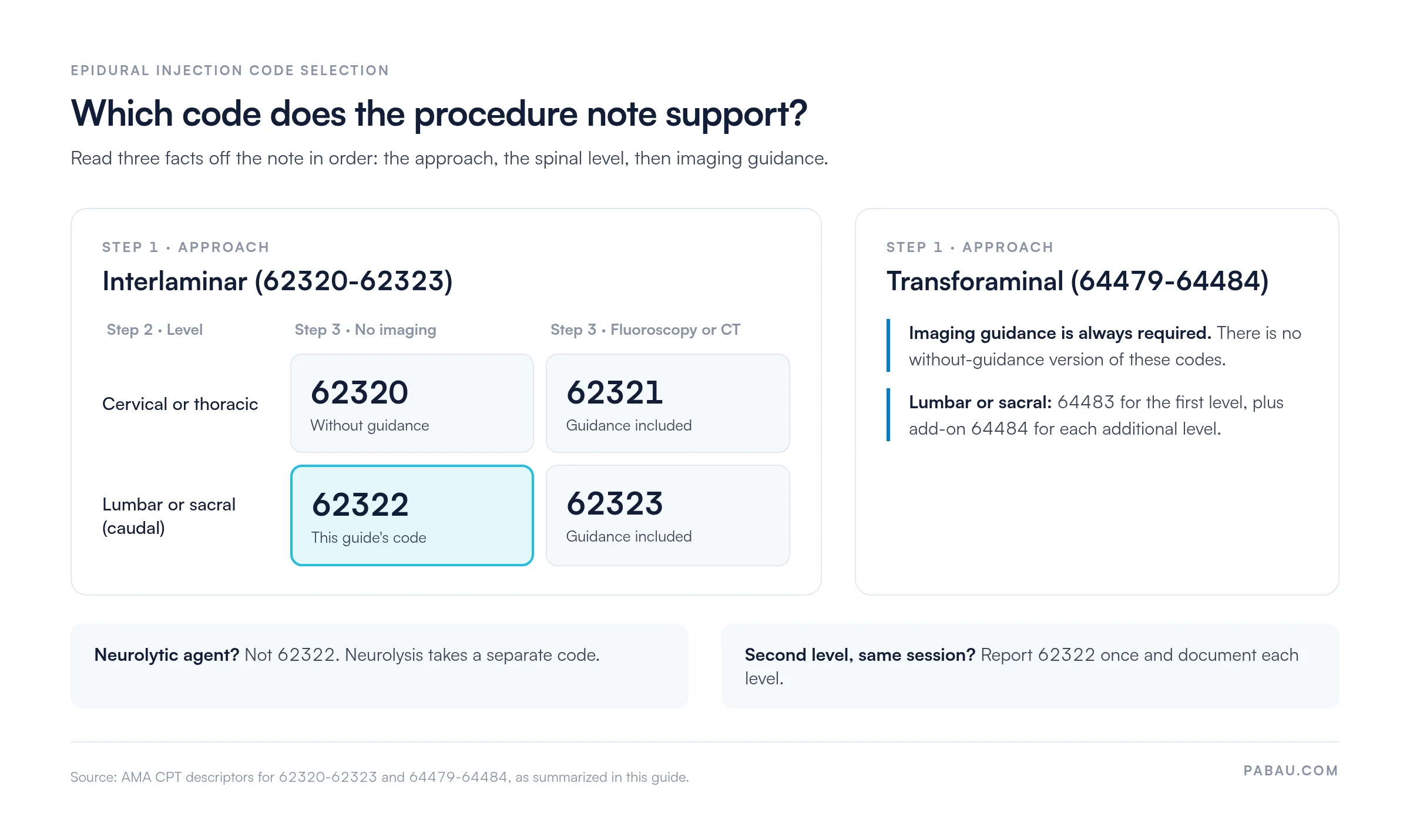
The injectate may be a corticosteroid, a local anesthetic, saline, or a combination. What it may not be is a neurolytic agent. Neurolysis requires a separate code and cannot be billed under 62322. Correct billing for this code family starts with recording those three parameters in the procedure note.
The code covers a specific, bounded set of clinical scenarios. Anything outside those boundaries requires a different code.
A common billing mistake is appending a separate fluoroscopy code alongside 62322. Payers treat imaging guidance as bundled into 62323. Billing 62322 plus a fluoroscopy code will trigger a bundling edit, not two payments.
CPT 62322 and 62323 describe the same interlaminar lumbar or sacral epidural injection. The only clinical difference is whether imaging guidance was used during the procedure.
The procedure note is the deciding document. If the note says fluoroscopy was used to confirm needle placement, 62322 cannot be billed. The note must be explicit about the absence of imaging when 62322 is the intended code.
The most consequential coding confusion in lumbar epidural billing is selecting between the interlaminar and transforaminal code families. Approach technique determines the code, not injectate, indication, or level alone.
Because 64483 always requires imaging guidance, there is no transforaminal counterpart to 62322. A practice billing 64483 without documentation of fluoroscopy or CT guidance will face immediate denial.
CPT Code 62322 belongs to a four-code interlaminar epidural family organized by spinal level and imaging status. Coders selecting the correct code from this family need to know both variables before reaching for the code book.
For the transforaminal family (64479-64484), every code requires imaging guidance, and add-on codes cover additional levels. CPT Code 62322 has no add-on code and is reported once per session, however many levels are injected (its MUE is 1). If a second level is injected, report 62322 once and document each level in the note.
Payers require a paired ICD-10-CM diagnosis code that establishes medical necessity. The table below lists the codes most frequently submitted with CPT Code 62322. Note that specific payer Local Coverage Determinations (LCDs) issued by Medicare Administrative Contractors may define additional or more restrictive criteria for which diagnoses qualify.
Many payers require documentation that conservative treatment failed (typically 6 weeks of physical therapy or analgesics) before approving an epidural injection. Verify current LCD criteria through the relevant Medicare Administrative Contractor for the practice’s state, as criteria differ across regions.
Check the MAC’s epidural steroid injection LCD before scheduling a Medicare patient. These LCDs generally require imaging guidance for steroid injections, so coverage for a non-imaged 62322 with steroid is often limited or non-covered. The same caution applies to 62320.
Prior authorization (PA) requirements for CPT Code 62322 vary significantly by payer type. Insurance eligibility verification before scheduling shows whether the plan needs an authorization while there is still time to request one.
PA requirements change annually. Verify authorization status directly with each payer before scheduling the procedure. Document the authorization number in the patient record and include it on the claim form where required.
A clean claim submission for CPT Code 62322 depends entirely on what the procedure note records. Missing a single element is enough for a payer to deny or downcode the claim.
A frequent documentation failure is leaving out the statement that imaging guidance was not used. Without it, a coder reviewing the note later cannot confidently select 62322. The claim then sits in a work queue, or goes out as 62323 for imaging the physician never performed.
Medicare pays for CPT Code 62322 under the Medicare Physician Fee Schedule (MPFS), which is updated annually on January 1. Rates differ by setting and geographic location.
The non-facility figure is 4.36 total RVUs multiplied by the CY2026 conversion factor, which gives about $146 at either the $33.4009 or $33.5675 rate. These figures are national averages.
Geographic Adjustment Factors (GAFs) applied by each Medicare Administrative Contractor shift rates up or down, sometimes significantly in high-cost urban markets. Always verify current rates using the FastRVU 2026 RVU lookup or the CMS fee schedule search tool before building a reimbursement model.
Commercial payers set their own fee schedules, typically expressed as a percentage of MPFS. Rates often run between 110% and 160% of Medicare for in-network spine procedures, though this varies considerably by contract.
Tracking electronic remittance processing for 62322 claims shows billing staff when a payer is consistently paying below contracted rates. It also gives them the documentation to start a contract dispute.
Denial patterns for CPT Code 62322 cluster around the same root causes across payers. Structured denial management workflows catch most of these before the claim age-out period expires.
These pre-submission checks address the denial causes above before the claim leaves the practice. Build them into the procedure note template, so the clinician records each element at the time instead of a coder chasing it the next day.

Run a monthly audit of 62322 claim denials sorted by CARC (Claim Adjustment Reason Code). If CARC 97 (bundling) or CARC 4 (service inconsistent with modifier) appear together, a coder is regularly adding a fluoroscopy code alongside 62322. One targeted training session closes this recurring revenue leak.
Review the medical claims clearinghouse submission process alongside the documentation requirements above. A clearinghouse that checks claims against CPT edit logic catches bundling errors and missing modifiers before the claim reaches the payer. That cuts the rework of correcting and resubmitting claims.
In many pain practices, 62322 billing happens after the procedure. A coder reads the note, rekeys the claim into a clearinghouse portal, then checks payer websites for status and remittances.
Pabau, the practice management and EHR platform we build, keeps the procedure note, the diagnosis and the claim on one patient record. Its pain practice claims software submits claims through the Claim.MD clearinghouse integration to thousands of US payers, then tracks their status.
Staff run real-time eligibility checks before the injection and post ERA remittances when payment lands. A procedure note template with prompts for level, approach and imaging status helps the clinician record the facts that decide the code.

Pabau submits and tracks 62322 claims through its Claim.MD clearinghouse integration, with real-time eligibility checks and ERA posting in the same system.

CPT Code 62322 is straightforward once the note locks three facts: lumbar or sacral level, interlaminar approach, and no imaging guidance. Coding errors come from notes that leave one of those open, and from habit in teams that bill transforaminal codes more often.
Before your next non-imaged lumbar injection, check two points. Does the note state each fact in plain words? And does the patient’s MAC LCD cover a non-imaged steroid injection at all? If either answer is no, fix it before the procedure date, or confirm whether image-guided 62323 is the covered option.
To see how Pabau submits and tracks these claims through Claim.MD, book a demo.

Want to understand how clearinghouse claim validation works? Medical claims clearinghouse covers how claims move from practice to payer and where edits catch coding errors before adjudication.
Looking for denial pattern analysis by CARC code? Denial codes in medical billing maps the most common CARC and RARC codes and explains how to respond to each.
Need a primer on the full billing cycle from claim to payment? Revenue cycle management walks through every stage from eligibility check through ERA posting.
Billing a transforaminal injection instead? CPT code 64483 covers the lumbar or sacral transforaminal epidural with imaging guidance.
Injecting at the cervical or thoracic level? CPT code 62321 explains the image-guided interlaminar code for the upper spine.
CPT Code 62322 is the procedure code for a lumbar or sacral interlaminar epidural injection performed without imaging guidance. It covers corticosteroid, anesthetic, opioid, saline or other non-neurolytic solution injectates. It excludes neurolytic agents and any case where fluoroscopy or CT guidance was used.
No. CPT 62322 is specifically the without-imaging-guidance version of the interlaminar lumbar or sacral epidural injection. If the physician uses fluoroscopy or CT guidance to confirm needle placement, the correct code is 62323. Billing 62322 and then appending a fluoroscopy code is an unbundling error and will be denied.
Medicare pays about $146 in a non-facility (office) setting and approximately $68-$78 in a facility setting under the 2026 MPFS. Rates vary by location through GAF adjustments. MPFS rates update every January 1, so check the CMS Physician Fee Schedule search tool before building reimbursement projections.
The usual cause is picking 62323 or 64483 instead of 62322, or a note missing the spinal level or approach. Claims also fail without prior authorization from a Medicare Advantage or commercial payer. Other causes are an ICD-10 code outside the payer’s LCD criteria, and a fluoroscopy code billed alongside 62322 instead of using 62323.



