

HCPCS Code L0472: Hyperextension TLSO billing guide
HCPCS code L0472: Official descriptor and device definition HCPCS code L0472 des...

Last Updated: Nov 5, 2026
61635 is the CPT code for transcatheter placement of intravascular stent(s), intracranial (eg, atherosclerotic stenosis), including balloon angioplasty, if performed.
Denials commonly trace to three causes. On Medicare claims, the first is missing Category B IDE billing elements, and the second is an incorrect ICD-10 pairing. The third is confusion with 61630, the adjacent angioplasty-only code.
Let Pabau's smart automation suggest the right codes, reduce claim denials, and keep your practice compliant—effortlessly.
Automate repetitive tasks and focus on what matters most—your patients.
Reduce coding errors and ensure compliance with the latest regulations.
Clean claims, fewer denials, and faster reimbursements.
Powerful insights and reporting to help your practice thrive.
HIPAA compliant SOC 2 certified GDPR-compliant Trusted by 4,000+ clinics worldwide

CPT code 61635 describes transcatheter intracranial stent placement, including angioplasty if performed. Angioplasty without a stent (61630) is not separately billable on the same vessel and date.
Medicare covers 61635 under NCD 20.7 only within FDA-approved Category B IDE trial protocols, for cerebral artery stenosis of 50% or more from intracranial atherosclerosis. All other indications are non-covered.
Common denial triggers include missing Category B IDE claim elements, an ICD-10 mismatch, and a non-facility place of service on a hospital-only procedure.
In the CY2026 Medicare fee schedule, 61635 carries 40.61 total facility RVUs and a global period of XXX, so no post-operative window applies.
Pabau’s claims management software pre-fills claims from existing record data, submits them through Claim.MD and tracks their status.
In the AMA’s CPT code set, CPT code 61635 describes: Transcatheter placement of intravascular stent(s), intracranial (eg, atherosclerotic stenosis), including balloon angioplasty, if performed. The key word is “intracranial.” The code applies only to stent placement within cerebral vessels, such as the middle cerebral, basilar or intracranial carotid artery.
Stenting outside the skull uses other code families. Cervical carotid stenting is reported with 37215 or 37216, and intrathoracic common carotid or innominate stenting with 37217 or 37218. Extracranial vertebral artery stenting is excluded from 37236 and has its own Category III codes, 0075T and 0076T.
The parenthetical “eg, atherosclerotic stenosis” names intracranial atherosclerotic stenosis as the typical indication, but the descriptor does not limit the code to it. The phrase “including balloon angioplasty, if performed” bundles pre-dilation angioplasty into 61635. It is not separately billable on the same vessel.
CPT code 61635 is an all-inclusive code for the intracranial stenting encounter. Coders can overbill by reporting companion codes that are already bundled, or underbill by missing services that are separately reportable. The table below draws the line.
An audit-ready operative report for 61635 covers five elements. A claim that passes payer adjudication today can still fail a post-payment audit if the documentation is incomplete. Solid medical billing compliance depends on thorough op-note structure for high-value neurovascular codes.
If pre-dilation angioplasty was performed before stent deployment, the op note should describe it. Do not bill 61630 separately, because the descriptor’s “including balloon angioplasty, if performed” language already accounts for it.
CPT code 61635 sits in a group of endovascular codes that share anatomical territory but serve different clinical scenarios. Selecting the wrong code is a common denial cause, alongside missing Category B IDE billing elements on Medicare claims. The chart below sorts each neighboring code by where the work happened and what was done.
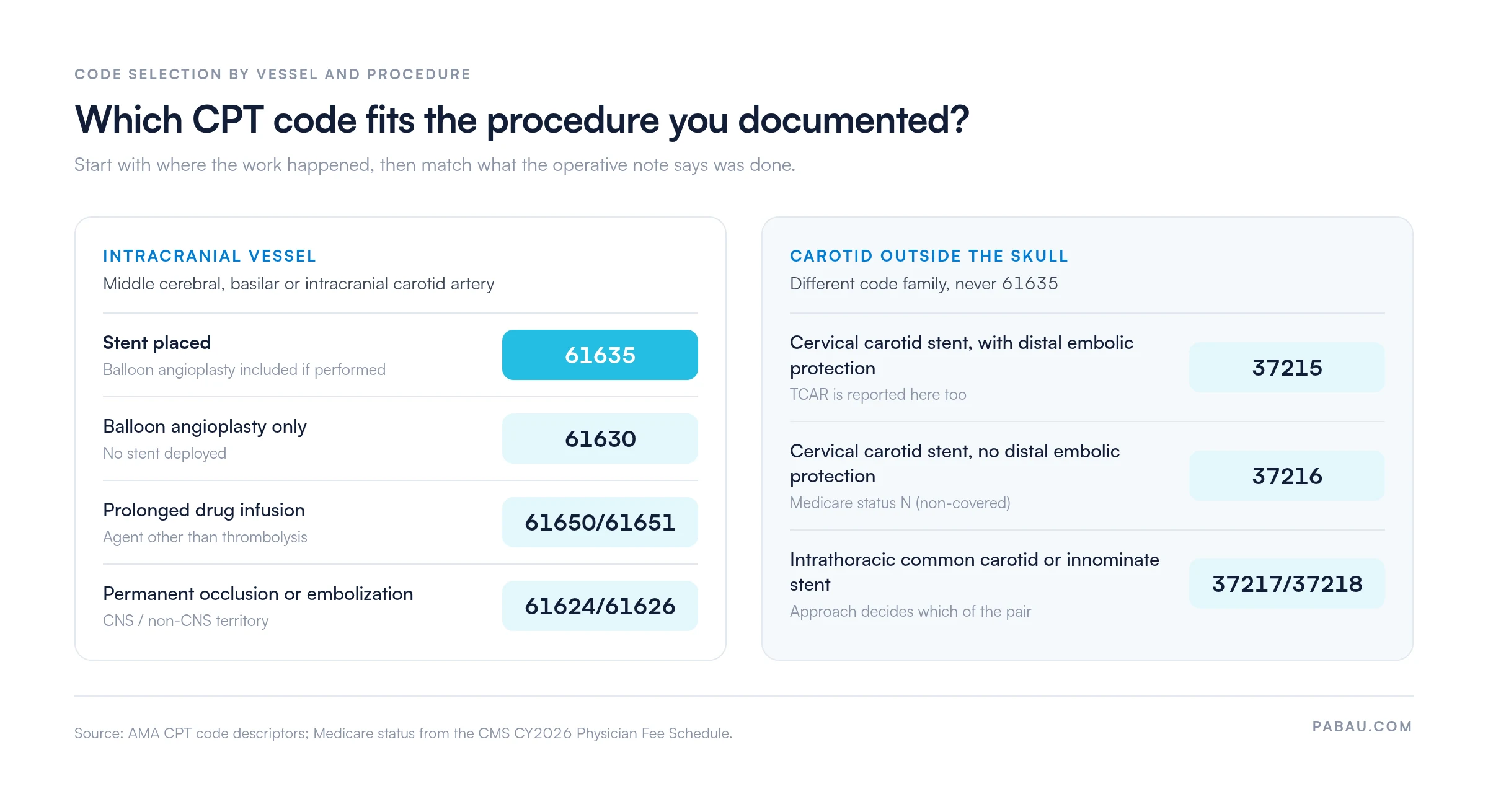
Sometimes the operative note documents cervical carotid stenting followed by intracranial stent placement on the same date. In that case, bill 37215 or 37216 for the cervical stent and 61635 for the intracranial stent. These are anatomically distinct procedures. Check the current NCCI PTP edits before submitting, and flag the op note clearly for both vessel segments.
The National Correct Coding Initiative (NCCI) bundles CPT 61630 into CPT code 61635 when billed on the same date of service for the same vessel. This is a common unbundling risk on 61635 claims. Submitting both codes typically triggers a CO-97 denial. Verify the current NCCI PTP edit before appending -59 or -XS.
Modifiers change the claim story for 61635. Use each only when the clinical and documentation facts support it.
Payers evaluate ICD-10 pairing as part of medical necessity review. The diagnosis must reflect the intracranial vessel disease that necessitated stent placement. I65.x and I66.x are the primary code families, but the exact code must match the vessel documented in the op note.
Some payers publish a specific covered-diagnosis list for intracranial stenting as part of their Local Coverage Determination (LCD). Confirm the active LCD for your Medicare Administrative Contractor (MAC) before submitting, because covered ICD-10 pairings can vary by region.
Always pair the most specific code available rather than defaulting to an “unspecified” I66.9 or I65.9. Coders pairing 61635 with cerebellar artery disease can check the code notes for I66.3 before submitting.
Medicare’s National Coverage Determination 20.7 (Percutaneous Transluminal Angioplasty) is the governing policy for anyone billing CPT code 61635 to CMS. Since November 6, 2006, it has covered intracranial PTA and stenting for cerebral artery stenosis of 50% or more in patients with intracranial atherosclerotic disease.
That coverage applies only when the procedure is furnished under the FDA-approved protocols governing Category B Investigational Device Exemption (IDE) clinical trials.
In 2008, CMS reviewed a request to expand coverage and kept it limited to Category B IDE trials.
The NCD also predates the 2011 SAMMPRIS trial, which found higher complication rates with stenting than with aggressive medical management. That is useful context for medical necessity reviews.
For billing, the rule is simple: if the procedure was not furnished under a Category B IDE trial protocol, Medicare treats it as non-covered.
Commercial payers are not bound by the Medicare NCD and set their own coverage and prior authorization criteria for 61635. Verify each payer’s policy before scheduling the procedure.
Commercial payers frequently require prior authorization for CPT code 61635. The documentation package differs between Medicare and commercial insurers, and incomplete submissions are a common cause of initial prior-auth denials. Completing insurance eligibility verification and prior-auth submission in parallel reduces scheduling delays for neurovascular cases.
A clean claim for 61635 carries the prior-auth reference number at the time of submission. Do not add it later in a correction, because reference numbers added after initial submission do not always prevent a denial.
CMS publishes RVU values for CPT code 61635 each year in the CMS Physician Fee Schedule (MPFS). The figures below come from the CY2026 MPFS file, which lists 61635 with status R (restricted coverage). They are national values before Geographic Practice Cost Index (GPCI) adjustment, so payment differs by locality.
CY2026 uses two conversion factors: $33.4009 for non-qualifying APM participants and $33.5675 for qualifying APM participants (QP).
CPT code 61635 carries a global period of XXX in the CY2026 MPFS, so the global-surgery rules do not apply. Modifiers -24, -78 and -79 are not triggered by the stenting claim. E/M services on other dates are billed as usual.
The main drivers of 61635 denials are Medicare’s Category B IDE coverage limit and the bundling rules surrounding adjacent codes. A denial management workflow for 61635 needs a pre-submission checklist that covers each common cause below before the claim leaves the practice.
Intracranial stenting needs neurovascular imaging and a team able to manage complications, so it is performed in a hospital, reported as POS 21 (inpatient) or POS 22 / 19 (hospital outpatient).
A claim with POS 11 (office) or another non-facility POS is expected to deny and is a compliance risk.
Teams that decode payer denial codes against the claim’s CARC and RARC data can pin down the failure point behind a rejection.
Build a 61635 pre-submission checklist that runs whenever the code appears on a claim in your billing software. First, Medicare claims carry the IDE number, NCT number, Z00.6 and the Q0 or Q1 modifier. Second, the prior-auth number is present and not expired. Third, the ICD-10 code names the treated vessel, with laterality where the code set has it. Fourth, 61630 is not on the same claim for the same vessel. Fifth, the POS is a hospital setting. Checking all five before submission catches the common denial causes above while they are still cheap to fix.
A Medicare 61635 claim carries several identifiers at once: the IDE and NCT numbers, Z00.6, the Q0 or Q1 modifier, and the prior-auth reference. When staff key them by hand from the op note and the trial file, any one of them can drop off the claim.
Pabau, the practice management platform we build, pulls existing record data into a pre-filled claim, so demographics and insurance details arrive without retyping. Its simpler claims management then keeps each claim and its status on the patient record.
Claim.MD, Pabau’s US clearinghouse integration, submits claims and tracks their status. Eligibility checks run through it too, so coverage questions surface before the procedure date. Your coders still own code selection and the IDE elements, but they follow every claim in one place instead of across payer portals.

Pabau pre-fills claims from the patient record, submits them through Claim.MD and tracks every status change. Your billing team spends less time re-keying data and chasing payer portals.

CPT code 61635 pays when three questions are settled before the claim leaves the practice. Was the stent intracranial? Does the Medicare claim carry the Category B IDE elements? Does the place of service match a hospital setting?
Answer them in the op note and the claim, and 61630 stays off the claim while the stenting code pays at its facility rate. The trade-off is upfront work: the trial identifiers and prior-auth reference must sit on the record before the procedure, not be chased afterward.
Book a demo to see how Pabau pre-fills, submits and tracks neurovascular claims for your billing team.

Need to understand how clearinghouse claim routing works? Medical claims clearinghouse overview explains how claims flow from billing software through electronic submission to payer adjudication.
Struggling with remittance reconciliation after 61635 payments? Electronic remittance advice guide covers how ERA 835 files work and how to match payments to original claims.
Want to understand how RCM connects to overall practice profitability? Revenue cycle management fundamentals walks through the full patient-to-payment workflow for procedural specialties.
CPT Code 61635 describes transcatheter stent placement in an intracranial vessel, such as the middle cerebral or basilar artery, including balloon angioplasty when performed. It covers guide catheter placement, roadmap angiography, stent deployment, and post-deployment imaging as a single bundled service.
CPT 61630 covers intracranial angioplasty without stent placement; CPT 61635 covers angioplasty with stent placement. When a stent is deployed, bill 61635 only. Code 61630 is not separately reportable on the same vessel on the same date of service, because angioplasty is bundled into 61635’s descriptor.
Common denial causes start with missing Category B IDE billing elements on Medicare claims, such as the IDE number, NCT number or Z00.6. Others include expired or absent prior authorization, unspecified ICD-10 codes, an NCCI bundling conflict with 61630, and an incomplete operative report. A place-of-service mismatch, such as a non-facility POS for a procedure that requires a hospital setting, also triggers denials.
TCAR (transcarotid artery revascularization) is carotid stent placement through a small transcervical incision, with flow reversal for cerebral protection. TCAR is reported with CPT 37215, a cervical carotid stent code, not with 61635, which is limited to intracranial vessels.



