

CCSD code G5100: Bypass of duodenum billing guide
CCSD code G5100 bills a bypass that leaves the duodenum in place CCSD code G5100...

Last Updated: Oct 16, 2026
60220 is the CPT code for total thyroid lobectomy, unilateral; with or without isthmusectomy. It covers removal of one complete thyroid lobe, and removing the isthmus with it does not change the code.
The code sits in the Thyroid Gland subsection (60000-60300) of CPT Surgery. When tissue also comes out of the opposite lobe, the claim moves to 60212, 60225 or 60240. Many payers also require a -LT or -RT laterality modifier on 60220.
Let Pabau's smart automation suggest the right codes, reduce claim denials, and keep your practice compliant—effortlessly.
Automate repetitive tasks and focus on what matters most—your patients.
Reduce coding errors and ensure compliance with the latest regulations.
Clean claims, fewer denials, and faster reimbursements.
Powerful insights and reporting to help your practice thrive.
HIPAA compliant SOC 2 certified GDPR-compliant Trusted by 4,000+ clinics worldwide

CPT code 60220 covers removal of one complete thyroid lobe, with or without the isthmus, and never the entire gland.
Many commercial and Medicare Advantage payers require the -LT or -RT laterality modifier on 60220, so check payer policy before you submit.
When the surgeon removes tissue from both lobes, the claim moves to 60212, 60225, 60240 or 60252, and the operative report must support it.
Pabau, the practice management platform we build, validates each claim in the background and submits it electronically through Claim.MD.
CPT code 60220 is defined by the American Medical Association as: Total thyroid lobectomy, unilateral; with or without isthmusectomy. The code sits in the Thyroid Gland subsection (60000-60300) of the Endocrine System section of CPT Surgery. It covers one complete thyroid lobe plus, optionally, the isthmus connecting the two lobes.
The phrase “with or without isthmusectomy” settles a common coding question. Removing the isthmus alongside the lobe does not change the code. Both scenarios bill as CPT code 60220, which is why documentation of isthmus status matters less for code selection than lobe count.
Knowing what is bundled into CPT code 60220 prevents unbundling denials and ensures separately reportable services get their own line item.
Included in the base code: standard hemostasis, wound closure, routine nerve identification, and postoperative care within the 90-day global period. The global package covers all follow-up visits related to the surgery for 90 days after the procedure date.
Global package services are one of the most common audit triggers for endocrine surgery practices, so check them against your billing compliance requirements. Post-op visits billed within the 90-day window without a modifier indicating a new problem will be denied as bundled.
A 60220 claim often downcodes or denies for medical necessity when the operative report leaves out the extent of resection. Coders rely entirely on the surgeon’s note to justify the code.
The operative report must document all of the following to support CPT code 60220:
If the operative report describes bilateral lobe removal, the coder must escalate to 60225, 60240 or 60252 regardless of the pre-operative plan.
Choosing the wrong thyroid surgery code is a common denial trigger. The deciding fact is how much tissue came out of each lobe, as the chart below shows.
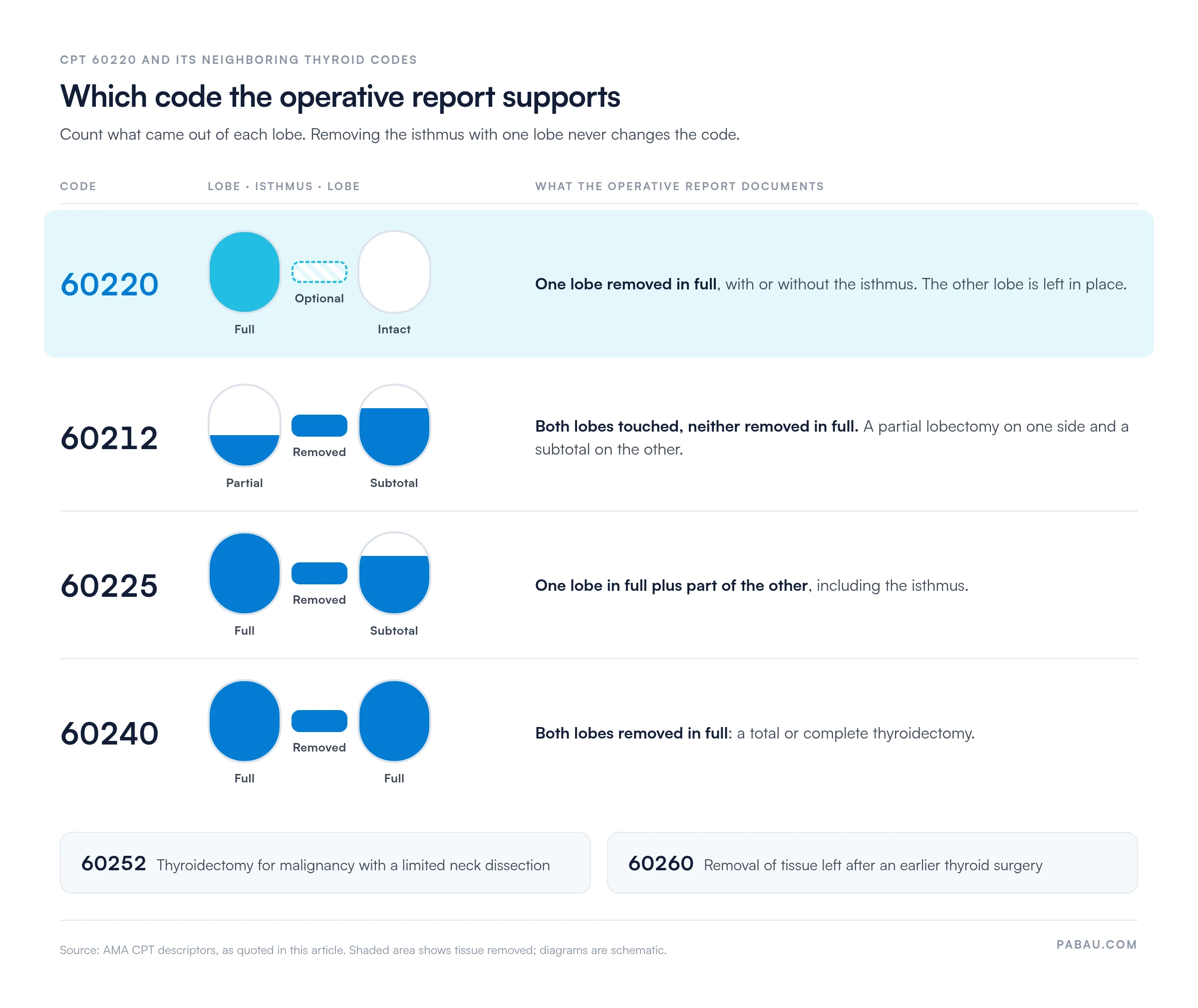
The table adds each code’s full descriptor and the mistake it most often attracts. Coders need to tell these six codes apart on every thyroid surgery case.
Intraoperative upgrades: a surgeon may plan a lobectomy, then remove contralateral tissue because of intraoperative findings. The final code must reflect what was performed, and the operative note must document the decision to extend the resection.
Submit 60225 if part of the other lobe came out, or 60240 if both lobes were removed in full. If prior authorization was granted for 60220, attach a brief explanation and check each payer’s policy on reporting an intraoperative change.
Always query the operative report before coding. If the surgeon documents ‘isthmus divided and removed with the right lobe,’ that is still 60220. If the report documents ‘bilateral thyroid lobes excised in their entirety,’ that is 60240 regardless of the pre-op plan or the consent form.
Modifier application on CPT code 60220 determines whether claims process correctly or deny for missing laterality or incorrect bilateral reporting. Three modifier types apply to this code.
Many commercial and Medicare Advantage payers require -LT or -RT on every 60220 line for a clean claim submission. Laterality rules vary by plan, so check payer policy during eligibility verification.
Pairing CPT code 60220 with the correct ICD-10-CM code establishes medical necessity. Payers map each diagnosis to coverage criteria, so a valid procedure code with an unsupported diagnosis will deny.
Practices using indeterminate cytology diagnoses (Bethesda III or IV) should reference the pathology report in the medical record. If molecular testing influenced the surgical decision, note the Afirma or ThyroSeq result too. Some Medicare Advantage plans require molecular testing documentation before approving lobectomy for indeterminate nodules.
If the record supports C73, check whether the surgeon also performed a neck dissection. That combination may move the claim from 60220 to 60252.
The Medicare payment for CPT code 60220 is based on the total relative value units (RVUs) assigned by CMS. The geographic practice cost index (GPCI) then adjusts it for the practice location. Use the CMS Physician Fee Schedule lookup tool to retrieve the current-year national figures for your MAC jurisdiction.
For precise current-year figures, use the FastRVU 2026 RVU lookup tool to retrieve work, practice expense, and malpractice RVUs with the conversion factor applied.
The 90-day global period means the surgeon’s payment for 60220 already includes all related post-op visits. Billing a follow-up visit within the global window requires modifier -24 (unrelated E/M) or -79 (unrelated procedure) to avoid automatic denial.
Prior authorization requirements for CPT code 60220 vary by payer and plan type. Medicare proper does not require pre-authorization for this code. Medicare Advantage plans and most commercial insurers do require it.
Standard documentation required for prior authorization submission:
Confirming insurance eligibility verification before the auth request identifies plan type, benefit limits, and any diagnosis-specific exclusions that could block approval. Solid medical billing documentation practices give the payer’s clinical reviewers a complete auth package. Each request for additional information adds days to the timeline.
Thyroid lobectomy and parathyroidectomy are sometimes performed in the same operative session. Whether CPT 60220 and CPT 60500 (parathyroidectomy or parathyroid adenomectomy) can be billed together depends on NCCI edit status and clinical documentation.
In the most recently published NCCI edit tables, 60220 and 60500 carry a modifier indicator of “1.” A modifier can override the bundle when the procedures are clinically distinct and separately documented. Use modifier -59 (distinct procedural service) or XS (separate structure) to show the parathyroid procedure was on a different anatomical structure.
Run every 60220 + 60500 combination through your own claim scrubber for modifier review before submission. A modifier fixed before the claim leaves costs far less than an appeal after the denial.
Denial patterns on CPT code 60220 are predictable. The same five reasons account for most of the rework on endocrine surgery claims.
Strong denial management workflows for endocrine surgery start before the claim leaves the practice. Code-specific scrubbing rules for 60220 (laterality requirement, NCCI pair check, global period flag) catch many of these denials before they reach the payer.
For claims that do deny, track each reason code against our denial codes guide. Patterns across the practice show which documentation habits need fixing, so no denial gets treated as a one-off.
Build a 60220-specific claim scrubbing checklist: laterality modifier present, diagnosis supports medical necessity, NCCI edit check for concurrent 60500, and global period conflict screen. Running this before submission reduces denials by catching the five most common errors at the practice level rather than at the payer.
Without integrated billing software, each 60220 claim is checked by hand. A coder reads the operative note, adds the laterality modifier, confirms the authorization number and keys the claim into a clearinghouse portal. Every manual step is another chance for a denial trigger to slip through.
Pabau’s claims management software checks membership and authorization numbers in the background before each claim goes out. It then submits CMS-1500 claims electronically through Claim.MD, Pabau’s US clearinghouse partner.
Claim.MD runs real-time eligibility checks, tracks claim status and returns electronic remittance advice (ERA) to the practice. Your billing team sees a missing authorization number before the payer does, so fewer thyroid surgery claims come back for rework.

Pabau’s claims management software checks membership and authorization numbers in the background before each claim goes out. It submits CMS-1500 claims through Claim.MD, checks eligibility, tracks claim status and returns ERA.

Treat the operative report as the source document for every 60220 claim. If it doesn’t name the side, the extent of resection and the parathyroid status, query the surgeon before you code.
That query costs a few minutes per case. A corrected claim, a retroactive authorization request or a reconsideration letter on a high-value surgical code costs far more.
Once those checks are routine, build them into your billing workflow so every thyroid lobectomy claim passes through them. Book a demo to see how Pabau flags missing authorization numbers before your thyroid surgery claims go out.

Pairing 60220 with a benign thyroid diagnosis? ICD-10 code D34 covers benign neoplasm of the thyroid gland and the documentation that supports it.
Waiting on a payer to approve the surgery? The prior authorization process walks through each step of a request, from clinical documentation to follow-up.
Submitting claims through a clearinghouse for the first time? How a medical claims clearinghouse works explains 837P formatting, edit types, and what happens when a claim fails pre-adjudication.
Tracking denial reason codes across your endocrine surgery cases? Revenue cycle management fundamentals covers how to build a denial tracking workflow that spots recurring coding errors across your caseload.
CPT code 60220 is the procedure code for unilateral thyroid lobectomy, covering removal of one thyroid lobe with or without the isthmus. It is used in endocrine and ENT surgery billing when only one lobe is removed, regardless of whether the connecting isthmus is also excised.
CPT 60220 covers removal of one thyroid lobe only; CPT 60240 covers total thyroidectomy, meaning both lobes are removed. If the surgeon removes both lobes in full, the code is 60240. If one lobe comes out in full and part of the other, the code is 60225. The operative report, not the pre-operative plan, determines code selection.
The primary modifiers are -LT (left thyroid lobe) and -RT (right thyroid lobe), which many commercial and Medicare Advantage payers require, so check payer policy. Modifier -80 applies when an assistant surgeon (MD or DO) is present; non-physician assistants use -AS. Modifier -59 or XS is used when a concurrent parathyroidectomy (CPT 60500) is reported on the same claim to override the NCCI bundle.
The national average Medicare facility payment for CPT 60220 is about $640 in 2026. That is 19.17 total facility RVUs multiplied by the $33.4009 conversion factor, before the GPCI adjustment for your locality. Use the CMS Physician Fee Schedule lookup for the exact rate in your MAC jurisdiction, as rates change annually.
Yes, when the parathyroid procedure is clinically distinct and separately documented. The NCCI edit between 60220 and 60500 carries modifier indicator “1,” meaning modifier -59 or XS applied to 60500 allows separate reporting. The operative report must document the parathyroid adenoma separately from the thyroid lobe, with its own clinical indication.
The most common ICD-10 diagnoses paired with CPT 60220 are E04.1 (nontoxic single thyroid nodule) and E04.2 (nontoxic multinodular goiter). C73 (malignant neoplasm of thyroid gland), D34 (benign thyroid neoplasm) and E05.10 (thyrotoxicosis with toxic single nodule) are also common. Diagnosis selection must match the clinical documentation and support medical necessity under the applicable payer’s coverage policy.
The operative report must specify: laterality of the lobe removed, vessel ligation steps, isthmus handling, recurrent laryngeal nerve identification, parathyroid gland status, and specimen disposition. For prior authorization, most payers also want the pre-operative thyroid ultrasound and the FNA biopsy report with Bethesda classification. They also want thyroid function tests from within six months of the request.



