



CCSD code G5100: Bypass of duodenum billing guide
CCSD code G5100 bills a bypass that leaves the duodenum in place CCSD code G5100...

Last Updated: Oct 16, 2026

CPT Code 59514 covers cesarean delivery only – the billing provider did not furnish any antepartum or postpartum care during the pregnancy episode.
Use 59514 instead of the global code 59510 when a covering or on-call physician performs the c-section without providing prenatal or postpartum visits.
Common billing error: submitting 59514 when the same provider also billed antepartum-only codes (59425 or 59426) for the same patient episode.
Practice management software like Pabau runs real-time eligibility checks, builds the CMS-1500, and tracks claim status and ERA responses.
CPT Code 59514 covers cesarean delivery only. It applies when the physician billing the delivery furnished no antepartum and no postpartum care for that pregnancy episode.
The scenario is routine. A covering physician takes over labor at shift change, performs the cesarean, and leaves postpartum care to the patient’s regular OB. As a result, the wrong code there costs the practice a denial or a takeback under NCCI edits.
Choosing between 59514 and the global package code 59510 is where obstetric billing errors start. In short, this reference covers the official descriptor, the cesarean code family, modifier usage, CY2026 Medicare reimbursement, documentation requirements, and the errors that trigger denials.
Reviewed by Dr Vanja Kitanova, Medical Reviewer, Pabau. Also, reimbursement figures reflect the CY2026 Medicare Physician Fee Schedule and are updated each January.
59514 is the delivery-only code in the cesarean family. The American Medical Association’s CPT code set defines it as applying when the delivering physician furnished no antepartum or postpartum care.
The code sits in the Cesarean Delivery subsection, which runs from 59510 to 59525. By contrast, codes for delivery after a previous cesarean sit in their own subsection, 59610 to 59622.
The official AMA descriptor reads: Cesarean delivery only. That two-word qualifier – “delivery only” – is the entire clinical and billing difference. The same provider who performs the cesarean might also bill a single antepartum visit or the postpartum check. In that case 59514 is no longer the correct code.
The cesarean delivery code family splits along a single axis. How much of the global obstetric package did the billing provider furnish?
The cesarean delivery code family covers four main cases. The table below maps each code to its official descriptor and the care components included – then use it to select the correct code before every claim.
The choice between CPT Code 59514 and the global obstetric package (59510) comes down to one question. Did the billing provider furnish antepartum or postpartum care for this patient episode? If the answer is yes to either component, 59514 is wrong, and the diagram below shows which code takes its place.
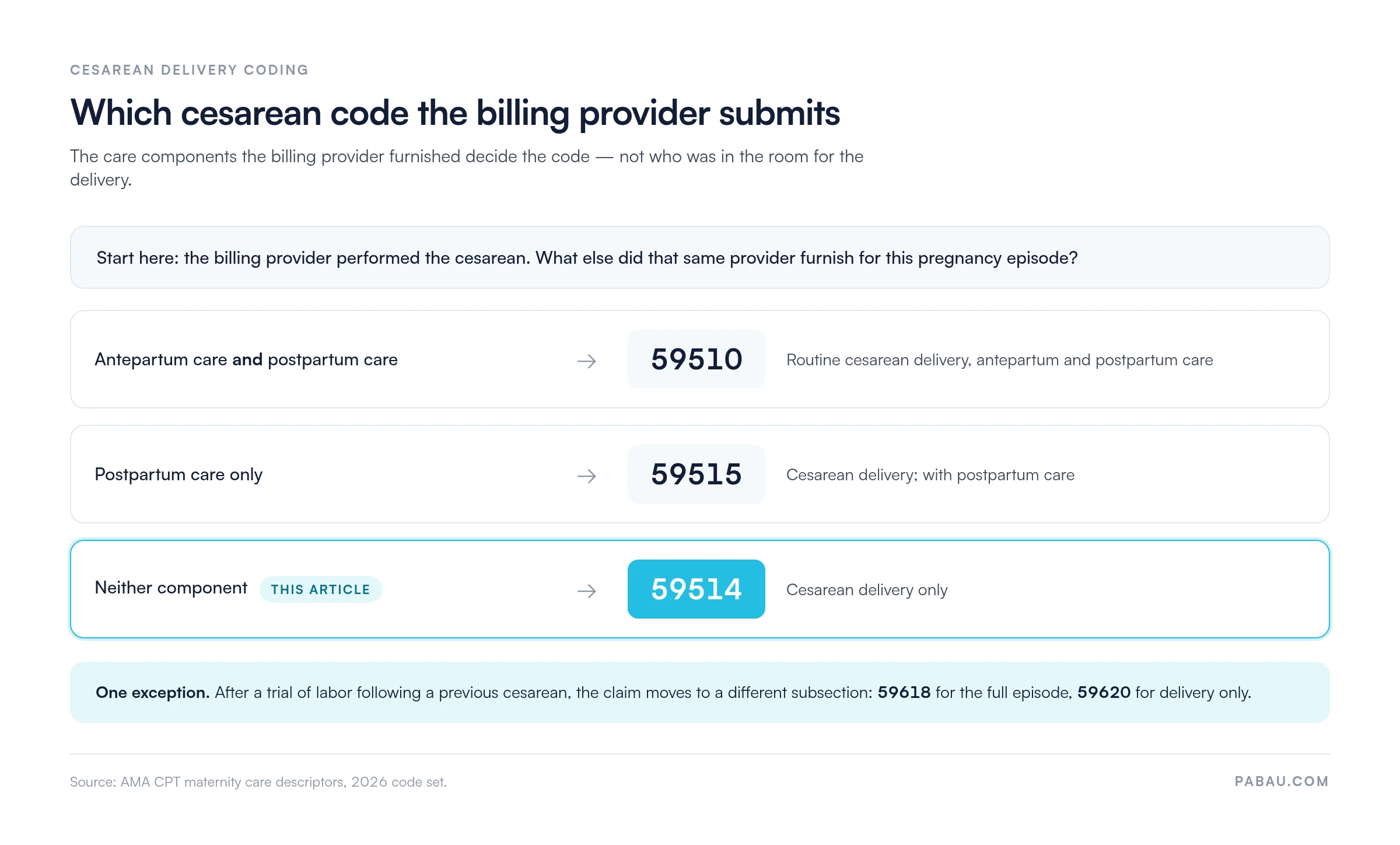
Use this scenario-to-code mapping before every cesarean billing submission:
When antepartum care was split between providers, each provider bills only the components they furnished. The provider who did not furnish antepartum care cannot bill 59510. In that case 59514 is the right code, even when practice partners billed antepartum visits under separate NPIs.
Several modifiers apply to CPT Code 59514, each with its own billing logic. Using the wrong modifier – or omitting one when required – is a leading cause of obstetric claim denials. So check payer-specific modifier acceptance before submitting, as acceptance varies by payer policy and may conflict with NCCI edits.
Cervical ripening before a cesarean raises the same bundling question. CPT Code 59200 bundles into the delivery claim when the same provider bills it on the delivery date. A different date of service, or a different provider, keeps that line separately billable.
Obstetric modifier billing for assistant surgeons is where CPT Code 59514 claims most often go wrong. So the choice between -80, -82, and AS depends on the assisting provider’s credentials and the payer.
Before submitting CPT 59514 with any assistant surgeon modifier, pull the payer’s current medical policy for assistant-at-surgery. Medicare, Medicaid, and commercial payers each maintain separate lists of procedures where assistants are covered. Check the payer’s position on cesarean delivery. Some payers require a prior authorization or a specific diagnosis, such as placenta previa or prior uterine surgery, to allow the assistant claim.
CPT Code 59514 reimbursement under Medicare is calculated through the Resource-Based Relative Value Scale (RBRVS). In other words, the physician fee schedule payment equals the code’s total RVU multiplied by the annual conversion factor.
CY2026 carries two conversion factors: $33.5675 for qualifying alternative payment model participants and $33.4009 for everyone else. So confirm which one applies to your practice through the CMS Physician Fee Schedule lookup tool before submitting claims.
For CY2026, 59514 carries 24.66 total RVUs in the CMS relative value file. At the non-qualifying conversion factor that produces a national unadjusted payment of roughly $824. Geographic practice cost indices then move that figure up or down by locality.
Check your own locality figure against current CMS MPFS data, since third-party estimates vary. Medicaid rates are set at the state level and can sit well below Medicare, so never assume parity. Commercial rates are negotiated on their own and often exceed the Medicare allowable, depending on the contract.
Electronic remittance advice from the payer breaks down how each RVU component was priced for your locality. So read it after every paid claim to catch underpayments against your contracted rate.
Good documentation is the foundation of a defensible CPT Code 59514 claim. Payers audit cesarean delivery-only codes because the delivery-only scenario is often miscoded. Your operative report and billing record must support every part of the code choice.
Required documentation elements for 59514 include:
Diagnosis choice turns on what the operative record documents. When that record shows pre-eclampsia superimposed on pre-existing hypertension, the complication code for the delivery is O11.4.
A clean obstetric claim pairs complete operative documentation with accurate diagnosis code choice. As a result, a missing element in either one triggers a request for records or an outright denial.
Most CPT Code 59514 denials trace back to the same handful of mistakes. So fixing them at the coding stage is far cheaper than fixing them at the appeals stage.
Compliance on obstetric codes comes down to two habits. So train coding staff on these differences, and build a pre-submission checklist that checks the code choice against the operative note.
CPT Code 59514 sits within a broader maternity care code set. Coders in OB/GYN practices need the full family, including the vaginal delivery equivalents and the antepartum-only codes. Our CPT code library indexes the other codes we cover, and the AAPC Codify CPT lookup helps with crosswalking.
Obstetric billing errors are usually a documentation and workflow problem. But billers know the rules. The trouble is that three facts decide the code, and they rarely sit in the same place:
Those facts often reach the biller days after the delivery, once the operative note is signed.
Pabau, an all-in-one practice management system, keeps the clinical record and the claim in one place. Its claims management software runs a real-time eligibility check before the delivery. That confirms the payer and the plan while the patient is still in front of you.
When the encounter is complete, Pabau builds the CMS-1500 from the record and checks the required fields, including membership and authorization numbers.
In the US, Pabau submits through the Claim.MD clearinghouse, which reaches thousands of payers. Claim status updates and electronic remittance advice come back into the same record, so the biller matches a 59514 payment without leaving the platform.
For a practice where many providers split one pregnancy episode, that shared record is what settles which parts each of them can bill.
Run a quarterly audit of all 59514 claims submitted by your practice. Pull every claim where the same provider NPI also billed 59425 or 59426 for the same patient in the same year. Any overlap signals a potential overbilling issue. So cross-reference the operative reports to confirm the delivering physician furnished no antepartum care. Catching these patterns in-house is far less costly than a payer audit.

Pabau runs real-time eligibility checks, builds the CMS-1500, and tracks claim status and ERA responses in one place. Required fields are validated before the claim is submitted.

CPT Code 59514 reads as a simple code and still causes a large share of obstetric denials. The scope is clear. The errors happen upstream, when care episode components are not tracked per provider before the claim is built.
So fix it upstream. Record which provider furnished which component while the episode is still open, and the code choice settles itself at submission.
Pabau links the clinical record to claim submission, with real-time eligibility checks, CMS-1500 generation, and claim status and ERA tracking through Claim.MD. So book a demo to see how an OB/GYN practice keeps 59514 claims clean from the operative note onward.

Need to understand how clearinghouse claims submission works? Medical claims clearinghouse guide explains how 837P transactions, ERA responses, and payer enrollment work for physician practices.
Want to reduce obstetric claim denials before they happen? Denial codes in medical billing covers the most common remittance codes OB/GYN practices encounter and how to respond to each.
Credentialing with payers for your OB practice? How to get credentialed with insurance companies walks through the provider enrollment process step by step.
CPT Code 59514 is the cesarean delivery only code. It covers the surgical delivery of the infant by cesarean section. The billing provider furnished no prenatal visits and no 6-week postpartum check for that episode. The code does not bundle prenatal visits, postpartum management, or any component of the global obstetric package. If the delivering physician also gave any prenatal or postpartum care, a different cesarean delivery code applies.
Medicare reimburses CPT 59514 through the Physician Fee Schedule using the RBRVS methodology. For CY2026 the code carries 24.66 total RVUs, which at the non-qualifying conversion factor of $33.4009 gives roughly $824 nationally. Geographic practice cost indices adjust that figure by locality. So check current rates using the CMS Physician Fee Schedule lookup tool.
No. The same provider cannot bill CPT 59514 and also bill antepartum-only codes (59425 or 59426) for the same patient and the same pregnancy episode. Billing both would contradict the delivery-only definition of 59514 and is likely to trigger NCCI edit bundling or a payer audit. A provider who furnished both antepartum and postpartum care bills 59510 instead. So a provider who furnished postpartum care only bills 59515.
No. CPT 59514 covers delivery only and CPT 59515 covers delivery with postpartum care. One provider cannot bill both for the same patient and delivery episode. Each code covers a different mix of care, and only one of them fits any given delivery. So bill whichever code accurately reflects what the delivering physician furnished for the specific episode.



