

HCPCS Code Q4185: Cellesta flowable amnion billing guide
HCPCS Code Q4185: definition and official descriptor HCPCS Code Q4185 is the Lev...

Last Updated: Nov 20, 2026
58200 is the CPT code for total abdominal hysterectomy, including partial vaginectomy, with para-aortic and pelvic lymph node sampling. Removal of the tubes and ovaries is optional under the descriptor's "with or without" wording.
The code sits in the Corpus Uteri subsection of the Female Genital System surgery chapter. It applies when lymph node staging accompanies an open abdominal hysterectomy. Coders most often confuse it with 58150, which lacks the vaginectomy and node sampling, and 58210, which adds radical parametrial resection. Reporting 58150 for this procedure underreports the work, while 58210 overstates it.
Let Pabau's smart automation suggest the right codes, reduce claim denials, and keep your practice compliant—effortlessly.
Automate repetitive tasks and focus on what matters most—your patients.
Reduce coding errors and ensure compliance with the latest regulations.
Clean claims, fewer denials, and faster reimbursements.
Powerful insights and reporting to help your practice thrive.
HIPAA compliant SOC 2 certified GDPR-compliant Trusted by 4,000+ clinics worldwide

CPT code 58200 covers a total abdominal hysterectomy with partial vaginectomy and pelvic and para-aortic lymph node sampling, with or without adnexal removal.
Documented partial vaginectomy and node sampling separate 58200 from 58150, which covers the open hysterectomy alone.
Radical parametrial dissection with bilateral total pelvic lymphadenectomy moves the procedure to 58210, so the operative note decides between the two.
Modifier 22 draws additional payer review and needs specific documentation of complexity beyond the typical procedure.
Pabau’s billing software submits 58200 claims through Claim.MD, checks eligibility, and tracks ERA remittances on the patient record.
CPT code 58200 is the surgical procedure code for a total abdominal hysterectomy that includes partial vaginectomy and pelvic and para-aortic lymph node sampling. In the AMA’s CPT code set, it sits in the Corpus Uteri subsection of the Female Genital System surgery chapter. Removal of the tubes and ovaries is optional under the descriptor. Gynecologic oncologists use it for open abdominal staging of uterine and cervical cancers.
The defining feature of 58200 is the lymph node sampling requirement. Without documented pelvic and para-aortic node sampling, the procedure codes differently. Node sampling documentation is a frequent point of dispute.
CPT 58200 bundles several surgical components into a single billable unit. Billing any of the included elements separately triggers NCCI edit violations and denial. Knowing the boundary prevents both unbundling errors and missed capture of separately reportable work.
Included (bundled):
Not included (separately reportable when performed and documented):
The hysterectomy code family spans open, vaginal, and laparoscopic approaches with varying degrees of radicality. Selecting the wrong code is a frequent cause of denials, so a side-by-side belongs in every coder’s reference set.
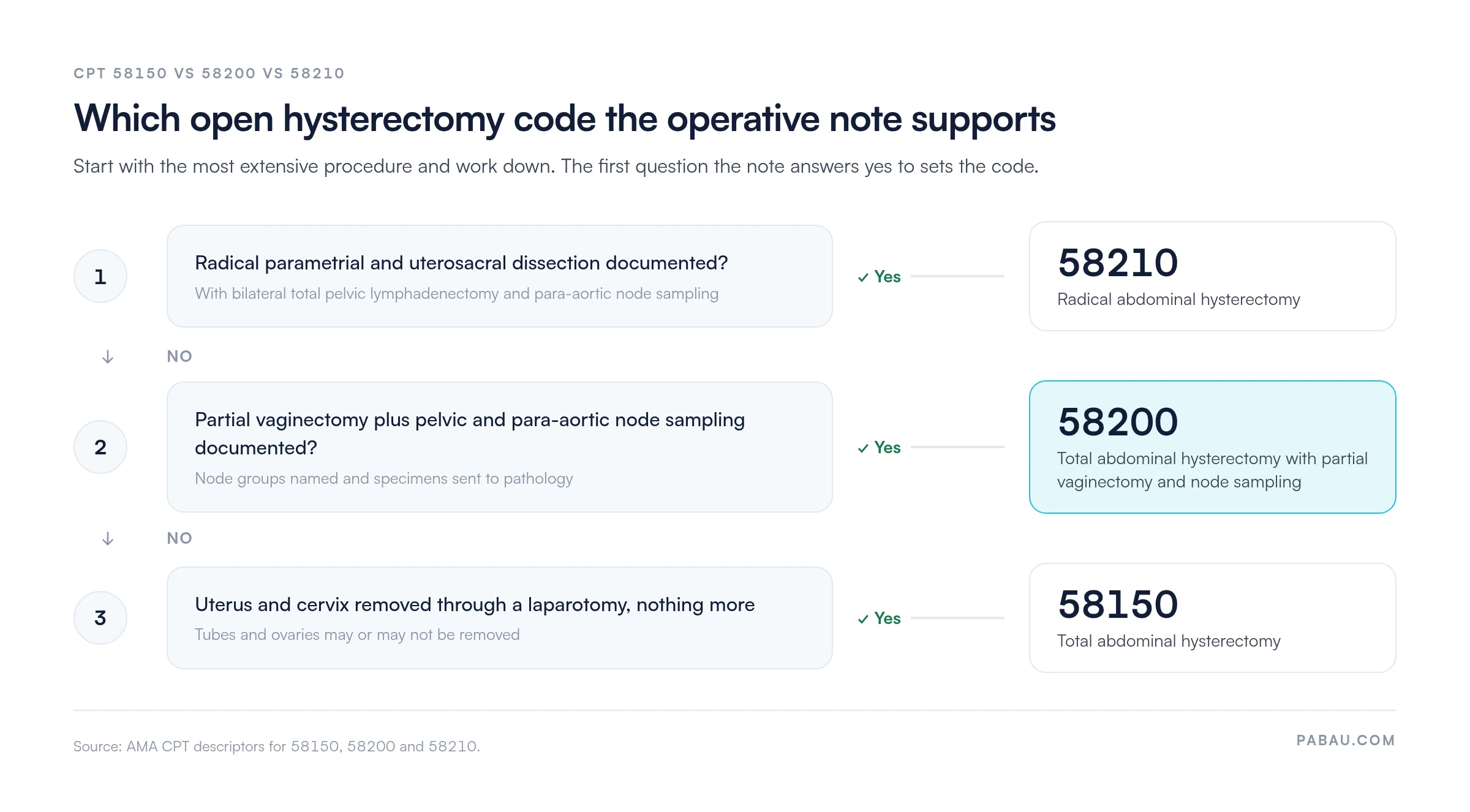
The decision between 58200 and 58210 is the highest-stakes choice in this code family. If the operative report does not specifically describe radical parametrial and uterosacral ligament dissection, the procedure is 58200, not 58210. Billing 58210 without that documentation overstates the procedure. A laparoscopic radical hysterectomy with the same node dissection is reported with CPT 58548 instead.
At the other end, an open hysterectomy with neither vaginectomy nor node sampling documented drops to 58150. The flow below walks an operative note through all three codes, starting with the most extensive.
CPT code 58200 is appropriate when an open abdominal hysterectomy is performed with intentional lymph node staging, almost always in a gynecologic oncology context. The code is not used for routine benign hysterectomies; those map to 58150 or the vaginal/laparoscopic equivalents. Debulking surgery for ovarian malignancy, with bilateral salpingo-oophorectomy and omentectomy alongside the hysterectomy, is reported with code 58953 instead.
Use 58200 when the operative report documents all of these:
Flag planned node sampling in the preoperative plan, so coders know to look for it before the case closes. Without that flag, a staging procedure can slip to 58150 by mistake.
When not to use 58200: sometimes the surgeon plans lymph node sampling but abandons it intraoperatively, for example because of adhesions or hemodynamic instability. Only the components performed are billable, and the operative note must state which elements were completed.
Code 58150 for a completed abdominal hysterectomy without node sampling, and document the reason for abandonment separately. Because the scenario is complex, have a certified coding professional review the claim before submission.
Medical necessity for CPT 58200 turns on the diagnosis. Payers expect a gynecologic malignancy or a documented staging indication, most often C54.1 for endometrial cancer. The table below covers the most frequently paired ICD-10-CM codes and notes payer acceptance patterns. Always verify individual payer policy, as LCD requirements vary.
Modifier selection for CPT code 58200 affects both payment and audit exposure. Each modifier must be supported by specific documentation in the operative and anesthesia records. A clean claim needs a matching chart note behind every modifier before it goes out.
Modifier 22 draws close scrutiny in gynecologic surgery. Before appending it to 58200, confirm the operative report names at least two specific complexity factors. Prior radiation, a BMI over 40, and dense adhesions all qualify. The note should also show operative time well beyond the typical range. Vague wording such as ‘procedure was difficult’ will not survive a payer audit.
CPT 58200 carries a 90-day global surgical period under Medicare, so pre- and post-operative care within that window is included in the base payment. Medicare prices it on the Physician Fee Schedule using the resource-based relative value scale (RBRVS). Work, practice expense, and malpractice RVUs are adjusted by the geographic practice cost index (GPCI) for the locality. The total is then multiplied by the annual conversion factor.
GPCI adjustments can produce meaningful differences between, say, Manhattan and rural Mississippi. Always use the CMS Physician Fee Schedule Lookup for the specific locality before quoting a reimbursement figure to a physician. The FastRVU 2026 RVU lookup tool provides current work, practice expense, and malpractice RVU breakdowns for 58200 by locality.
Commercial payers typically benchmark their allowed amounts as a percentage of the Medicare allowable, set contract by contract. For a single code like 58200, the variance between payer contracts can be substantial. Track each payer’s contracted rate separately rather than assuming Medicare equivalence.
Medicare fee-for-service does not list CPT 58200 on its prior authorization required procedure list. Medical necessity must still be documented in the operative record. Many Medicare Advantage and commercial plans require prior authorization for major gynecologic surgery. Verify 58200 with each payer before scheduling, because requirements change by plan year.
For medical billing documentation purposes, the prior authorization package typically includes:
Commercial payers who require prior authorization typically demand the same documentation package. When authorization is obtained, retain the authorization number in the patient record and include it on the claim. A missing authorization number is one of the most preventable denials on this code.
The five denial causes below each start in the documentation or coding workflow, so each one is preventable. Systematic denial management workflows catch most of them before the remit arrives.
When a denial does arrive, check the remittance denial codes on the ERA before deciding whether to appeal or recode. CO-4 means the procedure code is inconsistent with the modifier used. CO-50 means the payer judged the service not medically necessary. Each points to a different corrective action.
Run a quarterly audit of all 58200 claims against your 58150 claims for the same surgeons. In a gynecologic oncology practice, an unexpectedly high share of 58150 suggests node-sampling procedures are being undercoded. A cluster of 58210 bills from one surgeon calls for a review of each op note for documented radical parametrial dissection.
Accurate documentation is what separates a payable 58200 claim from an audit finding. The operative note must explicitly describe each bundled component of the procedure. Vague language is an audit trigger even when the surgery was performed correctly.
The operative report must contain all of the following to support 58200 billing, per medical billing compliance standards:
Missing any of the first four elements is a common cause of denial or audit findings. A structured operative dictation template that prompts for each element keeps those omissions out of the note in the first place.
A 58200 claim passes through three hands: the surgeon dictating the op note, the coder reading it, and the biller working the remit. When each step lives in a separate system, a missing node-sampling line only surfaces once the denial comes back.
Pabau, the practice management platform we build, keeps the patient record, the claim and the remittance in one place. Its surgical practice claims software submits CMS-1500/837P claims through Claim.MD, checks eligibility, and tracks ERA remittances.
Your billers see a CO-4 or CO-50 the day the ERA posts, on the same record as the operative note. The corrected claim goes out while the case is still fresh, instead of weeks later.
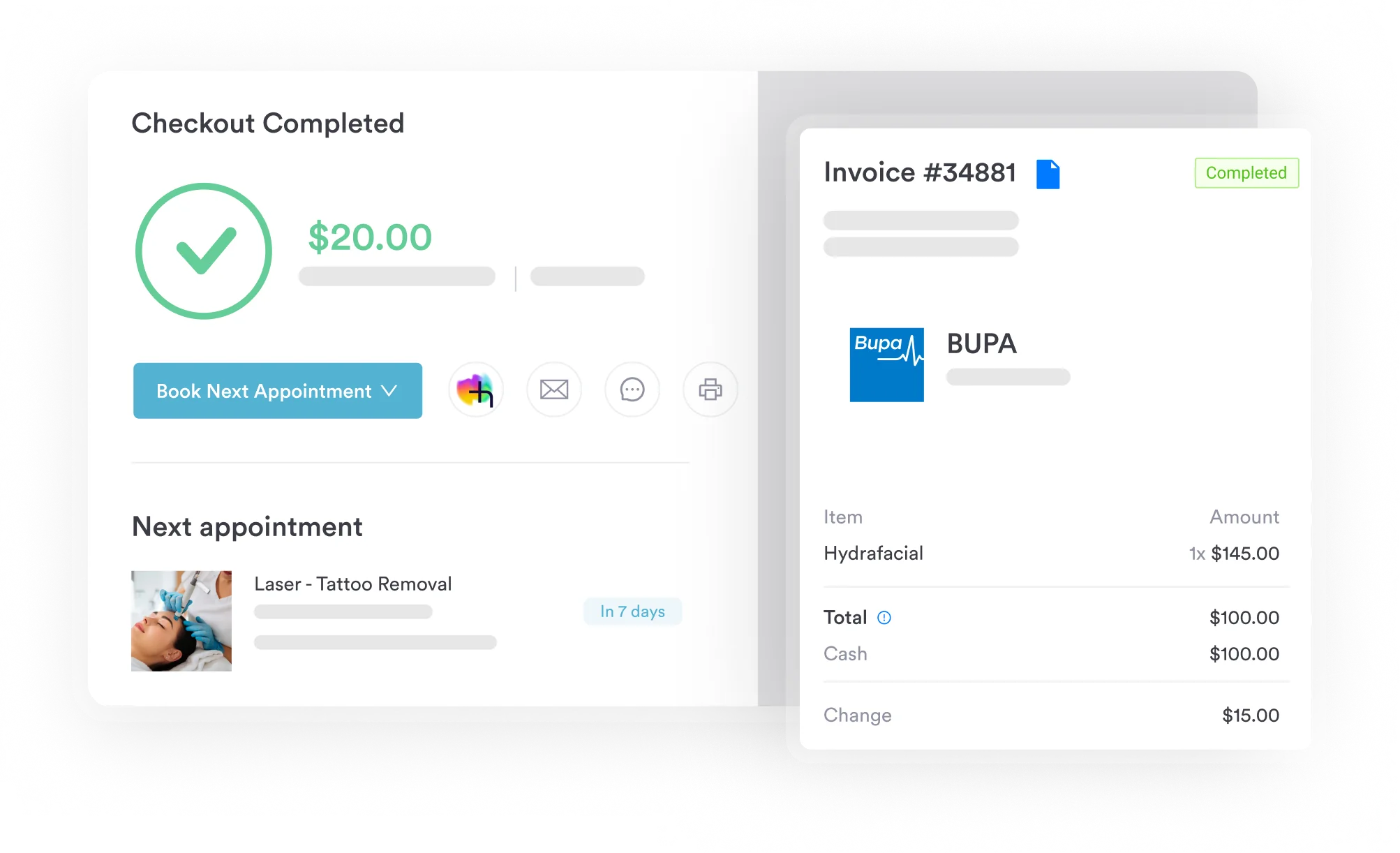

Pabau submits CMS-1500/837P claims through Claim.MD, checks eligibility, and tracks ERA remittances on the patient record. Your team sees each denial early and fixes it at the source.

Report 58200 when the operative note names a partial vaginectomy and both the pelvic and para-aortic node groups. Drop to 58150 when either is missing, and move to 58210 only when radical parametrial dissection is described.
Most 58200 denials are settled before the claim exists, by a dictation template that prompts for each component. Fix the template once, and the coder stops guessing from the note.
Book a demo to see how Pabau tracks gynecologic surgery claims from submission to remittance.

Coding the laparoscopic-assisted vaginal approach instead? CPT 58550 covers laparoscopic-assisted vaginal hysterectomy for a uterus of 250 g or less.
Was the hysterectomy fully laparoscopic? CPT 58571 explains total laparoscopic hysterectomy with removal of the tubes or ovaries.
Was the uterus removed vaginally? CPT 58260 sets out the vaginal hysterectomy code and its weight threshold.
Want the bigger picture on getting paid? Revenue cycle management fundamentals explains how coding, claims, and payment posting fit together.
CPT code 58200 is the surgical procedure code for a total abdominal hysterectomy with partial vaginectomy and pelvic and para-aortic lymph node sampling. Removal of the fallopian tubes and ovaries is optional under the descriptor. Gynecologic oncologists use it for open abdominal staging of uterine or cervical cancers.
CPT 58210 adds radical parametrial and uterosacral ligament dissection with bilateral total pelvic lymphadenectomy, which 58200 does not include. If the operative report does not explicitly describe radical parametrial resection, the correct code is 58200, not 58210. Billing 58210 without that documentation overstates the procedure.
The most common modifiers are 22, 51, 59, 62, 80, and AS. They cover increased complexity, multiple procedures, a distinct procedural service, two primary surgeons, an assistant surgeon, and a PA, NP, or CNS assisting. Each requires specific documentation in the operative and anesthesia records before it is appended.
Medicare fee-for-service does not require prior authorization for CPT 58200, but medical necessity must be documented in the operative record. Many Medicare Advantage and commercial plans require prior authorization for major gynecologic surgery, so verify 58200 with each payer before scheduling.
No. The descriptor for CPT 58200 explicitly includes removal of tubes and/or ovaries with “with or without” language, meaning adnexal removal is bundled. Separately billing an oophorectomy add-on code when 58200 is on the same claim will trigger an NCCI bundling edit and denial.





