CPT Code 62284: Injection procedure for myelography
CPT Code 62284: official descriptor and procedure overview The American Medical ...

Last Updated: Oct 19, 2026
58260 is the CPT code for vaginal hysterectomy, for uterus 250 g or less. It applies only when three criteria hold. The uterus is removed entirely through the vagina, the specimen weighs 250 grams or less, and the tubes and ovaries stay in place.
A larger specimen moves the case to 58290, and tube or ovary removal moves it to 58262. Laparoscopic or robotic assistance moves it into the laparoscopic code family. Choosing the wrong code among these neighbors is a common source of payer audits and denials.
Let Pabau's smart automation suggest the right codes, reduce claim denials, and keep your practice compliant—effortlessly.
Automate repetitive tasks and focus on what matters most—your patients.
Reduce coding errors and ensure compliance with the latest regulations.
Clean claims, fewer denials, and faster reimbursements.
Powerful insights and reporting to help your practice thrive.
HIPAA compliant SOC 2 certified GDPR-compliant Trusted by 4,000+ clinics worldwide

CPT code 58260 covers a vaginal hysterectomy for a uterus weighing 250 g or less, with no laparoscopic or robotic assistance.
The operative note or pathology report must record specimen weight, because without it the payer cannot tell 58260 from 58290.
Removing a tube or ovary moves the case to 58262, and billing 58260 for it misstates the procedure on the claim.
Medicare’s 2026 national payment for 58260 is about $741.83, built on 13.80 work RVUs and a 90-day global period.
Pabau’s claims management software validates each claim for missing or invalid details before it reaches the clearinghouse.
CPT code 58260 is defined by the American Medical Association as: Vaginal hysterectomy, for uterus 250 g or less. Three elements must be true simultaneously for 58260 to apply:
The code carries a global surgical period of 90 days under the Medicare Physician Fee Schedule. All routine pre- and postoperative visits within that window are bundled into the base payment. Place of service may be hospital inpatient (POS 21), on-campus hospital outpatient (POS 22), or an ambulatory surgical center (POS 24).
Understanding the surgical scope bundled into 58260 prevents both undercoding and overbilling errors. The procedure encompasses colpotomy, uterine mobilization, ligation of vascular pedicles, and vaginal cuff closure.
Included (cannot be billed separately):
Not included (may be separately reportable with correct modifier or code):
Three questions settle the code. Was the approach entirely vaginal, did the uterus weigh 250 g or less, and were the tubes and ovaries left in place? The decision path below runs them in the order a coder meets them in the operative note.
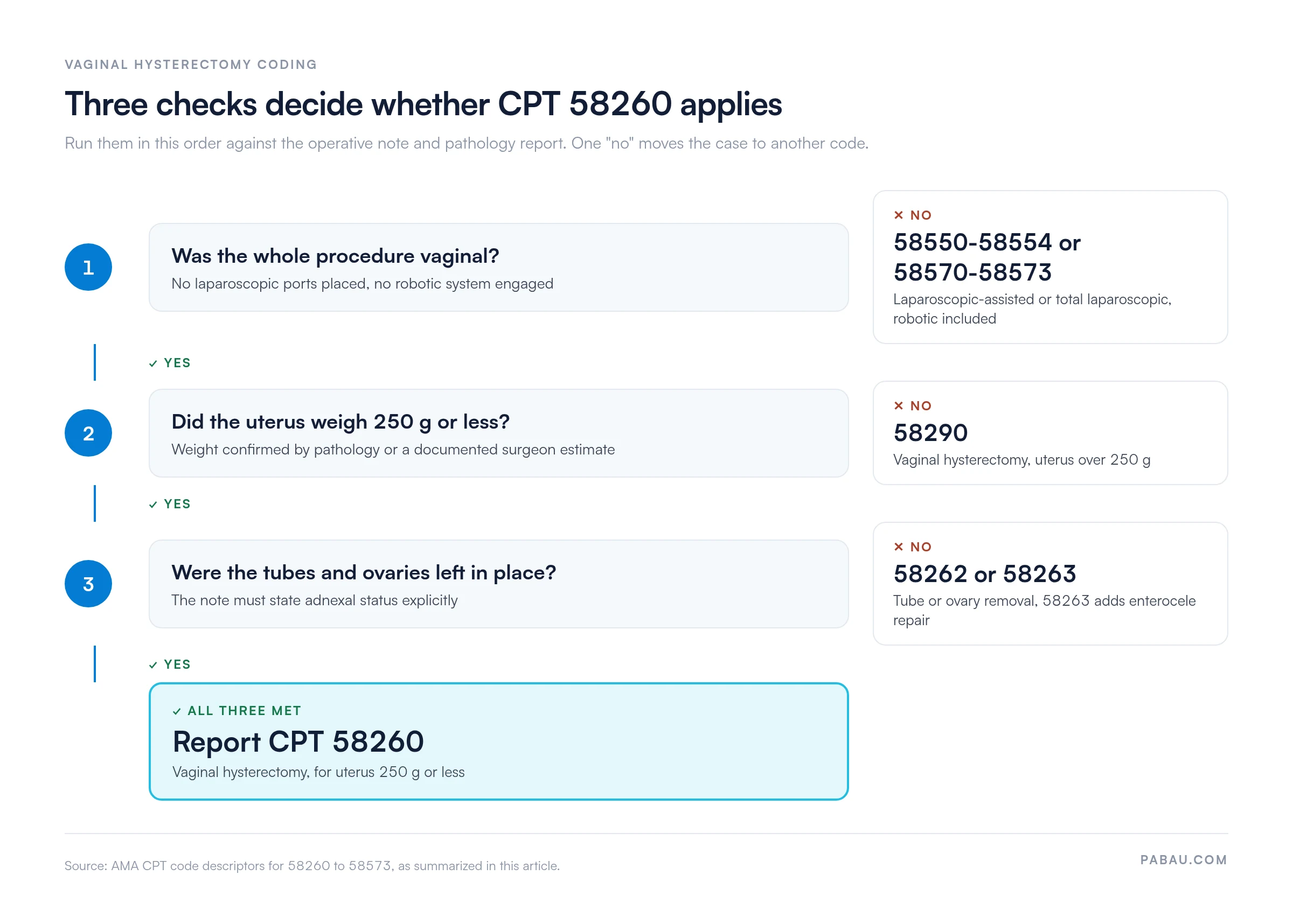
The table maps each neighboring code by approach, uterine weight, and adnexal scope.
Robotic approach: CPT code 58260 never covers a robotic-assisted hysterectomy. Robotic cases are reported with the standard laparoscopic codes, such as 58571 for a total laparoscopic hysterectomy with tube or ovary removal. CPT has no separate robotic hysterectomy code, so submitting 58260 for a robotic procedure misreports the approach.
A 58260 claim stands or falls on the operative report. It must establish each defining criterion before the claim is submitted.
The operative note must explicitly state:
A superbill documentation workflow that captures specimen weight at the time of surgery keeps many 58260 claims from being reviewed or recoded later.
Every 58260 claim requires a primary ICD-10-CM diagnosis code establishing medical necessity. The following diagnoses appear most frequently alongside this procedure code.
When leiomyoma is the primary indication and the uterus is close to the 250g threshold, confirm specimen weight with the pathologist before submitting the claim. A 251-gram uterus belongs under 58290, so a claim filed as 58260 misreports the procedure. Build the weight confirmation step into your post-op workflow before the operative note closes.
The applicable modifiers for CPT 58260 depend on case complexity, concurrent procedures, and payer requirements. Using a modifier without adequate documentation is as problematic as omitting one that applies.
Modifier -50 (bilateral) does not apply to hysterectomy. Modifier -22 should not be appended routinely. Payers scrutinize it closely, and repeated use without substantive documentation invites an audit.
Medicare reimbursement for CPT code 58260 is based on the annual CMS Physician Fee Schedule. Rates vary by place of service and geographic locality. The figures below are 2026 national amounts before locality adjustment. Use the CMS fee schedule lookup to confirm the rate for your ZIP code.
Commercial payers set their own fee schedules, often expressed as a percentage of Medicare. Prior authorization requirements vary widely. Traditional Medicare does not require prior authorization for an inpatient vaginal hysterectomy.
Commercial payers such as UnitedHealthcare, Aetna, and BCBS plans may require it in both inpatient and outpatient settings. Verify benefits individually before scheduling.
National Correct Coding Initiative (NCCI) edits define which procedure codes count as components of 58260. Those codes cannot be billed on the same date without a modifier documenting a distinct service.
Misreading the edits causes two opposite errors. Unbundling bills a component separately when it should not be billed. The reverse error leaves a distinct same-day service, such as a 57288 sling procedure, unbilled.
Always verify current NCCI edit pairs against the CMS NCCI tables before submitting. Edit pairs are updated quarterly, so a bundling rule that applied last year may have changed.
Most 58260 denials trace to a small set of preventable errors. Each denial reason below maps to a specific corrective action that can be built into the billing workflow before the claim leaves the practice.
Strong denial management workflows treat each denial as a data point. Log the denial codes on every 58260 rejection, trace each one to a root cause, and update the billing workflow so it does not repeat. A single correction to an operative template or charge capture form can remove a whole category of future denials.
Run a monthly audit of your 58260 denial codes using your practice management system’s reporting module. Filter claims denied in the last 30 days for this code and categorize by denial reason. If more than 10% share the same root cause, the problem sits in the workflow, and fixing that workflow prevents the next batch of denials.
Clean 58260 billing depends on three steps lining up for every case: the right code, a complete operative record, and a validated claim. Pabau, the practice management platform we build, connects those steps through its denial-reducing claims management. The record and the claim then come from the same system.
Payments post from electronic remittance advice files, so the practice can compare each 58260 payment with the expected fee schedule amount. Submitting a clean claim at first pass shortens days in accounts receivable and cuts rework.

Pabau validates every hysterectomy claim for missing or invalid details before it reaches the clearinghouse. Your practice spends less time on denials and resubmissions.

CPT 58260 rewards practices that settle the code before the patient leaves the operating room. Approach, specimen weight, and adnexal status all belong in the note, and each one changes the code when it differs.
The trade-off is a little more structure in the operative form against far fewer records requests, recoupments, and resubmissions. Make those three fields mandatory, and 58260 becomes a routine claim rather than a recurring query.
Book a demo to see how Pabau validates OB/GYN surgical claims before they reach the payer.

Need to understand clearinghouse claim submission for surgical codes? How Claim.MD clearinghouse works covers the end-to-end electronic claims process for US payers.
Want to reduce revenue cycle lag across your OB/GYN practice? Revenue cycle management explained outlines the full workflow from eligibility check through final payment posting.
CPT code 58260 covers a vaginal hysterectomy for a uterus of 250 g or less, done entirely through the vagina. It includes colpotomy, uterine mobilization, ligation of the vascular pedicles, and vaginal cuff closure. It does not include tube or ovary removal, colporrhaphy, cystoscopy, or a sling procedure.
CPT 58262 adds removal of one or both fallopian tubes or ovaries to a vaginal hysterectomy for a uterus of 250 g or less. When adnexal removal happens in the same operation, 58262 is the correct code. Submitting 58260 for that case misreports the procedure.
CPT 58260 applies when the uterine specimen weighs 250 grams or less. CPT 58290 is the correct code when the uterus exceeds 250 grams in a vaginal hysterectomy without adnexal removal. The specimen weight must be documented in the pathology report or the operative note before submitting either code.
No. CPT 58260 is strictly for a vaginal approach with no laparoscopic or robotic assistance. A laparoscopy-assisted vaginal hysterectomy for a uterus of 250 g or less is coded 58550, or 58552 with tube or ovary removal. A total laparoscopic or robotic hysterectomy uses 58570 or 58571, because CPT has no separate robotic hysterectomy code.
The most common modifiers with CPT 58260 are -22, -51, -59, and -62. Use -22 for substantially increased work, -51 for multiple procedures on the same date, and -59 for a distinct same-day service such as colporrhaphy. Modifier -62 applies when two surgeons share the case, and modifier -50 never applies to hysterectomy.
Most denials trace to missing documentation or the wrong code. Common causes are an undocumented specimen weight, a laparoscopic case billed as vaginal, or tube and ovary removal billed as 58260 instead of 58262. A missing diagnosis, missing prior authorization, or a same-day NCCI conflict without modifier -59 also triggers denials.