HCPCS Code E0215: Electric heating pad (non-moist) billing guide
HCPCS Code E0215: Official description and device definition HCPCS Code E0215 is...

Last Updated: Nov 16, 2026
58550 is the CPT code for laparoscopy, surgical, with vaginal hysterectomy, for uterus 250 g or less. It describes a laparoscopy-assisted vaginal hysterectomy (LAVH) in which the tubes and ovaries stay in place.
The surgeon frees the uterus laparoscopically, then removes it through the vagina. A uterus over 250 g moves the claim to 58553, and removing a tube or ovary moves it to 58552 or 58554. Laparoscopic myomectomy, which keeps the uterus, is coded separately as 58545 or 58546.
Let Pabau's smart automation suggest the right codes, reduce claim denials, and keep your practice compliant—effortlessly.
Automate repetitive tasks and focus on what matters most—your patients.
Reduce coding errors and ensure compliance with the latest regulations.
Clean claims, fewer denials, and faster reimbursements.
Powerful insights and reporting to help your practice thrive.
HIPAA compliant SOC 2 certified GDPR-compliant Trusted by 4,000+ clinics worldwide

CPT code 58550 reports a laparoscopy-assisted vaginal hysterectomy (LAVH) for a uterus of 250 g or less, with the tubes and ovaries left in place.
Removing a tube or ovary moves the claim to 58552, and a uterus over 250 g moves it to 58553 or 58554.
Total laparoscopic hysterectomy is coded 58570-58573, and laparoscopic myomectomy is coded 58545 or 58546, so neither family stands in for 58550.
The uterine weight in grams, usually taken from the pathology report, is the figure that decides between the LAVH codes.
The code carries a 90-day global period, so routine follow-up visits after the surgery are not billed separately.
CPT code 58550 reports a laparoscopy-assisted vaginal hysterectomy (LAVH) when the uterus weighs 250 g or less and the tubes and ovaries stay in place.
OBG Management’s hysterectomy code update lists 58550 as the LAVH code for a uterus of 250 g or less. Codes 58552-58554 cover the other combinations.
The table below gathers the billing facts for 58550 in one place. Check payment amounts in the current CMS Physician Fee Schedule lookup tool, because rates change every January.
The American Medical Association publishes the descriptor as Laparoscopy, surgical, with vaginal hysterectomy, for uterus 250 g or less. In plain terms, the surgeon starts the hysterectomy laparoscopically and finishes it vaginally.
In the laparoscopic phase, the surgeon inspects the pelvis and frees the upper attachments of the uterus, such as the round and utero-ovarian ligaments. The vaginal phase usually secures the uterine vessels, detaches the cervix, and delivers the uterus through the vagina.
Four boundaries decide whether 58550 fits the case:
CPT code 58550 is not a myomectomy code. Laparoscopic myomectomy is reported with 58545 or 58546, and the old laparoscopic myomectomy code, 58551, was deleted in 2003. Fibroids that come out attached to the uterus are part of the hysterectomy and are not billed separately.
Three facts pick the code in this family: the surgical approach, whether a tube or ovary came out, and the uterine weight. Read the operative report in that order before you choose.
The weight has to be a number in grams. It normally comes from the pathology report, which weighs the specimen after removal. A pre-operative ultrasound estimate, or a phrase like “small uterus”, does not set the code. The grid below places the four LAVH codes against those two facts.
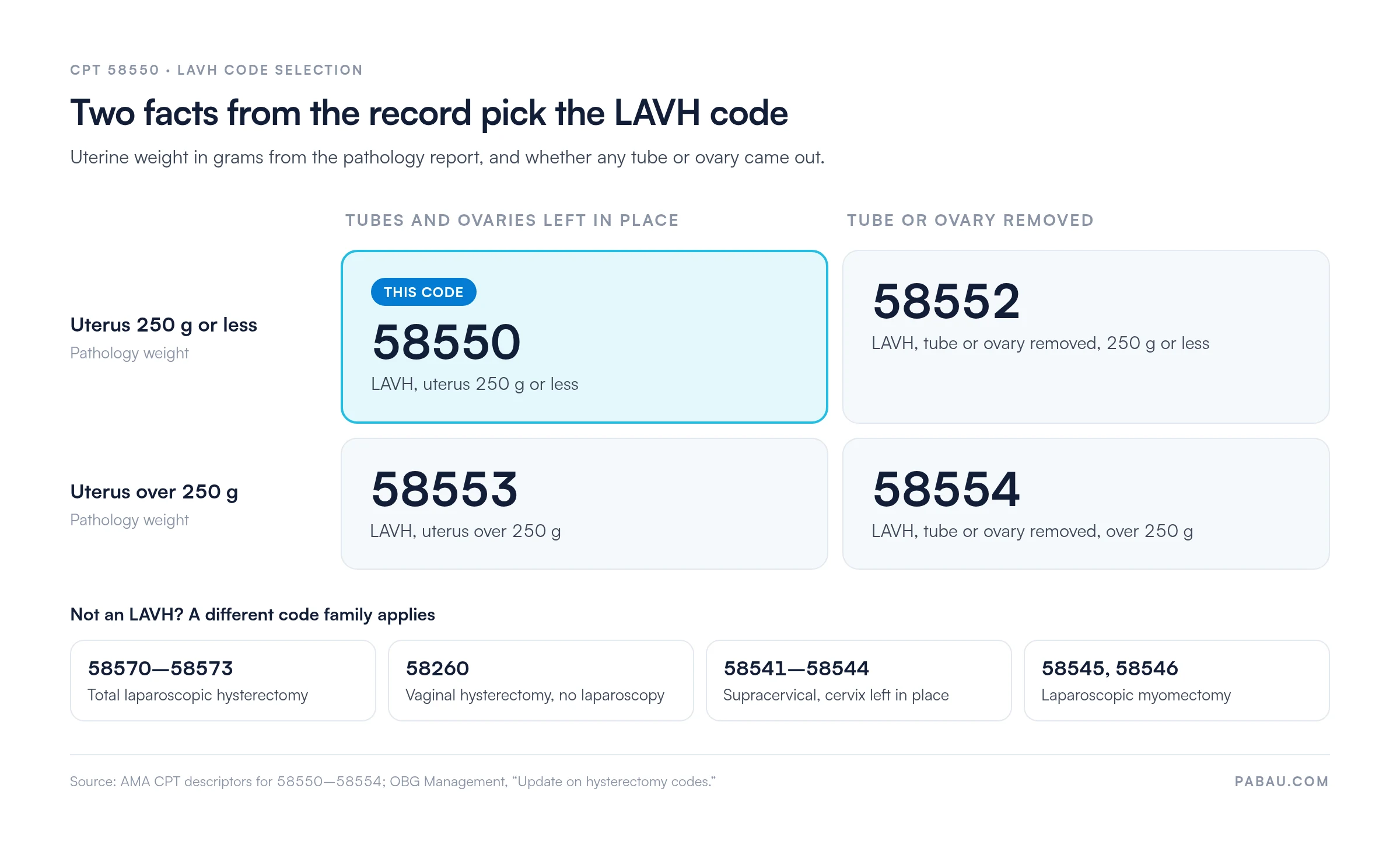
Both codes describe an LAVH on a uterus of 250 g or less. The difference is the adnexa: CPT code 58552 adds removal of one or more tubes or ovaries. A bilateral salpingectomy done at the same session counts too, so an LAVH with both tubes removed is 58552, not 58550.
Fibroids and adenomyosis often push uterine weight past the limit. A uterus recorded at 265 g is 58553, even when the surgery went smoothly. Code to the pathology weight, and query the surgeon if the operative note gives a different figure.
In a total laparoscopic hysterectomy, the surgeon secures the vessels, detaches the uterus, and closes the vaginal cuff laparoscopically. Delivering the uterus through the vagina does not turn a TLH into an LAVH. When part of the hysterectomy itself is done vaginally, the case belongs in the LAVH family.
The TLH counterpart with tube or ovary removal is CPT code 58571. It covers the same weight band as 58552, but a different technique.
A myomectomy removes fibroids and keeps the uterus. Laparoscopic myomectomy is 58545 for 1 to 4 intramural myomas with a total weight of 250 g or less, or surface myomas. It is 58546 for 5 or more intramural myomas, or a total weight over 250 g. Open abdominal myomectomy is 58140 or 58146.
None of these codes is added to 58550 for fibroids removed with the uterus. A fibroid removed from a separate site, or one that made the surgery much harder, needs a note and the operative report with the claim.
If the surgeon converts a planned LAVH to an open abdominal hysterectomy, report the procedure that was completed, such as CPT code 58150. Document the reason for the conversion in the operative note.
Several services at the same session are already part of 58550, and billing them separately triggers National Correct Coding Initiative (NCCI) edits. The edits change every quarter, so check the current tables on the CMS NCCI edits page before you submit a code pair.
The tube and ovary row causes the most avoidable denials. CPT code 58661 is a stand-alone laparoscopic adnexal code, so it never rides alongside an LAVH code at the same session.
An LAVH is done for several benign conditions, so no single diagnosis leads every claim. Code the condition that drove the decision to remove the uterus, at the highest specificity the record supports.
List the structural diagnosis first, such as a fibroid, adenomyosis, or prolapse code, then add symptom codes as secondary. A claim led by a symptom alone gives the payer less to support medical necessity. Confirm each code against the pathology report, which can change the final diagnosis.
Modifiers on 58550 follow the standard rules for major surgery. The table lists the ones OB/GYN billing teams use most often with this code.
Modifier 22 is paid on evidence. Without an operative note that describes the extra work and time, the claim pays at the standard rate or denies. Payer modifier rules vary, so confirm with the MAC or commercial plan.
A clean claim for 58550 rests on the operative report and the pathology report agreeing with the code. These are the elements payers and auditors look for:
Prior authorization rules for 58550 vary by payer and plan, so check the specific plan before you schedule. Run insurance eligibility verification at the same time, well before the surgery date. These patterns hold across most markets:
If authorization is denied, lead the appeal with clinical evidence. Send the imaging report, the relevant office notes, and a letter from the surgeon on why this patient needs a hysterectomy.
Medicare pays 58550 under the Physician Fee Schedule, using relative value units adjusted by a locality’s Geographic Practice Cost Index. Rates change each January, so pull current figures from the CMS lookup tool rather than an old fee sheet.
The 90-day global shapes what the practice can bill after surgery. Routine follow-up visits are part of the 58550 payment. An unrelated visit takes modifier 24, a related return to the OR takes 78, and an unrelated procedure takes 79.
Most 58550 denials trace back to a mismatch between the code and the record. Start by reading the denial codes on the remittance, then check these causes first.
Add one line to every LAVH operative note. Give the uterine weight in grams, its source, and whether each tube and ovary was removed or left in place. Those three facts settle the choice between 58550, 58552, 58553, and 58554.
Many 58550 denials start before the claim is built: a missing authorization, an eligibility problem, or a weight that never reached the coder. Pabau, the practice management platform we build, keeps the authorization, eligibility check, and claim in one patient record.
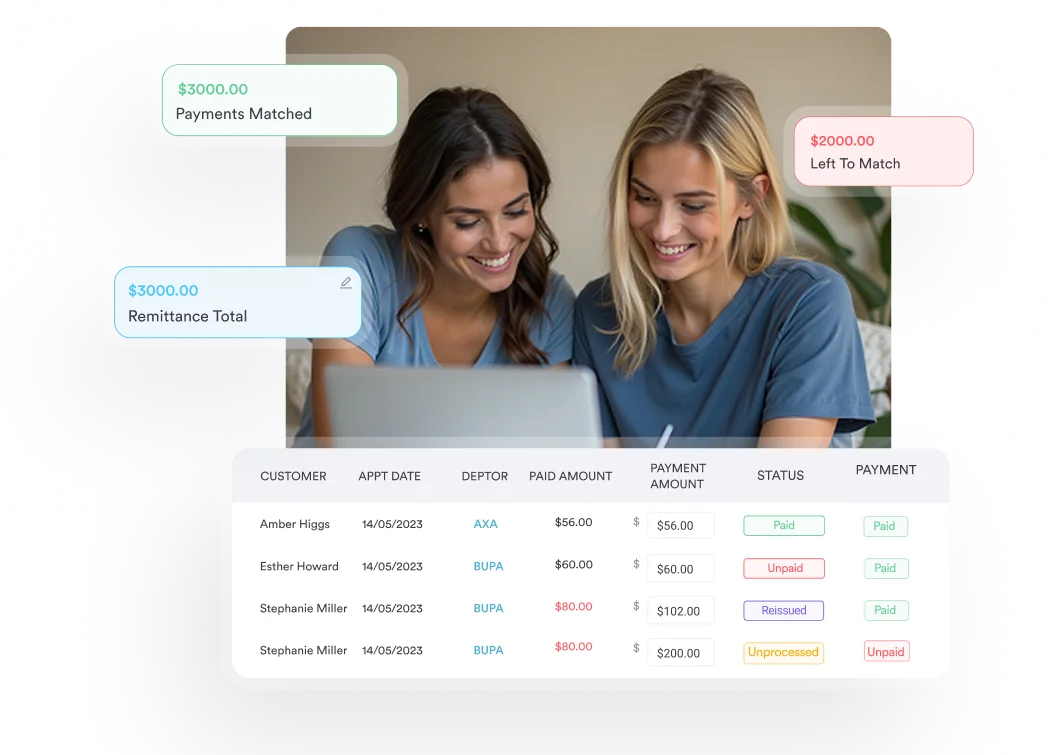
In Pabau, the practice records the prior authorization on the patient’s case, with the auth code, its dates, and the approved sessions. Pabau warns staff when an authorization is missing, so the front desk can chase it before the surgery date.
US practices send claims through Pabau’s Claim.MD integration as CMS-1500 or 837P claims. Staff run eligibility checks from the same system, and ERA remittances come back into Pabau, along with secondary claims when a second payer is involved.
Code selection stays with the coder, who reads the weight, adnexal status, and modifiers from the operative and pathology reports. Pabau handles the submission around that decision, and its claims management cuts rework for OB/GYN practices billing hysterectomy codes.

Pabau tracks prior authorizations on the patient’s case and sends CMS-1500/837P claims through Claim.MD, with eligibility checks and ERA remittances in the same system.

Treat 58550 as a narrow code. It fits one operation: an LAVH on a uterus of 250 g or less, with the tubes and ovaries left in place. Change any one of those facts and a sibling code takes over.
The practical move is to stop coding from the name of the surgery. Wait for the pathology weight, confirm the adnexal status in the operative note, and check current NCCI edits for any other procedure done that day. That costs a short delay before submission, which is far cheaper than a recoupment after audit.
Book a demo to see how Pabau handles prior authorizations, eligibility checks, and Claim.MD submission for OB/GYN surgical claims.

Did the surgeon remove a tube or ovary? CPT code 58552 covers LAVH with adnexal removal for a uterus of 250 g or less.
Was the hysterectomy done fully laparoscopically? CPT code 58571 explains the total laparoscopic hysterectomy code with tube or ovary removal.
No laparoscopic phase at all? CPT code 58262 covers vaginal hysterectomy with removal of tubes or ovaries.
Did the case convert to an open approach? CPT code 58150 covers total abdominal hysterectomy and its billing rules.
Working a denied hysterectomy claim? Denial codes in medical billing breaks down CARC reason codes and the fix for each common denial.
CPT code 58550 covers a laparoscopy-assisted vaginal hysterectomy (LAVH) for a uterus of 250 g or less, with the tubes and ovaries left in place. The surgeon frees the uterus laparoscopically, then removes it through the vagina. The code includes the diagnostic laparoscopy and fibroids removed with the uterus.
No. CPT 58550 is a hysterectomy code, so the uterus is removed. Laparoscopic myomectomy, which keeps the uterus, is coded 58545 or 58546. The former laparoscopic myomectomy code, 58551, was deleted in 2003.
Both describe an LAVH on a uterus of 250 g or less. CPT 58552 adds removal of one or more tubes or ovaries, including a bilateral salpingectomy at the same session. When the tubes and ovaries stay, the code is 58550.
Use 58553 when the uterus weighs more than 250 g and the tubes and ovaries stay in place. Take the weight from the pathology report, not a pre-operative ultrasound estimate. If a tube or ovary was also removed, the code is 58554.
CPT 58550 is an LAVH, where part of the hysterectomy is done vaginally. CPT 58571 is a total laparoscopic hysterectomy with removal of tubes or ovaries, for a uterus of 250 g or less. The two codes belong to different families and are never billed together.
Common primary codes include D25.0-D25.9 for uterine fibroids, N80.03 for adenomyosis, and N81.2 or N81.3 for uterovaginal prolapse. Heavy bleeding codes such as N92.0 and N92.1 also support the claim. List the structural diagnosis first and symptom codes after it.
CPT 58550 carries a 90-day global period. Routine post-op visits within those 90 days are part of the surgical payment. Bill an unrelated visit with modifier 24, a related return to the OR with 78, and an unrelated procedure with 79.
The most common are 22 for substantially increased work and 51 for a separately reportable procedure at the same session. Modifier 59 or XS bypasses an NCCI edit. Modifiers 80 or 82 apply to an assistant surgeon. Modifiers 24, 78, and 79 apply during the 90-day global period.