

HCPCS Code L0472: Hyperextension TLSO billing guide
HCPCS code L0472: Official descriptor and device definition HCPCS code L0472 des...

Last Updated: Nov 5, 2026
55875 is the CPT code for transperineal placement of needles or catheters into prostate for interstitial radioelement application, with or without cystoscopy.
It covers the surgical needle-placement step of prostate brachytherapy. The radiation oncologist reports the radiation source application separately, with codes such as 77778 for LDR seeds or 77770-77772 for HDR.
Let Pabau's smart automation suggest the right codes, reduce claim denials, and keep your practice compliant—effortlessly.
Automate repetitive tasks and focus on what matters most—your patients.
Reduce coding errors and ensure compliance with the latest regulations.
Clean claims, fewer denials, and faster reimbursements.
Powerful insights and reporting to help your practice thrive.
HIPAA compliant SOC 2 certified GDPR-compliant Trusted by 4,000+ clinics worldwide

CPT code 55875 covers transperineal needle or catheter placement into the prostate. The radiation oncologist bills the radiation source application as a separate step.
C61 (malignant neoplasm of prostate) is the primary supported ICD-10 diagnosis. Payer LCDs add staging, PSA and Gleason criteria on top of it.
Modifier 62 applies when a urologist and radiation oncologist co-perform the procedure. Verify that each payer accepts it rather than modifier 66.
Medicare’s CY2026 national payment for 55875 is about $687.72, from 20.59 total RVUs at the non-QP conversion factor.
Pabau’s claims management, part of the practice software we build, scrubs each claim for missing or invalid details before submission.
CPT code 55875 describes transperineal placement of needles or catheters into the prostate for interstitial radioelement application, with or without cystoscopy. The American Medical Association (AMA), which maintains the CPT code set, assigns it to the surgical treatment step of prostate brachytherapy. Also, the step is performed through the perineum under scan guidance.
Also, the code sits within the Male Genital System group of CPT’s Surgery section (codes 54000-55899). First, it is billed by the urologist or surgeon who places the needles or catheters. In contrast, the radiation oncologist bills the brachytherapy source codes (often from the 77000-series).
Because 55875 is a surgical code, it never carries the radiation oncology work. As a result, two teams bill the same patient visit from two angles, and their codes must stay apart.
So each biller in the session reports its own line, whether the case uses LDR seeds or HDR catheters.
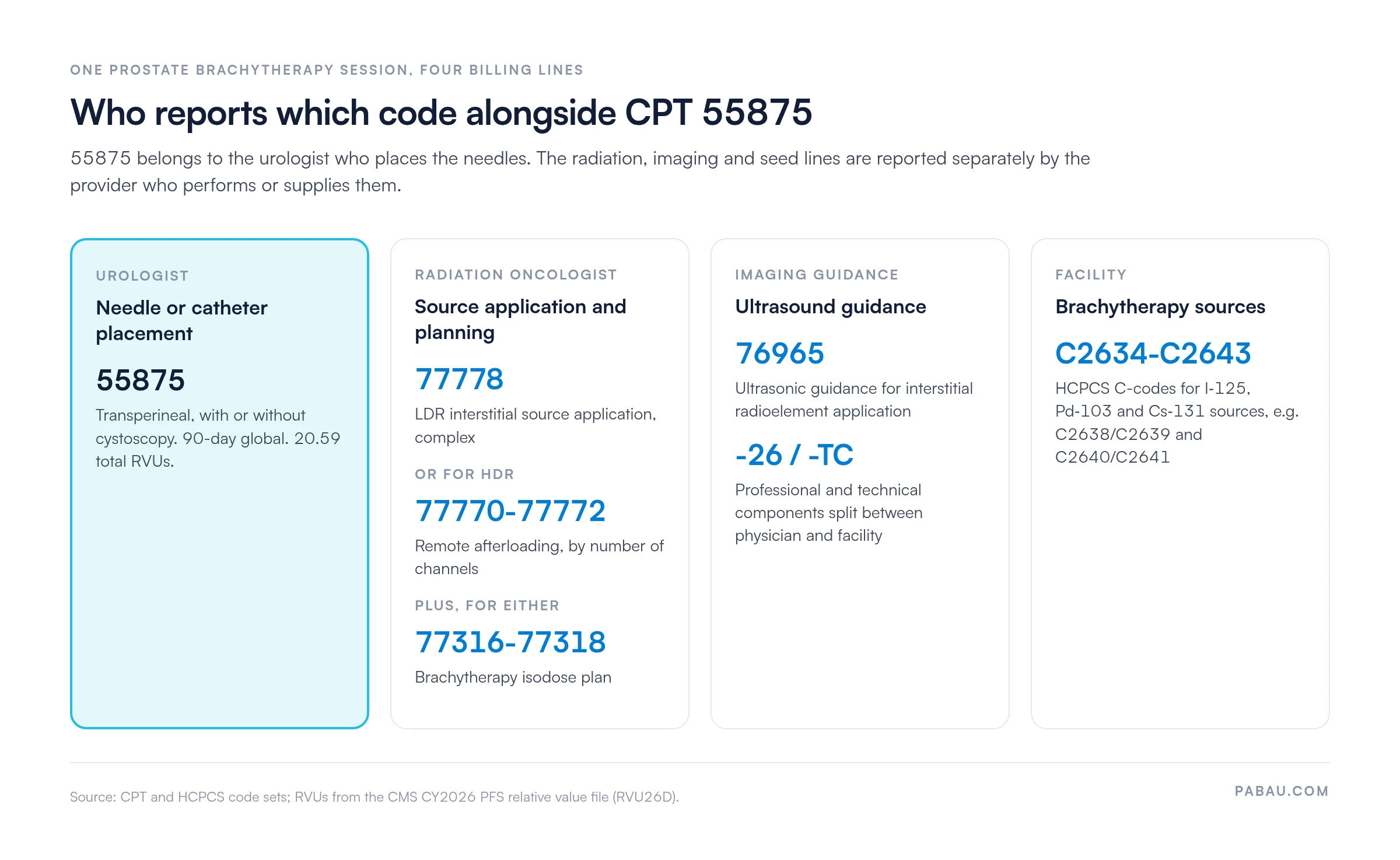
The transperineal approach follows a fixed sequence. In addition, each step maps to a detail the claim depends on. If an op report skips one, it invites a medical-necessity denial.
The op report must confirm the transperineal approach clearly. For example, a report that notes only “brachytherapy performed” without listing the route falls short for most Medicare Administrative Contractor (MAC) reviews.
CPT code 55875 covers the needle or catheter placement step for both low-dose-rate (LDR) and high-dose-rate (HDR) prostate brachytherapy. However, the distinction between types changes which linked codes follow, not whether 55875 itself applies.
Practices doing HDR work should check current National Correct Coding Initiative (NCCI) edits before billing. This matters because bundling links between 55875 and the HDR codes change with CMS update cycles.
CPT 55875 covers transperineal needle or catheter placement for interstitial radioelement application (brachytherapy). CPT 55876 covers placement of interstitial devices, such as fiducial markers or dosimeters, for radiation therapy guidance (via needle, any approach). The two codes share the word “interstitial” but serve two goals, and mixing them up draws payer checks.
A useful shorthand: If the radioactive source goes in during the session, use 55875. If the procedure places a marker so that outside radiation can be aimed correctly later, use 55876.
First, CPT code 55875 covers needle or catheter placement only. The radiation source application, scan guidance, and dosimetry planning are each billed on their own lines when performed and noted. Check current NCCI edits before billing any linked code, since CMS revises the bundling pairs often.
When a urologist and radiation oncologist co-perform the brachytherapy session, have each provider document their distinct services in separate operative or procedure notes. A shared note signed by both physicians invites payer scrutiny and can result in one provider’s claim being denied as a duplicate.
Most Medicare Local Coverage Determinations (LCDs) covering prostate brachytherapy require C61 as the main diagnosis on a 55875 claim. So billing without it is the most direct path to a medical-necessity denial.
Payer LCDs also specify more criteria beyond the diagnosis code. For example, most require the Gleason score, PSA level, and staging (often T1c-T2c for LDR brachytherapy monotherapy). Then check the specific LCD for your MAC jurisdiction before filing. Part B MACs that process these claims include Novitas Solutions (JH/JL), CGS Administrators (J15), NGS (J6/JK) and WPS (J5/J8).
Overall, Medicare pays CPT code 55875 under the Medicare Physician Fee Schedule (MPFS), adjusted for the practice’s locality. The CMS Physician Fee Schedule lookup tool is the authoritative source for current rates. Also, the figures below are the 2026 national base values from the CMS relative value file.
Because CMS sets no second non-facility rate for 55875, the professional payment is the same in a hospital, an ASC or an office. Meanwhile, the facility receives its own Ambulatory Payment Classification (APC) payment for the technical side. The CMS PFS relative value files list the work, practice expense and malpractice RVUs for each code.
After the session, practices should reconcile expected and actual payments by reviewing electronic remittance advice (ERA) files. ERAs show the CARC reason code when a claim is reduced or rejected. As a result, reading them quickly exposes a repeated billing error before it spreads across more claims.
First, prior auth rules for CPT 55875 vary widely by payer and plan. Traditional Medicare (Parts A and B) does not require prior auth for prostate brachytherapy, but Medicare Advantage plans and most private payers do. Treat each non-traditional-Medicare claim as needing prior auth until that specific plan confirms it does not.
Notes that often support medical necessity in a prior auth request include:
If a payer’s LCD includes comparative-effectiveness criteria, note why implants were chosen over EBRT, radical prostatectomy or active surveillance. Also, that rationale belongs in the record as part of medical billing compliance. Private prior auth often takes 5-10 business days, and Medicare Advantage plans vary. So submit the request at least two weeks before the session date.
Correct modifier use on CPT 55875 claims prevents payment reductions and avoids team-surgery audit triggers. So four modifiers apply most often to this code.
When using modifier 62, both the urologist’s and radiation oncologist’s claims must carry modifier 62, and each must note their own part. Still, a single shared op note may not satisfy all payer rules for the two-surgeon modifier.
The denials below trace to office and charting problems that a billing team can fix before filing. In addition, each fix follows the root-cause approach used in denial management.
Review the medical billing denial codes for the full CARC/RARC reference. Then trace each denial to the charting or coding error behind it.
So the following records are required for a 55875 claim to survive payer review. If any one is missing, the payer can request records or deny the claim outright. Use this as a pre-filing checklist before each treatment case is coded and billed. For practical guidance on building a clean claim, review how each part maps to a CMS-1500 field or EDI loop.
Run a pre-submission audit on every 55875 claim. Pull the operative note, confirm it states the transperineal approach, count the documented needles, and check that C61 is the principal diagnosis.
A single treatment session produces claim lines from the urologist, the radiation oncologist, imaging and the facility. Each line needs its own auth number, diagnosis pointer and place-of-service code before it goes out.
Pabau’s claims management software scrubs each claim for missing or invalid details before filing. Your team corrects a flagged 55875 claim before a payer ever sees it.
Also, US practices submit through Claim.MD, Pabau’s integrated US clearinghouse partner, which reaches thousands of US payers. It runs real-time eligibility checks before the session date. Once payers respond, Pabau brings ERA files back against the claims they settle and shows the reason for a rejected claim.

Pabau’s claims management scrubs each CPT 55875 claim for missing or invalid details before submission. US claims then go to thousands of payers through Claim.MD.

Overall, treat 55875 as one line in a claim set that spans up to four billers. The urologist’s claim holds up when the op note names the transperineal approach and needle count, and C61 leads the diagnoses.
Before the first case, agree with radiation oncology and the facility on who reports 77778 or 77770-77772, 76965 and the source C-codes. If you settle that once, you prevent the duplicate-service denials that would surface in the ERA weeks later.
Pabau routes 55875 claims through the Claim.MD clearinghouse with claim scrubbing and real-time eligibility checks. It brings ERA files back into Pabau against the claims they settle, and shows the reason for a rejected claim. Book a demo to see that workflow on a prostate brachytherapy claim.

Need to track denial codes across multiple 55875 claims? What is revenue cycle management explains how to build a denial tracking workflow that catches repeat patterns early.
Submitting claims through a clearinghouse for the first time? Claim.MD clearinghouse overview walks through how a claim moves from your practice to the payer.
Billing the companion fiducial placement? CPT code 55876 covers the descriptor, documentation and payment rules for prostate fiducial markers.
Coding the diagnosis behind the procedure? ICD-10 code C61 explains when to report malignant neoplasm of prostate as the principal diagnosis.
Preparing your billing team for a payer audit? Superbill creation guide covers how to structure a superbill for surgical procedures that carry multiple companion codes.
CPT code 55875 covers transperineal placement of needles or catheters into the prostate for interstitial radioelement application, with or without cystoscopy. It covers only the needle placement step of prostate brachytherapy. The radiation oncologist bills the radiation source application separately, using codes such as 77778.
CPT 55875 places radioactive seeds or brachytherapy catheters into the prostate as the treatment itself. CPT 55876 places non-radioactive fiducial markers or dosimeters that guide external beam radiation therapy delivered in a separate course. In short, 55875 implants the radiation source, while 55876 places a guidance device.
C61 (malignant neoplasm of prostate) is the primary required diagnosis code under most Medicare MAC LCDs for CPT 55875. Some LCDs also require staging documentation. Check your MAC’s LCD to confirm which secondary codes, such as PSA status or staging, it accepts.
Traditional Medicare does not require prior authorization for CPT 55875, but most Medicare Advantage and commercial payers do. Requirements vary by plan, so verify with the individual payer before scheduling. Submit requests at least two weeks ahead, with biopsy pathology, PSA level, Gleason score and staging documentation.
Yes. 55875 and 77778 are billed together when both services are performed and separately documented. The urologist bills 55875 for needle placement, and the radiation oncologist bills 77778 for the interstitial radiation source application. When one physician performs both steps, check NCCI edits to confirm the pair is not bundled.



