CPT code 33234: Pacemaker lead removal billing guide
CPT code 33234: Official descriptor and code placement CPT code 33234 is the cod...

Last Updated: Nov 26, 2026
57156 is the CPT code for insertion of a vaginal radiation afterloading apparatus for clinical brachytherapy. It covers placing the applicator, most often a vaginal cylinder after hysterectomy, and not the radiation delivery or dosimetry.
Coders see it most on adjuvant vaginal cuff brachytherapy for endometrial cancer. Ovoids or a uterine tandem move the case to 57155, and HDR courses bill 57156 once per insertion.
Let Pabau's smart automation suggest the right codes, reduce claim denials, and keep your practice compliant—effortlessly.
Automate repetitive tasks and focus on what matters most—your patients.
Reduce coding errors and ensure compliance with the latest regulations.
Clean claims, fewer denials, and faster reimbursements.
Powerful insights and reporting to help your practice thrive.
HIPAA compliant SOC 2 certified GDPR-compliant Trusted by 4,000+ clinics worldwide

CPT code 57156 covers only the insertion of a vaginal afterloading applicator, such as a cylinder, and the radiation delivery is billed separately.
Ovoids or a uterine tandem, alone or together, move the case to CPT 57155 instead of 57156.
For HDR brachytherapy, 57156 is billed once per insertion, so a five-fraction course carries five lines rather than one.
Payers look for a procedure note that names the applicator type, the dose prescribed, and the treating provider for every insertion.
Practice software such as Pabau sends 57156 claims through Claim.MD, with eligibility checks and ERA remittances kept on the patient record.
CPT code 57156 covers the insertion of a vaginal radiation afterloading apparatus, such as a vaginal cylinder, for clinical brachytherapy. In the Society of Gynecologic Oncology coding guidance, placing a vaginal cylinder for adjuvant vaginal brachytherapy is coded 57156. The radiation delivery and dosimetry are reported with separate codes.
The code sits in the Female Genital System section of CPT, among the introduction procedures on the vagina. The radioactive source is loaded into the applicator afterward, in the vaginal vault rather than the uterine cavity.
Check the descriptor against the current-year AMA CPT code set before you rely on it, since descriptors can change in annual revisions.
CPT 57156 captures the insertion step of vaginal brachytherapy. That means placing a vaginal cylinder or other vaginal-only afterloading applicator in the vaginal vault. Ovoids, with or without a tandem, are coded 57155, and the radiation delivery that follows is billed with its own codes.
The code is billed most often after hysterectomy for endometrial or cervical cancer. In those cases the patient receives adjuvant vaginal cuff brachytherapy to lower the risk of local recurrence.
The clinical scenarios where 57156 applies include:
The source loaded into the applicator is most commonly iridium-192 (Ir-192) for HDR treatments. Name the applicator in the note, such as "vaginal cylinder" with its diameter. Auditors read the procedure note first when they question medical necessity.
The difference between high-dose-rate (HDR) and low-dose-rate (LDR) brachytherapy decides how often 57156 is billed. HDR delivers a high dose in minutes through a remote afterloader. LDR delivers a lower, continuous dose over hours or days, with the applicator left in place.
For an HDR vaginal cuff course of five fractions, 57156 is billed five times, once per applicator insertion. A five-fraction course billed as a single unit of service is likely to be denied or returned for incorrect units. Confirm the billing unit against the payer’s LCD or policy before submitting.
Several brachytherapy codes are routinely reported with CPT code 57156, depending on the services documented. Each one needs its own note or report. Aetna’s brachytherapy policy lists the same code families, and the table below shows which are separately billable.
NCCI (National Correct Coding Initiative) edits are updated quarterly. Run a current NCCI check before submitting 77316-77318 or 77770-77772 alongside 57156, because bundling pairs can change each quarter.
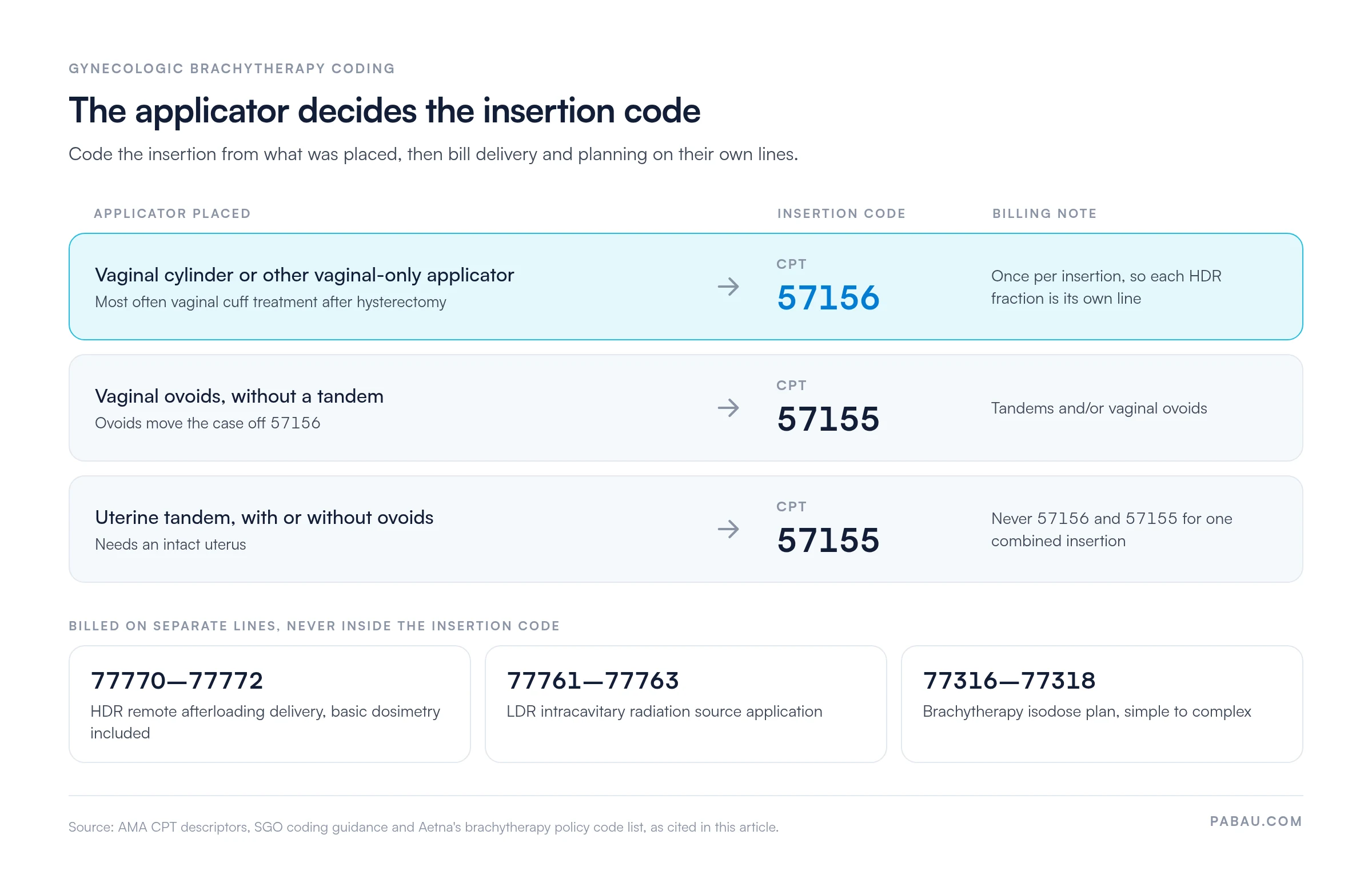
CPT 57155 covers the insertion of uterine tandems and/or vaginal ovoids, while CPT 57156 covers a vaginal cylinder or other vaginal-only applicator. The applicator decides the code. If ovoids are placed, with or without a tandem, 57155 applies. A cylinder alone in the vaginal vault, usually after hysterectomy, is 57156.
A combined tandem-and-ovoid or tandem-and-ring setup is one 57155 insertion, not 57155 plus 57156. Billing 57156 for that case understates the procedure and may be queried in post-payment audits. The chart below maps each applicator setup to its insertion code and the lines billed beside it.
Documentation is the most controllable factor in whether a 57156 claim is accepted. Payers, Medicare included, routinely deny brachytherapy claims when the procedure note misses key elements, even when the service was appropriate. Billing compliance for radiation oncology depends on a complete note before each fraction.
Every 57156 claim should be supported by documentation that includes:
A clean claim for CPT code 57156 needs all six elements before it leaves the billing team. Missing even one, most often the applicator type, is enough to trigger a documentation denial.
Run a documentation checklist before each 57156 claim, not after. Build a standard procedure note template that asks the radiation oncologist to record applicator type, diameter, dose prescribed, and treating provider. Catching a missing field before submission takes seconds. Working a denial appeal takes hours.
Medical necessity for CPT code 57156 is established through the linked ICD-10-CM diagnosis on the claim. Payers cross-reference the diagnosis against the procedure to confirm it fits. For most vaginal cuff cases, the linked diagnosis is endometrial cancer, coded C54.1.
Z85.42 fits a patient who has finished active treatment and is in surveillance. Many payers want an active malignancy code, such as C54.1 or C53.x, while brachytherapy fractions are part of a current treatment plan. Confirm the payer’s policy before using a history code in place of an active-disease code.
Medicare covers CPT code 57156 for medically necessary vaginal brachytherapy. A credentialed radiation oncologist must perform it, with documentation that meets the applicable Local Coverage Determination (LCD). LCDs are issued by Medicare Administrative Contractors (MACs), and the LCD number and effective date vary by jurisdiction. Check the current LCD for your region rather than a generic national policy.
Key coverage considerations for Medicare claims:
RVU values for CPT code 57156 are published each year in the Medicare Physician Fee Schedule (MPFS). Verify current-year figures with the CMS Physician Fee Schedule lookup tool, because RVUs and the conversion factor are updated each January. The table below shows how each component behaves by setting.
We don’t print fixed RVUs for 57156 here, because CMS revises them each year. Payment also moves with the conversion factor and your locality’s GPCI adjustment. Use the FastRVU 2026 RVU lookup tool for a breakdown by ZIP code, or pull national rates from the CMS search.
Commercial payer rates for 57156 are set in each practice’s payer contracts. Check the fee schedule in your agreement rather than relying on a published average.
Denials on 57156 tend to repeat a short list of errors. Fixing each pattern at its source cuts rework and protects revenue. Strong denial management workflows for brachytherapy codes should cover each of the following before claims leave the queue.
Reviewing denial codes alongside your 57156 remittance data lets the billing team group errors by root cause. Fixing the documentation template or the billing unit rule prevents repeats, which beats appealing each claim on its own.
Modifiers change how a 57156 line is paid, so apply them with care. As a surgical code with no professional or technical split, 57156 takes neither -26 nor -TC.
An HDR vaginal cuff course turns one coding decision into three to five 57156 lines. Each line needs its own date of service, a procedure note, and an authorization that still covers that session. Many billing teams track those sessions in a spreadsheet beside the claims system.
Pabau, a practice management platform with insurance billing built in, sends US claims through the Claim.MD clearinghouse as CMS-1500/837P claims. Eligibility checks run from the patient’s record, and ERA remittances come back against each claim.
Pabau’s claims management software also keeps the authorization code, dates and approved sessions on the patient’s case. It warns your team when an authorization is missing, so you can compare approved sessions with the fractions already billed.
The result is one record for the course, holding the authorization, the claim lines and the remittances. When a 57156 line is denied, the ERA reason code sits on that claim, so you fix the cause rather than rebuild the history.

Pabau sends US claims through Claim.MD, runs eligibility checks and posts ERA remittances back to each claim. Authorization codes and approved sessions sit on the patient’s case.

Treat 57156 as the insertion code alone. Bill it once per insertion, name the applicator in every note, and put delivery and planning on their own lines. When ovoids or a tandem go in, the case belongs to 57155.
The trade-off is volume. A five-fraction HDR course means five insertion lines, five notes and five chances for a missing detail. Getting each note right before the fraction is billed costs far less than appealing a denied line.
Book a demo to see how Pabau tracks authorizations, claims and remittances across a brachytherapy course.

Need a clearinghouse for radiation oncology claims? Pabau’s Claim.MD clearinghouse guide explains how the integration handles electronic submissions, real-time eligibility, and ERA responses for CPT claims.
Getting repeat denials on brachytherapy claims? What makes a clean claim walks through the pre-submission checklist that prevents the documentation and coding errors that drive 57156 denials.
Want to benchmark your denial rate? What is revenue cycle management covers the key metrics – denial rate, days in AR, clean claim rate – that radiation oncology practices should track by code.
CPT code 57156 describes the insertion of a vaginal radiation afterloading apparatus, such as a vaginal cylinder, for clinical brachytherapy. It is used most often for vaginal cuff treatment after hysterectomy. It covers the insertion only. Radiation delivery, treatment planning and dosimetry are reported separately.
CPT 57156 applies to both HDR and LDR intracavitary brachytherapy. For HDR, it is billed once per insertion, so each fraction is a separate unit of service. For LDR, it is billed once per insertion episode. The LDR source application is reported with 77761-77763, and HDR delivery with 77770-77772.
Yes. Medicare covers CPT code 57156 for medically necessary vaginal brachytherapy, performed by a credentialed radiation oncologist and documented per the applicable LCD. Coverage details, including supervision and site-of-service rules, vary by MAC jurisdiction. Medicare Advantage plans may require prior authorization that traditional Medicare Part B does not.
CPT 57155 covers the insertion of uterine tandems and/or vaginal ovoids. CPT 57156 covers a vaginal cylinder or other vaginal-only applicator. The applicator decides the code. Ovoids, with or without a tandem, are 57155, while a cylinder alone, usually after hysterectomy, is 57156.
RVU values for CPT 57156 are published in the Medicare Physician Fee Schedule and updated each January. Use the CMS MPFS lookup tool or AAPC Codify to retrieve current work, practice expense, and malpractice RVUs. Non-facility rates are higher than facility rates because they include the practice’s overhead.
The most common causes are billing an HDR course as one unit and a procedure note that omits the applicator type or dose. Missing prior authorization and a diagnosis that does not establish gynecologic malignancy also drive denials. Fixing the note template and the billing unit rule prevents most of them before submission.