CPT code 27488: Removal of total knee prosthesis
CPT code 27488: official description and procedure overview CPT code 27488 is de...

Last Updated: Oct 15, 2026
CPT code 55876 reports placing interstitial devices in the prostate to guide radiation therapy. The devices are usually gold fiducial markers or dosimeters, inserted by needle through any approach. One unit covers the session, whether the physician places one marker or several.
Radiation teams use the markers to find the prostate on daily imaging before each treatment. Imaging guidance and the marker supply are reported on their own claim lines. CPT 55874 is a different service, the transperineal placement of a biodegradable spacer between the prostate and rectum.
Let Pabau's smart automation suggest the right codes, reduce claim denials, and keep your practice compliant—effortlessly.
Automate repetitive tasks and focus on what matters most—your patients.
Reduce coding errors and ensure compliance with the latest regulations.
Clean claims, fewer denials, and faster reimbursements.
Powerful insights and reporting to help your practice thrive.
HIPAA compliant SOC 2 certified GDPR-compliant Trusted by 4,000+ clinics worldwide

CPT 55876 reports needle placement of fiducial markers or dosimeters in the prostate, through any approach, to guide radiation therapy.
CPT 55874 is a separate service: transperineal placement of a biodegradable rectal spacer such as SpaceOAR.
Imaging guidance (76942, 77002, 77012 or 77021) and the marker supply (HCPCS A4648) are reported separately from 55876.
CPT 55876 carries a 000-day global period and pays about $151 in the office under the 2026 Medicare fee schedule.
C61 supports medical necessity for most 55876 claims, including salvage radiation after prostatectomy.
CPT code 55876 reports the placement of interstitial devices in the prostate to guide radiation therapy. The AMA’s CPT code set files it under Surgery, in the male genital system’s prostate codes.
The official descriptor reads: “Placement of interstitial device(s) for radiation therapy guidance (eg, fiducial markers, dosimeter), prostate (via needle, any approach), single or multiple.”
Three words in that descriptor settle most coding questions. “Needle” means a percutaneous placement. “Any approach” means transrectal and transperineal routes use the same code. “Single or multiple” means one unit covers the session, however many markers go in.
The code covers the placement itself. Imaging guidance and the marker supply sit on separate claim lines, and the sections below explain both.
The prostate shifts a few millimeters between treatments as the bladder and rectum fill. Fiducial markers, usually small gold seeds, give the team a fixed landmark inside the gland.
The markers show clearly on the kV imaging and cone-beam CT built into modern linear accelerators. Before each fraction, the team aligns the beam to the markers, not to the planned position.
The two codes describe different devices in different places. CPT 55876 puts guidance devices inside the prostate. CPT 55874 puts a biodegradable spacer between the prostate and the rectum.
Many practices place markers and a spacer in one session. In that case, each code reports its own service. Check the NCCI table for the date of service before you submit the pair.
CPT 55875 is a third, separate code. It reports transperineal placement of needles or catheters into the prostate for interstitial radioelement application. Markers placed for external beam guidance never belong under 55875.
The CPT parenthetical under 55876 points imaging guidance to four codes. Most placements run under ultrasound, so 76942 is the pairing you will see most often. Otherwise, pick the code that matches the imaging your physician used.
A parenthetical that lists guidance codes signals separate reporting. NCCI edits still apply, though, and CMS updates them every quarter. Check the current NCCI procedure-to-procedure table for your code pair before submission.
Never add modifier 59 or XU just to push a pair through. Those modifiers need a distinct service on record, and a routine guidance image does not qualify.
The prostate biopsy family works the other way. Imaging guidance is built into the 55706 descriptor, and AMA parentheticals bar 76942 across the 55705 to 55715 range.
When your practice buys the markers, report them with HCPCS A4648, implantable tissue marker, one unit per marker. The CMS one-time notification on implantable tissue markers names 55876 as a procedure where A4648 is payable. That payment applies on the physician claim.
In a hospital outpatient department or ASC, the facility usually supplies the markers. In that setting, the physician claim carries 55876 and the guidance code only. The claim map below shows how each line changes with the setting.
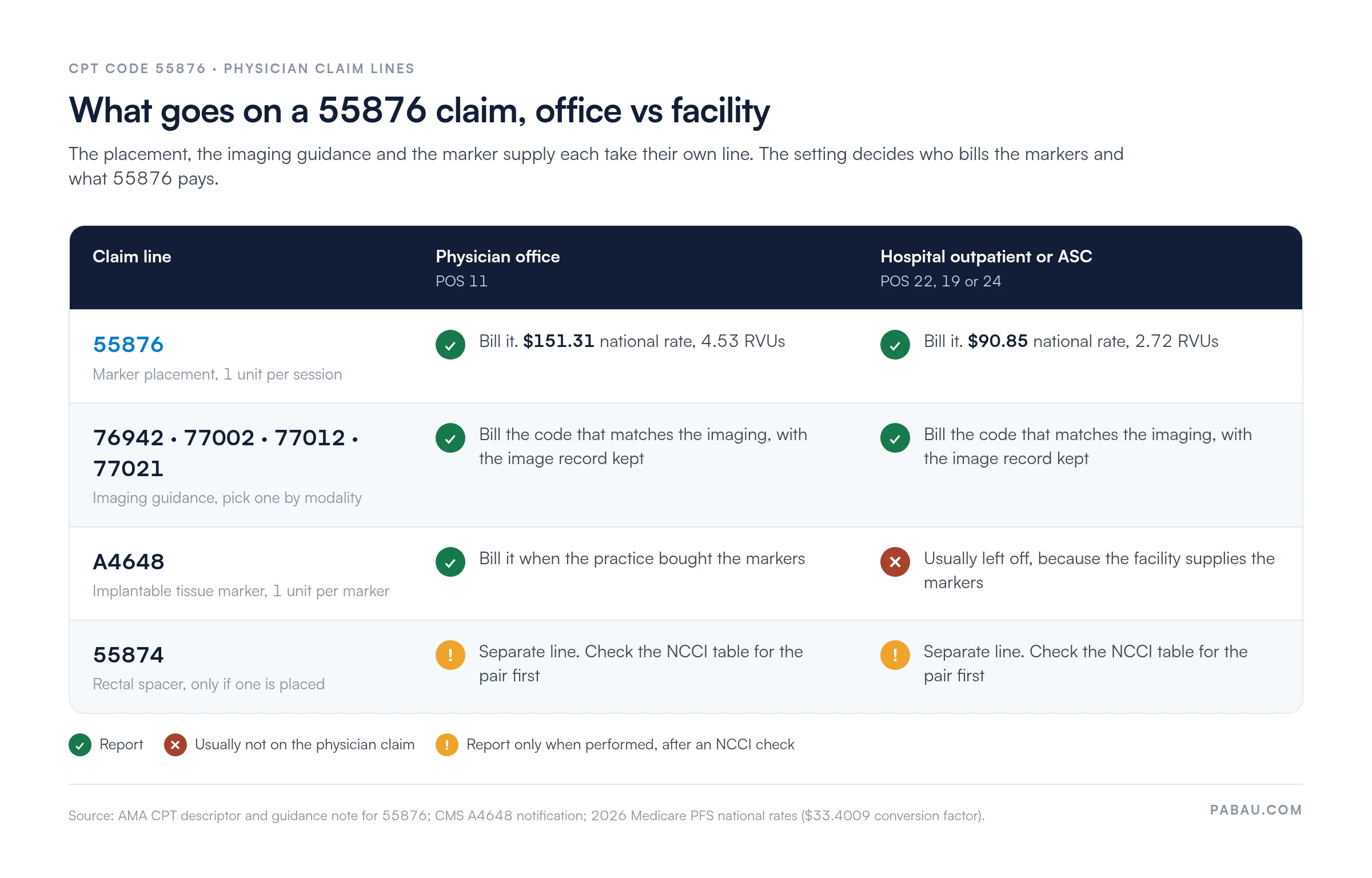
A 55876 claim needs a diagnosis that shows prostate cancer treated with radiation. For most patients, that is C61.
Z85.46, personal history of prostate cancer, rarely fits here. ICD-10-CM guidelines reserve history codes for cases with no further treatment directed at the site. Salvage radiation is that treatment, so C61 stays primary. Confirm current descriptors in the CDC/NCHS ICD-10-CM browser tool.
CPT 55876 is a minor procedure with a 000-day global period. Only same-day care is bundled, and the payment depends on where the placement happens.
These national figures come from FastRVU’s 2026 lookup and use the $33.4009 conversion factor. Your locality adjustment changes the final amount. Confirm your rate in the CMS Physician Fee Schedule Look-Up Tool before you quote it.
The office rate is higher because it covers the practice’s overhead. In a facility, the hospital or ASC is paid separately for that overhead.
Traditional Medicare does not usually require prior authorization for 55876. Many other payers do, so check before you schedule.
Build the request around the treatment plan. Name the cancer diagnosis, the planned EBRT or SBRT course, and why image guidance is needed. Our prior authorization process guide covers the request process in more detail.
Payers and auditors look for the same handful of facts in a 55876 note. Missing one is enough to trigger a records request.
Most 55876 denials repeat the same few errors. Each one has a fix you can build into your pre-submission routine. For a broader process, see our denial management guide.
Start with the reason code on the remittance. Our list of common denial codes explains what each CARC means for the claim.
A 55876 denial often waits in a payer portal while staff chase other work. Pabau, the practice management platform we build, connects to the Claim.MD clearinghouse for US practices.
Your billing team submits the claim from the patient record and follows its status in one place. Pabau’s claims management software records each denial against the encounter. Staff correct the claim, attach the procedure note and resubmit without rekeying the visit.
Code selection stays with your coders and the checklist above. Pabau’s job starts once the claim leaves the practice, so a denied claim moves straight back into the correction queue.
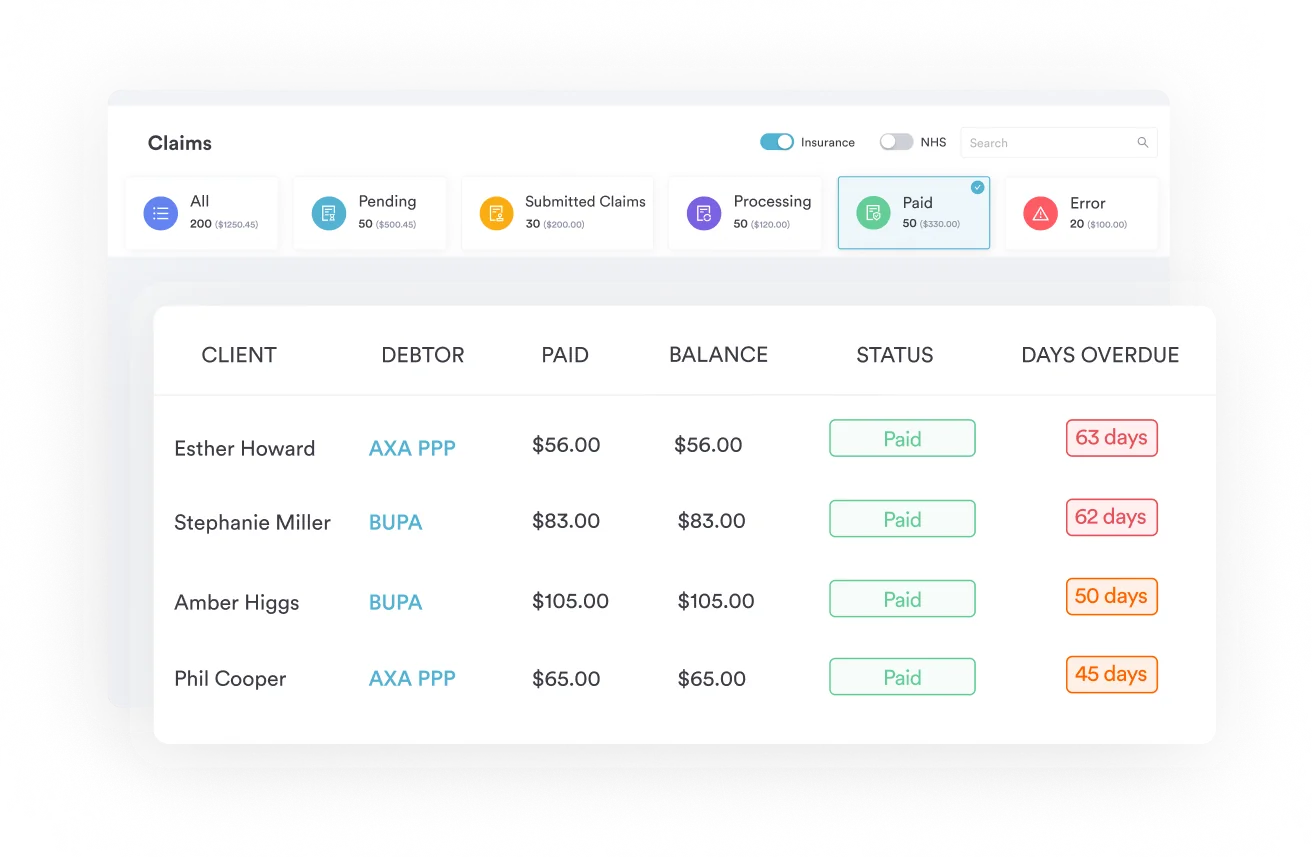

Pabau’s Claim.MD integration lets US practices submit claims, track denials and resubmit corrections from the patient record.

Most 55876 coding trouble starts with a misread descriptor. Treat 55876 as the marker code and 55874 as the spacer code, and the approach confusion goes away.
Then let the note carry the claim. Name the device, count the markers and record the imaging. Bill the guidance and the supply on their own lines, and the payer has little left to question.
After submission, the work shifts to follow-up. Book a demo to see how Pabau tracks 55876 claims from submission to payment.

Need to understand the full claim submission workflow? What is medical billing walks through the end-to-end process from patient encounter to payment posting.
Tracking down denied claims efficiently? Denial codes in medical billing explains the most common CARC and RARC codes practices encounter on remittances.
Want to reduce eligibility-related denials before they happen? Insurance eligibility verification covers how real-time verification fits into a pre-service workflow.
Seeing the same denial twice? Denial management in healthcare shows how to log denial reasons and fix the workflow behind them.
CPT 55876 covers needle placement of gold fiducial markers or dosimeters in the prostate. They guide radiation therapy. Any approach qualifies, and one unit covers single or multiple devices.
SpaceOAR placement is reported with CPT 55874, in use since January 1, 2018. It describes transperineal placement of biodegradable peri-prostatic material. Image guidance is included when performed, so 76942 is not added.
Yes, in most cases. Simulation and treatment planning codes describe separate radiation oncology services, often on later dates. When one provider bills both on the same date, check the current NCCI table first.
No. CPT points imaging guidance for 55876 to 76942, 77002, 77012 or 77021. Report the code that matches the imaging used, and keep the image record in the chart.
Bill one unit per session. The descriptor says “single or multiple,” so five markers still count as one service. When your practice supplies the markers, report each one with A4648.
CPT 55876 has a 000-day global period. Only same-day care is bundled, so a separate visit on a later date is billed on its own.