CPT Code 70490: CT soft tissue neck without contrast
CPT Code 70490: Official descriptor and clinical scope CPT Code 70490 carries th...

Last Updated: Oct 15, 2026
55706 is the CPT code for biopsies, prostate, needle, transperineal, stereotactic template guided saturation sampling, including imaging guidance.
The code covers saturation mapping of the whole gland through a perineal grid, with ultrasound guidance built in. The documented grid and saturation mapping decide the code. A transperineal ultrasound-guided biopsy without template saturation sampling is reported with 55709. CPT 55700 was deleted on January 1, 2026, while the 55706 descriptor stayed the same.
Let Pabau's smart automation suggest the right codes, reduce claim denials, and keep your practice compliant—effortlessly.
Automate repetitive tasks and focus on what matters most—your patients.
Reduce coding errors and ensure compliance with the latest regulations.
Clean claims, fewer denials, and faster reimbursements.
Powerful insights and reporting to help your practice thrive.
HIPAA compliant SOC 2 certified GDPR-compliant Trusted by 4,000+ clinics worldwide

CPT code 55706 reports transperineal, stereotactic template-guided saturation sampling of the prostate, with imaging guidance included. Other prostate biopsies route to 55705 or 55707–55715, since CPT 55700 was deleted in 2026.
The operative note must name the transperineal approach, the stereotactic template, saturation mapping, and the indication. A note that reads like a routine transperineal biopsy points the payer to 55709 instead.
Ultrasound codes 76872 and 76942 are not reported with 55706, because its descriptor has always included imaging guidance.
Aetna (CPB 0698) and BCBS Texas (SUR717) cover 55706 for a repeat biopsy after negative biopsies with a rising PSA. Atypia or HGPIN on a prior biopsy also qualifies. Both list active surveillance staging and pre-treatment mapping as experimental.
Pabau, the practice management platform we build, helps urology practices submit clean 55706 claims, track prior authorization, and manage denial appeals in one place.
CPT code 55706 reports a transperineal prostate biopsy taken by stereotactic template-guided saturation sampling, with imaging guidance included in the code. It sits in the Incision Procedures on the Prostate range (55705–55725) of the Surgery section in the AMA CPT code set.
The 55706 descriptor is unchanged since before 2026, and the same wording dates back to at least 2010. It has never set a minimum core count, and imaging guidance has always been part of the code. The “needle or punch” wording some coders remember belonged to CPT 55700.
The 2026 update deleted 55700, revised 55705, and added nine biopsy codes, 55707 through 55715. Knowing the medical billing fundamentals behind procedure-specific codes helps before you rebuild charge capture around the new family.
A saturation biopsy maps the whole prostate through a perineal grid, taking systematic cores zone by zone at set template coordinates. It usually yields far more cores than a sextant biopsy, but the descriptor sets no minimum count. The technique defines the code: transperineal access, a stereotactic template, and saturation sampling.
Payer policies cover CPT code 55706 for a narrow set of indications. Under Aetna CPB 0698 and BCBS Texas SUR717, the covered uses are:
Both policies list active surveillance staging as experimental and investigational. They treat pre-treatment mapping before focal therapy, such as HIFU or cryotherapy, the same way. Confirm the specific payer’s clinical policy before you schedule, because coverage criteria vary.
Billing CPT code 55706 for a routine transperineal biopsy is a compliance risk. A transperineal ultrasound-guided biopsy without template saturation mapping is reported with 55709.
CPT 55706 is one of 11 active prostate biopsy codes in 2026, and the choice between them turns on approach, imaging, and targeting. No code in the family is defined by a core count.
CPT 55700, the old “single or multiple” needle biopsy code, was deleted on January 1, 2026. It is invalid for any date of service from that day, so it is never an alternative to 55706.
Three questions settle the code before you bill a 2026 prostate biopsy, and the matrix after them maps every answer to its code:
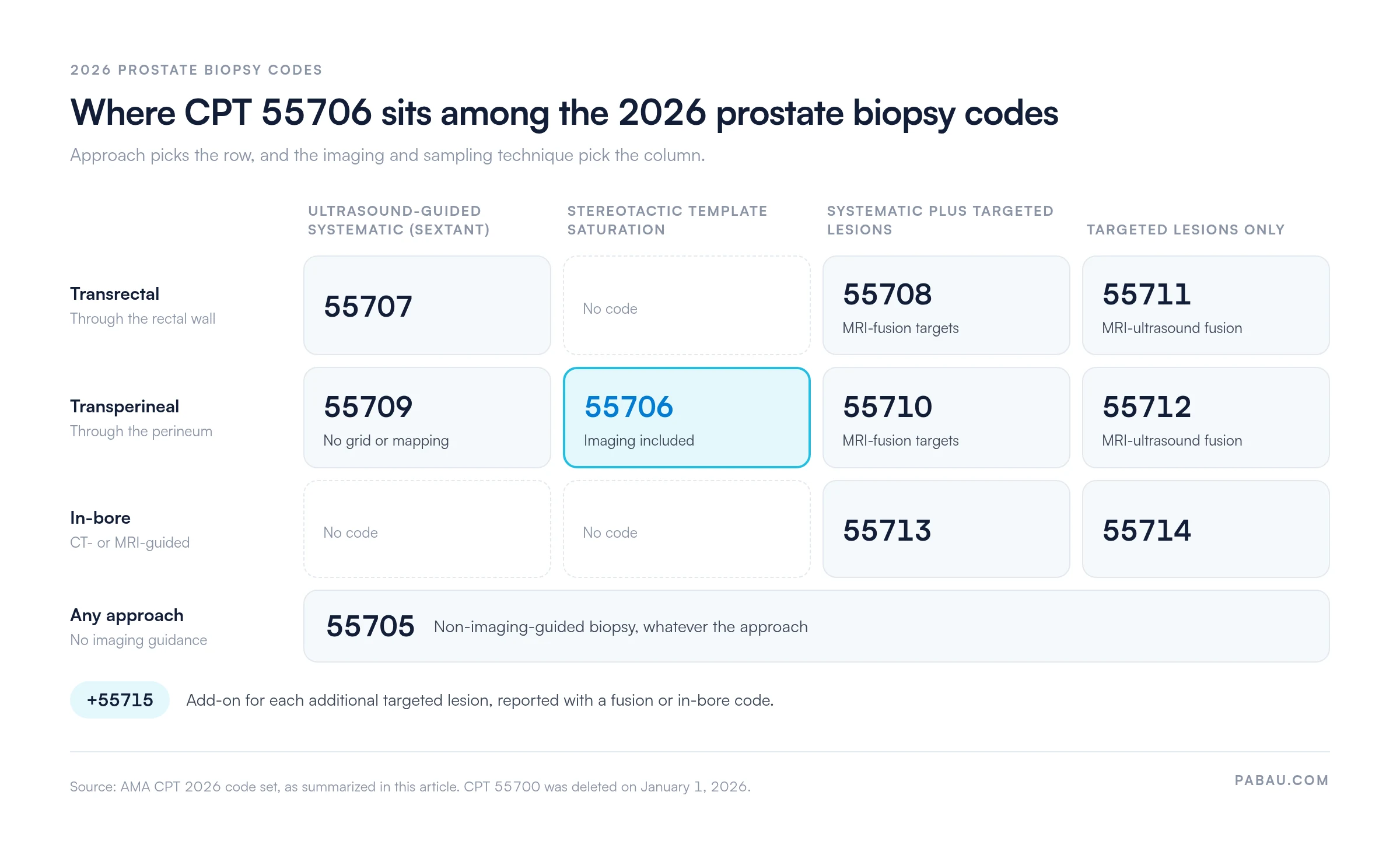
The line that matters most for 55706 sits between it and 55709. Both codes are transperineal and both include ultrasound guidance. If the operative note does not confirm a stereotactic template and saturation mapping, the payer will read the session as 55709. Check the note for the grid and the mapping before billing 55706.
Transrectal ultrasound (CPT 76872) and ultrasonic needle guidance (CPT 76942) are not reported with CPT code 55706. Imaging guidance has always been part of the 55706 descriptor. AMA parenthetical notes also bar both codes with every prostate biopsy code from 55705 to 55715.
Check the current CMS Physician Fee Schedule lookup and the quarterly NCCI edit tables before you report any service alongside CPT code 55706. Commercial payers usually mirror NCCI edits, sometimes with a short lag.
Audit every prostate biopsy order set and superbill this year. Any template that adds 76872 or 76942 to a 55706 claim generates a line-item denial. Remove deleted code 55700 from the same templates while you are there.
Generic “prostate biopsy” language in the operative report is the most preventable cause of 55706 denials. State every element below explicitly, because a missing one lets the payer recode the session as 55709 or 55705. Practices that connect their urology claims management workflow to structured note templates catch missing fields before submission.
Building a clean claim submission for 55706 requires confirming all six elements are present before the claim leaves the practice. A pre-submission checklist in the billing workflow flags a missing element while the surgeon can still add it, not weeks later in a denial.
Diagnosis code selection for CPT code 55706 claims determines whether medical necessity is satisfied. A diagnosis that does not match the payer’s coverage criteria for saturation biopsy is a frequent denial reason.
Pair R97.20 as a secondary diagnosis, not as the primary. Payers evaluating saturation biopsy expect a primary code that reflects the established clinical context. For a covered repeat biopsy, that usually means a neoplasm of uncertain behavior after a negative biopsy, with the PSA trend on file.
The AAPC Codify CPT lookup cross-references medical necessity crosswalks that identify acceptable ICD-10 pairings by payer.
Medicare does not have a National Coverage Determination specifically for saturation prostate biopsy. Coverage defaults to Local Coverage Determinations by MAC jurisdiction.
Most MACs cover 55706 when medical necessity criteria are met and documentation supports the saturation technique. Submit claims with complete operative documentation and a covered ICD-10 code. Missing either one triggers a medical necessity denial.
Practices that bill through Pabau can send claims through its Claim.MD clearinghouse integration. Eligibility and payer requirements are checked before the 55706 claim goes out, which cuts preventable rejections.
Note that BCBS SUR717 referenced here is the BCBS Texas policy. Other BCBS plans maintain separate policies that may define covered indications differently. Always verify the specific plan’s current policy with its effective date before billing CPT Code 55706.
The 2026 Medicare national average physician payment for CPT code 55706 is about $203 in a facility setting, based on 6.09 total RVUs. Medicare does not pay 55706 in the office setting, so the non-facility rate is listed as not applicable.
These figures are unadjusted national averages from the Boston Scientific 2026 prostate biopsy coding quick reference. They are built on CMS files and the 2026 conversion factor of $33.4009. Your payment depends on your MAC locality and its Geographic Practice Cost Index.
The comparison carries the practical point. 55706 pays the surgeon about $40 more than 55709 in a facility, but it has no office rate. A saturation biopsy booked in the office cannot be billed as 55706 to Medicare.
The FastRVU 2026 RVU lookup breaks 55706 into work, practice expense, and malpractice RVUs with location multipliers. Accurate fee schedule data supports your revenue cycle management and protects commercial rates benchmarked against Medicare.
Prior authorization for CPT code 55706 is required by many commercial payers but is not universally mandated. The table below covers the payer types urology billers meet most often, though requirements change every plan year.
Confirming insurance eligibility verification and prior authorization status before the procedure date is the single most effective way to prevent a 55706 authorization denial.
Medicare Advantage plans are the highest-risk category, because they behave like commercial payers rather than traditional Medicare. Their prior auth rules for saturation biopsy can be stricter than Aetna’s.
Pre-submission checklist for CPT 55706 prior authorization:
CPT code 55706 denials cluster around seven patterns. Each has a specific documentation fix and, when a denial does occur, a defined appeal path. Review your denial management workflows against this table each quarter.
Knowing the common denial codes gives your team the vocabulary to triage 55706 denials quickly. The CARC code on the remittance advice points to the denial category, which speeds up the appeal. Your clearinghouse’s ERA module shows the current CARC assignments.
Track every 55706 denial by CARC code in a denial log. After 30 days, sort by CARC. If ‘insufficient documentation’ (CARC 4 or 16) appears more than twice, the operative note template needs mandatory fields. Add core count, approach, and template type. Fix the template, not just the individual appeal.
Many 55706 denials start in the operative note, long before the claim reaches a payer. When a biller finds the template or the mapping missing, the surgeon has to dictate an addendum. That delay ages the claim and stalls any appeal.
Pabau’s clinical note templates can make approach, grid type, core count, and indication required fields for every saturation biopsy. The claim is built from that record, with the diagnosis attached, and sent through the Claim.MD integration. Authorization numbers sit on the patient’s record, so the scheduler sees a missing auth before the procedure date.
The outcome is fewer claims recoded to 55709 and no rejected imaging lines for 76872 or 76942. Your team spends its time on new claims instead of appeals.

Pabau helps urology practices manage prior authorization tracking, structured clinical documentation, and claim submission in one workflow. See how Pabau reduces 55706 denials before they happen.

CPT 55706 came through the 2026 overhaul with its descriptor intact, but the codes around it changed. CPT 55700 is gone, and 55709 now sits beside it as the transperineal ultrasound-guided option. That makes the operative note the document that decides which code the payer accepts.
Before your next saturation biopsy claim, update the charge master and remove 76872 and 76942 from the order set. Then add template and mapping fields to the operative note. The surgeon writes a longer note, and in exchange the claim holds at the 55706 rate.
Book a demo to see how Pabau carries urology documentation from the operative note to a clean claim.

Getting denials with remittance codes you do not recognize? Electronic remittance advice explained covers how to read ERA files and act on CARC denial codes.
Want to reduce claim rejections before they leave your practice? Medical billing compliance guide covers documentation and coding compliance requirements for procedure-level claims.
CPT code 55706 reports a transperineal prostate biopsy using stereotactic template-guided saturation sampling, with imaging guidance included. Payers cover it mainly for a repeat biopsy after negative biopsies with a rising PSA, or for atypia or HGPIN on a prior biopsy. Aetna and BCBS Texas list active surveillance staging and pre-focal-therapy mapping as experimental.
CPT 55700 was deleted on January 1, 2026, so it is no longer a valid alternative to 55706. It covered any prostate needle biopsy. CPT 55706 covers only transperineal stereotactic template saturation sampling, with imaging included. Biopsies once billed as 55700 now route to 55705 or 55707–55715.
Traditional Medicare generally covers CPT Code 55706 when medical necessity is established through documentation. Coverage is set by Local Coverage Determinations from the patient’s MAC jurisdiction rather than a national policy. Medicare Advantage plans may require prior authorization and apply stricter clinical criteria than traditional Medicare.
The operative note must state the transperineal approach, the stereotactic grid, and systematic saturation mapping with the core count and template locations. It also names the imaging used, the clinical indication, and prior biopsy dates and results when relevant. Missing any one element lets payers recode the claim as 55709 or 55705.
Prior authorization requirements vary by payer. Traditional Medicare generally does not require it. Medicare Advantage plans and most commercial payers, including Aetna and many BCBS plans, do require it for saturation biopsy. Verify the plan’s requirements for the current plan year before scheduling the procedure.
No. CPT code 55706 requires a transperineal approach, a stereotactic template, and saturation sampling. A transperineal ultrasound-guided biopsy without template saturation mapping is reported with 55709, or 55710 when MRI-fusion targeting is added. A non-imaging-guided biopsy by any approach uses 55705.
No. The 55706 descriptor has always included imaging guidance, and AMA parenthetical notes bar 76872 and 76942 with every prostate biopsy code. A claim that lists either one alongside 55706 gets the imaging line denied.
Medicare’s 2026 national average physician payment for CPT 55706 is about $203 in a facility setting, based on 6.09 RVUs. The code has no office rate. Your locality’s payment differs, so check the CMS Physician Fee Schedule lookup for your MAC region.