CPT Code 27425: Lateral retinacular release billing guide
CPT Code 27425: Official descriptor and procedure overview CPT code 27425 is def...

Last Updated: Nov 16, 2026
54163 is the CPT code for repair of an incomplete circumcision. It covers surgical re-excision of residual foreskin left after an earlier circumcision, with wound closure, and carries a 10-day global period.
It isn't an initial circumcision (54150, 54160 or 54161), and it isn't lysis of post-circumcision adhesions (54162) on its own. Coding a revision as an initial circumcision (54160/54161) is a frequent error. Adhesion lysis done during the same repair is bundled into 54163.
Let Pabau's smart automation suggest the right codes, reduce claim denials, and keep your practice compliant—effortlessly.
Automate repetitive tasks and focus on what matters most—your patients.
Reduce coding errors and ensure compliance with the latest regulations.
Clean claims, fewer denials, and faster reimbursements.
Powerful insights and reporting to help your practice thrive.
HIPAA compliant SOC 2 certified GDPR-compliant Trusted by 4,000+ clinics worldwide

CPT code 54163 covers surgical repair of an incomplete circumcision, not an initial circumcision, adhesion lysis or frenulotomy.
ICD-10 codes N47.1 (phimosis) and N47.0 (adherent prepuce, newborn) are the usual diagnoses supporting medical necessity, and payers reject claims without a qualifying diagnosis.
54163 carries a 10-day global period, and modifier 78 applies when the repair falls inside the original circumcision’s 10-day global window.
Lysis of adhesions done during the same repair is bundled into 54163, so don’t report 54162 alongside it.
Pabau, the practice software we build, tracks the prior authorization on the case and pre-fills the 54163 claim from the patient record.
CPT code 54163 is the code for repairing an incomplete circumcision, listed in CPT as “Repair incomplete circumcision.” Payer policies read it narrowly. WellCare of North Carolina’s Medicaid circumcision policy, for example, covers it when excessive residual prepuce remains after a previous circumcision.
The code sits in the Male Genital System subsection of CPT, under Excision procedures on the penis (54100-54164). The quick reference below covers the fields billers check first.
In practice, the encounter looks like this. A patient circumcised as a newborn or later in life returns with residual foreskin, phimosis of the remaining tissue or a related complication. The urologist excises the remaining prepuce and closes the wound, and that encounter maps to 54163.
The code covers surgical revision of an earlier circumcision that left tissue behind. Excision and closure are part of it. Neighboring services that have their own codes are not.
The line between 54162 and 54163 trips up coders more than any other. Lysis frees fibrous bands between the glans and the remaining prepuce without removing tissue. Repair of an incomplete circumcision requires excision of residual foreskin, so a note that documents only lysis cannot support 54163.
The reverse also holds. When the surgeon lyses adhesions and then excises the leftover skin, report 54163 alone. AAPC’s Urology Coding Alert notes that payers treat the lysis as part of the repair, even with modifier 59 attached.
Five codes in this family get confused, and two questions separate them. Has the patient been circumcised before? And what did the surgeon actually do? The table maps each code to its scenario, and the diagram after it walks the same decision.
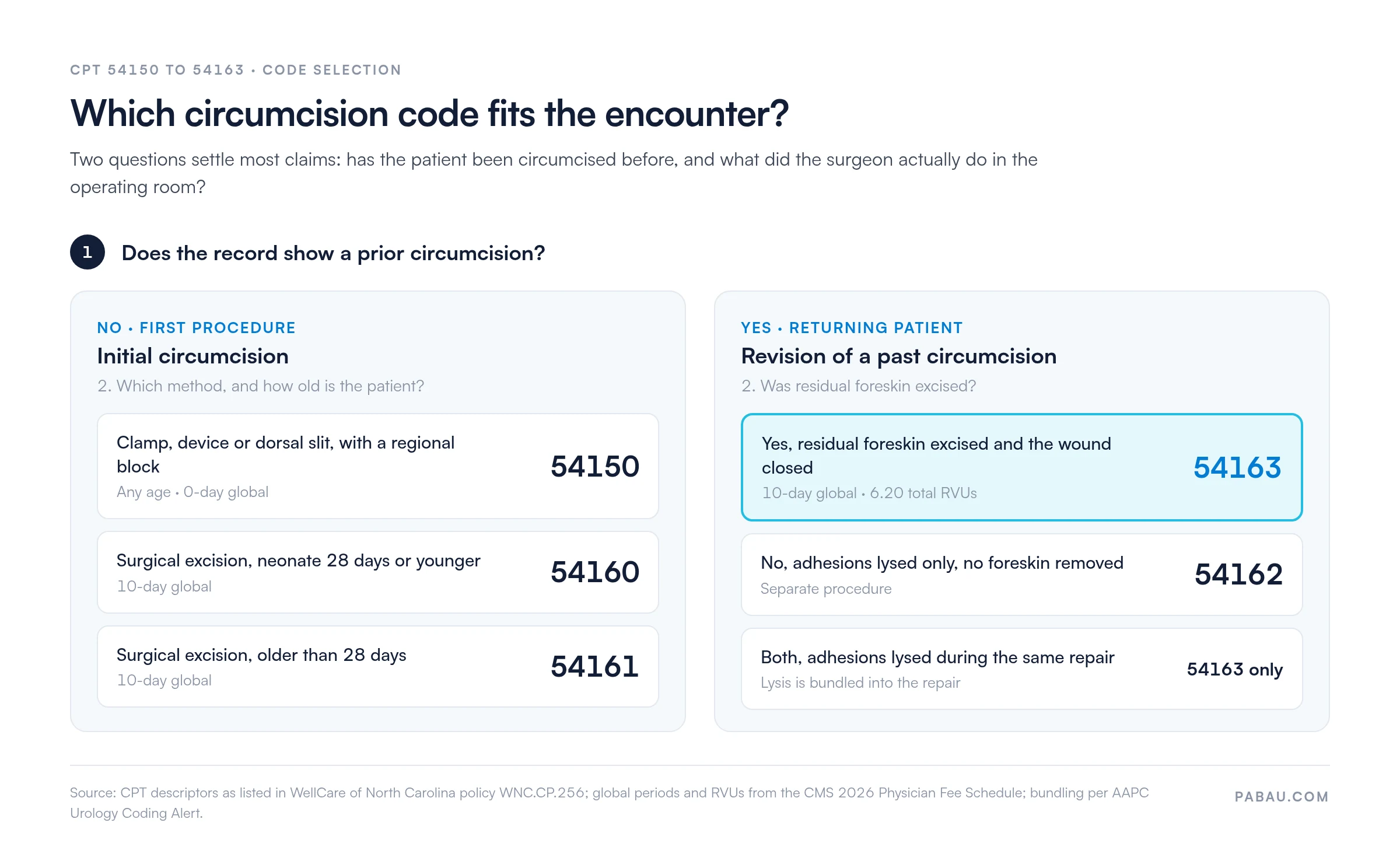
A frequent error is billing 54161 for a revision. 54161 is a first circumcision by surgical excision, other than clamp or device, in a patient older than 28 days. Clamp and device cases at any age go to 54150. Neither fits a patient who was already circumcised and returns for more tissue to be removed.
Payers reviewing 54163 want to see that this wasn’t a first circumcision or a simple lysis. These five elements give them that.
With the note in order, the diagnosis has to justify a revision rather than an elective repeat procedure. These ICD-10-CM codes are the ones most often accepted for 54163. Check them against each payer’s policy and your MAC’s local coverage determinations (LCDs) before billing.
An elective revision with no supporting diagnosis is almost always denied. The code must rest on objective findings in the medical record, not just sit on the claim form.
Verify diagnosis codes against your MAC’s local coverage determinations before billing 54163. Medicaid plans in particular vary on which N47 subcodes they accept for revision circumcision. A diagnosis one payer accepts may be excluded by another, even within the same state.
CMS publishes national payment values in the Medicare Physician Fee Schedule (MPFS) and updates them every year.
For 2026, 54163 carries 6.20 total RVUs whether the repair happens in an office or a facility. Pull locality-adjusted figures from the CMS Physician Fee Schedule search tool rather than relying on cached lookups.
Commercial rates differ from Medicare and are set by contract. Confirm each payer’s fee schedule and the patient’s eligibility before the appointment, so a correctly coded claim isn’t priced against the wrong schedule. The AAPC Codify CPT lookup lists 54163 alongside its neighboring codes.
Prior authorization for revision circumcision isn’t universal, but many commercial and Medicaid plans require it. Rules vary by payer, state and plan type, so check the specific plan’s policy every time. A typical authorization package includes these documents.
Watch for frequency limits too. The WellCare of North Carolina policy above covers repair of incomplete circumcision once per lifetime. A second revision there needs a separate conversation with the payer.
Medicare generally doesn’t cover elective adult circumcision. A revision for a documented medical indication, such as phimosis causing functional impairment, may be covered on individual review. Sound medical billing compliance means getting an Advance Beneficiary Notice (ABN) signed whenever coverage is uncertain.
CPT code 54163 carries a 10-day global surgery period. Routine follow-up within those 10 days, such as wound checks and post-op visits, is bundled into the payment and denied if billed separately. Modifiers matter most when 54163 lands inside another procedure’s global window.
That usually means the original circumcision. A surgical-excision circumcision (54160 or 54161) carries its own 10-day global, while 54150 has a 0-day global. So the modifier question only arises when the revision happens within 10 days of a 54160 or 54161.
Choosing between 78 and 58 carries the most audit risk. If nobody anticipated the revision at the original surgery, use 78. If the original note or surgical plan described a second stage, 58 starts a new global period and allows full payment. The wrong choice in either direction invites a records request.
Knowing the rules is half the job. The other half is moving the claim through the practice without dropping a piece, and this is the order it usually travels in.
Two minutes here saves weeks of rework. Hold the claim until every line is true.
When a 54163 claim does come back, the cause is usually one of these. Each has a simple fix upstream.
Reading the denial reason codes on each 54163 remittance tells you whether the problem was authorization, medical necessity or bundling. A steady clean claim process then stops the same denial from coming back.
Adjacent tissue transfer (14040) can be billed with 54163, but only when the two are separate, documented services. Treating them as a default pairing is the usual mistake.
The specific error to avoid is reporting 54161-51 plus 14040 when 54163 alone is correct. If the revision included tissue rearrangement at the same site as part of the same repair, 54163 may already cover it. Swapping in 54161 also misstates a revision as a first circumcision.
When adjacent tissue transfer is separately billable, all of these conditions hold:
When they’re met, both codes go on the claim with modifier 51 on the lower-valued one. When they aren’t, 54163 stands alone. The AMA’s CPT coding resources and the current CMS NCCI Policy Manual give the definitive bundling guidance.
Run a quarterly NCCI edit check on every code you report alongside 54163, including 14040. Edits update four times a year, so a pairing that was separately billable in one quarter may bundle in the next. Remember that 54162 never goes on the same claim as a same-session repair.
Revision claims tend to stall on paperwork rather than coding. The authorization sits in one inbox, the operative note in another, and the claim goes out missing a field.
Pabau keeps those pieces on the patient record. The authorization code, dates and sessions are tracked on the case, with a warning when one is missing. When you raise the claim, the CPT code attached to the service lands on the charge line. Diagnosis slots fill from the patient’s problem list.
Our urology practice claims software checks that required fields are complete before the claim can be sent. US claims go through Claim.MD, with eligibility checks and ERA remittances posted back to the record. Your team spends its time on the coding decisions in this guide, not on chasing missing numbers.

Pabau tracks prior authorizations on the case, pre-fills the claim from the patient record and sends it through Claim.MD. Your team catches a missing authorization before the claim leaves the practice.

CPT code 54163 rewards precise records more than clever coding. Once the chart proves an earlier circumcision and the note describes excised residual foreskin, the code choice is settled.
The money gets lost elsewhere. A missing authorization will send the claim back. So will a diagnosis with no findings behind it, or a repair inside a 10-day global billed without modifier 78. Fix those three habits, and revision claims stop returning for the same reasons.
Book a demo to see how Pabau tracks the authorization and pre-fills the claim, so your 54163 revisions go out complete.

Need to understand how clearinghouse submission works for surgical codes? Our Claim.MD clearinghouse guide explains how payer enrollment, eligibility checks, and claim validation work before 54163 claims reach the payer.
Seeing recurring 54163 denials and not sure where the cycle starts? Medical billing fundamentals covers how claims move from the operative encounter to paid remittance, and where revision surgical codes most often stall.
Want to understand what ERA data tells you about 54163 remittances? Electronic remittance advice (ERA) explained shows how to read CARC and RARC denial codes in 835 files, so your team can act on denials faster.
Billing adhesion lysis without a revision? CPT code 54162 covers lysis or excision of post-circumcision adhesions when no residual foreskin is removed.
An incomplete circumcision leaves enough foreskin to cover part of the glans or cause symptoms. Common reasons for revision include phimosis of the leftover skin, recurrent inflammation and redundant tissue.
Usually not. Most plans exclude cosmetic surgery, so a revision done for appearance alone becomes patient responsibility. Get a signed financial waiver, or an ABN for Medicare patients, before surgery.
Report where the repair happened, such as office (11), on-campus outpatient hospital (22) or ambulatory surgical center (24). Medicare’s 2026 practice expense RVUs for 54163 match across settings, so the physician payment doesn’t change.
Yes, when an anesthesia provider is involved. They report anesthesia code 00920 for procedures on male genitalia, not 54163. Local anesthesia given by the surgeon is part of the surgical package.
CPT sets no frequency limit, but payers can. Some Medicaid plans cover the repair once per lifetime. Check the plan’s policy before scheduling a second revision.
Yes. CPT codes aren’t restricted by specialty, so any qualified physician who performs the repair can report it. Payers still check credentialing, the site of service and prior authorization.