CCSD code A2720: Proximal gastric vagotomy billing guide
What is CCSD code A2720? CCSD code A2720 is the procedure billing code assigned ...

Last Updated: Oct 8, 2026
52224 is the CPT code for cystourethroscopy with fulguration or other treatment of minor lesions under 0.5 cm, with or without biopsy. Fulguration here includes cryosurgery and laser surgery.
A urologist reports it when a cystoscopy finds one or more minor lesions and destroys them in the same session. Lesions of 0.5 cm or larger move to the bladder tumor codes 52234, 52235 and 52240, which are chosen by measured size. Because biopsy is built into the descriptor, billing CPT 52204 alongside 52224 for the same lesion triggers an NCCI edit and a denial.
Let Pabau's smart automation suggest the right codes, reduce claim denials, and keep your practice compliant—effortlessly.
Automate repetitive tasks and focus on what matters most—your patients.
Reduce coding errors and ensure compliance with the latest regulations.
Clean claims, fewer denials, and faster reimbursements.
Powerful insights and reporting to help your practice thrive.
HIPAA compliant SOC 2 certified GDPR-compliant Trusted by 4,000+ clinics worldwide

CPT code 52224 covers cystourethroscopy with fulguration or treatment of minor lesions under 0.5 cm, with or without biopsy.
Larger lesions move to the bladder tumor codes 52234 (0.5 to 2.0 cm), 52235 (2.0 to 5.0 cm) and 52240 (over 5.0 cm).
The operative note needs a measured lesion size, because the centimeter cutoffs in the descriptors decide which code is correct.
Biopsy (CPT 52204) is bundled into 52224 and cannot be billed separately for the same lesion under NCCI edits.
Pabau, the practice management platform we build, checks eligibility and validates each claim before it reaches the payer.
CPT code 52224 is a surgical cystoscopy code in the AMA’s urologic endoscopy series (52000-52700). It covers cystourethroscopy with fulguration (including cryosurgery or laser surgery) or treatment of minor lesions, less than 0.5 cm, with or without biopsy. Lesions of 0.5 cm or larger belong to the bladder tumor codes 52234, 52235 and 52240 instead.
The American Medical Association maintains CPT and publishes the official descriptor. Coders should check the current year’s codebook for any annual descriptor revisions.
Three elements in the descriptor define when CPT 52224 applies, and the operative note has to document all three:
Cystourethroscopy with fulguration begins with the urologist inserting a rigid or flexible cystoscope through the urethra into the bladder under direct visualization. The bladder is distended with irrigation fluid to allow inspection of the entire mucosal surface. When a lesion is found, the urologist assesses its appearance, location, and size before choosing a treatment method.
Fulguration is then applied to the lesion. Electrocautery (the most common method), cryosurgery, or laser energy destroys the tissue. A cold-cup biopsy taken before or during fulguration is captured by the “with or without biopsy” language in the descriptor. It is not separately reportable. The procedure ends with bladder inspection, irrigation, and scope withdrawal.
CPT 52224 can be performed in an office setting when the practice has cystoscopy equipment and the patient can tolerate the procedure with local anesthesia. Verify via the CMS Physician Fee Schedule lookup that non-facility RVU values are assigned for 52224 before billing from an office POS.
A frequent billing error with CPT code 52224 is unbundling CPT 52204 from it in the same encounter. Because the official descriptor includes “with or without biopsy,” a biopsy taken before or during fulguration of a minor lesion is already paid through 52224.
Billing 52204 alongside 52224 in the same session triggers a National Correct Coding Initiative (NCCI) column-2 edit. The payer then denies the 52204 line.
Before submitting a claim with both 52224 and 52204, ask: was the biopsy taken from the same minor lesion being fulgurated? If yes, report only 52224. The biopsy is bundled. Separate reporting is appropriate only when 52204 documents a biopsy at a clearly separate site that is not being fulgurated in the same session. Even then, modifier -59 or XS must show a distinct procedural service. Verify the current NCCI edit pair before submitting.
The NCCI edits are published quarterly by CMS. Always verify the current quarter’s table confirms the 52224/52204 pair before treating any guidance as definitive. The underlying principle will not change, but the edit may carry modifier indicators that affect whether an override is ever allowable.
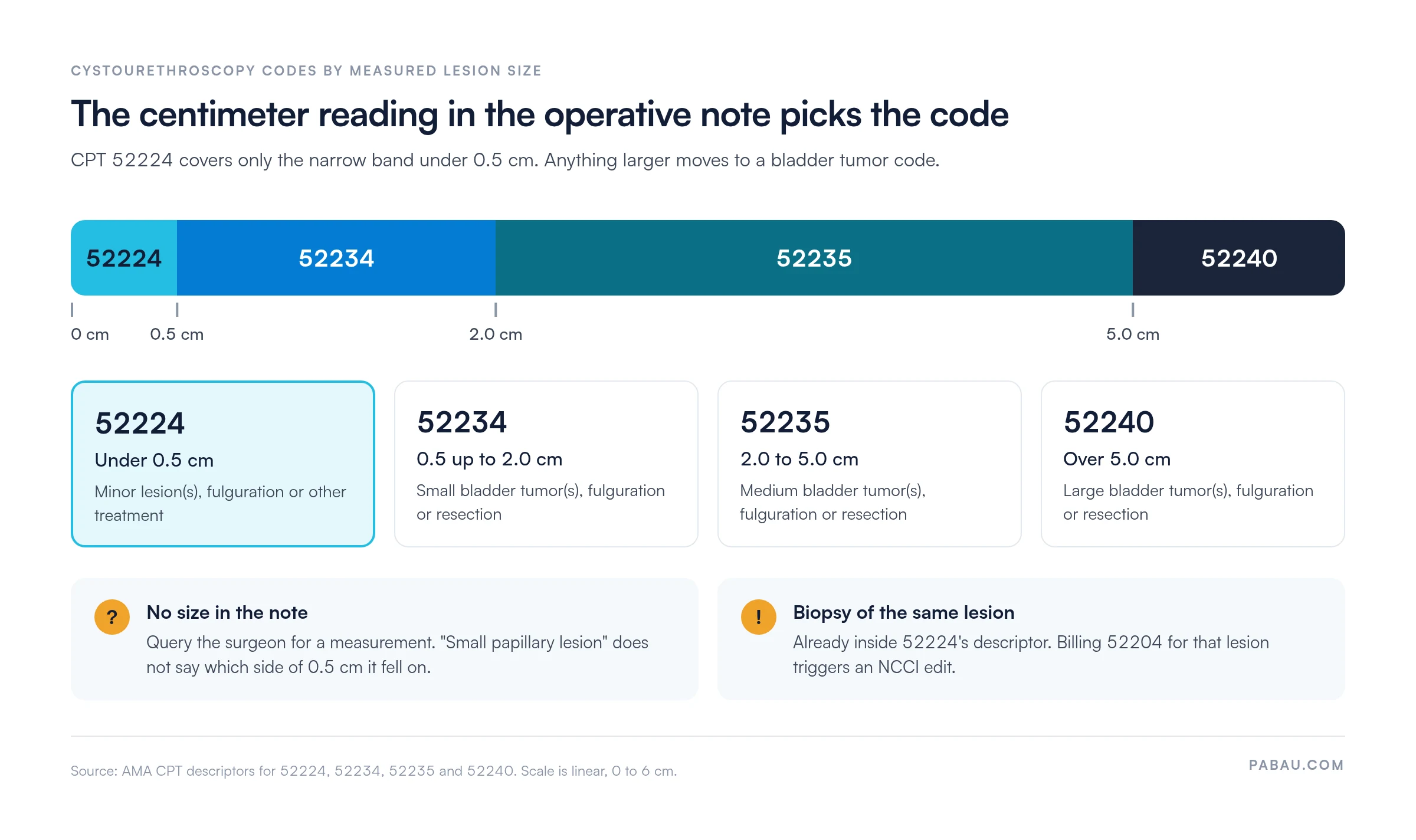
CPT 52224 sits below the bladder tumor codes. It covers minor lesions under 0.5 cm, and three sibling codes cover bladder tumors of 0.5 cm and up. Each descriptor carries a centimeter range, so the measured size in the operative note decides the code.
The 0.5 cm line between 52224 and 52234 is where most size errors happen. A note that says only “small papillary lesion” does not tell the coder which side of that line the lesion fell on. Query the surgeon for a measurement before coding, rather than picking a code from the adjective.
The wording adds a second trap. “Small” in the 52234 descriptor means 0.5 to 2.0 cm, a different band from the minor lesions under 52224. The scale below shows how narrow the 52224 band is next to its three neighbors.
CPT 52214 and CPT code 52224 both involve cystourethroscopy with fulguration, but they apply to different scenarios. CPT 52214 covers fulguration of the trigone, bladder neck, prostatic fossa, urethra, or periurethral glands. CPT 52224 covers fulguration or treatment of minor lesions under 0.5 cm, most often on the bladder mucosa.
Check the operative note for anatomical specificity. Fulguration of the trigone, bladder neck, or urethra for a non-neoplastic condition belongs under 52214. A papillary or suspicious lesion under 0.5 cm elsewhere in the bladder belongs under 52224. Check whether an NCCI edit pairs 52214 and 52224 before reporting both in one session.
The ICD-10-CM diagnosis code billed with CPT 52224 must reflect the documented diagnosis, never a default or presumed code. The codes below are common pairings, and each one needs support in the clinical record.
Payers use ICD-10-CM codes to evaluate medical necessity. A C67.x or D09.0 code paired with CPT 52224 is generally accepted as supporting medical necessity for fulguration. A diagnosis code that does not support bladder fulguration will generate a medical necessity denial. A urethral stricture code with no bladder lesion documentation is a typical example.
When hematuria prompted the cystoscopy, R31.9 or a more specific R31 code can sit as the secondary diagnosis.
Modifier selection for CPT 52224 depends on the clinical scenario, the payer, and whether the procedure is being reported alongside other same-session services. A wrong or missing modifier is a common reason the second line on the claim gets denied.
Medicare reimbursement for CPT 52224 is calculated using the Resource-Based Relative Value Scale (RBRVS). The total payment sums work, practice expense, and malpractice RVUs, each adjusted by a geographic cost index and multiplied by the annual conversion factor. Rates differ by place of service.
Facility rates (ASC or hospital outpatient) are lower than non-facility rates (office), because CMS pays the facility separately for overhead.
The FastRVU lookup tool returns current-year RVU values for CPT 52224. Apply your geographic locality adjustment to estimate the Medicare allowed amount. A practice in Manhattan receives a higher allowed amount than one in rural Montana for the same code.
Confirm final figures against CMS before quoting them. This reference reflects 2025-2026 Medicare Physician Fee Schedule policy, which can change with each January update.
A professional claim for CPT 52224 goes out on the CMS-1500 form, or its electronic equivalent, the 837P transaction.
Thin documentation is a frequent reason CPT 52224 claims are denied or downgraded. The operative note must support each element of the descriptor on its own: the cystourethroscopy, the fulguration method, and a lesion size under 0.5 cm. A claim that cannot be reconstructed from the operative note alone will not survive audit.
Supporting medical billing compliance for 52224 requires that the operative note clearly document:
A clean claim submission for CPT 52224 combines complete documentation with correct code selection and payer-matched prior authorization status. Building a clean claim submission checklist into the urology billing workflow catches the most common omissions before the claim leaves the practice.
Most CPT 52224 denials are preventable. They cluster around five root causes, and each one has a fix that can run before the claim is sent.
Systematic denial management workflows for urology practices should include a 52224/52204 code-pairing audit and a pre-auth checklist by payer. Add a POS reconciliation step before claim transmission. Reviewing denial codes in medical billing helps billing staff interpret remittance advice reason codes and prioritize appeals effectively.
Run a monthly query on all 52224 claims against a 60-day remittance window. Flag any claim that also had 52204 billed in the same encounter. One repeat NCCI denial means the charge entry template still lets 52204 through. Correct the template before the next billing cycle.
Urology practices billing CPT 52224 juggle bundling rules, payer-specific prior authorization, and quarterly NCCI updates. Pabau’s urology claims management tools turn the invoices you already raise into electronic CMS-1500 claims. Validation checks run before each claim goes out, confirming details such as membership numbers and authorization codes are in place.
In the US, Pabau connects to the Claim.MD clearinghouse. Your front desk can run a real-time eligibility check before the cystoscopy is booked, and claims go electronically to thousands of US payers.
Each claim then sits in the Claims dashboard with a live status, from submitted through to paid or error. Electronic remittance advice (ERA) flows back into Pabau, so a denied 52204 line shows up when the remittance lands rather than at month-end.


Pabau checks eligibility, validates each CPT claim before it goes out, and tracks it through to payment. See the urology billing workflow in a live demo.

CPT code 52224 covers a narrow slice of urology work: minor lesions under 0.5 cm, treated through the cystoscope. Its billing risk sits in two places. One is the 0.5 cm boundary with 52234, and the other is the bundled biopsy that makes 52204 unbillable for the same lesion.
Settle both at documentation and charge entry, and most preventable denials never reach the payer.
The practical step is an operative note template with a required lesion measurement, fulguration method, and biopsy notation, checked against NCCI before submission. To see how Pabau handles urology claim submission end to end, book a demo with the team.

Want to understand how clearinghouses fit into CPT claim submission? Medical claims clearinghouse explains how electronic claims move from the practice to the payer and where edits are caught.
Building a compliant billing process for your urology practice? Revenue cycle management covers the full financial lifecycle from patient registration through payment posting.
CPT code 52224 is the AMA procedure code for cystourethroscopy with fulguration or other treatment of minor lesions under 0.5 cm, with or without biopsy. A urologist reports it when a cystoscopy finds one or more minor lesions and destroys them in the same session. Biopsy, when taken, is bundled into the code and cannot be billed separately.
Yes. The official descriptor for CPT 52224 includes “with or without biopsy,” so any biopsy of the treated lesion in the same encounter is bundled. Separately billing CPT 52204 (cystoscopy with biopsy) alongside 52224 for the same lesion breaks NCCI bundling rules. The 52204 line will be denied.
CPT 52224 covers fulguration or treatment of minor lesions under 0.5 cm. CPT 52234 covers fulguration or resection of small bladder tumors measuring 0.5 up to 2.0 cm. The measured size in the operative note decides which code applies. If the note gives no size, query the surgeon before coding.
Medicare does not require prior authorization for CPT 52224. Many commercial payers do require pre-authorization, and requirements vary by insurer and plan. Always verify prior auth requirements with the specific payer before scheduling the procedure, and document any authorization number on the claim.
Common ICD-10-CM pairings with CPT 52224 are C67.x (bladder cancer by site), D09.0 (bladder carcinoma in situ), D41.4 (uncertain-behavior bladder neoplasm), and N30.x (cystitis). The diagnosis code must match the documented clinical findings and support medical necessity for the fulguration.
Yes. CPT 52224 can be performed and billed in an office setting when the practice has cystoscopy equipment and the procedure runs under local anesthesia. Before billing from an office (POS 11), check that the current CMS Physician Fee Schedule assigns non-facility RVU values to 52224.