CCSD Code K2542: Revision replacement of mitral valve
What CCSD code K2542 covers CCSD code K2542 is the UK private healthcare code fo...

Last Updated: Oct 22, 2026
74430 is the CPT code for cystography with a minimum of three views, covering radiological supervision and interpretation only. The radiologist reviews a bladder filled with contrast through a catheter, checking its shape, its wall, and any reflux into the ureters.
The contrast injection and catheter placement are billed separately under their own codes. A study that adds a voiding phase with urethral imaging is coded 74455 instead.
Let Pabau's smart automation suggest the right codes, reduce claim denials, and keep your practice compliant—effortlessly.
Automate repetitive tasks and focus on what matters most—your patients.
Reduce coding errors and ensure compliance with the latest regulations.
Clean claims, fewer denials, and faster reimbursements.
Powerful insights and reporting to help your practice thrive.
HIPAA compliant SOC 2 certified GDPR-compliant Trusted by 4,000+ clinics worldwide

CPT code 74430 covers cystography (contrast-filled bladder, minimum three views) including radiological supervision and interpretation only.
Contrast injection is billed under 51600-51610 and bladder catheterization under 51701-51703; neither is part of 74430.
74430 and 74455 (voiding cystourethrography) are distinct codes, so billing both for the same session requires a verified NCCI edit check.
Pabau’s claims management software submits CPT claims electronically through Claim.MD and lets you record the ICD-10 code against the claim.
CPT code 74430 is defined by the American Medical Association as Cystography, minimum of 3 views, radiological supervision and interpretation. First, the bladder is filled with contrast dye through a urethral catheter. Then a series of X-rays shows the bladder’s shape, its wall, and any reflux into the ureters.
In fact, the three-view minimum is the key rule. For this reason, two views taken in one session do not qualify, so do not bill them under 74430. Practices that often capture only two views (for example, AP and one oblique) should therefore check their reports before they submit the claim.
74430 covers the radiological supervision and interpretation part of the cystogram. However, it does not cover the work of placing the catheter or injecting the contrast. Instead, the injection is reported with 51600 when the study is a cystogram.
Additionally, the most common error is billing 74430 and 74455 together for one continuous study. For that reason, check the CMS National Correct Coding Initiative (NCCI) edit tables before you bill both codes on the same date of service.
Cystoscopy CPT codes (in the 52000 range) cover scope procedures, while 74430 is a radiology imaging code. As a result, mixing up the two code families is a frequent coder error. Therefore, use the table below to pick the right code for each case.
74430 and 74455 cannot be billed for the same exam unless two separate studies are documented and performed. In contrast, when a VCUG is the goal, 74455 is the right code. Also, the decision path below runs the same checks in the order a coder meets them.
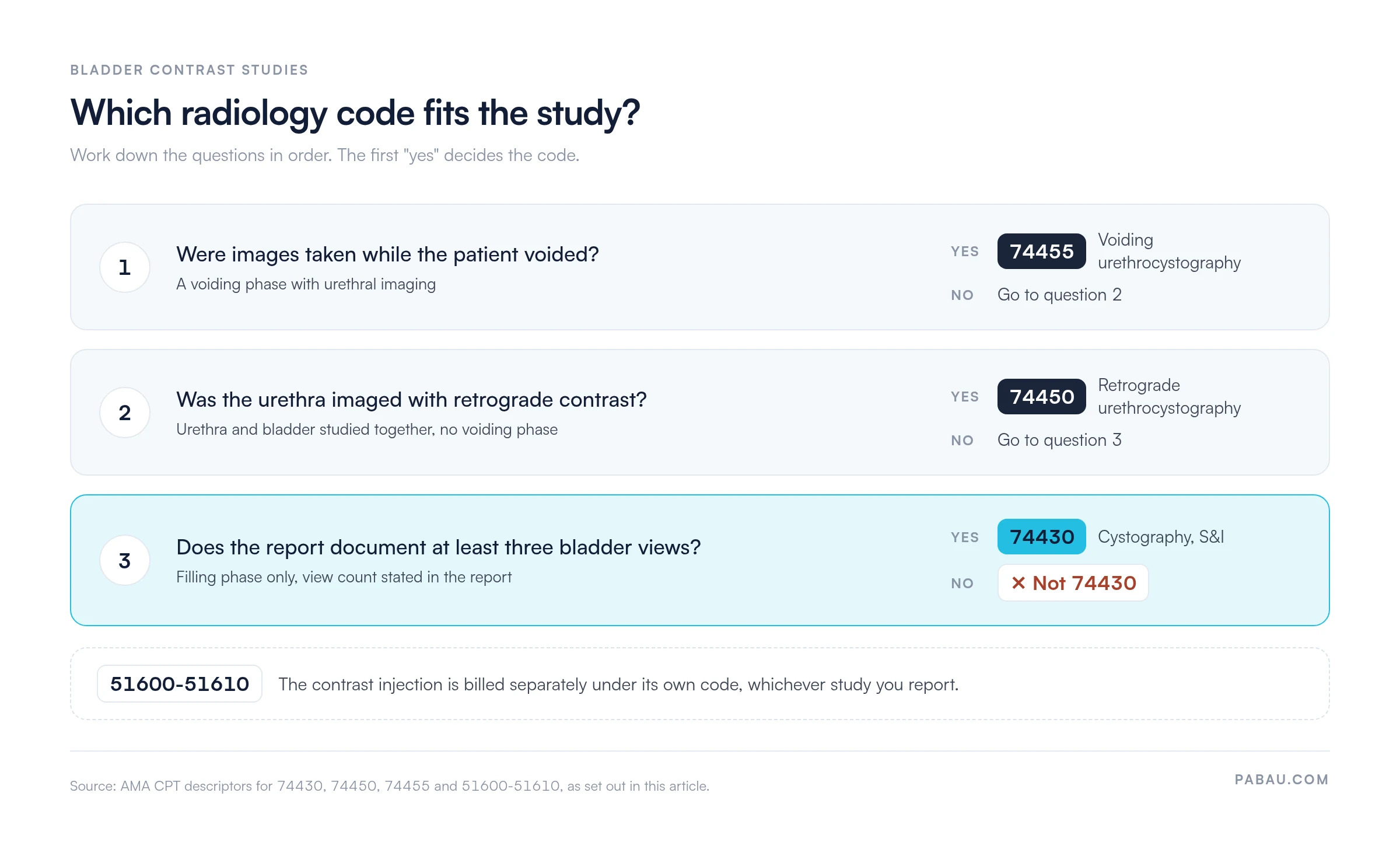
Run a CCI edit check before billing 74430 alongside any same-day cystoscopy code (52000 range). That is because the NCCI tables flag many procedure-plus-imaging pairs as bundled. Then document separate clinical purposes in both the procedure and radiology reports to support modifier 59 when it applies.
Medical necessity for CPT code 74430 depends on a valid ICD-10-CM diagnosis code that justifies bladder imaging with contrast. Payers review these pairings closely, especially for repeat or follow-up studies. Also, use the CDC/NCHS ICD-10-CM tool to check a code, since it carries the current fiscal year codes.
However, codes that often trigger automatic medical necessity reviews include gross hematuria (R31.0) and surveillance codes (Z87.x) without an active diagnosis. Meanwhile, when the order doesn’t say whether hematuria is gross or microscopic, the fallback is R31.9, the unspecified hematuria code. Therefore, include the referring physician’s clinical indication in the radiology report to avoid these reviews.
Modifier choice for 74430 depends on how the radiologist and the facility split the billing. For example, global billing, split billing, and same-day procedures each use different modifiers.
When you use modifier 59, the radiology report must show that the cystography served a separate clinical purpose from any same-day urology procedure. A generic statement is not enough, so spell out the separate reason.
The Medicare Physician Fee Schedule (MPFS) sets the 74430 Medicare reimbursement rate each year. In addition, rates differ by component (global, professional, technical) and by site of service (facility vs. non-facility). Therefore, use the CMS Physician Fee Schedule lookup tool for the current year’s exact figures, because rates are updated each January 1.
Next, non-facility rates (office setting) are usually higher than facility rates (hospital outpatient) for global and technical-component claims. This is because the practice expense RVUs cover overhead that a facility would otherwise absorb. By contrast, the professional component (modifier 26) is paid at the same rate in either setting.
Check the site of service on each claim, because a wrong place-of-service code risks an overpayment clawback. Also, commercial payer rates vary and are not published on the MPFS schedule.
Traditional Medicare does not require prior authorization for CPT code 74430 in most cases. Medicare Advantage plans, however, often add prior auth rules for diagnostic radiology services, and these rules vary by plan and plan year.
First, a prior auth request should include the referring physician order and the ICD-10 diagnosis code. In addition, add the number of prior studies and the clinical question the imaging should answer. In fact, incomplete requests are the main reason for post-service denials on imaging studies.
Above all, the radiology report is the main record for 74430. Moreover, a report that omits key items is the fastest route to a medical necessity denial or an audit finding. According to guidance from the AAPC, every cystography report supporting 74430 should therefore contain the following items.
In fact, a report that leaves out the view count or the contrast record is the likeliest trigger for a post-payment audit repayment request on 74430.
First, build a structured radiology report template for cystography with required fields for view count, contrast agent, clinical indication, and reflux grading. As a result, radiologists who dictate from the template produce reports that pass payer review without addenda.
Denials on 74430 cluster around a few common failure points. Therefore, addressing them in your denial management workflow reduces rework and speeds up payment.
Next, each denial comes back with a claim adjustment reason code (CARC). Furthermore, our guide to medical billing denial codes covers how to answer the common ones. In addition, submitting clean claims on the first pass is the most efficient way to cut days in accounts receivable for diagnostic imaging codes.
Most 74430 denials are settled before the claim leaves the practice. For instance, a report without a view count, a lapsed authorization, or the wrong place-of-service code each turns up weeks later. By then, it is a remittance line someone has to chase.
In addition, Pabau, the practice management platform we build, connects its medical billing software to the Claim.MD clearinghouse. With it, your team runs 270/271 eligibility checks before the study, sends CMS-1500 claims online, and tracks each claim’s status in one place.
Next, ERAs come back into Pabau, and denied claims are flagged for rework while the study is still fresh. You can also record the ICD-10 code against the claim, so whoever works a denial sees the medical necessity pairing straight away.

Pabau integrates with Claim.MD to support electronic CPT claim submission, real-time eligibility verification, and denial tracking. See how it works for your practice.

In short, treat the radiology report as the source for every 74430 claim. If the view count, contrast, and indication aren’t in it, an appeal rarely recovers the payment.
Instead, the quickest win is a structured cystography template plus a pre-submission check for 74455 overlap and place of service. Once both are in place, most of the denials in the table above stop arriving.
Finally, Pabau’s claims management software, integrated with Claim.MD, supports online claim submission, claim status tracking, and ERA remittance matching for urology and radiology billing teams. Book a demo to see how it keeps your 74430 claims moving.

Need a reference on denial codes you can act on? Denial codes in medical billing explains the most common CARC codes and how to respond to each.
Billing the injection that comes with the cystogram? CPT code 51600 covers the injection procedure for cystography and how it pairs with the imaging code.
Imaging the upper tract instead? CPT code 74420 covers retrograde urography and when it applies in place of a cystogram.
Want to understand how the clearinghouse layer works? Medical claims clearinghouse guide covers how 837P files are validated and routed to payers.
Preparing an 837 file for submission? 837 file format guide walks through the transaction set structure and common formatting errors.
CPT code 74430 covers cystography with a minimum of three views, including radiological supervision and interpretation of the contrast-filled bladder study. However, it does not cover catheter placement, contrast injection, or any voiding-phase imaging.
The CPT code for a cystogram (static contrast bladder study with three or more views) is 74430. If the study includes a voiding phase, use 74455 instead.
Traditional Medicare generally does not require prior authorization for CPT 74430. Medicare Advantage and most commercial plans, however, may require it. Verify with the specific plan before the procedure is scheduled to avoid post-service authorization denials.
Modifier 26 is appended when the radiologist bills only the professional (interpretation) component. Likewise, modifier TC is appended by the facility billing the technical component. Modifier 59 applies when 74430 is billed on the same date as a related urological procedure with an NCCI edit conflict. Also, both reports must document a distinct clinical purpose for each study.
Yes, in some cases, but check NCCI edit tables first. That is because many cystoscopy codes in the 52000 range have bundling edits with radiology imaging codes. If the cystography and cystoscopy were performed for distinct clinical purposes on the same date, modifier 59 may allow separate billing when documentation supports it.