CPT Code 27425: Lateral retinacular release billing guide
CPT Code 27425: Official descriptor and procedure overview CPT code 27425 is def...

Last Updated: Nov 16, 2026
L1920 is the HCPCS Level II code for an ankle foot orthosis, single upright with static or adjustable stop (Phelps or Perlstein type), custom-fabricated. It is a metal brace built for one patient, with a calf band and an ankle joint that limits plantarflexion.
Medicare covers it under LCD L33686 when the record also shows why a prefabricated AFO would not work. Each claim line needs RT or LT, plus one of KX, GA or GZ.
Let Pabau's smart automation suggest the right codes, reduce claim denials, and keep your practice compliant—effortlessly.
Automate repetitive tasks and focus on what matters most—your patients.
Reduce coding errors and ensure compliance with the latest regulations.
Clean claims, fewer denials, and faster reimbursements.
Powerful insights and reporting to help your practice thrive.
HIPAA compliant SOC 2 certified GDPR-compliant Trusted by 4,000+ clinics worldwide

L1920 is a custom-fabricated ankle foot orthosis built on a single metal upright, with a static or adjustable stop that controls plantarflexion.
A prefabricated plastic AFO with fitting included bills as L1930, and a custom-fabricated plastic AFO bills as L1940.
Medicare covers L1920 under LCD L33686 only when the record also shows why a prefabricated brace would not do the job.
Every L1920 claim line needs RT or LT plus KX, GA or GZ, or the DME MAC rejects it as missing information.
Pabau’s claims management software keeps the order, the fabrication notes and the claim on one patient record, so an L1920 file is ready for audit.
HCPCS code L1920 describes an ankle foot orthosis (AFO), single upright with static or adjustable stop (Phelps or Perlstein type), custom-fabricated. The DME MAC policy article A52457 defines it as a custom-fabricated AFO designed to control only the plantarflexion motion of the ankle and foot. It is a metal brace made for one patient, never a stock plastic shell.
The construction is a single rigid metal upright, medial or lateral, joined to a rigid calf band that closes around the upper calf. At the ankle, a joint with a static or adjustable stop limits how far the foot can point down. The brace attaches to the patient’s shoe, which is why it often bills alongside orthopedic footwear.
L1920 sits in the HCPCS Level II L-code series, the orthotic and prosthetic procedures that CMS maintains under the Healthcare Common Procedure Coding System. Within that series, it belongs to the ankle-foot orthosis range, L1900 to L1990. Its neighbors in that range are listed in our HCPCS code library.
L1920 covers one custom-made metal AFO for one leg. Several braces that do a similar job carry a different code, so check the build before you pick the line.
Two questions separate these codes. Was the brace made for this patient or taken from stock, and is it a metal upright or a plastic shell? L1920 is the only one of the three that is both custom-fabricated and metal.
The practical test has two steps, and the chart below maps both. If the brace came off a shelf and was adjusted at fitting, look at L1930 or another prefabricated code. If it was made for the patient, the material decides. A molded plastic shell points to L1940, and a metal single upright with a plantarflexion stop is L1920. Compare the full descriptors in AAPC’s HCPCS code lookup before you submit.
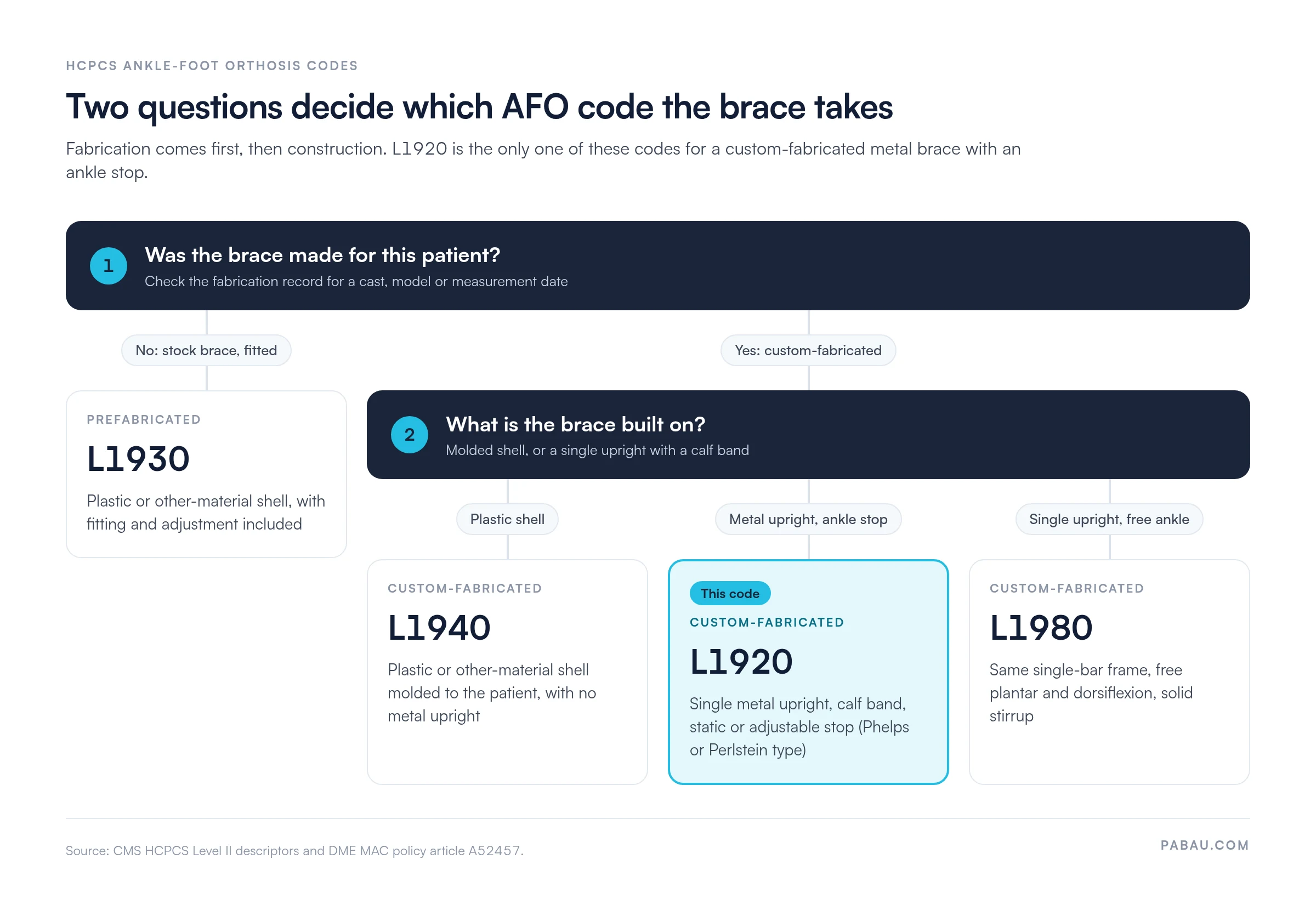
Audit your AFO lines each quarter against the fabrication record. A custom-fabricated code with no cast, model or measurement date on file is an upcoding exposure. Flag those claims before your DME MAC does.
Medicare Part B covers an AFO under LCD L33686, Ankle-Foot/Knee-Ankle-Foot Orthosis, which the DME MACs maintain. The base rule applies to every AFO. The patient is ambulatory, has weakness or deformity of the foot and ankle, needs stabilization for medical reasons, and can benefit functionally.
L1920 is custom-fabricated, so the record has to clear a second bar as well. The LCD covers a custom-fabricated AFO only when at least one of these is documented:
Policy article A52457 adds a documentation rule. The treating practitioner’s records must explain why the patient needs a custom-fabricated orthosis rather than a prefabricated one. The orthotist’s functional evaluation then has to corroborate it.
LCD L33686 does not publish a diagnosis list for L1920. Coverage turns on the functional criteria above, so the diagnosis has to explain the weakness, deformity or instability the brace controls. These ICD-10-CM codes commonly support it:
A diagnosis on its own does not carry the claim. The notes have to describe the functional problem, such as the forefoot catching during swing. They also have to say why a prefabricated brace would not solve it.
Most L1920 denials start with a thin file. Build it in this order before the claim goes out:
An ABN belongs in the file too, when you expect Medicare to deny the line. Take it before delivery, then bill with GA.
Pabau, the practice management platform we build, lets an orthotics practice turn that list into a required checklist with its digital intake and documentation forms. A file stays on hold until the order date, the evaluation and the fabrication record are all in place.
Policy article A52457 is strict about modifiers on AFO claims. A line with no KX, GA or GZ is rejected as missing information, and so is a line with no RT or LT.
KX, GA and GZ are alternatives, so only one goes on a line. For a bilateral fitting on the same date, bill two lines with one unit each, L1920-RT-KX and L1920-LT-KX. Never bill RTLT on one line with two units.
L1920 denials follow a short list of patterns. Each row pairs the root cause with the step that stops it recurring.
When a medical necessity denial comes back, read the treating practitioner’s notes before you look at the ICD-10 code. The diagnosis may be valid while the notes never say why a prefabricated brace would fail. Ask the practitioner to add the missing detail if the clinical picture supports it, then resubmit. A structured denial management workflow keeps those appeals moving.
Set a tickler for every L1920 claim that receives an additional documentation request. Missing the response window turns a fixable claim into a denial. Treat each request as a same-day task.
An L1920 claim depends on records that usually live apart. The order arrives by fax, the orthotist’s evaluation sits in a paper chart, and the fabrication notes stay in the lab. Pulling them back together for an audit takes hours.
Pabau holds them on one patient record instead. Its claims management software builds the claim from that record, so the diagnosis and the charge line are never retyped. Required fields, including the side modifier, are checked before the claim can be sent.
In the US, claims go out through the Claim.MD clearinghouse, with eligibility checks, claim status and remittance posting on the same pipeline. That supports sound medical billing compliance, because each L1920 line is built from documents you can produce on request.

Pabau keeps the written order, the evaluation notes and the claim on one patient record. Required fields are checked before submission, so custom AFO claims go out complete.

L1920 is easy to misread. It is a custom-made metal brace with a plantarflexion stop. Coders who treat it as a stock plastic AFO bill the wrong code from the start. Check the build first, then the paperwork.
The paperwork carries more weight here than on a prefabricated AFO. The notes have to justify custom fabrication, and the fabrication record has to prove it happened. Suppliers who collect both before the brace is made stop losing L1920 lines to medical necessity denials. Book a demo to see how Pabau keeps the order, the evaluation and the claim together for custom orthotic billing.

Need a structured approach to DME claim denials? Denial management in healthcare covers the full workflow for tracking, appealing, and preventing claim denials across DME and medical billing.
Want to understand what makes a claim pay first time? Clean claim submission breaks down the elements a claim must have to pass payer edits without rejection.
Looking for the broader billing picture? Revenue cycle management explained covers how individual claims like L1920 fit into the full patient-to-payment workflow.
HCPCS code L1920 describes an ankle foot orthosis, single upright with static or adjustable stop (Phelps or Perlstein type), custom-fabricated. It is a metal brace made for one patient, with a calf band and an ankle stop that controls plantarflexion. It bills to Medicare Part B through an enrolled DMEPOS supplier.
L1920 is custom-fabricated. The brace is built for one patient from a cast, model or measurements, and no other patient could use it. A prefabricated plastic AFO that includes fitting and adjustment bills as L1930 instead.
L1920 is a custom-fabricated metal single-upright AFO with a static or adjustable stop. L1930 is a prefabricated plastic or other-material AFO, with fitting and adjustment included. L1940 is a custom-fabricated AFO made of plastic or other material. Fabrication and construction decide which one applies.
Every L1920 line needs RT or LT for the side, plus one of KX, GA or GZ. Use KX when the file meets every LCD L33686 criterion. Use GA when you expect a denial and hold a valid ABN, and GZ when you have no ABN. A line without these modifiers is rejected.
L1920 was not on CMS’s Required Prior Authorization List for DMEPOS in its July 29, 2026 update. CMS has been adding orthosis codes to that list, so check the current version before you fabricate. Medicare Advantage and commercial plans may require authorization on their own terms.
Yes, when the shoe is an integral part of the brace and medically necessary for it to work. Policy article A52457 lists L1920 among the braces that orthopedic footwear can be billed with. The shoe goes on its own claim line with its own code and side modifier.