CCSD code D1510: Myringotomy and tube insertion billing guide
What Is CCSD Code D1510? CCSD code D1510 is the procedure code assigned to myrin...

Last Updated: Oct 5, 2026
45382 is the CPT code for colonoscopy, flexible; with control of bleeding, any method. It covers hemostasis of active bleeding found anywhere from the rectum to the cecum, billed as one unit per session whatever technique is used.
GI billers commonly run into two problems with this code. The first is submitting it when the documentation describes prophylactic treatment rather than active hemorrhage control. The second is reporting it alongside 45378, or alongside 45385 for bleeding at the polypectomy site. Both mistakes can trigger denials.
Let Pabau's smart automation suggest the right codes, reduce claim denials, and keep your practice compliant—effortlessly.
Automate repetitive tasks and focus on what matters most—your patients.
Reduce coding errors and ensure compliance with the latest regulations.
Clean claims, fewer denials, and faster reimbursements.
Powerful insights and reporting to help your practice thrive.
HIPAA compliant SOC 2 certified GDPR-compliant Trusted by 4,000+ clinics worldwide

CPT code 45382 covers flexible colonoscopy with control of active bleeding anywhere from the rectum to the cecum, by any hemostasis method.
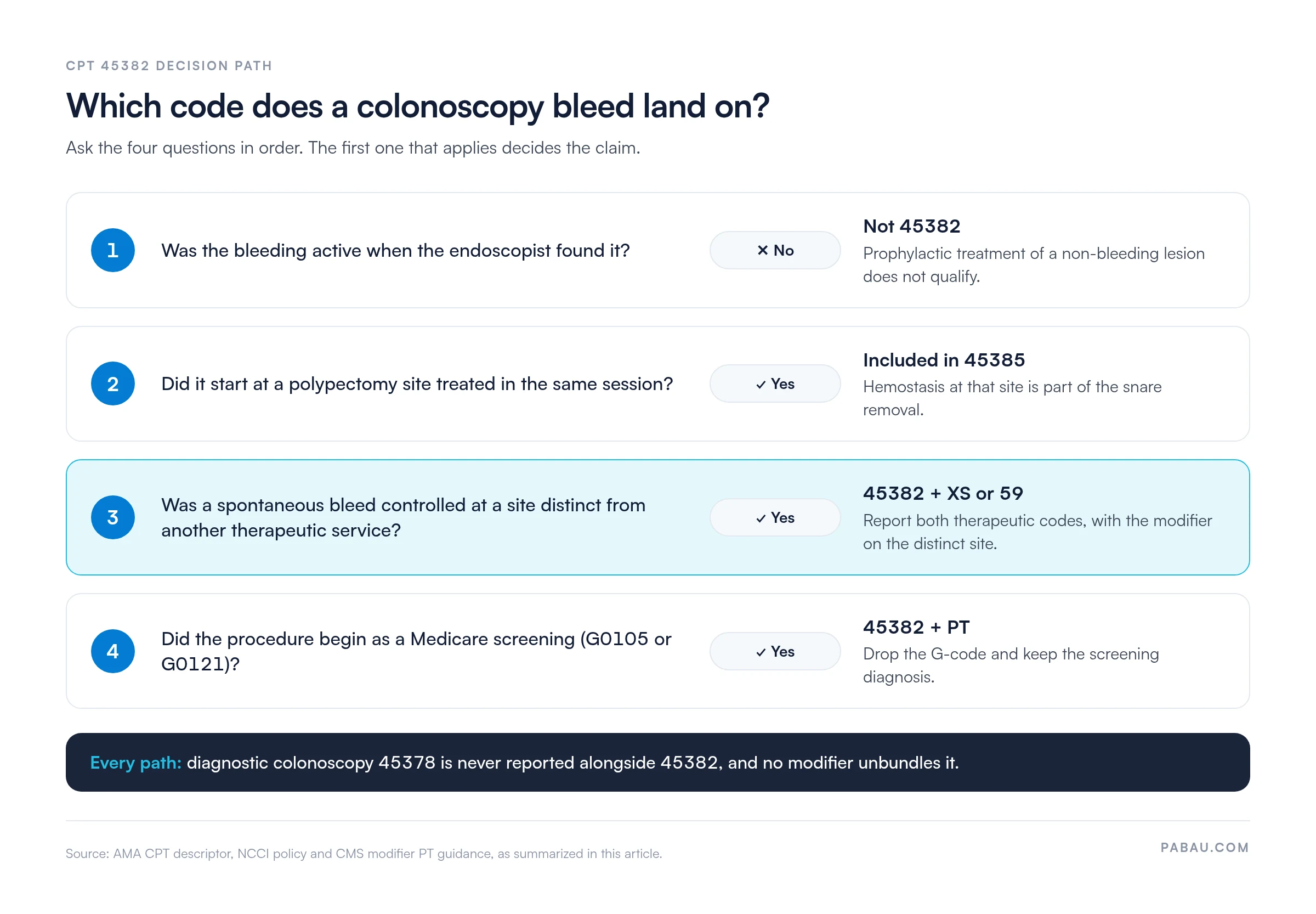
The code requires documented active bleeding at the procedure site, not prophylactic treatment of a non-bleeding lesion.
Diagnostic colonoscopy 45378 is never reported alongside 45382, and modifier 59 or XS applies only between two therapeutic codes at distinct sites.
A Medicare screening that converts to bleeding control is billed as 45382 with modifier PT and the screening diagnosis.
Pabau’s claims management software submits and tracks 45382 claims, with eligibility checks and ERA posting in one workflow.
CPT code 45382 is defined by the American Medical Association (AMA) as “Colonoscopy, flexible; with control of bleeding, any method.” Colonoscopy examines the entire colon, from the rectum to the cecum, and may include the terminal ileum. That scope is shared by every code in the 45378-45398 colonoscopy family.
“Any method” is the operative phrase. The code applies regardless of which hemostasis technique the endoscopist uses, provided active bleeding is identified and treated during the same session. Multiple methods used in a single session still bill as one unit of 45382.
The code does not apply when the endoscopist treats a lesion prophylactically that is not actively bleeding. That documentation mistake is a common audit trigger for 45382 claims.
Because 45382 covers “any method,” knowing what qualifies helps coders confirm the documentation is complete before submission. The operative report must name the specific technique used.
Each code in the colonoscopy family represents a distinct intervention, and choosing the wrong one triggers NCCI bundling edits or undercoding. The most frequent mix-up is reporting diagnostic colonoscopy 45378 on the same claim as a therapeutic code.
Critical bundling rule: When post-polypectomy bleeding is treated during the same session as 45385, the hemostasis is included in 45385. You cannot add 45382 on top of 45385 for the same site.
Bleeding found at a separate, distinct site and controlled independently is different. There, modifier XS or 59 may allow separate billing of 45382 and 45385. Verify the current National Correct Coding Initiative (NCCI) edit table before submitting, because these edits change quarterly. The decision path below puts these rules in the order a coder should apply them.
Run the 45382/45385 pair through your NCCI edit checker before every submission. The edit status can change quarterly. What was separately billable in Q1 may be bundled by Q3 without a payer bulletin.
Medicare reimbursement for CPT code 45382 is calculated from the Medicare Physician Fee Schedule (MPFS). Rates change on January 1 each year, so verify current figures through the CMS Physician Fee Schedule lookup tool for the applicable payment year. The figures below reflect approximate 2025 national rates as a reference point.
Verify exact RVU values and conversion factors using the FastRVU 2026 RVU lookup tool, which pulls directly from CMS data. Medicaid rates vary by state, so contact the relevant state Medicaid agency for the authoritative fee schedule. Commercial payer rates (UnitedHealthcare, Aetna, BCBS) are contract-specific and cannot be generalized.
The paired ICD-10-CM diagnosis code must reflect active gastrointestinal bleeding documented at the time of the procedure. A mismatch between the ICD-10 code and the operative report is a frequent denial trigger for 45382 claims. Confirm codes are current for the applicable fiscal year edition using the CDC/NCHS ICD-10-CM resources.
The diagnosis code must link directly to the operative finding. If the pre-procedure diagnosis was “hematochezia” but the scope found and controlled a diverticular bleed, update the claim to K57.31. Use K57.33 only when the endoscopist also documents diverticulitis. Submitting the pre-procedure symptom code after a definitive finding was documented is a common error that delays payment.
The operative or endoscopy report is the primary documentation source for 45382 claims. Payers audit this code closely, because brief notes often blur the line between active bleeding control and prophylactic treatment. Sound medical billing workflows start with a documentation checklist the endoscopist completes before the scope is withdrawn.
The report must contain all of the following:
What disqualifies 45382: documenting “polypectomy site cauterized to prevent bleeding” or “APC applied to angiodysplasia for prophylaxis” does not support 45382. The code requires active, identified bleeding that is being controlled, not prevention of potential future bleeding.
When a Medicare screening colonoscopy converts to a therapeutic procedure with hemorrhage control, the claim moves from the screening HCPCS code to 45382. The conversion changes both the coding and what the patient owes.
CMS guidance distinguishes the two screening codes as follows:
When the endoscopist identifies and controls active bleeding during a procedure that began as a screening exam, G0105 or G0121 comes off the claim. For Medicare, report 45382 with modifier PT and keep the screening diagnosis on the claim. Modifier PT tells the contractor the session started as a colorectal cancer screening.
Patients still owe coinsurance on these converted procedures, but less over time. Under Section 122 of the Consolidated Appropriations Act of 2021, the coinsurance is 15% for 2023 through 2026 and 10% for 2027 through 2029. From 2030 it drops to 0%. The CMS guidance on the coinsurance phase-down sets out the schedule.
Choosing the right modifier for 45382 prevents bundling denials and supports the medical necessity case when payers question multiple same-session codes. For superbill generation and claim assembly, coders need five modifiers on hand for GI colonoscopy sessions.
Modifier 59 vs. XS: CMS introduced the -X{EPSU} modifiers (XE, XS, XP, XU) as more specific alternatives to modifier 59. For bleeding control at a site separate from another therapeutic colonoscopy service, Medicare Administrative Contractors prefer XS (separate structure) over the generic modifier 59. Check your MAC’s current guidance before choosing between them.
Prior authorization requirements for CPT code 45382 vary by payer, plan type, and clinical urgency. Confirm insurance eligibility verification and authorization status before every elective procedure. An unverified authorization is the fastest path to a non-coverage denial.
Emergent or urgent procedures: when the procedure is performed emergently for acute GI hemorrhage, most payers allow retrospective authorization within 24-72 hours. Document the emergent nature explicitly in the operative report and flag the claim accordingly. Missing the payer’s retrospective authorization window results in denial regardless of clinical appropriateness.
Denials for CPT code 45382 cluster around three root causes: incomplete documentation, bundling errors, and authorization failures. Strong denial management workflows catch these before submission rather than after. Review our medical billing denial codes reference for the CARC/RARC codes payers use to explain 45382 rejections.
For clean claim submission, run 45382 through your clearinghouse’s pre-submission scrubber. A scrubber catches format errors and payer edits. It cannot tell whether the operative note documents active bleeding, so the checklist below still decides whether the claim holds up.
Build a 45382 claim checklist into your endoscopy report template: (1) Was active bleeding documented? (2) Is the ICD-10 code updated post-procedure? (3) Is PA on file? (4) Have you checked the NCCI edit for any same-session codes? Four checkboxes add two minutes pre-submission and prevent days of appeals work.
Many GI billing teams still assemble a 45382 claim by hand. They copy codes from the endoscopy report into a clearinghouse portal, then check eligibility and remittances in yet another screen.
Pabau, the practice management and billing platform we build, pulls the record data your team has already entered into a pre-filled claim. Its claims management software then submits and tracks the claim to thousands of US payers via Claim.MD. Eligibility checks and ERA posting run in the same workflow.
Coding judgment stays with your coders. Pabau does not choose the code or audit modifiers, so the documentation rules above still decide whether 45382 is supportable. What drops away is the re-keying between systems, which leaves your billers more time for the denials that need a person.

Pabau’s claims management software submits and tracks claims to thousands of US payers via Claim.MD. Eligibility checks and ERA posting run in the same workflow for GI and multi-specialty practices.

A 45382 claim stands or falls on one sentence in the operative note: that bleeding was active when the endoscopist found it. Without that sentence, no modifier or diagnosis code rescues the claim.
The bundling rules are just as fixed. Drop 45378 whenever 45382 is reported, keep post-polypectomy hemostasis inside 45385, and save XS or 59 for a separate bleed at a distinct site. On a converted Medicare screening, modifier PT protects the patient’s reduced coinsurance.
Build those checks into the endoscopy report template, and the claim is right before it reaches billing. Book a demo to see how Pabau submits and tracks GI claims so your team spends less time re-keying them.

Need to understand how claims reach payers? Medical claims clearinghouse guide explains the 837P submission pathway and how clearinghouse edits catch errors before adjudication.
Struggling with ERA reconciliation after 45382 claims? Electronic remittance advice (ERA) workflows covers 835 file processing and how to match payments to claims.
Want a framework for reducing first-pass denials? Revenue cycle management guide outlines the workflow stages where GI practices typically lose recoverable revenue.
Coding the polyp removal in the same session? CPT code 45385 covers snare polypectomy and how it interacts with bleeding control.
Sampling tissue instead of treating a bleed? CPT code 45380 explains colonoscopy with biopsy and its documentation requirements.
CPT code 45382 covers flexible colonoscopy with control of bleeding by any method, performed from the rectum to the cecum, and terminal ileum if examined. It applies when the endoscopist identifies and treats active hemorrhage during the same session. Thermal coagulation, injection therapy, mechanical devices, or a combination all qualify.
Medicare reimburses CPT 45382 through the Physician Fee Schedule at roughly $450-$500 in a physician office and $220-$260 (physician component) in a facility or ASC. Both figures rest on about 4.43 work RVUs and approximate 2025 national rates. Rates change every January 1, so verify current figures in the CMS Physician Fee Schedule lookup tool.
Modifier XS (separate structure) or modifier 59 applies when 45382 and a different therapeutic colonoscopy code, such as 45385, are performed at distinct sites. Neither one unbundles 45378. Modifier 53 covers a discontinued procedure, and modifier PT marks a Medicare screening that became therapeutic. Some payers want SG on the ASC facility claim.
G0105 is used for a Medicare high-risk screening colonoscopy when no therapeutic intervention is performed. If active bleeding is found and controlled during a screening billed as G0105 or G0121, the session is billed as 45382 with modifier PT. The screening diagnosis stays on the claim, and the G-code comes off.
The operative or endoscopy report must document five elements. They are active bleeding at a specific anatomical site, the hemostasis method and result, extent of scope insertion, hemostasis confirmed before withdrawal, and medical necessity. Prophylactic treatment of a non-bleeding lesion does not qualify.