CPT code 93503: Swan-Ganz catheter billing and modifiers
CPT code 93503: Official descriptor and procedure overview In the AMA CPT code s...

Last Updated: Oct 23, 2026
D1510 is the CCSD code for myringotomy and insertion of tube through tympanic membrane (and bilateral). It covers the surgeon's fee for opening the eardrum and placing a grommet, in one ear or both.
A bilateral procedure in the same session is billed as one line, not two. Most UK private insurers, including Bupa and Aviva, expect pre-authorization that matches the planned laterality. Anesthesia and facility fees are billed separately by their own providers.
Let Pabau's smart automation suggest the right codes, reduce claim denials, and keep your practice compliant—effortlessly.
Automate repetitive tasks and focus on what matters most—your patients.
Reduce coding errors and ensure compliance with the latest regulations.
Clean claims, fewer denials, and faster reimbursements.
Powerful insights and reporting to help your practice thrive.
HIPAA compliant SOC 2 certified GDPR-compliant Trusted by 4,000+ clinics worldwide

CCSD code D1510 covers myringotomy and tube insertion in one or both ears, so a bilateral procedure is billed once under a single code.
Otitis media with effusion (glue ear) and recurrent acute otitis media are the primary accepted clinical indications for D1510.
Most UK private medical insurers require pre-authorization before the procedure, and it must match the planned laterality.
Pabau’s claims management software helps ENT practices track D1510 pre-authorization, submit claims, and manage denials in one place.
CCSD code D1510 is the procedure code for myringotomy and insertion of a ventilation tube through the tympanic membrane. Its official descriptor covers bilateral cases too. It belongs to Chapter 5 (Ear, nose and throat) of the CCSD schedule, maintained by the CCSD Group. UK private health insurers use that schedule to assess specialist procedure claims. To see how one major insurer applies it, read our guide to Bupa CCSD codes.
The code applies when an ENT surgeon makes a small incision in the eardrum and inserts a grommet to ventilate the middle ear. The grommet is a short-term or long-term pressure-equalizing tube. The bilateral qualifier in the descriptor matters. A surgeon operating on both ears in the same session submits D1510 once, not twice. How laterality is shown on the claim form is covered below.
Private health insurers reject a D1510 claim when the clinical indication is missing from the submitted records. The accepted indications are well established. In the UK, the NICE glue ear guideline (NG233) sets out when grommet surgery is offered to children under 12.
Each of these indications requires documented conservative management before the insurer considers the procedure medically necessary. A history of watchful waiting, antibiotic courses, or allergy management should appear in the clinical notes submitted with the claim or referenced in it.
The phrase “and bilateral” in the D1510 descriptor means the code covers both unilateral and bilateral myringotomy-with-tube procedures. A surgeon who operates on both ears in a single operating session does not bill D1510 twice. Instead, laterality goes in the claim form’s procedure notation field or a laterality modifier, depending on the insurer’s requirements.
Submitting D1510 twice for a bilateral same-session procedure is one of the most common unbundling errors on ENT claims. Most insurers will auto-deny the duplicate line or pay only the first unit. Confirm each insurer’s rules, as some set their own laterality notation requirements.
Before submitting a bilateral D1510 claim, check whether the pre-authorization was issued for bilateral or unilateral surgery. A pre-auth granted for one ear only does not automatically cover the second. Contact the insurer in advance if bilateral surgery is planned after a unilateral authorization was issued.
D1510 covers the myringotomy incision and the insertion of the ventilation tube as a combined procedure. The type of tube placed (short-term Shepard grommet vs long-term T-tube) does not change the code under the current CCSD descriptor. What changes billing is what else happens during the same session.
The most common unbundling risk is adding the myringotomy incision as a separate line alongside D1510. Because the incision is inherent to the tube insertion procedure, payers will deny or reduce the additional line. The correct approach is D1510 only, with the tube type and incision technique documented in the operative note.
CCSD code D1510 sits within a family of ENT ear procedure codes, and picking the wrong one is a common source of claim edits. The table below maps the key adjacent codes. You can look up any neighboring ear procedure in our CCSD codes library.
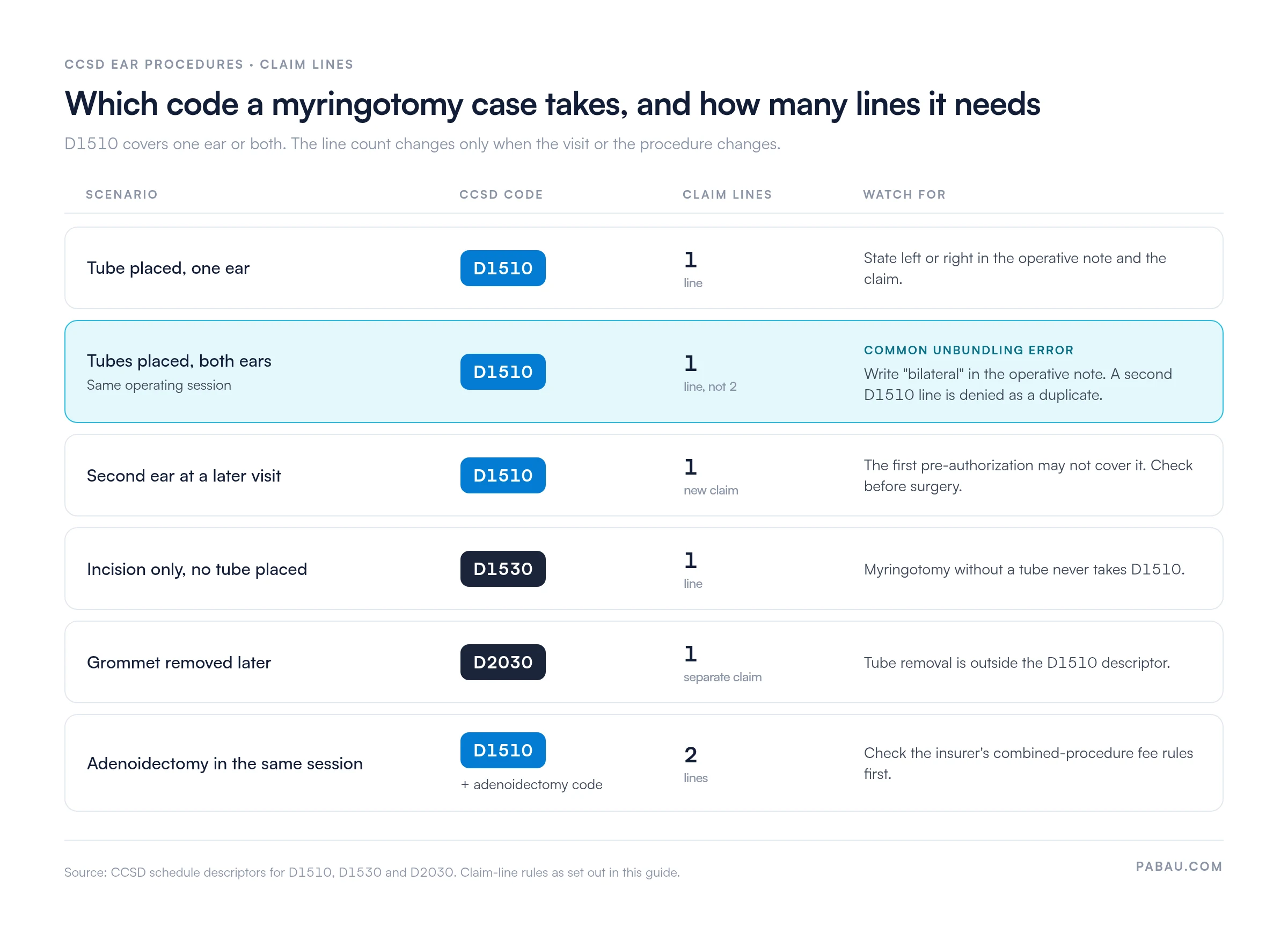
An incision with no tube placed is billed as D1530, and grommet removal at a later visit is billed as D2030. The map below shows which code each scenario takes and how many claim lines it needs.
The CCSD schedule does not split insertion from removal in every case. CCSD code C8654 covers insertion of a radioactive eye plaque and its later removal in one claim.
For combined procedures, check the Healix fee schedule or the equivalent schedule from the patient’s insurer for unbundling rules before submitting. Some insurers apply an assistant surgeon reduction or a combined-procedure fee cap when two or more ENT procedures are performed in the same session. Adenoidectomy and tonsillectomy codes should be confirmed against the current CCSD schedule, which is reviewed periodically.
Payer audits of ENT procedure claims focus on two documents, the operative report and the clinical history that establishes medical necessity. Both must be complete before the claim is submitted. Pabau, the practice management platform we build, lets ENT practices attach clinical records to a claim before submission through its claims management software. That cuts the round trip when a payer asks for supporting documentation.
The operative report must include all of the following to withstand an audit:
The clinical history section should reference the duration of symptoms and previous audiometric or tympanometric findings. It should also record any conservative management that failed before surgery was recommended. Watchful waiting, antibiotic courses and decongestants all count. Capturing structured pre-operative assessments on digital clinical forms keeps this documentation available at claim time.
Most UK private health insurers require pre-authorization before an elective D1510 procedure. Proceeding without a valid authorization number is one of the top denial causes. It typically means a full claim write-off rather than a reduced payment. Insurers including Bupa and Vitality maintain online code lookup tools that show current authorization requirements for specific procedure codes.
A standard pre-authorization submission for D1510 should include:
Response times vary by insurer. Allow time for the insurer’s stated response period when planning elective cases, and confirm the authorization number covers the correct laterality before proceeding. Practices running high volumes of pediatric ENT procedures benefit from practice management software built for private ENT workflows. It can track pre-auth status alongside the patient record.
Request a copy of the pre-authorization letter and file it in the patient record before the procedure date. If the insurer queries the claim after the procedure, the authorization number and scope are immediately available without contacting the insurer again.
D1510 covers the surgeon’s procedural fee only. Anesthesia, the facility fee, and any implant costs are billed separately by the respective providers under their own codes.
A common audit flag is a D1510 claim that bundles anesthesia fees into the surgeon’s account. Submit each provider’s fees on a separate account. Check the Aviva fee schedule or your insurer’s own schedule for the expected fee split. It also shows any combined-procedure reductions when D1510 is billed alongside an adenoidectomy or another concurrent procedure.
ENT billing managers consistently identify the same denial triggers across UK insurers. Addressing each one before submission is faster than managing the appeal cycle afterward. Strong denial management workflows catch most of these at a pre-submission audit rather than in post-denial review.
Most UK private insurers have a formal appeals or dispute resolution process. The steps below apply to most of them, though timelines and escalation routes differ.
Appeal deadlines vary by insurer, so check the insurer’s stated window and track it from the date of the denial. Beyond that window, the claim is typically written off as untimely.
Many ENT practices run D1510 billing across three places. Pre-authorization numbers sit in a spreadsheet, operative notes in the clinical system, and claims in the insurer’s portal. Each handover is a chance for a laterality mismatch or a missing letter to reach the insurer.
In Pabau, the referral letter, the pre-authorization letter and the operative note sit on the same patient record as the claim. Clinical records attach to the claim before it is submitted. Each denial reason is logged against the claim it came from, so the appeal starts with the evidence already in one place.
The result is fewer D1510 claims returned for missing paperwork, and faster appeals when one does come back. Your billing team checks one record instead of three systems.

Pabau helps ENT and specialist practices track CCSD claims, attach operative notes to submissions, and monitor pre-authorization status alongside patient records. See how it works for private surgical practices.

D1510 is easy to select and easy to get wrong on the claim. The two errors that cost the most are billing a bilateral case twice and treating both ears on a pre-authorization issued for one.
Fix both at booking. Confirm laterality on the authorization before the surgery date, and close the operative note before the claim leaves the practice. That costs a few minutes of checking per case, against a full write-off when an insurer rejects the claim.
Book a demo to see how Pabau links pre-authorization letters, operative notes and D1510 claims on one patient record.

Need a guide to CCSD procedure codes for private insurers? Pabau’s Bupa CCSD codes guide explains how private insurer CCSD schedules are structured and how to find the right code for each procedure.
Billing an incision with no tube placed? CCSD code D1530: Myringotomy billing guide covers the scope, documentation and denial risks of myringotomy without a grommet.
Removing grommets at a later visit? CCSD code D2030: Removal of grommets billing guide explains how tube removal is claimed separately from the original insertion.
Clearing the middle ear as a standalone procedure? CCSD code D1520: Suction clearance of middle ear shows when suction clearance is billed as the sole procedure.
Want to reduce claim write-offs across your practice? Denial management in healthcare covers the workflow changes that reduce avoidable denials across specialist and surgical practices.
CCSD code D1510 covers myringotomy and insertion of a ventilation tube (grommet) through the tympanic membrane, including bilateral procedures performed in the same session. It pays the surgeon’s procedural fee for the incision and tube placement. Anesthesia and facility fees are billed separately under their own codes.
D1510 is billed once, even when both ears are treated in the same session. The descriptor includes bilateral procedures. Submitting D1510 twice for a bilateral same-session procedure is an unbundling error, and the duplicate line will typically be denied. State “bilateral” in the operative report and in the claim notation field.
Yes, in most cases. Most UK private health insurers require pre-authorization before an elective D1510 procedure. The pre-auth submission should include the referral letter, audiometric evidence, clinical history of failed conservative management, and the intended laterality. Confirm pre-auth requirements with the specific insurer, as policies vary.
Most D1510 denials trace back to five causes. Missing or expired pre-authorization and incomplete operative notes (laterality, tube type, or anesthesia type absent) are the most frequent. Undocumented medical necessity, bilateral billed as two units, and an ICD-10 code that doesn’t match the insurer’s accepted indications make up the rest.
Yes. When adenoidectomy is performed in the same session as myringotomy-with-tube, D1510 and the adenoidectomy CCSD code are both submitted. Confirm the insurer’s combined-procedure policy and any fee reduction rules that apply. Submit each procedure on its own line rather than combining them into a single code.