HCPCS Code L0472: Hyperextension TLSO billing guide
HCPCS code L0472: Official descriptor and device definition HCPCS code L0472 des...

Last Updated: Nov 5, 2026
43770 is the CPT code for laparoscopic, surgical, gastric restrictive procedure; placement of adjustable gastric restrictive device (e.g., gastric band and subcutaneous port components). It covers initial placement only, and the port and tubing are bundled into the code. Prior authorization is almost universally required.
Coders often confuse it with the revision, removal, and replacement codes in the same family (43771-43774). That confusion is a common reason 43770 claims get denied or returned. Documentation must confirm a laparoscopic approach, band placement, and port fixation. The 90-day global period includes the day before surgery, the day of surgery, and the 90 days after.
Let Pabau's smart automation suggest the right codes, reduce claim denials, and keep your practice compliant—effortlessly.
Automate repetitive tasks and focus on what matters most—your patients.
Reduce coding errors and ensure compliance with the latest regulations.
Clean claims, fewer denials, and faster reimbursements.
Powerful insights and reporting to help your practice thrive.
HIPAA compliant SOC 2 certified GDPR-compliant Trusted by 4,000+ clinics worldwide

CPT 43770 covers initial laparoscopic placement only, not revision (43771), removal (43772, 43774), or removal and replacement (43773).
Port placement and subcutaneous tubing are bundled into 43770 and cannot be billed separately.
ICD-10 code E66.01 (morbid obesity due to excess calories) is the primary diagnosis for most 43770 claims, paired with a Z68 BMI code.
A 90-day global surgical period applies, so routine post-op band adjustments during that window are not separately reimbursable.
Pabau’s claims management software submits CMS-1500 claims to thousands of US payers through Claim.MD, runs real-time eligibility checks and flags denied claims.
CPT code 43770 is the code the American Medical Association (AMA) assigns to initial adjustable gastric band placement. Its descriptor reads “Laparoscopic, surgical, gastric restrictive procedure; placement of adjustable gastric restrictive device (e.g., gastric band and subcutaneous port components).” The descriptor is precise because it defines scope. Port placement and the subcutaneous tubing system are explicitly included in the descriptor, meaning they are bundled and not separately billable under any circumstances.
In the procedure, the surgeon gains laparoscopic access to the abdomen. An inflatable silicone band goes around the upper stomach to create a small gastric pouch. The surgeon then tunnels the tubing and fixes a subcutaneous access port to the abdominal fascia. All three steps, band, tubing, and port, fall inside the single code. Any coder who bills port placement separately creates an unbundling violation that will trigger a National Correct Coding Initiative (NCCI) edit.
The 43770 series covers every stage of the adjustable gastric band lifecycle. Using the wrong sibling code is the second most common denial trigger after missing prior authorization.
Key distinction: 43770 requires that no adjustable gastric band was previously in place. For a patient returning after a prior LAP-BAND procedure, use 43771, 43772, 43773, or 43774, based on the work the operative note describes. Submitting 43770 on a revision case is an upcoding error.
Three laparoscopic bariatric codes are easy to cross-code. The anatomical mechanism differs significantly between them, and payers scrutinize operative reports to confirm the billed code matches the procedure performed.
Decision rule: If the stomach itself was resected or rerouted, 43770 is wrong. Use 43644 for bypass (with intestinal reconstruction) or 43775 for sleeve (with gastric resection). A long-limb bypass with small intestine reconstruction to limit absorption is reported with CPT 43645. Use 43770 only when an external adjustable device was placed around an intact stomach. The diagram below combines this check with the sibling-code check from the previous section.
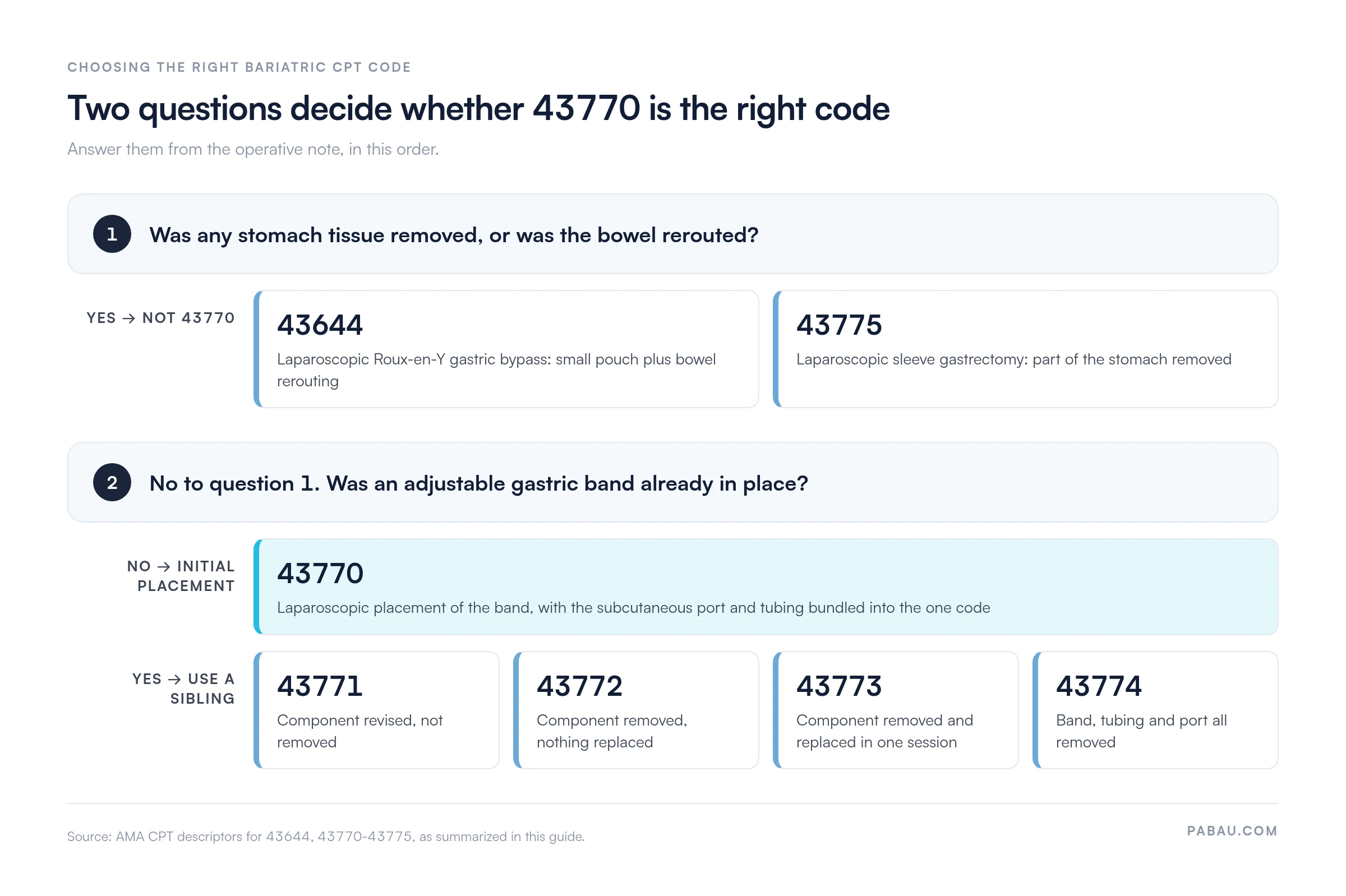
When auditing bariatric claims, pull the operative report and check one thing first: was any gastric tissue removed or was the small bowel rerouted? If yes, 43770 is incorrect regardless of what was submitted.
Medical necessity for CPT code 43770 requires at least one primary obesity diagnosis code plus any applicable comorbidity codes. Medicare’s National Coverage Determination (NCD) 100.1 and most commercial payers require BMI documentation that aligns with the submitted ICD-10 code.
Critical distinction: E66.01 and E66.09 are not interchangeable. E66.01 specifically designates morbid (severe) obesity, which supports the BMI and comorbidity documentation payers review. Submitting E66.09 on a claim that should carry E66.01 creates a medical necessity mismatch that triggers payer review.
Modifier selection for CPT code 43770 depends on surgical team configuration and procedural complexity. Each modifier requires supporting documentation in the operative report.
Modifier 62 (co-surgery) eligibility is payer-specific. Not all commercial payers recognize co-surgery for bariatric procedures. Verify individual payer policy before appending Modifier 62 to CPT code 43770.
Reimbursement for CPT code 43770 is set annually by CMS through the Medicare Physician Fee Schedule (MPFS) and varies by geographic locality. Commercial payer rates differ and are negotiated independently.
Medicare covers laparoscopic gastric banding under NCD 100.1 when clinical criteria are met. 43770 is a major abdominal surgery performed in a hospital or ambulatory surgical center. The facility’s payment is therefore separate from the physician’s professional fee. Always use the facility rate column in the MPFS lookup rather than the non-facility rate.
Nearly every payer requires prior authorization before CPT code 43770 can be submitted. Confirm each payer’s bariatric criteria before you start the request. Completing insurance eligibility verification first confirms the patient’s benefit level and whether bariatric services are covered at all under their plan.
Medicare’s NCD 100.1 sets the baseline. For Medicare to cover 43770, the patient must meet all of the following (verify current criteria with your MAC):
Commercial payers generally follow similar thresholds but add their own documentation layers. Most require 3-12 months of documented dietary counseling, a psychological evaluation, and letters of medical necessity from both the referring physician and the surgeon. Gather all of this before submitting the auth request; a missing document restarts the timeline.
The operative report for CPT code 43770 must contain specific elements. A generic bariatric surgery note will not survive payer audit. Practices that follow medical billing compliance protocols build this checklist into their pre-billing workflow.
For submitting a clean claim, the auth number, diagnosis codes, and operative note must align perfectly. A mismatch between the auth number’s approved procedure and the submitted CPT code is a likely denial. A corrected authorization is usually needed to overturn it.
CPT code 43770 carries a 90-day global surgical period under the Medicare Physician Fee Schedule. The global period covers the day before surgery, the day of surgery, and the 90 days after it. During this window, CMS and most commercial payers bundle routine post-operative services into the procedure payment.
Denial patterns on CPT code 43770 are predictable. Most map to one of five root causes, and each shows up as one of a handful of claim denial codes. Effective denial management workflows address each one before the claim is submitted rather than after it bounces.
Build a pre-claim checklist specific to 43770. Confirm auth validity, verify E66.01 is the primary diagnosis, and check whether a band was previously placed. Then flag any same-session charges that might trigger NCCI bundling edits. Catching these before submission cuts rework by the time it takes to handle a denial and appeal.
Billing CPT code 43770 means keeping four moving parts in step:
When those live in separate spreadsheets and inboxes, mismatches reach the claim before anyone spots them.
Pabau, the practice management platform we build, keeps them in one system. Its denial-tracking claims software generates claims from the invoices you already raise. It carries the diagnosis codes your team enters through to the claim, so nobody re-keys them in a clearinghouse portal.
Pabau works with Claim.MD, its US clearinghouse partner, to submit CMS-1500 claims to thousands of US payers. Together they run real-time eligibility checks and flag denied claims. Claim statuses and electronic remittance advice come back into Pabau, so your billing team sees which 43770 claims were paid or denied.
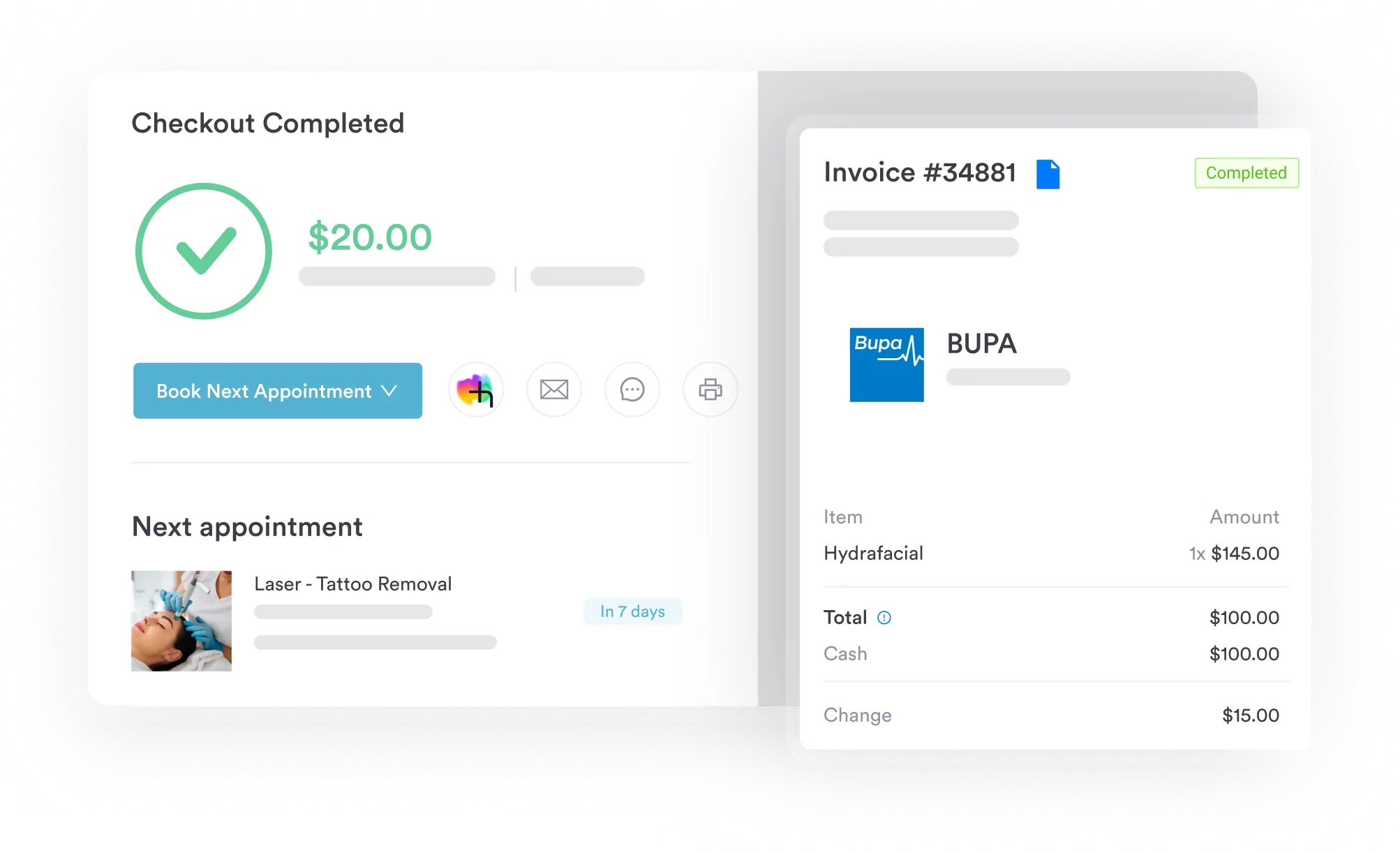
For bariatric practices, keeping the operative note and claim in one system makes mismatches easier to spot. A coder can check the note against 43770 before the claim goes out, instead of after a denial comes back.

Pabau submits CMS-1500 claims to thousands of US payers through Claim.MD, runs real-time eligibility checks and flags denied claims. See how it works for your bariatric billing.

CPT code 43770 pays cleanly when three checks happen before submission. Confirm no band was ever placed, keep the port and tubing on the one 43770 line, and match the authorization to the date of service.
The trade-off is a few minutes of review on every bariatric case. Skipping it can cost an appeal, a corrected authorization, and weeks of delayed payment on a high-value surgical claim.
If your team tracks authorizations, eligibility and claim status in separate places, start by pulling them together. Book a demo to see how Pabau keeps bariatric claims, eligibility checks and denials in one workflow.

Want to understand claim denials before they happen? Denial management in healthcare covers root-cause analysis and prevention workflows for high-denial code categories.
Need a clearinghouse that reaches thousands of US payers? Pabau’s Claim.MD clearinghouse guide explains how electronic claims submission works from invoice to remittance.
Looking for a billing compliance framework? Medical billing compliance outlines documentation and audit-readiness standards relevant to bariatric billing.
Coding the obesity diagnosis on the same claim? ICD-10 code E66.01 covers the primary diagnosis most 43770 claims carry.
Billing a gastric bypass instead of a band? CPT code 43644 walks through laparoscopic Roux-en-Y gastric bypass billing.
CPT code 43770 covers laparoscopic placement of an adjustable gastric restrictive device, including the subcutaneous port and tubing. The procedure involves placing an inflatable silicone band around the upper stomach to create a small gastric pouch. Port placement and tubing are bundled into the code and cannot be billed separately. It covers initial placement only: Revisions, removals, and replacements use sibling codes 43771 through 43774.
43770 is for initial laparoscopic placement of an adjustable gastric band in a patient with no prior band. 43771 is for revision of an adjustable gastric restrictive device component when the band or port is modified but not fully removed. Submitting 43770 on a revision case is an upcoding error that can trigger payer review. Always confirm whether a band was previously placed before selecting the code.
Yes, Medicare covers laparoscopic adjustable gastric banding under National Coverage Determination (NCD) 100.1. The patient needs a BMI of 35 or greater, at least one obesity-related comorbidity, and prior unsuccessful medical treatment for obesity. Medicare Advantage plans may apply additional requirements beyond NCD 100.1.
The modifiers most often used with 43770 are 22, 51, 62, and 80. Modifier 22 marks unusual difficulty documented in the operative note, and Modifier 51 marks multiple procedures in one session. Modifier 62 covers two surgeons performing distinct portions, subject to payer approval, and Modifier 80 covers a surgical assistant. Within the 90-day global period, Modifier 24 applies to unrelated E/M visits and Modifier 78 to a related return to the OR. Modifier 58 applies to staged or planned related procedures, and Modifier 79 to unrelated procedures.