HCPCS code J0330: Succinylcholine chloride injection billing guide
HCPCS code J0330: Definition and clinical overview HCPCS code J0330 is the offic...

Last Updated: Nov 2, 2026
43645 is the CPT code for a laparoscopic gastric restrictive procedure with gastric bypass and small intestine reconstruction to limit absorption. It reports a long-limb, or distal, gastric bypass in which the Roux limb measures more than 150 cm.
The measured limb length separates it from CPT 43644, which covers a Roux limb of 150 cm or less. A laparoscopic revision or reversal of an earlier bypass is not reported with 43645. Those cases go to unlisted code 43659.
Let Pabau's smart automation suggest the right codes, reduce claim denials, and keep your practice compliant—effortlessly.
Automate repetitive tasks and focus on what matters most—your patients.
Reduce coding errors and ensure compliance with the latest regulations.
Clean claims, fewer denials, and faster reimbursements.
Powerful insights and reporting to help your practice thrive.
HIPAA compliant SOC 2 certified GDPR-compliant Trusted by 4,000+ clinics worldwide

CPT code 43645 reports a laparoscopic gastric bypass with small intestine reconstruction to limit absorption, the long-limb or distal variant.
The measured Roux limb decides the code: 150 cm or less is 43644, and more than 150 cm is 43645.
Laparoscopic revision or reversal of a bypass has no dedicated code and is reported with unlisted code 43659, while 43848 covers open revision.
For 2026, Medicare assigns 43645 30.74 work RVUs, a 90-day global period, and inpatient-only status.
Pabau’s claims management software submits CPT 43645 claims through Claim.MD, which reaches thousands of US payers.
CPT code 43645 reports a laparoscopic gastric bypass that adds small intestine reconstruction to limit absorption. The official American Medical Association (AMA) descriptor reads: “Laparoscopy, surgical, gastric restrictive procedure; with gastric bypass and small intestine reconstruction to limit absorption.”
In practice, coders assign 43645 to a long-limb, or distal, Roux-en-Y gastric bypass. The surgeon creates a small gastric pouch and then bypasses a longer stretch of small intestine than a standard bypass. A Roux limb of more than 150 cm is the working threshold, as AAPC guidance and Cigna’s bariatric coverage policy both state.
The longer limb shortens the length of bowel where food meets digestive enzymes, so the operation adds malabsorption to restriction. Surgeons tend to choose it for patients with very high BMI or for patients who need more weight loss than a standard bypass delivers.
The difference between CPT 43644 and 43645 is the length of the Roux limb. CPT 43644 covers a standard laparoscopic Roux-en-Y gastric bypass with a limb of 150 cm or less. CPT 43645 covers the long-limb, malabsorptive version, with a limb of more than 150 cm.
Both codes describe a first bypass, so prior bariatric surgery is not part of either code. The only fact that moves a claim from one code to the other is the measured limb length in the operative note. A note that says “approximately 150 cm” supports 43644. Payers expect a measured length above 150 cm before they accept 43645.
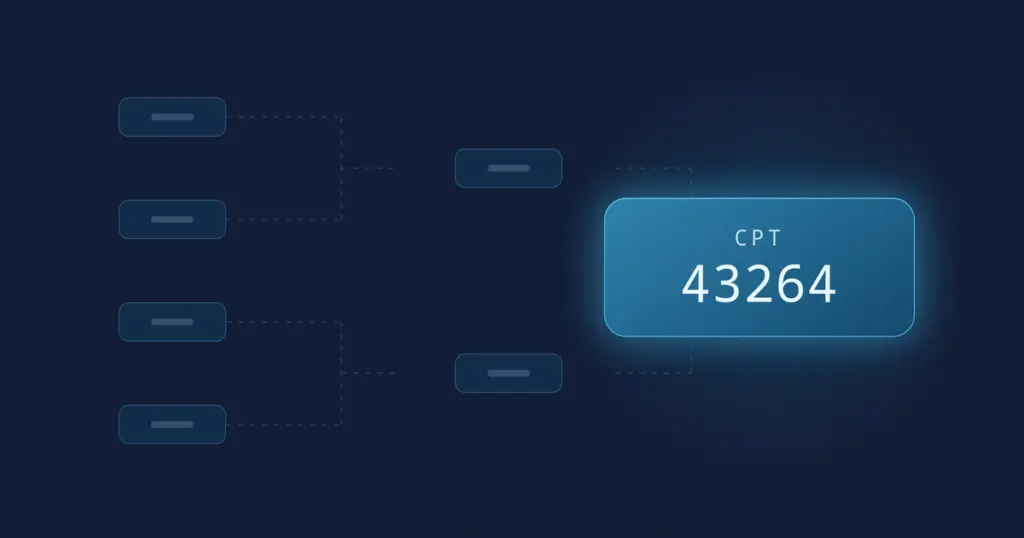
Never report 43644 and 43645 together for the same operation. They describe two versions of the same bypass, so only one applies. The decision path below places 43645 among its laparoscopic, open, and revision neighbors.
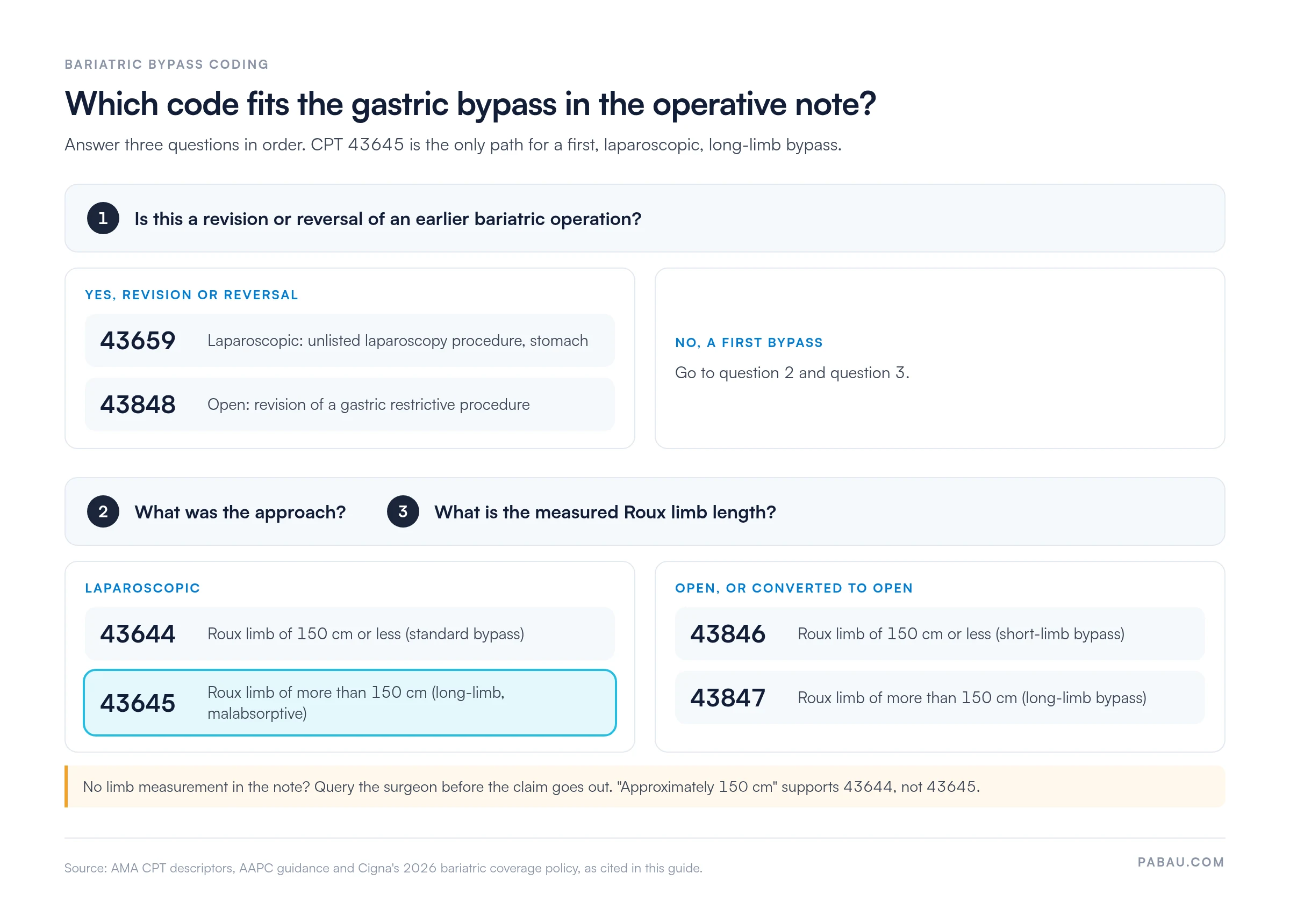
Auditors check that the operative note proves each part of the 43645 descriptor. A strong note lets a coder assign the code without querying the surgeon. Practices that review operative notes before submission catch missing details before the claim goes out.
The operative note for 43645 should record:
Pre-operative records matter as much as the operative note. Payers expect BMI, comorbidities, prior weight-loss attempts, and the multidisciplinary evaluation to be on file before surgery.
Before coding any gastric bypass, search the operative note for the Roux limb measurement. A number above 150 cm points to 43645, and 150 cm or less points to 43644. If the note gives no number, query the surgeon before the claim goes out.
CPT 43645 does not describe a revision or reversal of an earlier bariatric operation. A laparoscopic revision or reversal of a gastric bypass has no dedicated CPT code. Report it with unlisted code 43659 (unlisted laparoscopy procedure, stomach).
CPT 43848 covers revision of a gastric restrictive procedure, but only through an open approach. It does not apply to a laparoscopic case. A claim that uses 43645 for a revision misstates the procedure, which invites a denial or a post-payment recovery.
Conversions need a closer look. Cigna’s bariatric coverage policy lists 43645 among the procedures a patient may be converted to after a failed earlier operation.
If the payer’s policy describes the conversion that way, document the full long-limb reconstruction and check the policy before choosing between 43645 and 43659.
An unlisted claim needs a comparison report. Name the procedure performed, the closest specific code, and how the work differs from it. Payers use that report to price the service, and they often return unlisted claims that arrive without one.
Bariatric coders work within a small family of laparoscopic and open stomach codes. The table below shows which code fits each procedure, using descriptors from CMS and Cigna’s 2026 coverage policy.
CMS billing article A56422 lists 43645 among the covered bariatric procedures. It names E66.01, E66.812 or E66.813 as the primary diagnosis. A BMI code and the documented comorbidities then support the claim as secondary diagnoses.
BMI codes are secondary only and never stand alone as the reason for surgery. Check the CMS ICD-10 page for codes valid on the date of service. For a comorbidity the table does not list, look up its descriptor in the ICD-10-CM code archive.
Most commercial payers require prior authorization for CPT 43645. Medicare covers the procedure under its national bariatric surgery coverage policy, with billing guidance in A56422. Thorough insurance eligibility verification before the case is booked prevents most authorization-related denials.
A typical authorization request for 43645 includes:
Criteria differ between payers and change between plan years. Read the specific payer’s current policy before you submit, and confirm the request names 43645 rather than 43644.
The figures below come from the CMS 2026 National Physician Fee Schedule Relative Value File (October release). Payment is national and unadjusted, so your locality will differ. Check the CMS Physician Fee Schedule look-up for your area.
That fee covers the surgeon’s professional work only. The hospital bills separately, and the inpatient stay typically groups to MS-DRG 619, 620 or 621. Medtronic’s 2026 Medicare guide lists 43645 as inpatient only, although CMS is phasing out the inpatient-only list by 2029.
Useful modifiers include 80 or 82 for an assistant surgeon and 62 for co-surgeons. Modifier 22 applies only when the note shows substantially more work than usual. Modifier 78 covers an unplanned return to the operating room during the 90-day global period.
Check NCCI edits before adding a second code to 43645. Laparoscopic adhesiolysis (44180) and a diagnostic EGD performed during the operation are usually bundled into the bypass.
Most 43645 denials trace back to code selection or missing records rather than the surgery itself. A solid denial management workflow starts by knowing which problems to expect.
A clean claim on the first pass needs each of these points settled before submission. A superbill that confirms the code, modifiers, diagnoses, and place of service makes that check routine.
Bariatric programs at hospitals and weight loss practices often keep pre-operative records, operative notes, and claims in separate systems. That split is where limb measurements and authorization details go missing.
Pabau, the practice management platform we build, keeps them together in one patient record. Digital intake forms capture BMI, comorbidities, and weight-loss history from the first visit. Customizable note templates prompt the surgeon to record the Roux limb length.
Pabau’s claims management software then submits the claim electronically through Pabau’s Claim.MD integration, which reaches thousands of US payers. Your team can follow each claim’s status without leaving the patient record.

Pabau keeps intake forms, operative notes, and claims in one patient record, then submits claims through Claim.MD. Your billing team spends less time chasing missing details.

Treat the Roux limb measurement as the deciding fact on every gastric bypass claim. Over 150 cm, with the surgeon’s rationale on file, supports 43645. A limb of 150 cm or less belongs to 43644.
Keep 43645 out of revision and reversal cases entirely. Those go to 43659 when laparoscopic and 43848 when open. A coder who checks limb length and surgical history before choosing the code avoids the denials that cost the most on high-value cases.
Book a demo to see how Pabau keeps bariatric documentation and claims in one place for your surgical billing team.

Need a clearinghouse that handles surgical claims? Pabau’s Claim.MD clearinghouse overview explains how electronic claims reach thousands of US payers from inside Pabau.
Want to keep high-value surgical claims compliant? Medical billing compliance covers the documentation standards that keep surgical claims payable on first submission.
New to the billing side of surgery? What is medical billing? walks through how procedure codes, diagnosis codes, and clearinghouses connect in the revenue cycle.
CPT code 43645 covers a laparoscopic gastric restrictive procedure with gastric bypass and small intestine reconstruction to limit absorption. Coders use it for a long-limb, or distal, gastric bypass with a Roux limb of more than 150 cm.
The difference is the Roux limb length. CPT 43644 covers a laparoscopic Roux-en-Y gastric bypass with a limb of 150 cm or less. CPT 43645 covers the long-limb, malabsorptive version, with a limb of more than 150 cm.
No. CPT 43645 describes a gastric bypass, not a revision. A laparoscopic revision or reversal has no dedicated code and is reported with unlisted code 43659. An open revision of a gastric restrictive procedure is reported with 43848.
Yes, when the patient meets Medicare’s bariatric surgery criteria. CMS billing article A56422 lists 43645 as a covered procedure with E66.01, E66.812 or E66.813 as the primary diagnosis. It is billed as an inpatient, facility-only procedure.
The 2026 Medicare Physician Fee Schedule assigns 43645 30.74 work RVUs and 51.44 total facility RVUs. That works out to about $1,718 nationally before locality adjustment. The global period is 90 days.
The operative note must state the laparoscopic approach, describe the gastric pouch and anastomoses, and give the measured Roux limb length above 150 cm. Pre-operative records should show BMI, comorbidities, and the multidisciplinary evaluation.
The primary diagnosis is E66.01, E66.812 or E66.813. Add a BMI code from Z68.35 to Z68.45. Then code the documented comorbidities, such as E11.9 for type 2 diabetes or G47.33 for sleep apnea.