CCSD Code D1010: Radical mastoidectomy including meatoplasty
CCSD Code D1010: Definition and clinical scope CCSD Code D1010 is the UK private...

Last Updated: Nov 25, 2026
43275 is the CPT code for endoscopic retrograde cholangiopancreatography (ERCP); with removal of foreign body(s) or stent(s) from biliary/pancreatic duct(s).
It covers taking a stent, retained guidewire or other foreign body out of the bile or pancreatic duct without placing a new one. Stone and debris removal is reported with 43264, and a same-session stent exchange with 43276.
Let Pabau's smart automation suggest the right codes, reduce claim denials, and keep your practice compliant—effortlessly.
Automate repetitive tasks and focus on what matters most—your patients.
Reduce coding errors and ensure compliance with the latest regulations.
Clean claims, fewer denials, and faster reimbursements.
Powerful insights and reporting to help your practice thrive.
HIPAA compliant SOC 2 certified GDPR-compliant Trusted by 4,000+ clinics worldwide

CPT code 43275 covers ERCP removal of foreign body(s) or stent(s) from the biliary/pancreatic duct(s), while stone and debris removal is reported with 43264.
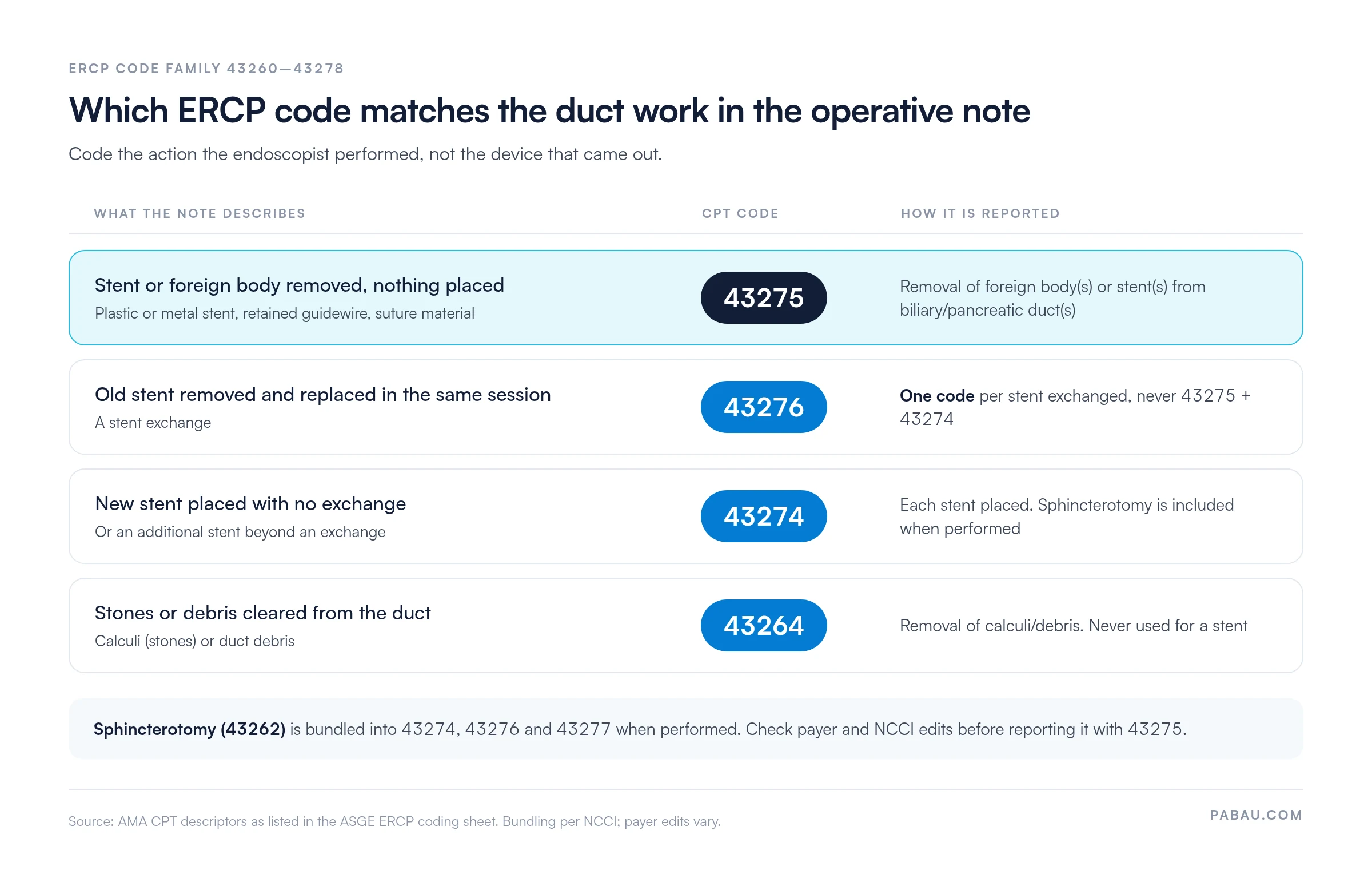
A same-session stent exchange is reported with the single code 43276, one unit per stent exchanged, never as 43275 plus 43274.
The 2026 work RVU for CPT 43275 is 6.69, but verify the locality-adjusted payment in the CMS Physician Fee Schedule before billing.
Sphincterotomy (43262) is bundled into 43274, 43276 and 43277, so check payer and NCCI edits before reporting it with 43275.
Pabau, a practice management platform, sends US claims through Claim.MD from the same record that holds the ERCP note.
CPT code 43275 is the ERCP code for removing a foreign body or stent from the bile or pancreatic duct without placing a new one. The ASGE ERCP coding sheet lists the official descriptor, which the American Medical Association sets. It reads Endoscopic retrograde cholangiopancreatography (ERCP); with removal of foreign body(s) or stent(s) from biliary/pancreatic duct(s).
The descriptor names stents outright, alongside other foreign bodies such as retained guidewires and suture material. Stones and debris fall under a different code, so the material removed decides which code applies.
NCCI edits and payer logic treat stone extraction and foreign body retrieval as separate services. Billing 43264 for a stent removal misstates the service and invites a RAC audit. A same-session stent exchange is different again. It is reported with 43276, one unit per stent exchanged.
ERCP foreign body removal starts with a side-viewing duodenoscope passed through the mouth, esophagus and stomach into the duodenum. From there, the endoscopist cannulates the common bile duct or pancreatic duct through the ampulla of Vater. Fluoroscopy guides the procedure throughout, locating the foreign body and confirming its position before extraction.
The clinical steps relevant to supporting the CPT 43275 claim are:
Fluoroscopy performed during ERCP is bundled into the procedure code and is not separately reportable under current NCCI policy. A fluoroscopy line added to a 43275 claim denies as CO-97.
Several services are automatically bundled into 43275 and cannot be separately billed on the same date without meeting a distinct-service exception.
The 43260-43278 family covers the diagnostic and therapeutic ERCP services. Most upcoding and downcoding errors in this family come from mixing up neighboring codes. The table below maps the codes most often confused with 43275.
See AAPC Codify for the full ERCP family range with cross-references and bundling lookups. In practice, the choice comes down to what the operative note says happened in the duct.
Modifier selection for CPT code 43275 turns on two questions. Were other procedures performed at the same session, and was the removal harder than usual?
Always confirm modifier policy directly with the payer before submitting ERCP combination claims. CMS accepts X-modifiers as replacements for Modifier 59, but many commercial payers still require the two-digit modifier. Sending XS to a payer that only recognizes 59 results in a preventable denial.
The work relative value unit (wRVU) for CPT code 43275 is 6.69, based on published CMS data. The total Medicare payment also uses practice expense and malpractice RVUs, adjusted by the Geographic Practice Cost Index (GPCI) for each locality.
Verify the final 2026 rate in the CMS Physician Fee Schedule lookup tool, since the annual conversion factor changes the dollar amount paid per RVU.
Use the FastRVU 2026 RVU lookup to calculate locality-adjusted payment estimates quickly. For superbill documentation, include the wRVU value alongside the CPT code and procedure description to support retrospective audits and physician compensation reporting.
A well-documented operative note is the strongest defense against a RAC audit or payer denial. The procedure note needs each of the following elements to support a CPT code 43275 claim.
Payers increasingly cross-reference operative notes against submitted procedure codes during pre-payment review. Support medical billing compliance by reviewing notes before claim submission rather than at the point of denial. A note that describes stent removal but does not specify the anatomical duct accessed gives a reviewer grounds to downcode to 43260.
Medicare generally does not require prior authorization for CPT code 43275 in a participating hospital outpatient department or ASC, provided medical necessity is documented. Commercial payer requirements vary widely. Blue Cross Blue Shield plans, UnitedHealthcare and Cigna each keep their own prior auth criteria. Practices billing in several states can’t apply one blanket rule.
Typical clinical criteria commercial payers use to approve ERCP foreign body removal:
Most payers waive prior auth when the procedure is performed emergently for ascending cholangitis, biliary sepsis or acute obstruction. Document the urgency clearly in the admission note and procedure report. The claim may still be reviewed for medical necessity afterward, even when no prior auth was required.
Run insurance eligibility verification before every scheduled ERCP. Confirm whether the payer requires prior authorization for 43275 and note the reference number. Then check that the authorization covers both the facility fee and the professional fee. Missing a payer-specific auth requirement is one of the most preventable denial triggers for ERCP billing.
Denials for CPT code 43275 cluster around a predictable set of errors, and each one can be caught before the claim goes out. For a systematic approach to denial management workflows, work through each trigger below.
When a 43275 claim does come back denied, the guide to reading denial codes explains what each CARC means. Match the code on the remittance to the rows above before you correct and resubmit.
ERCP foreign body removal often shares a session with a sphincterotomy, a stone extraction or new stent work. Each pairing follows its own rule, and a stent exchange takes 43275 off the claim entirely.
Sphincterotomy is often performed before stent extraction to widen the papillary orifice. It is bundled into 43274, 43276 and 43277 when performed, so it is never added to those codes.
Pairing it with 43275 needs checking first. Verify the payer’s policy and the current NCCI edit before reporting 43262 alongside 43275. If both are reported, the operative note must describe the sphincterotomy as a distinct step, not just a way to reach the foreign body.
A stent exchange, where the old stent comes out and a new one goes in, is reported with the single code 43276. Report one unit per stent exchanged. Removal without replacement is 43275 alone.
Report 43275 with 43274 only when a different or additional stent goes in beyond an exchange. In that case, document the removal and the extra placement as separate steps with their own rationale.
When a stent is removed and calculi are also extracted at the same session, 43275 and 43264 may both be billed with Modifier 59. The operative note must specifically describe both activities: The foreign body retrieval and the separate stone extraction. Without two clearly documented therapeutic interventions, the payer will downcode to the higher-valued single code and deny the second.
For electronic 837P claim files, a clean claim submission checklist helps each line carry the correct modifier and place of service code.
In many GI practices, the ERCP note and the claim live in different places. The endoscopist documents a stent removal or exchange, and a biller later reads the note and picks 43275, 43276 or 43274. That handoff is where an exchange gets split into two codes, or a sphincterotomy lands on a code that already includes it.
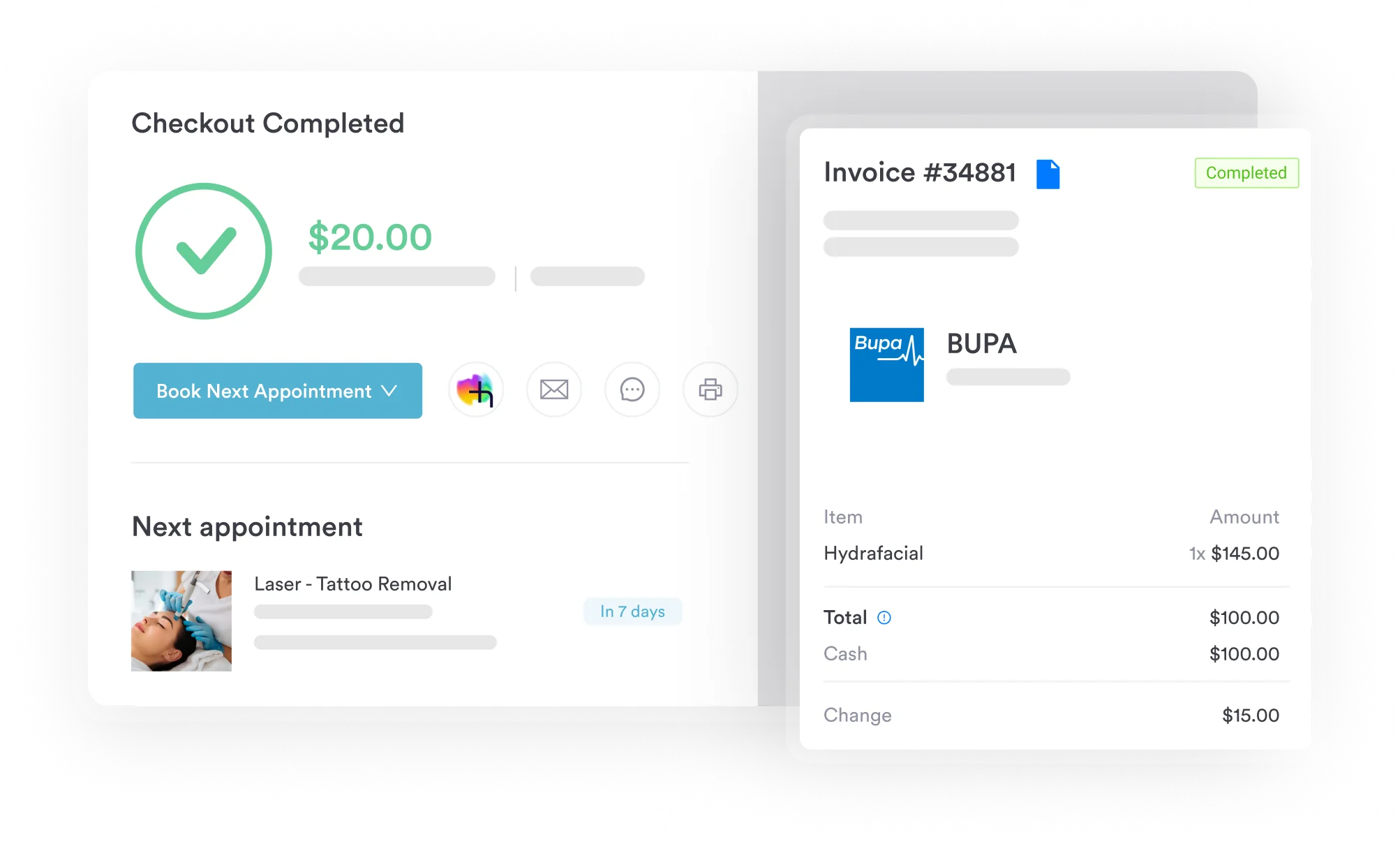
In Pabau, the procedure note, the codes and the claim sit on the same patient record. That record feeds Pabau’s claims management without rework. US claims go out as CMS-1500/837P files through Claim.MD, with eligibility checks beforehand and ERA remittances posted back afterward.
Prior authorization codes, dates and sessions are tracked on the patient’s case, with a warning when one is missing. So you can see before the ERCP whether the payer’s auth is on file, instead of learning it from a CO-15 denial.

Pabau keeps the ERCP note, the CPT code and the claim on one record, then sends US claims through Claim.MD. Your team spends less time reworking stent removal and exchange claims.

Getting CPT code 43275 right comes down to reading the operative note for what happened in the duct. A stent or foreign body that came out with nothing placed is 43275. A same-session exchange is 43276, not 43275 + 43274, and stones or debris belong to 43264.
The most reliable fix sits upstream of billing. Build the note template to ask what was removed, what was placed and whether a sphincterotomy was done. Then the biller no longer has to guess which code the endoscopist meant.
Pabau keeps the ERCP note and the claim on one record, so the code your team submits matches the procedure your endoscopist documented. Book a demo to see how it handles stent removal and exchange claims for your GI practice.

Want to see where ERCP claims sit in the revenue cycle? What is revenue cycle management explains how a procedure code moves through the claim lifecycle from scheduling to payment posting.
Confused by clearinghouse edit rejections? 837 electronic claim file guide breaks down how ERCP claims are structured and transmitted for payer adjudication.
Building a denial prevention workflow? Insurance eligibility verification covers how to confirm patient coverage and PA requirements before the ERCP is performed.
CPT code 43275 covers removal of foreign body(s) or stent(s) from the biliary/pancreatic duct(s) during an ERCP. Foreign bodies include plastic stents, metal stents, retained guidewires and suture material. It does not cover stone (calculus) or debris removal, which is coded as 43264.
The 2026 Medicare payment for CPT 43275 starts from its RVUs, including a work RVU of 6.69. Total RVUs are multiplied by the annual conversion factor and adjusted by the GPCI for the billing locality. Verify the exact dollar amount in the CMS Physician Fee Schedule lookup tool, as rates vary by location and change each year.
CPT 43275 covers removal of foreign bodies or stents, such as plastic or metal stents, guidewires and suture material. CPT 43264 covers removal of calculi (stones) and debris from the biliary or pancreatic ducts. Stent removal alone is 43275, and a same-session exchange is 43276. Billing the wrong code typically draws a CO-4 or CO-97 denial.
Only when a different or additional stent is placed beyond an exchange. When an old stent is removed and replaced at the same ERCP session, report the single code 43276, one unit per stent exchanged. Removal without replacement is 43275 alone. If 43275 and 43274 are both reported, document the removal and the extra placement as distinct steps.
The most frequent trigger is incorrect code selection, such as billing 43264 for a stent removal. Others include a missing Modifier 59 or XS on combination claims and fluoroscopy billed separately, since it is bundled. Vague operative notes and missing commercial prior authorization round out the list.
Medicare generally does not require prior authorization for CPT 43275 in a participating hospital outpatient department or ASC with documented medical necessity. Commercial payers often do require prior auth. Always verify the specific payer’s requirements before the procedure is scheduled.