CPT code 56501: Simple destruction of vulvar lesion
CPT code 56501: official descriptor and procedure overview CPT code 56501 is def...

Last Updated: Oct 21, 2026
37229 was the CPT code for endovascular atherectomy of the initial tibial or peroneal artery in one leg. Angioplasty within the same vessel was included when performed. The AMA deleted it effective January 1, 2026.
From January 1, 2026, initial-vessel tibial or peroneal atherectomy is reported with 37288 or 37290. Code 37288 is for a straightforward lesion (stenosis), and 37290 is for a complex lesion (occlusion). Keep 37229 for corrected claims and appeals with earlier dates of service.
Let Pabau's smart automation suggest the right codes, reduce claim denials, and keep your practice compliant—effortlessly.
Automate repetitive tasks and focus on what matters most—your patients.
Reduce coding errors and ensure compliance with the latest regulations.
Clean claims, fewer denials, and faster reimbursements.
Powerful insights and reporting to help your practice thrive.
HIPAA compliant SOC 2 certified GDPR-compliant Trusted by 4,000+ clinics worldwide

The AMA deleted CPT 37229 on January 1, 2026, so it is valid only for tibial or peroneal atherectomy with earlier dates of service.
For 2026 dates of service, report 37288 for a straightforward lesion (stenosis) or 37290 for a complex lesion (occlusion).
Angioplasty was never required for 37229. The code covered atherectomy and included same-vessel angioplasty only when it was performed.
Each additional tibial or peroneal vessel took an add-on code, such as 37233 for atherectomy, billed vessel by vessel rather than lesion by lesion.
Pabau, our practice management and billing platform, checks each claim for missing details before it goes out through the Claim.MD clearinghouse.
CPT code 37229 is a deleted code. It described endovascular atherectomy of the first tibial or peroneal artery treated in one leg. Angioplasty in that vessel was included when performed.
The AMA deleted it, along with the whole 37220–37235 lower extremity revascularization family, effective January 1, 2026. For dates of service from that day, the same procedure takes one of two new codes:
The replacement set runs from 37254 to 37299 and is organized by vascular territory, according to the SIR coding Q&A on the 2026 codes. Atherectomy in an additional tibial or peroneal vessel moves from add-on 37233 to 37289 or 37291, again split by lesion type.
Keep 37229 for one job only: claims, corrected claims and appeals for dates of service on or before December 31, 2025. Payers reject a 2026 date of service billed with 37229 as an invalid code.
For claims dated before 2026, CPT code 37229, maintained by the American Medical Association, reads as follows. Revascularization, endovascular, open or percutaneous, tibial, peroneal artery, unilateral, initial vessel; with atherectomy, includes angioplasty within the same vessel, when performed.
Two phrases in that descriptor drive code selection. “Initial vessel” makes 37229 a base code, reported once per leg for the first tibial or peroneal artery treated. “When performed” makes angioplasty optional, so an atherectomy with no balloon inflation still coded as 37229.
The tibial/peroneal territory covers the anterior tibial, posterior tibial and peroneal arteries. The table shows what the code included and what was reported on top of it.
Each legacy tibial/peroneal code now splits in two, by lesion type. The crosswalk follows SCAI’s 2026 lower extremity revascularization guide, which maps 37229 to 37288 and 37290.
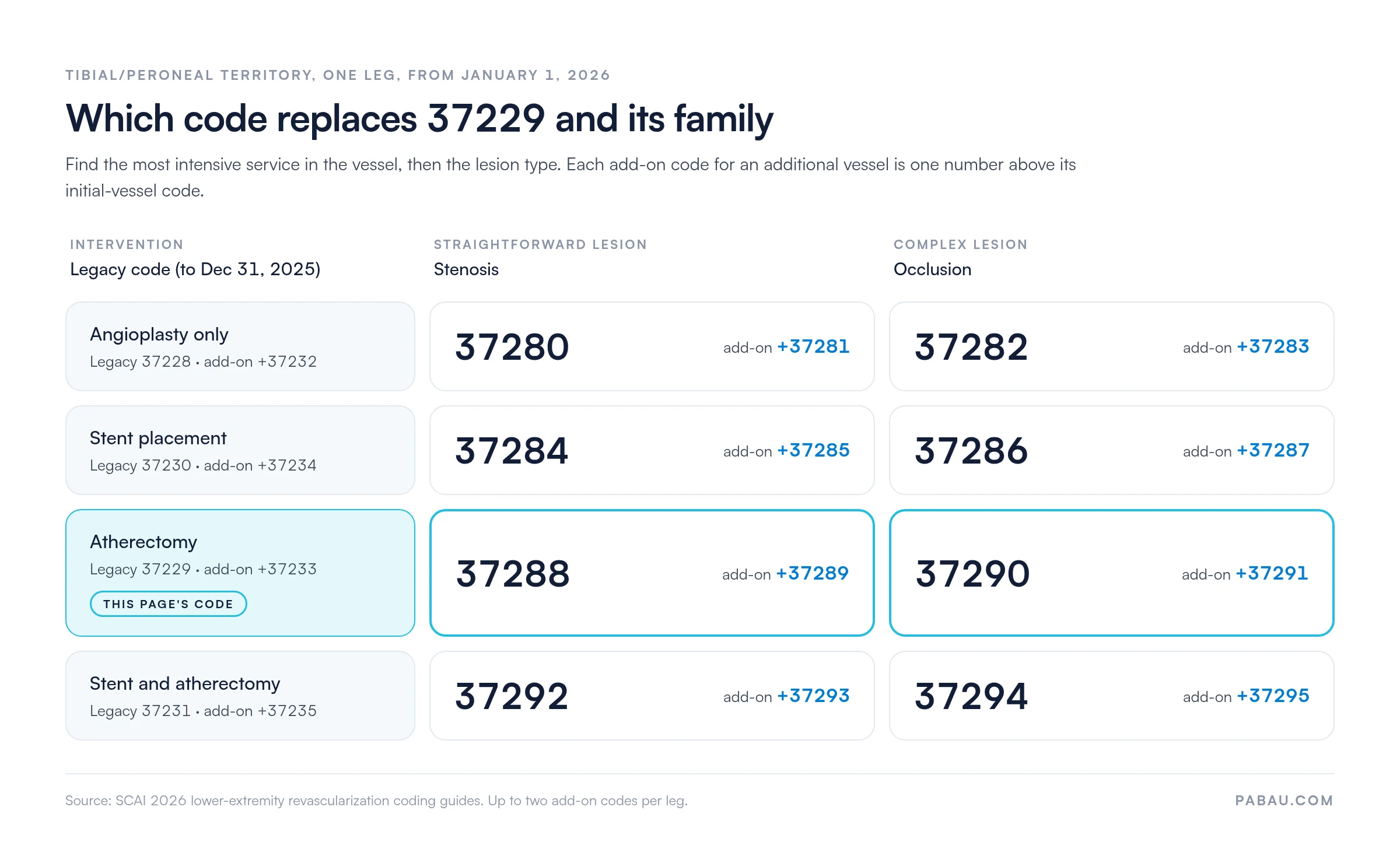
Under the 2026 rules, one initial-vessel code is reported per leg in this territory, with up to two add-on codes for additional vessels. The tibioperoneal trunk is not reported as a separate vessel unless it is the only vessel treated.
Femoral and popliteal work, legacy 37224–37227, has its own 2026 codes. It never shares a code with the tibial/peroneal territory.
The legacy tibial/peroneal family had four initial-vessel codes, ranked by the most intensive service in the vessel. You reported one code per vessel, from the top of this hierarchy:
So 37229 was correct whenever atherectomy was the most intensive service in the first vessel and no stent went in. A stent in the same vessel moved the code to 37231. Balloon dilation with no atherectomy device was 37228.
One common error was treating 37225 as an atherectomy-only alternative to 37229. Code 37225 belongs to the femoral/popliteal territory, which ran from 37224 to 37227. It cannot describe work in a tibial or peroneal artery.
CPT 37229 covered only the first tibial or peroneal vessel treated in the leg. Each additional vessel took an add-on code, chosen by the most intensive service in that vessel. Billing ran vessel by vessel, not lesion by lesion, so several lesions in one artery still counted as one vessel.
Add-on codes are reported only with a tibial/peroneal initial-vessel code for the same leg on the same claim. Each add-on lists the base codes it pairs with in its CPT parenthetical, so check the codebook for the date of service. Add-ons carry no global period of their own.
List each treated vessel and its most intensive service before you code. Atherectomy in the anterior tibial artery plus angioplasty alone in the peroneal artery bills as 37229 for the first vessel and 37232 for the second. Two lesions in the anterior tibial artery are still one vessel and one base code.
Modifier selection for CPT code 37229 affects both payment and claim edits. These modifiers apply most often.
Each lower extremity territory was coded separately: iliac (37220–37223), femoral/popliteal (37224–37227) and tibial/peroneal (37228–37235). Treating the superficial femoral artery and a tibial artery in one session gave one initial-vessel code in each territory.
Check the CMS NCCI edits for the date of service before adding a modifier. Append XS or 59 only when an edit applies and the operative note names the separate vessels.
Medicare paid 37229 under the Medicare Physician Fee Schedule (MPFS) for dates of service before 2026. Because the code is deleted, take the payment amount from the fee schedule year that matches the date of service. The CMS Physician Fee Schedule look-up tool lets you choose the year.
Key payment points for 37229 claims:
Submitting through a clearinghouse catches formatting errors before the payer sees the claim. Pabau sends claims electronically through Claim.MD, as our Claim.MD clearinghouse guide explains. Tracking electronic remittance advice afterward shows whether a 2025-dated 37229 claim paid at the expected rate.
Prior authorization rules for tibial and peroneal atherectomy vary by payer. Traditional Medicare has not required prior authorization for these procedures, but many Medicare Advantage and commercial plans do. Verify each payer’s policy before scheduling, because policies change at least annually.
For 2026 procedures, request authorization under 37288 or 37290, not 37229. An authorization on a deleted code may not match the claim that follows. Solid insurance eligibility verification before the procedure date prevents denials that are hard to rework on a 0-day global code.
Clinical criteria payers commonly ask for:
Submit the request with the ICD-10-CM diagnosis, ABI or TBI values, the imaging summary and any wound care or medication history. Incomplete submissions are a frequent cause of authorization delays.
Auditors reviewing 37229 claims look for specific elements in the pre-procedure workup and the operative note. A missing element can support a post-payment recovery demand.
Consistent documentation templates across the vascular team support medical billing compliance during payer audits. A note stating only that atherectomy and angioplasty were performed, with no vessel, device or result, will not survive an audit.
Denials on 37229 cluster around a few root causes. Most are preventable with checks before the claim is submitted.
Structured denial management workflows that sort 37229 denials by reason code expose patterns early. A spike in laterality denials after one operator starts dictating, for example, points to that operator’s note template.
For appeals on 2025 dates of service, keep 37229 on the claim. Recoding a 2025 procedure to 37288 or 37290 puts a code on the claim that did not exist on that date. Clean claim submission on the first pass depends on checking the code, diagnosis, modifier and authorization together.
Medical necessity for 37229 rests on a specific ICD-10-CM diagnosis. The I70.2- series, atherosclerosis of native arteries of the extremities, covers most cases. Laterality and severity both matter, and the unspecified code I70.209 rarely supports medical necessity alone.
Match the laterality of the ICD-10-CM code to the LT or RT modifier on 37229. A right-leg modifier paired with a left-leg diagnosis triggers a payer edit.
For bilateral tibial disease treated in one session with a 2025 date of service, report 37229-LT and 37229-RT as separate lines. Each line carries its own laterality modifier. Link each line to the ICD-10-CM code for that leg.
A code deletion hits a vascular practice at three points: the charge, the authorization and the claim. A 2025 procedure appealed in 2026 still needs 37229, while a new procedure needs 37288 or 37290. Mixing them up is easy when charges live in spreadsheets.
Pabau’s claims management software checks each claim for missing or invalid details, such as a missing authorization code, before it leaves the practice. In the US it also checks eligibility through Claim.MD before the visit.
It then tracks every claim from Pending to Paid, with remittances posted against it, so a rejected line is visible on the dashboard.

Pabau’s claims management checks each claim for missing details before submission and tracks it through payment. Your team can review the code and authorization on every claim before it reaches the payer.

Treat 37229 as a historical code. It still belongs on claims, corrected claims and appeals for 2025 dates of service, and nowhere else.
The bigger change sits in the operative note. Under the 2026 codes, a stenosis or an occlusion decides between 37288 and 37290. A practice that records the vessel, the lesion type and each device used will code the new series correctly the first time.
Book a demo to see how Pabau helps vascular practices catch missing claim details before claims reach the payer.

Need to understand how claims move through the clearinghouse after submission? Medical claims clearinghouse explained covers how 837P files are validated and routed to payers.
Getting denials with reason codes you don’t recognize? Denial codes in medical billing maps CARC and RARC codes to actionable rework steps.
Coding the angioplasty sibling of this code? CPT code 37228 covers tibial/peroneal angioplasty and its 2026 replacements, 37280 and 37282.
Want a primer on the full revenue cycle for a vascular procedure? What is revenue cycle management walks through each stage from patient registration to final payment posting.
CPT code 37229 is a deleted procedure code for endovascular atherectomy of the first tibial or peroneal artery treated in one leg. Angioplasty in the same vessel was included when performed. The AMA deleted it on January 1, 2026, so it applies only to earlier dates of service.
No. The AMA deleted 37229 effective January 1, 2026. For 2026 dates of service, report 37288 for atherectomy of a straightforward lesion (stenosis) or 37290 for a complex lesion (occlusion). Keep 37229 for corrected claims and appeals on dates of service before 2026.
CPT code 37229 carried a 0-day global period under Medicare. An E/M service on the procedure date was bundled unless it was significant and separately identifiable, reported with modifier 25. Follow-up visits on later dates were separately reportable when medically necessary.
LT or RT is the most common modifier, identifying the treated leg. XS or 59 applies only when an NCCI edit pairs two codes and the note documents separate vessels. Modifiers 76 and 77 cover a repeat procedure on the same date by the same or a different physician.
The most frequent causes are a deleted code on a 2026 claim, a femoral/popliteal code used for tibial work and a missing laterality modifier. Missing authorization, an unspecific ICD-10-CM code and add-ons billed without a base code follow close behind. Pre-submission claim checks and a documentation checklist prevent most of them.