HCPCS Code A4627: Spacer and valved holding chamber
HCPCS Code A4627: official descriptor and code definition HCPCS Code A4627 is th...

Last Updated: Oct 21, 2026
37225 was the CPT code for endovascular atherectomy of the femoral and/or popliteal artery in one leg. Angioplasty in the same vessel was included when performed. The AMA deleted it effective January 1, 2026, along with the rest of the 37220-37235 family.
For 2026 and later dates of service, report 37271 for a straightforward lesion (stenosis) or 37273 for a complex lesion (occlusion). Keep 37225 for corrected claims and appeals with earlier dates of service. A stent placed in the same leg moved the claim to 37227.
Let Pabau's smart automation suggest the right codes, reduce claim denials, and keep your practice compliant—effortlessly.
Automate repetitive tasks and focus on what matters most—your patients.
Reduce coding errors and ensure compliance with the latest regulations.
Clean claims, fewer denials, and faster reimbursements.
Powerful insights and reporting to help your practice thrive.
HIPAA compliant SOC 2 certified GDPR-compliant Trusted by 4,000+ clinics worldwide

CPT code 37225 reported femoral-popliteal atherectomy in one leg, with angioplasty in the same vessel included when performed.
The AMA deleted 37225 on January 1, 2026. For 2026 dates of service, report 37271 for a stenosis or 37273 for an occlusion.
Angioplasty alone was 37224, a stent was 37226, and a stent plus atherectomy was 37227.
Before 2026, the femoral-popliteal segment of one leg counted as one vessel, so only the most intensive code was reported.
Pabau’s billing software submits claims through Claim.MD and tracks claim status and remittances, so a rejected 37225 line gets recoded fast.
The American Medical Association (AMA) publishes the official descriptor for CPT code 37225. It reads: Revascularization, endovascular, open or percutaneous, femoral, popliteal artery(s), unilateral; with transluminal atherectomy, includes angioplasty within the same vessel, when performed. It covered plaque removal with an atherectomy device in the femoral-popliteal segment of one leg. A balloon angioplasty in the same vessel was part of the code, not a separate line.
The AMA deleted the whole 37220-37235 lower extremity revascularization family effective January 1, 2026. Its replacement is a set of 46 codes, 37254-37299, split by vascular territory and lesion type. A straightforward lesion is a stenosis, and a complex lesion is an occlusion.
Keep 37225 for corrected claims, appeals and audits with dates of service before 2026. For newer dates of service, the operative note must say whether the treated lesion was a stenosis or an occlusion. If it does not, query the physician before choosing between 37271 and 37273.
The 2026 codes also count vessels differently. The common femoral and profunda femoris arteries form one vessel, and the superficial femoral and popliteal arteries form another. Atherectomy in a second vessel uses add-on code 37272 (stenosis) or 37274 (occlusion), with one add-on per leg.
Three elements had to appear in the operative note for 37225. They were the anatomic zone (femoral and/or popliteal artery), the atherectomy, and the absence of a stent. Angioplasty in the same vessel was optional and included when performed. Change any one element and the code changes.
These services were bundled into CPT code 37225 and could not be billed separately for the same leg:
Separately reportable services in the same session include treatment of a different territory with its own code, such as iliac or tibial/peroneal. A tibial angioplasty in the same leg, for example, adds 37228. Diagnostic angiography is reportable only when no adequate prior study exists, the patient’s condition has changed, or the prior study was inadequate. A stent placed during the same session does not add a line. It moves the whole leg to 37227.
Coders do not need every surgical detail, but they do need to confirm that the operative note supports each step of the code. Here is the sequence for a standard femoral-popliteal atherectomy and what the note must confirm at each stage.
If step 4 is missing and only balloon angioplasty is described, the leg codes to 37224, not 37225. If a stent was deployed alongside the atherectomy, the correct code is 37227. Submitting 37225 without a documented atherectomy is an upcoding error and an audit risk. The grid below maps both questions to the pre-2026 code and its 2026 replacements.
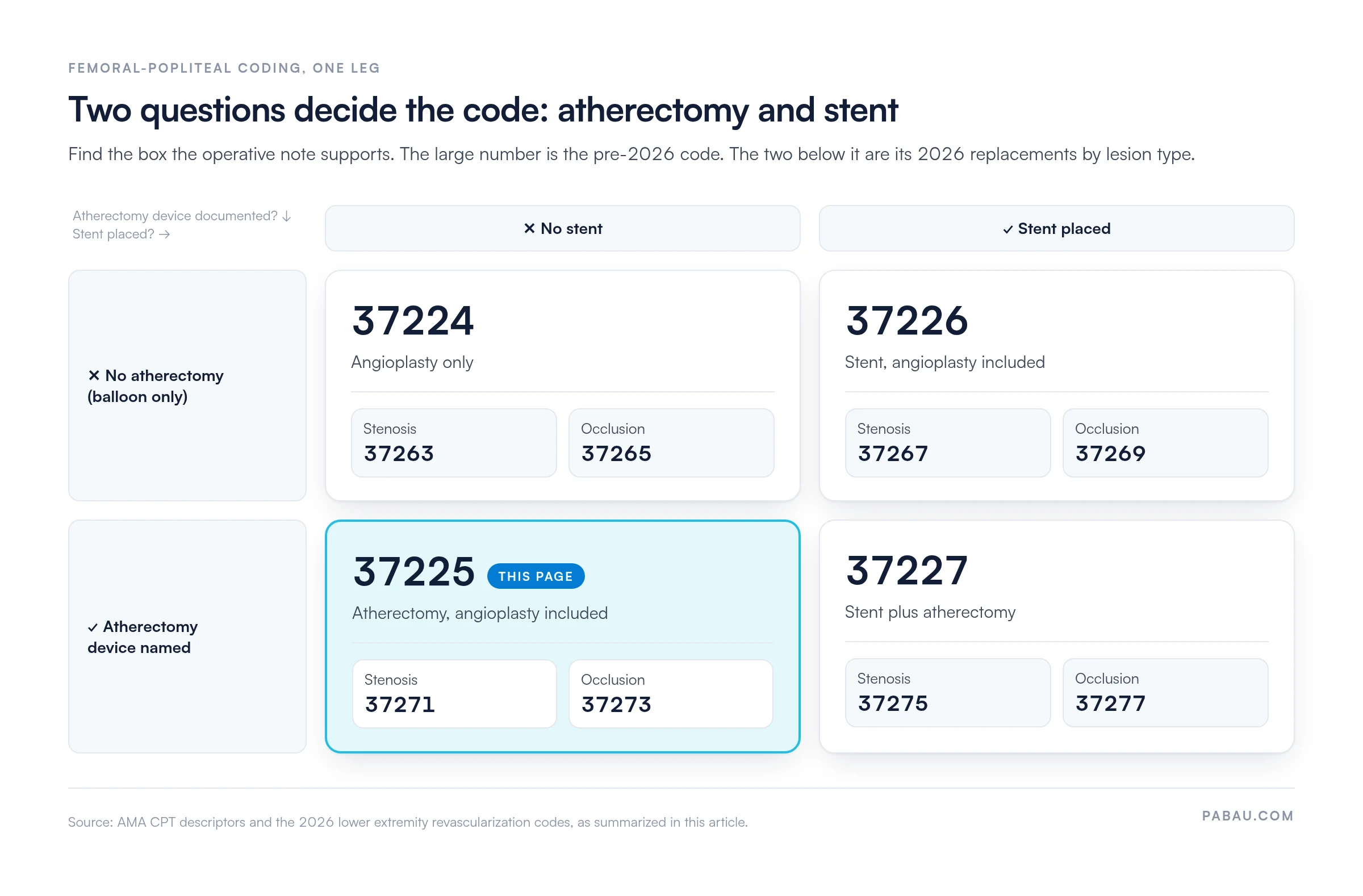
The most frequent femoral-popliteal code question is whether the physician removed plaque with an atherectomy device or only dilated the lesion with a balloon. The operative note is the deciding document.
Both codes cover the same anatomic territory, so the choice is procedural, not anatomic. A note headed “femoral-popliteal intervention” that describes only balloon work supports 37224. A note that names an atherectomy device and describes debulking supports 37225.
CPT code 37226 reported stent placement in the femoral-popliteal segment, with angioplasty included when performed. It covered no atherectomy. If the note describes a stent and no atherectomy device, the leg codes to 37226, not 37225.
The two codes were never reported together on the same leg. When a case combined both procedures, neither code applied, and the claim moved to 37227.
CPT code 37227 replaced 37225 when the physician also placed a stent in the same femoral-popliteal segment during the session. The hierarchy ran from angioplasty alone (37224) to atherectomy (37225), stent (37226), and stent plus atherectomy (37227).
Intravascular imaging such as optical coherence tomography (OCT) can guide an atherectomy. The atherectomy itself is still 37225 when no stent is placed. Before adding any line for the imaging, check the AMA CPT Knowledge Base guidance on imaging during atherectomy.
Check the operative note for the phrase ‘atherectomy device’ or a named atherectomy system. If one appears and no stent was deployed, the pre-2026 code is 37225. If a stent was also deployed, shift to 37227 before submitting.
CPT code 37225 sat within a family of lower extremity endovascular revascularization codes organized by vessel territory and procedure type. Knowing the full matrix prevents vessel-zone errors on legacy claims.
Each territory treated in one leg got its own primary code, and only the most intensive service in that territory was reported. The femoral-popliteal segment counted as a single vessel, so it had no add-on code. Additional iliac vessels used 37222 or 37223, and additional tibial or peroneal vessels used 37232-37235.
Check the CMS NCCI edits for the date of service before billing two territories in one session. Some combinations can be separated with a modifier, while others cannot.
CPT code 37225 is unilateral, so laterality modifiers carry most of the weight on the claim. The table below shows the common modifier scenarios.
Payers do not all handle bilateral vascular procedures the same way. Many want two lines, RT on the first and LT on the second. Check your Medicare Administrative Contractor (MAC) or payer policy before submitting a bilateral 37225 claim.
Submitting a clean claim for 37225 starts with the operative or procedure note. Payers and auditors look for these elements in it:
ICD-10-CM diagnosis codes most often paired with 37225 come from the I70.2- series for atherosclerosis of native arteries of the extremities. Common examples are I70.211, I70.212 and I70.213 for intermittent claudication in the right, left or both legs. I70.221 covers rest pain in the right leg, and I70.261-I70.269 cover atherosclerosis with gangrene. Code to the highest specificity the documented diagnosis supports.
Prior authorization requirements for femoral-popliteal atherectomy vary by payer type, plan and MAC region. Insurance eligibility verification should confirm the requirements before the procedure date. The table below reflects typical patterns, but payer policies change often, so verify them directly.
When auth is denied, document the clinical urgency in the appeal and attach the operative report and objective hemodynamic data. Keeping the authorization number in the patient record and on the claim reduces holds and denials.
Medicare paid CPT code 37225 under the Physician Fee Schedule, which updates every January 1. Look up the rate and relative value units for the year of the date of service in the CMS Physician Fee Schedule (MPFS) look-up. The 2026 schedule prices 37271 and 37273, not 37225. Electronic remittance advice (ERAs) from payers show the allowed amount applied to each claim.
CMS lists a 0-day global period for this code. Confirm the value for the year of the date of service in the MPFS before billing. Electronic claims submission through a clearinghouse lets the practice follow each claim through acceptance, payment or denial.
CPT code 37225 claims face a predictable set of denial patterns. The denial management strategies below pair each one with a corrective action. Reviewing common denial codes in medical billing alongside them helps the billing team decide which checks to build into pre-submission review.
Tracking ERA denial codes by service line shows repeat patterns, such as claim adjustment reason code (CARC) 97 or CARC 4. Fixing the documentation or coding step upstream then beats appealing claim by claim.
A quick legacy audit catches most of these errors before an appeal deadline passes. Compare each pre-2026 femoral-popliteal claim against the operative note.
Audit your pre-2026 femoral-popliteal claims. If a 37224 note names an atherectomy device, the leg may support 37225. If a 37225 note describes a deployed stent, the correct code is 37227.
Vascular billing teams now work two code sets side by side. Appeals and corrected claims still carry 37225, while new dates of service need 37271 or 37273. Without one view of each claim, a rejected line can sit unnoticed until it ages into a write-off.
Pabau, the practice management and billing platform we build, sends CMS-1500 claims to US payers through its Claim.MD integration. It runs real-time eligibility checks before the procedure, updates each claim’s status from the payer, and brings ERAs back in. Denied claims are flagged for rework, so a deleted code or missing modifier gets fixed and resubmitted quickly.
With denial-flagging claims software handling submission and remittance in one place, your coders can spend their time on the operative note. That is where 37225, 37226 and 37227 are decided.

Pabau submits claims through Claim.MD, checks eligibility in real time and brings remittances back in. Denied femoral-popliteal claims are flagged for rework before they age into write-offs.

CPT code 37225 now matters only for claims with dates of service before 2026, but those claims still get audited and appealed. On each one, confirm the atherectomy device in the note and check that no stent was placed. Then make sure the leg carries one femoral-popliteal code.
For newer cases, the lesion type in the note decides between 37271 and 37273, so ask physicians to state it every time. Book a demo to see how Pabau tracks vascular claims from submission to remittance.

Need a clean-claim checklist for vascular billing? What makes a clean claim covers the elements every endovascular claim must have before submission.
Struggling with claim denials across multiple codes? What is revenue cycle management explains how to build a denial-prevention workflow from auth through ERA reconciliation.
Want to understand how Pabau’s clearinghouse integration works? Pabau and the Claim.MD clearinghouse walks through how 837P claims are submitted and ERAs are matched automatically.
Coding an iliac intervention in the same session? CPT code 37220 covers iliac angioplasty, the territory above the femoral-popliteal segment.
CPT code 37225 reported endovascular atherectomy of the femoral and/or popliteal artery in one leg, open or percutaneous. Angioplasty in the same vessel was included when performed. The AMA deleted the code effective January 1, 2026.
No. CPT code 37225 was deleted on January 1, 2026. For 2026 and later dates of service, report 37271 for a stenosis or 37273 for an occlusion. Keep 37225 for corrected claims and appeals with earlier dates of service.
CPT 37224 covered femoral-popliteal angioplasty alone. CPT 37225 covered atherectomy in the same territory, with angioplasty included when performed. If the note names an atherectomy device and describes plaque removal, use 37225. If it describes only balloon work, use 37224.
CPT 37225 covered femoral-popliteal atherectomy without a stent. CPT 37227 covered atherectomy plus stent placement in the same territory. When a stent is deployed alongside the atherectomy, the whole leg codes to 37227.
Report each leg on its own line with RT or LT. Follow the payer’s policy on whether the second leg also needs modifier 50 or 59. Always append RT or LT, because a missing laterality modifier is a common denial trigger.
Yes, when both territories are treated in the same leg and session. 37225 covered femoral-popliteal atherectomy, and 37229 covered tibial or peroneal atherectomy in the initial vessel. Document each territory separately and check the NCCI edits for the date of service.
Traditional Medicare fee-for-service does not require prior authorization, but the procedure must meet LCD medical necessity criteria. Medicare Advantage plans and commercial insurers usually require prior auth for elective cases. Verify the plan’s current policy before scheduling.
CMS lists a 0-day global period for CPT code 37225. Post-procedure visits are therefore not bundled into a longer global period. Confirm the value for the year of the date of service in the CMS Physician Fee Schedule before billing.
The atherectomy itself is reported with 37225 when it is performed in the femoral-popliteal zone without a stent. If a stent is also placed, the code is 37227. Check the AMA CPT Knowledge Base guidance before reporting anything for the OCT imaging.