CPT Code 90961: ESRD monthly capitation billing guide
CPT Code 90961: Definition and official descriptor CPT Code 90961 is the monthly...

Last Updated: Oct 21, 2026
CPT code 36589 is the procedure code for removal of a tunneled central venous catheter without a subcutaneous port or pump. It covers Hickman, Broviac and Groshong lines, plus tunneled dialysis catheters, when the whole catheter comes out and no implanted reservoir comes out with it.
When a port or pump is removed along with the catheter, the claim goes out as CPT 36590 instead. Both descriptors hinge on that one reservoir, so the procedure note has to say which device was removed. This reference covers the documentation, ICD-10 pairings, Medicare payment, modifiers and denial patterns for 36589.

CPT 36589 covers tunneled catheter removal only when no subcutaneous port or pump is present. Port or pump removal uses CPT 36590.
Hickman, Broviac and Groshong catheters are the devices most often billed under 36589, and the operative note must confirm the device type.
Missing documentation of tunneled construction, and of the absence of a subcutaneous reservoir, are the top two reasons 36589 claims are denied.
Medicare pays 36589 under a 10-day global period, at about $166 in an office and $125 in a facility before geographic adjustment.
Pabau’s claims management software tracks vascular access claim status and flags incomplete documentation before the claim is submitted.
The American Medical Association’s CPT code set gives the official descriptor for 36589 as Removal of tunneled central venous catheter, without subcutaneous port or pump. The code sits in the Surgery section under Cardiovascular Procedures, in the Central Venous Access Procedures subsection (36555-36598).
The key clinical concept is tunneling. A tunneled catheter passes under the skin from the venous entry point to an exit site on the chest or upper arm. That tunnel lowers infection risk compared with non-tunneled lines, and it is what earns the device its own removal code.
Two device features determine which removal code applies:
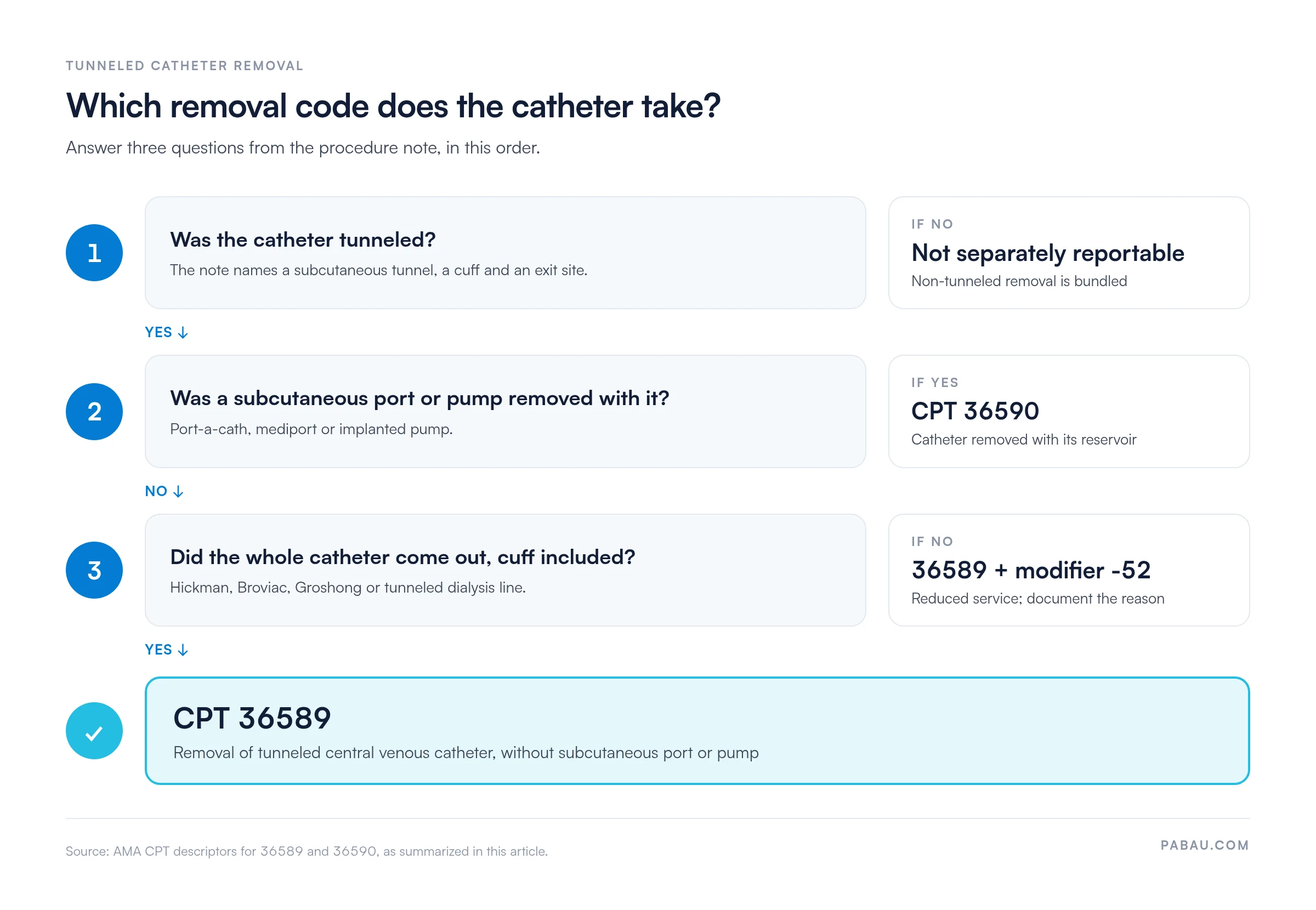
Add a third check for complete removal, and the coding choice becomes the three-question path below. Each answer rules out one of the alternatives.
Tunneled catheter removal happens at the bedside, in an outpatient office, or in an interventional suite. The setting depends on the patient’s condition and on whether the catheter is patent or adherent. The physician or qualified non-physician practitioner frees the Dacron cuff from the fibrous ingrowth around it, then applies steady traction until the line comes out.
For coding, the procedure note must document:
Incomplete removal that needs a return procedure changes the coding scenario entirely.
Place of service also affects reimbursement. Removal in a physician office (POS 11) is paid at the non-facility rate. Removal in a hospital outpatient department or ambulatory surgical center is paid at the lower facility rate. There, the facility bills separately for overhead and supplies.
The 36589 versus 36590 distinction is the rule coders misapply most often in tunneled catheter billing. The difference is one device component: a subcutaneous port or pump.
A removal that included a port should have been billed as CPT 36590. Billed as 36589 instead, the claim will be denied or, if paid, flagged in a retrospective audit. Coders should confirm the device type in the operative note, not from the ordering physician’s verbal description or the patient’s self-report.
PICC line removal is not automatically coded with CPT 36589. The device’s construction decides the code. Most peripherally inserted central catheters are non-tunneled, so their removal is bundled and not separately reportable.
The access site, arm or chest, has no bearing on code selection. A tunneled catheter inserted through the arm follows the same 36589 logic as a Hickman line at a chest exit site. In both cases, no port can be present.
These tunneled catheters are commonly billed under 36589 when they are removed without a subcutaneous port or pump:
A brand name alone is not enough documentation. The operative or procedure note must confirm the tunneled construction, the cuff location and the exit site. Payer auditors routinely request the procedure note when a 36589 claim is queried.
Flag every vascular access removal claim for a second documentation check before submission. Confirm three facts in the note: (1) the device is tunneled, (2) no port or pump was removed, and (3) the whole catheter came out. A claim missing any one of them is exposed to a first-pass denial.
A clean claim for CPT 36589 depends on specific elements in the procedure note. Payers and Medicare contractors look for all of the following:
Every 36589 claim needs a supporting ICD-10-CM diagnosis code, which establishes medical necessity for the removal. The right pairing depends on the clinical reason for removal:
Z45.2 is the most commonly used diagnosis for routine elective removal at the end of a chemotherapy or antibiotic course. For complication-driven removal, the complication code takes precedence and is listed as the principal diagnosis, with any underlying condition sequenced behind it.
Medicare Part B covers CPT 36589 when a physician or qualified non-physician practitioner performs the removal and documentation supports medical necessity. The code carries a 10-day global surgical period (010) under the Medicare Physician Fee Schedule (MPFS). Related follow-up visits in the 10 days after removal are included in its payment.
Payment varies by place of service. The CMS Physician Fee Schedule lookup tool gives the current facility and non-facility rates by HCPCS/CPT code and locality. As a general benchmark (verify current rates using the CMS tool before billing):
Rates change annually with each MPFS update. Verify current-year payment through the FastRVU RVU lookup tool or CMS directly before quoting expected reimbursement.
Prior authorization requirements for CPT 36589 vary by payer and plan year. Traditional fee-for-service Medicare generally doesn’t require prior authorization for this code. Commercial payers and Medicare Advantage plans differ widely. Some require authorization for outpatient facility settings but not for office-based removal, while others apply clinical criteria based on the underlying diagnosis.
Check the payer’s authorization lookup portal before scheduling removal in a facility setting. A missing authorization results in a technical denial that is difficult to overturn on appeal.
Denial patterns for 36589 are predictable and largely preventable. Effective denial management workflows for vascular access claims focus on these recurring failure points:
A denied 36589 claim comes back with a reason code that tells your billing team what went wrong. Our guide to denial codes for billers explains what the most common codes mean.
Several modifiers apply to CPT 36589, depending on the clinical scenario. The correct modifier prevents NCCI bundling edits and global period conflicts:
The Office of Inspector General (OIG) and Recovery Audit Contractors (RACs) periodically target vascular access codes as part of broader cardiovascular billing reviews. With 36589 and 36590, the risk is upcoding.
That covers billing 36590, the higher-paying code, when documentation only supports 36589. It also covers billing 36589 for a non-tunneled removal that should not have been billed at all. Consistent medical billing compliance practices protect against both.
Specific audit red flags for vascular access removal codes include:
Keep the original procedure notes for vascular access removals for at least seven years. Medicare contractors may request records from any claim period within their lookback window. Claims software for billers that links each claim to its documentation reduces audit exposure, because the supporting record is immediately retrievable.
Run a quarterly internal audit of all 36589 and 36590 claims billed in the prior period. Compare the code selected against the device type documented in each operative note. If discrepancies exceed 3-5% of claims, schedule targeted coder education before an external audit finds the pattern first.
In a generic billing tool, a missing port statement often surfaces only when the remittance comes back. By then the claim needs a correction, a resubmission and another wait for payment.
Pabau, the practice management platform we build, turns the invoice for the removal into an electronic CMS-1500 claim. Its claim validation checks each claim for missing or invalid details before it leaves the practice. In the US, claims reach payers through Claim.MD, Pabau’s clearinghouse partner.
Claim statuses and electronic remittance advice come back into Pabau, so your team can see where each removal claim stands.
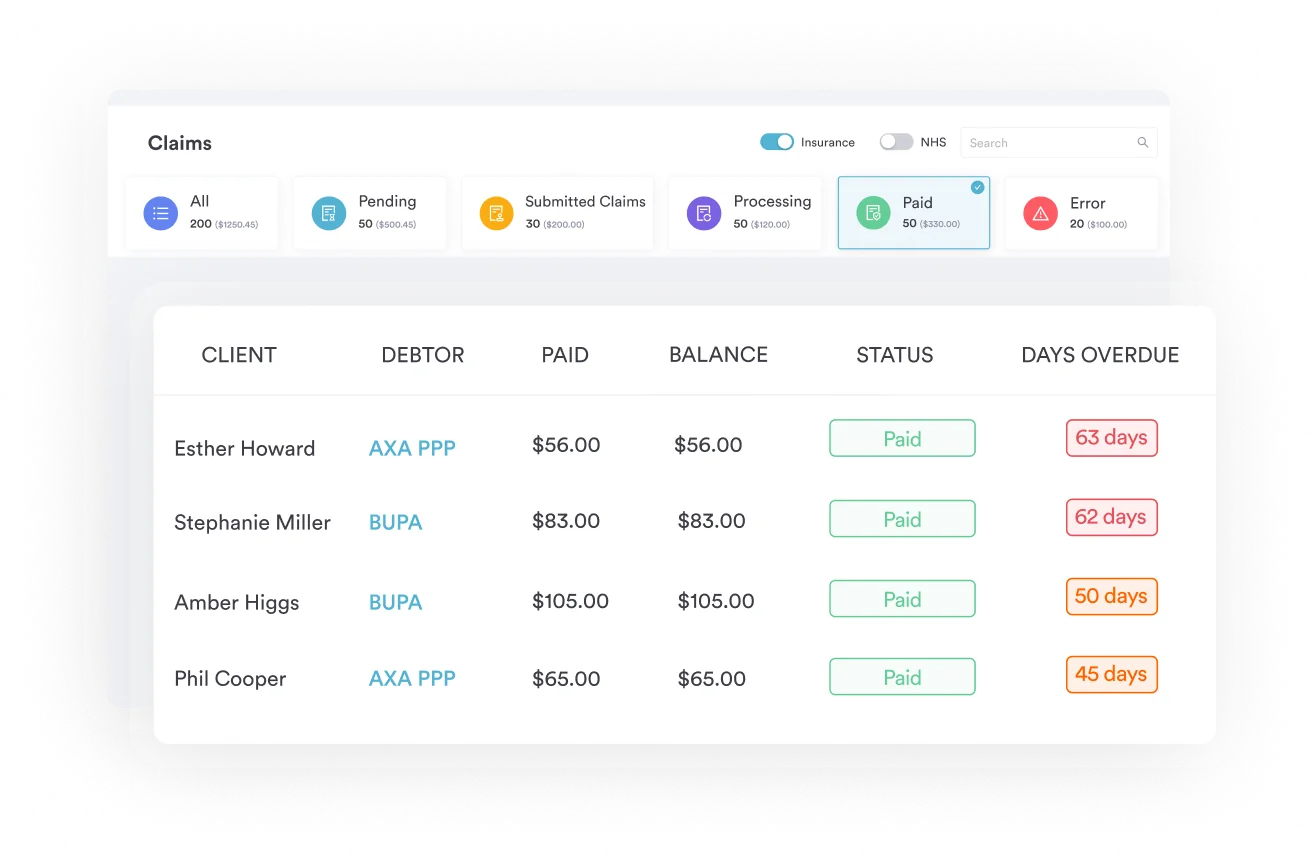
A claim that comes back rejected is flagged Needs action, with a link straight to the field that needs correcting. That helps catch incomplete documentation before the claim is submitted again. It also keeps the procedure note one step from the claim if an auditor asks for it.

Pabau’s claim validation checks each vascular access claim for missing or invalid details before submission. You then track its status through to payment in one workflow.

The device decides the code on every tunneled catheter removal. Before a 36589 claim leaves the practice, the operative note should confirm three facts: tunneled construction, no port or pump, and complete removal.
Pair those facts with the diagnosis that matches the reason for removal, and the common denial triggers for this code fall away. The cost is a few extra minutes at the documentation stage. That is far cheaper than an appeal, or an audit finding a year later.
For practices billing vascular access removals at volume, Pabau’s revenue cycle management workflow tracks claim status from submission through adjudication. It also helps catch incomplete documentation before the claim is submitted. Book a demo to see how Pabau takes a removal claim from procedure note to payment.

Need to understand clean claim requirements for procedural codes? Clean claim submission covers the documentation and formatting standards that reduce first-pass denial rates across procedure code families.
Managing vascular access denials at scale? Denial management in healthcare explains how to build a systematic denial tracking and appeal workflow for high-volume practices.
Want to understand how clearinghouse submission works? Medical claims clearinghouse explains how 837P electronic claims are validated, submitted, and acknowledged before reaching the payer.
Coding the placement instead? CPT 36558 covers insertion of a tunneled central venous catheter without a port or pump, for patients aged 5 and older.
CPT code 36589 covers removal of a tunneled central venous catheter that has no subcutaneous port or pump attached. It applies to devices such as Hickman, Broviac and Groshong catheters when the entire catheter is removed and no implanted reservoir comes out with it.
CPT 36589 is used when a tunneled catheter is removed without a subcutaneous port or pump. CPT 36590 is used when an attached port or pump, such as a mediport or port-a-cath, is removed too. The subcutaneous reservoir is the only factor that separates the two codes.
Only if the PICC is tunneled. Standard non-tunneled PICC removal is not separately reportable and is bundled into the associated service. If a PICC was placed with a tunneled technique and the operative note documents it, CPT 36589 applies, provided no port is present.
The most common pairing is Z45.2 (encounter for adjustment and management of vascular access device) for routine elective removal. Complication-driven removals use T80.211A for bloodstream infection, or T80.212A/T80.218A/T80.219A for local or other infection. T82.898A covers mechanical complications and T80.1XXA thrombosis-related removal. The complication code is listed as the principal diagnosis.
Yes. Medicare Part B covers CPT 36589 when documentation supports medical necessity for the removal. The code carries a 10-day (010) global period. Payment varies by place of service, and the office (non-facility) rate is higher because the facility bills separately for overhead in a facility setting.
The most common denial reason is selecting 36590 when the operative note describes a catheter without a port. Not documenting that the catheter was tunneled is another, and so is leaving out a statement that no port or pump was removed. A missing ICD-10 pairing and incorrect place of service codes are also frequent triggers.
Traditional Medicare fee-for-service does not generally require prior authorization for CPT 36589. Medicare Advantage plans and commercial payers vary. Some require authorization for facility-based removal but not for office-based removal. Always verify authorization requirements with the specific payer and plan before scheduling the procedure in a facility setting.