HCPCS Code J1110: Dihydroergotamine mesylate injection billing guide
HCPCS Code J1110: Official descriptor and drug overview HCPCS Code J1110 is the ...

Last Updated: Oct 29, 2026
36555 is the CPT code for insertion of a non-tunneled, centrally inserted central venous catheter in a patient younger than 5 years of age. It covers the insertion itself, with the catheter tip ending in a central vein such as the superior vena cava.
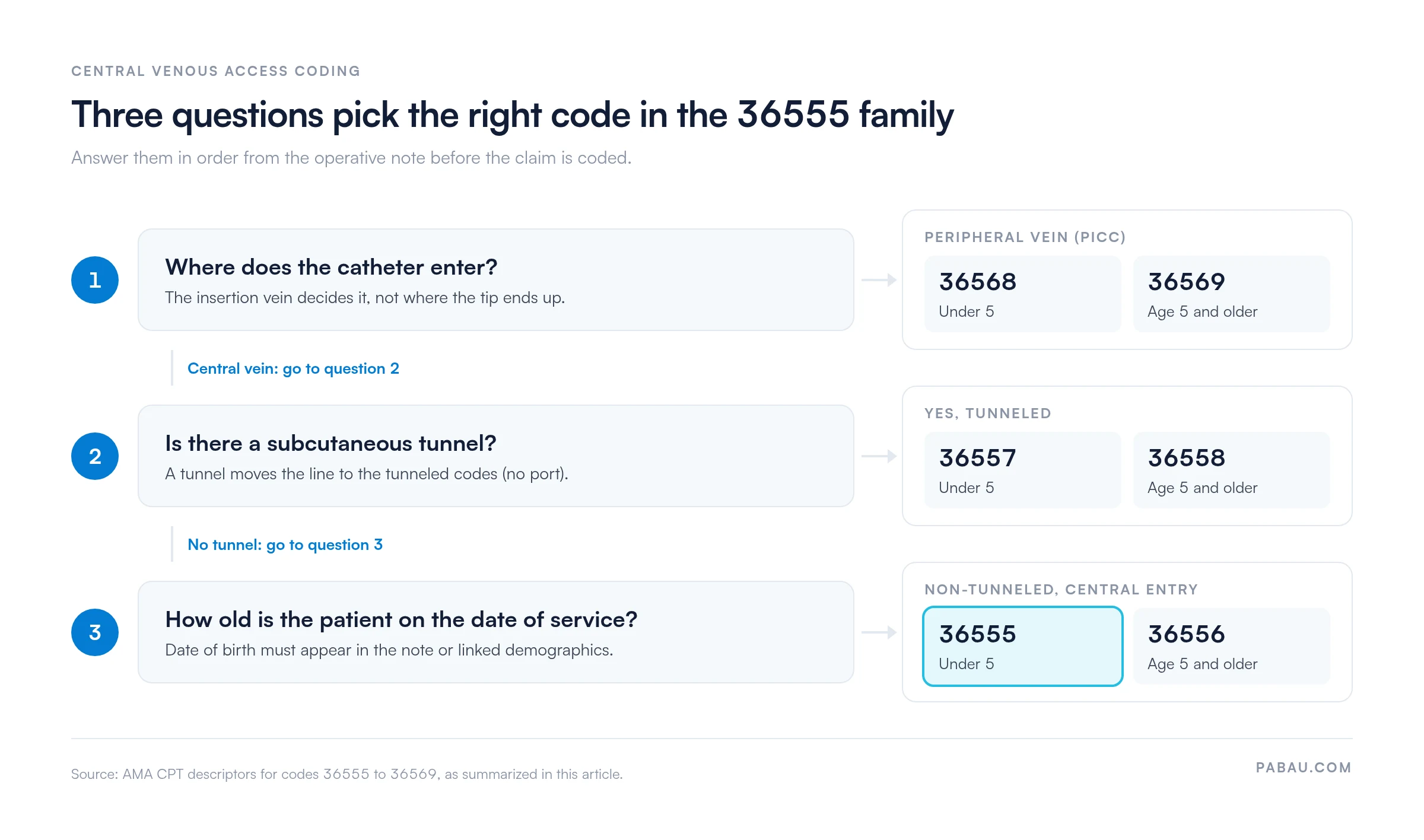
Age on the date of service separates it from CPT 36556, which covers the same procedure from the fifth birthday on. Tunneled catheters move to 36557 and 36558, and PICC lines to 36568 and 36569.
Let Pabau's smart automation suggest the right codes, reduce claim denials, and keep your practice compliant—effortlessly.
Automate repetitive tasks and focus on what matters most—your patients.
Reduce coding errors and ensure compliance with the latest regulations.
Clean claims, fewer denials, and faster reimbursements.
Powerful insights and reporting to help your practice thrive.
HIPAA compliant SOC 2 certified GDPR-compliant Trusted by 4,000+ clinics worldwide

CPT Code 36555 covers non-tunneled central venous catheter insertion in patients younger than 5 years of age. From the fifth birthday, the same procedure is billed as 36556.
Imaging guidance is not bundled into 36555. Ultrasound (76937) and fluoroscopic guidance (77001) are documented and billed separately.
The operative note must confirm the access site, the non-tunneled approach, and the catheter tip position, or the claim is open to a medical-necessity denial.
Pabau, the practice management platform we build, creates the claim from the invoice. Its built-in CPT and ICD-10 catalogs let the code be checked before submission.
CPT Code 36555 is the code for inserting a non-tunneled central venous catheter in a patient younger than five. It belongs to the central venous access device (CVAD) family maintained by the American Medical Association.
Correct coding starts with two facts: the catheter is non-tunneled, and the patient has not yet turned five. Knowing what a clean claim needs keeps both facts documented before submission.
CPT Code 36555 covers the insertion of a non-tunneled, centrally inserted central venous catheter in a pediatric patient who has not yet reached age five. The catheter tip must end in a central vein, typically the superior vena cava (SVC), for the code to apply. Common access sites include the subclavian vein, internal jugular vein, and femoral vein.
What the code includes: Percutaneous needle entry, guidewire placement, catheter threading, and tip-position verification. The code covers the insertion event only.
Several services are commonly billed alongside 36555 but need their own documentation and code, such as ultrasound guidance under 76937. Others are bundled by NCCI edits and cannot be reported separately on the same claim.
The 36555 family is easy to miscode because six codes describe closely related catheters. Two variables drive the choice: whether the line is tunneled, and the patient’s age.
A non-tunneled line in a patient aged five or older is 36556. A third variable, with or without a port, separates the 36560 series. Use the table below before every claim.
PICC vs. CPT Code 36555: A peripherally inserted central catheter (PICC) enters through a peripheral vein, typically the basilic or cephalic. CPT Code 36555 covers direct access through a central vein.
The insertion site is the deciding factor, so a PICC tip sitting in the SVC does not make the line billable as 36555. A PICC in a patient aged five or older is coded 36569. See the AAPC CPT code lookup for the full 36555 family descriptors.
The three questions below settle the code in the order a coder should ask them, starting with the entry vein.
Every element of the operative note maps to a coding requirement. Missing a single field gives a payer grounds for a medical-necessity denial. The seven steps below follow the procedure in order, with the detail each one has to leave in the note.
Build a 36555-specific procedure note template that includes a checklist field for each of these seven elements. Pull age from the patient record and require a tip-confirmation field before the note can be signed. That stops the age and tip-position denials before the claim reaches the clearinghouse.
Modifier selection for CPT Code 36555 depends on the clinical scenario. Using the wrong modifier, or leaving out one a payer requires, leads to a CO-4 or CO-97 denial. The table below covers the modifiers most frequently applied to central venous access device insertion codes.
Medicare reimbursement for CPT Code 36555 is set annually through the CMS Physician Fee Schedule Look-Up Tool. Rates are locality-adjusted and differ between facility (hospital/ASC) and non-facility (physician office) settings.
Pull figures directly from the current MPFS database. Figures in third-party guides go out of date as each annual conversion factor update takes effect.
For 2026 RVU values, use the FastRVU lookup tool, which sources its data from the CMS Physician Fee Schedule. Work RVU, Practice Expense RVU, and Malpractice RVU are each listed separately.
Multiply the total RVU by the 2026 Medicare conversion factor, published annually by CMS, and adjust for your locality’s geographic practice cost index.
Commercial payer rates for central venous catheter insertion typically benchmark at 110-160% of Medicare, though contracted rates vary by payer and market. Check your payer contract before relying on a national average.
Central venous catheter insertion billing requires a diagnosis code that establishes medical necessity. The ICD-10-CM code on the claim must link to a clinical condition for which a central venous catheter is the standard of care.
Payers routinely flag claims where the diagnosis does not obviously support CVC insertion and route them for medical necessity review. Use CrossCoder to verify current CPT-to-ICD-10 crosswalks for the 36555 family.
Verify each ICD-10-CM code against the current-year edition before billing. The CDC/NCHS updates the ICD-10-CM code set every year, and codes valid in prior years are sometimes retired or revised.
CPT Code 36555 generates a predictable cluster of denials. Most trace back to the age threshold, missing note fields, or the wrong modifier. Proactive denial management workflows and familiarity with medical billing denial codes resolve most of these before they repeat.
Prior authorization requirements for CPT Code 36555 vary significantly by payer and site of service. Insurance eligibility verification before scheduling the procedure is the most reliable way to confirm authorization requirements for a specific patient’s plan.
Coding a central line by hand means reading the operative note, choosing between near-identical codes, and keying the claim into a clearinghouse portal. Every handoff is another chance to bill 36555 for a six-year-old.
In Pabau, the claim is built from the invoice that already exists, and the CPT and ICD-10 catalogs sit inside that invoice. Pabau’s claims management software validates the claim, then submits it as an 837P through Claim.MD, our US clearinghouse partner, to thousands of payers.
Electronic remittance advice (ERA/835) comes back into Pabau and settles the claim automatically, matching the payment to what was billed. Your billing team then spends its time on the denials that need a person.

Pabau builds each claim from the invoice, checks the CPT and ICD-10 codes against built-in catalogs, and submits it through Claim.MD. ERAs settle paid claims automatically, so your team only chases denials.

CPT Code 36555 rarely fails on the procedure itself. It fails on the record, when the note leaves out the patient’s age, the access vein, or where the tip ended up.
So fix the template before you fix the claims. A procedure note that pulls the date of birth and won’t sign without tip confirmation prevents the 36556 mix-up at the source. It also gives you a defensible record if a payer audits the line later.
The trade-off is a few extra required fields for the clinician, which costs far less than reworking a denied pediatric line. Book a demo to see how Pabau carries a coded 36555 from the invoice to a paid claim.

Need to understand how claims move through a clearinghouse? Claim.MD clearinghouse overview explains the 837P transmission workflow and how electronic remittance advice is returned to the practice.
Want a framework for reducing claim rejections before submission? Clean claim submission guide covers the pre-submission checklist that prevents the most common billing errors.
CPT Code 36555 covers the insertion of a non-tunneled, centrally inserted central venous catheter in a patient younger than 5 years of age. The code covers the insertion only. Imaging guidance, repair, removal, and repositioning each carry a separate code.
The only difference is patient age. CPT 36555 applies when the patient is younger than 5 years of age; CPT 36556 applies when the patient is 5 years or older. Both codes describe non-tunneled central venous catheter insertion. Billing 36555 for a patient who has reached their fifth birthday will result in a CO-B9 or CO-4 denial.
Medicare reimbursement for CPT 36555 is locality-adjusted and changes annually with each Physician Fee Schedule update. Use the CMS MPFS Look-Up Tool at cms.gov to retrieve the current non-facility and facility payment rates for your specific geographic area. Quoting a national average without the locality adjustment can underestimate or overestimate the payment by 15% or more.
No. Imaging guidance is not bundled into CPT Code 36555. Ultrasound guidance (76937) and fluoroscopic guidance (77001) are separately billable when the guidance is used, permanently stored, and separately documented. If the guidance is not separately documented, it cannot be billed in addition to 36555.
Yes, but only when the E&M service is a distinct service unrelated to the decision to perform the central venous catheter insertion. Modifier 25 is required on the E&M code. If the entire encounter is devoted to the insertion, a separate E&M cannot be billed.
Commonly paired ICD-10-CM codes include A41.9 (sepsis) for IV antibiotics and Z51.11 (chemotherapy encounter) for oncology access. E43 (severe protein-calorie malnutrition) supports total parenteral nutrition. The diagnosis must reflect the clinical indication for central venous access and must be verified against the current ICD-10-CM edition.