

HCPCS Code E0272: Foam rubber mattress billing guide
HCPCS Code E0272: official descriptor and code overview HCPCS Code E0272 is the ...

Last Updated: Nov 6, 2026
36010 is the CPT code for introduction of catheter, superior or inferior vena cava. It covers a non-selective venous catheter whose tip stays in the SVC or IVC. Typical uses are central venous pressure monitoring, contrast injection for venography, and pulmonary embolism evaluation.
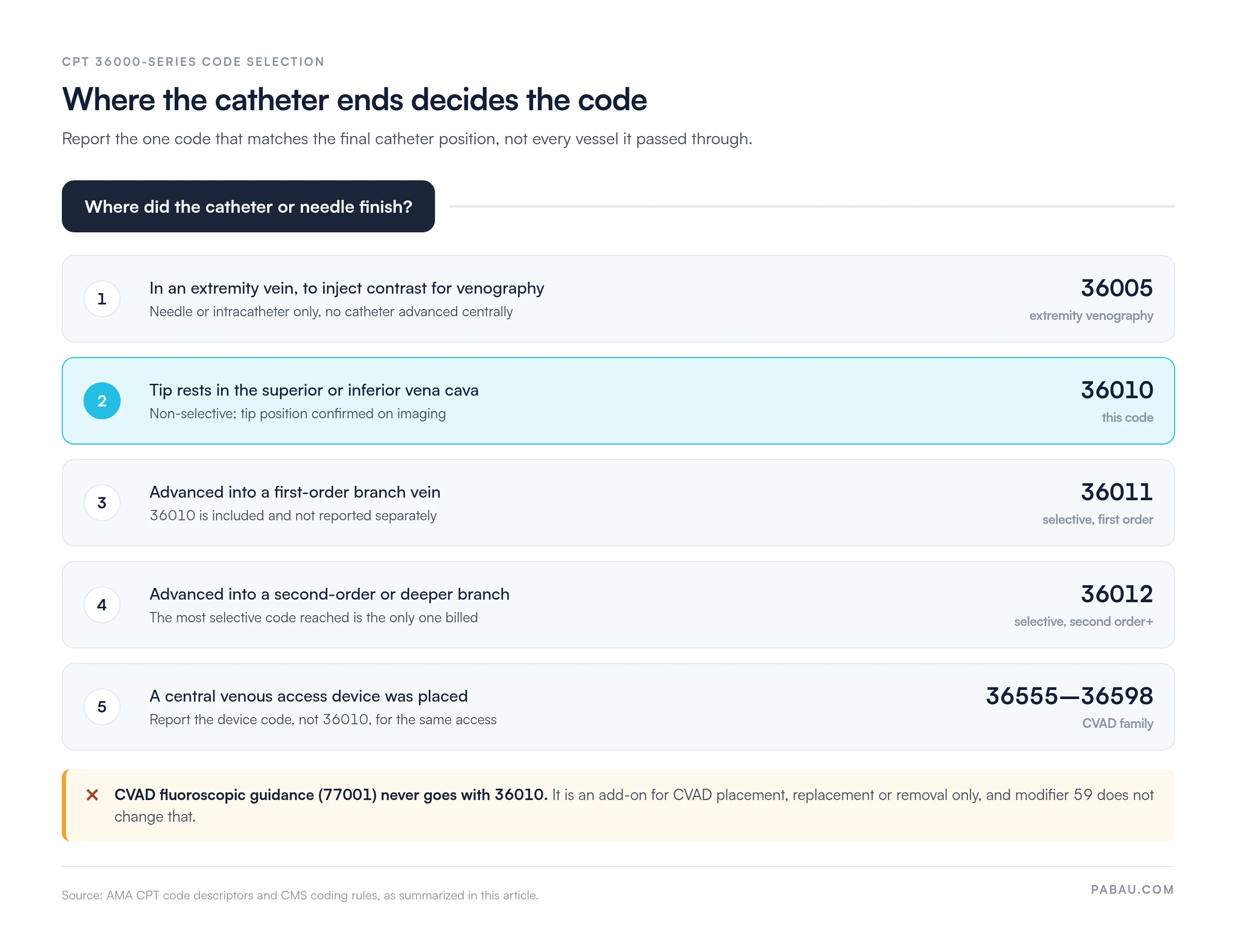
Once the catheter is advanced into a first-order branch vein, the service becomes selective and is reported with 36011 instead. Coders confirm the final tip position in the imaging note before choosing between the two.
Let Pabau's smart automation suggest the right codes, reduce claim denials, and keep your practice compliant—effortlessly.
Automate repetitive tasks and focus on what matters most—your patients.
Reduce coding errors and ensure compliance with the latest regulations.
Clean claims, fewer denials, and faster reimbursements.
Powerful insights and reporting to help your practice thrive.
HIPAA compliant SOC 2 certified GDPR-compliant Trusted by 4,000+ clinics worldwide

CPT code 36010 describes non-selective catheter introduction into the superior or inferior vena cava, not into branch vessels.
The procedure note must confirm the catheter tip position in the SVC or IVC on imaging. A missing confirmation is the top denial trigger.
36010 ends at the vena cava, while 36011 begins selective catheterization of a first-order branch and absorbs 36010.
The CVAD fluoroscopic guidance add-on can’t be billed with 36010, because 36010 places no central venous access device.
Claim validation in Pabau, our practice management platform, scrubs each 36010 claim for missing details before it reaches the payer.
CPT code 36010 is defined by the American Medical Association as: Introduction of catheter, superior or inferior vena cava. It falls under the Intravenous Vascular Introduction and Injection Procedures subsection of the Surgery chapter.
The procedure captures catheter placement that terminates in the vena cava without advancing into a branch vessel. Think of the venous tree as a highway system. CPT code 36010 covers parking on the main interstate, the SVC or IVC. The moment the catheter takes an exit ramp into a first-order branch, the service becomes 36011.
Common clinical indications include central venous pressure monitoring, contrast injection for CT or venography, inferior vena cava filter placement workup, and pulmonary embolism evaluation. The code is used by interventional radiologists, vascular surgeons, and intensivists.
CPT code 36010 covers introducing a catheter through a percutaneous venous approach and advancing it to the superior or inferior vena cava. It includes catheter manipulation within the vena cava.
Imaging guidance for a simple vena cava catheter introduction is not separately reportable as a CVAD-guidance add-on. The fluoroscopic guidance add-on for central venous access is valid only with central venous access device (CVAD) placement, replacement, or removal codes.
Those sit in the 36555-36598 family, and the add-on cannot be reported with 36010, with or without modifier 59.
Catheter placement only to give intravenous fluids or medication is not reported with 36010. A 36010 claim needs a documented diagnostic or therapeutic vascular purpose. When that purpose is treatment, the intervention carries its own code. Balloon angioplasty of a vein outside the dialysis circuit, for example, is code 37248.
Picking the wrong code from the 36000 series is a frequent coder error with vascular introduction procedures. The table below maps CPT code 36010 against its nearest neighbors.
When a procedure involves selective catheterization, report 36011 or 36012. CPT code 36010 is not added when the catheter passes through the vena cava on the way to a branch. The vena cava access is included in the more selective code, so the choice comes down to where the tip finally rests.
Procedural documentation for CPT code 36010 must establish three facts. The catheter was placed, its tip sat in the superior or inferior vena cava, and a qualifying clinical indication supported the procedure. Missing any of these elements is a direct path to a medical necessity denial.
For medical billing compliance, the procedure note must document each element below before a clean claim submission can go out.
The Society of Interventional Radiology and the American College of Radiology both recommend imaging verification of catheter tip position as standard practice. From a billing perspective, that note is also your primary defense against a retrospective audit.
CPT code 36010 requires a linked diagnosis code that establishes medical necessity. Payers match the procedure to the diagnosis during claims adjudication, and a mismatch generates a CO-50 (not medically necessary) denial. The table below lists commonly paired ICD-10-CM codes.
Payer coverage policies vary. Always verify that the ICD-10 code selected reflects the clinical indication documented in the procedure note. Reporting a diagnosis code that the clinical record does not support is a compliance violation, whether or not the claim pays.
Modifier selection for CPT code 36010 depends on the clinical setting and the specific billing scenario. Using the wrong modifier, or omitting one where payer policy requires it, is a common denial trigger.
Modifiers 26 and TC do not apply to CPT code 36010. CMS gives it a PC/TC indicator of 0, which means the code has no separate professional and technical components. The physician reports 36010 without either modifier, in a facility or an office.
The National Correct Coding Initiative (NCCI) governs which codes may be billed together and which are bundled.
For CPT code 36010, the column 1/column 2 edit logic decides what stands on its own. Practices using medical billing workflows that surface NCCI conflicts before submission catch these errors before the remittance stage.
NCCI tables are updated quarterly. Always verify the current edit status before submitting. The CMS Physician Fee Schedule lookup tool and the NCCI Policy Manual are the authoritative sources for current edit status.
Run a pre-submission NCCI check whenever CPT code 36010 shares a claim with a selective catheter, CVAD, or imaging code. Build the check into your billing workflow so it runs before the claim reaches the clearinghouse.
Medicare pays CPT code 36010 at a 2026 national rate of $95.19 in a facility and $512.37 in a non-facility setting. Those figures come from the January 2026 CMS RVU file and the $33.4009 conversion factor, before geographic adjustment. Qualifying APM participants use the $33.5675 conversion factor instead, which gives $95.67 and $514.93.
Verify locality-adjusted rates using the FastRVU 2026 RVU lookup tool or the CMS MPFS Look-Up Tool for your MAC jurisdiction.
The non-facility rate is more than five times the facility rate, and nearly all of that difference is practice expense. The AAPC Codify CPT lookup adds code-level context. Review your electronic remittance advice after submission to confirm the rate applied matches your expected fee schedule amount.
The place of service (POS) code directly affects reimbursement for CPT code 36010. CMS assigns a practice expense RVU of 0.31 in a facility and 12.80 in a non-facility setting. The POS code on the physician claim must therefore match where the procedure was done.
A POS mismatch between the physician claim and the facility claim for the same procedure date triggers an automatic edit. Confirm POS before submission. This matters most when interventional radiologists split their time between hospital-based and free-standing settings in the same billing period.
CPT code 36010 denials cluster around five root causes. Each one is preventable with the right pre-submission workflow. Practices with structured denial management workflows catch most of these before the claim reaches the payer.
On many teams, a vena cava catheter claim is coded from a dictated procedure note and then keyed into a separate billing system. The tip-position line, the modifier, and the linked diagnosis can each slip between those two steps.
Pabau, the practice management platform we build, raises the claim from the same patient record that holds the procedure note. Its medical billing software scrubs each claim for missing or invalid details before it leaves the system. In the US, eligibility checks and claims run through Claim.MD, Pabau’s clearinghouse partner.
Every claim’s status stays visible, so a 36010 denial is fixed and resubmitted instead of sitting unworked. Insurer payments are matched to each invoice they cover, which shows quickly whether the facility or non-facility rate was applied.

Pabau raises the claim from the same record as the procedure note and scrubs it for missing details before submission. Your team then tracks every denial to its cause and resubmits faster.

CPT 36010 is one of the simpler codes in the 36000 series to assign, because the rule turns on a single fact. Where did the catheter tip come to rest? When the imaging note proves the SVC or IVC position, the claim holds up.
The risk sits in the extras. Selective branch work, CVAD placement, and CVAD fluoroscopic guidance each have their own codes. None of them is stacked on 36010 for the same access. Make tip position a required field in the procedure note template, and the most common 36010 denial stops before submission.
Book a demo to see how Pabau links each vascular access note to a scrubbed, trackable claim.

Injecting contrast through an extremity vein? CPT code 36005 explains how extremity venography injections are coded and documented.
Placing a central line instead? CPT code 36556 walks through non-tunneled central venous catheter insertion billing.
Only starting a peripheral IV? CPT code 36000 sets out when needle or intracatheter placement in a vein is reportable.
Unsure which POS code fits? POS for medical practice lists the place of service codes and how each one changes payment.
CPT code 36010 covers the introduction of a catheter into the superior or inferior vena cava via a percutaneous venous approach. Selective catheterization of branch vessels and central venous access device insertion are reported with their own codes instead.
CPT 36010 describes non-selective catheter placement that terminates in the vena cava itself. CPT 36011 begins the selective catheterization hierarchy, covering placement into a first-order branch vessel beyond the vena cava. When the catheter advances past the vena cava into a branch, report 36011, not 36010.
Modifier 51 applies when 36010 is one of several procedures in the same session. Modifier 59 applies only when a bundled pair is genuinely distinct and documented. CMS assigns 36010 a bilateral indicator of 1, so modifier 50 pays 150% when a bilateral service is documented. Modifiers 26 and TC do not apply, and some payers ask for LT/RT to show the access side.
The most common Medicare denial reason is missing imaging confirmation of catheter tip position in the SVC or IVC. Other frequent causes are an ICD-10 code that does not establish medical necessity, and NCCI bundling with 36011 for the same access site. POS mismatches between the physician and facility claims round out the list.
The 2026 Medicare national rate for CPT code 36010 is $95.19 in a facility and $512.37 in a non-facility setting, at the $33.4009 conversion factor. Qualifying APM participants receive $95.67 and $514.93. Locality adjustment changes both figures, so confirm your rate in the CMS Physician Fee Schedule Look-Up Tool.
No. CPT 77001 is an add-on code for fluoroscopic guidance during central venous access device (CVAD) placement, replacement, or removal. It applies only with the 36555-36598 family. Because 36010 places no CVAD, 77001 cannot be reported with it, with or without modifier 59. Imaging guidance for a simple vena cava catheter introduction is not separately billable.




