HCPCS code G0248: Home INR monitoring demonstration
HCPCS code G0248: Official descriptor and code category HCPCS code G0248 is a Me...

Last Updated: Oct 26, 2026
36012 is the CPT code for selective catheter placement, venous system; second order, or more selective, branch. It covers a catheter advanced past a first-order vein, such as the left renal vein, into one of its branches.
The operative note decides the code. It must confirm the catheter tip reached a second-order branch, or the claim supports only 36011. Left adrenal vein sampling is the most common use, and the right adrenal vein in the same session is reported as 36011.
Let Pabau's smart automation suggest the right codes, reduce claim denials, and keep your practice compliant—effortlessly.
Automate repetitive tasks and focus on what matters most—your patients.
Reduce coding errors and ensure compliance with the latest regulations.
Clean claims, fewer denials, and faster reimbursements.
Powerful insights and reporting to help your practice thrive.
HIPAA compliant SOC 2 certified GDPR-compliant Trusted by 4,000+ clinics worldwide

CPT code 36012 covers catheter placement in a second-order or more selective venous branch. First-order branches are reported with CPT 36011.
The operative note must name the specific vessel catheterized and confirm catheter tip position at a second-order or more selective branch.
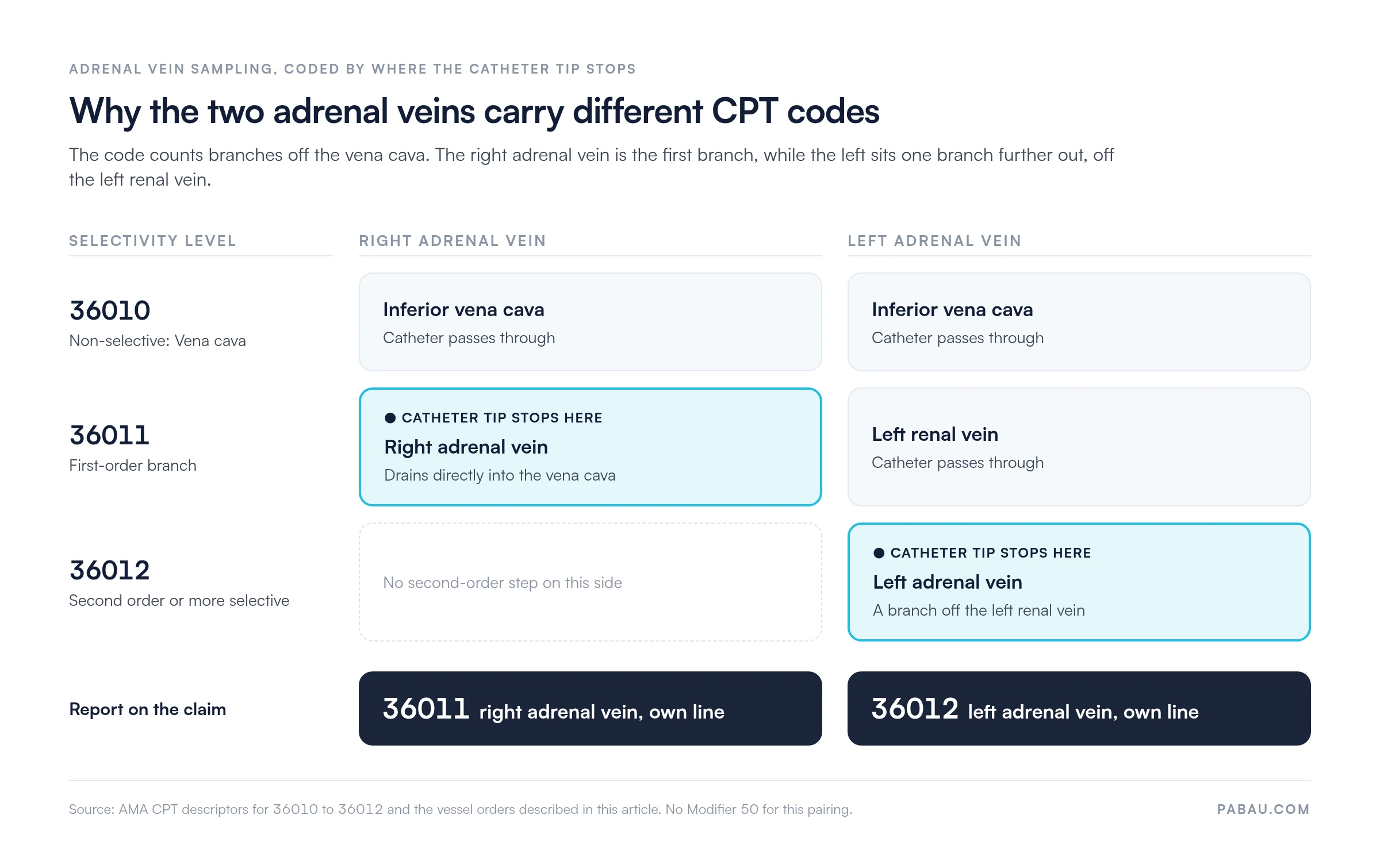
Left adrenal vein sampling is reported with 36012, while the right adrenal vein is first order and reported with 36011. Bilateral sampling is 36011 plus 36012, not 36012 with Modifier 50.
Pabau’s claims management software scrubs claims for missing or invalid details, shows rejection reasons, and submits through the Claim.MD clearinghouse.
CPT code 36012 reports selective catheter placement in a second-order or more selective venous branch. The CPT code set descriptor reads: Selective catheter placement, venous system; second order, or more selective, branch (eg, left adrenal vein, petrosal sinus).
The word “selective” is the operative distinction. In venous catheterization coding, a catheter that simply enters the inferior or superior vena cava is non-selective (36010).
Once the catheter is steered into a branch off the vena cava it becomes first-order selective (36011). When it is advanced further into a branch off that first-order vessel, it reaches second-order selective territory, which is where 36012 applies. Simple needle or intracatheter access into a vein, such as a peripheral IV, is reported with 36000 instead.
The anatomical hierarchy matters because payers reimburse each level differently and NCCI edits are built around it.
Interventional radiology teams perform this procedure most often for adrenal vein sampling and selective venography. The clinical steps determine what the operative note must document.
Adrenal vein sampling is the most frequent indication, because a hyperaldosteronism workup needs blood from both adrenal veins. The two sides do not code the same way. The right adrenal vein is first order (36011) and the left adrenal vein is second order (36012), as the diagram below traces.
Inadequate documentation of vessel order is the top reason payers deny CPT code 36012 claims. The operative or procedure note must contain all of the following elements to withstand audit.
A note that documents catheter placement in the “left renal vein” only supports 36011. To support CPT code 36012, the note must explicitly confirm advancement into the left adrenal vein or another named second-order branch.
Modifier selection for CPT code 36012 depends on whether it is reported alongside other procedures or needs to be distinguished from a bundled service. Adrenal vein sampling works differently from most bilateral procedures, because the two adrenal veins sit at different orders.
CPT 36012 is reported once per second-order branch in each vascular family, so the note has to show which family each catheter entered. Line and modifier formats still vary by payer. Check each payer’s billing guidelines before the first claim goes out, because a format mismatch causes an avoidable technical denial.
Code bilateral adrenal vein sampling one side at a time. The right adrenal vein is 36011 and the left is 36012, each on its own line. Confirm the payer’s line and modifier format in advance so you do not discover it on the remittance.
Medicare pays for CPT code 36012 under the Physician Fee Schedule using RVU-based pricing. Payment differs between facility and non-facility settings because practice expense RVUs reflect the site of service. For 36012 the non-facility total is more than five times the facility total.
These are the 2026 CMS national RVUs. Medicare’s payment multiplies total RVUs by the annual conversion factor. It is then adjusted for the Geographic Practice Cost Index (GPCI) of the service location. Always verify current rates using the CMS Physician Fee Schedule lookup tool before quoting expected reimbursement to a practice.
Commercial payer rates depend on each contract, so use the Medicare figure as a reference point when you review your fee schedules. Use the FastRVU 2026 RVU lookup to cross-reference work, practice expense, and malpractice RVU values with location multipliers applied.
The 360xx catheterization codes follow a hierarchical bundling logic under the National Correct Coding Initiative (NCCI). When a catheter reaches a second-order branch in a single session, the lower-order placements along its path are bundled into CPT code 36012.
In practice, this means you report only 36012 when the catheter reaches a second-order branch. You do not also report 36010 or CPT code 36011 for the same catheter’s passage through the vena cava and first-order branch. Reporting all three codes for a single catheter’s path is an unbundling error and a common audit target.
Review the current NCCI edits for 36012 on the CMS NCCI edits page before submitting claims involving multiple catheterization codes in the same encounter. NCCI edits update quarterly, and payer-specific edits sometimes differ from CMS tables.
Run CPT code 36012 through your clearinghouse’s edit checker before submission. For bilateral adrenal vein sampling, confirm the claim carries 36011 for the right side and 36012 for the left, not two units of 36012. Coding both sides as 36012 overstates the right side and invites a denial or an audit.
Claims for CPT code 36012 often deny because the second-order distinction is underdocumented. These are the denial patterns billing teams encounter most often.
For denials already received, start with the denial codes on the remittance. Each one tells you whether an appeal or a corrected claim is the faster fix.
In an appeal, cite the section of the operative note that places the catheter tip in the named second-order branch. Quote the fluoroscopic confirmation entry as well, and attach the relevant page of the procedure note.
For practices with high volumes of interventional radiology claims, a structured denial management workflow logs denial reason codes by CPT code. That log shows whether 36012 denials cluster around side coding, missing vessel names, or NCCI bundling conflicts. The pattern tells you whether the fix is coder education or a documentation template update.
In many interventional radiology billing teams, a 36012 problem only surfaces once the payer rejects the claim. The coder reads the note, keys the claim, and learns weeks later that a detail was missing.
Pabau, the practice management and billing platform we build, moves that check to before submission. Its claims management software scrubs each claim for missing or invalid details. Claims then go out through the Claim.MD clearinghouse, and Pabau shows the rejection reason whenever a payer sends one back.
ERA remittances are tracked in the same place, so your team can see which 36012 claims paid and which need a corrected line. Fixes happen while the procedure is still fresh in the physician’s memory, which makes a missing vessel name far easier to add.

Pabau’s claims management tools scrub CPT 36012 claims for missing or invalid details before submission. Claims then route through the Claim.MD clearinghouse to thousands of US payers. Book a demo to see how it works for your practice.

CPT code 36012 is won or lost in the operative note. One sentence naming the second-order branch, plus a line confirming the catheter tip on fluoroscopy, separates a payable 36012 from a downcoded 36011.
Start with your adrenal vein sampling claims, since they carry the most coding risk. Code the right side as 36011 and the left as 36012, and give physicians a procedure note template with a named-vessel field.
That template costs a few seconds of documentation per case and saves weeks of appeal work. Book a demo to see how Pabau catches missing claim details before your vascular procedure claims reach the payer.

Need a structured approach to medical billing compliance? Medical billing compliance essentials covers documentation standards, payer audit risks, and how to build defensible claim workflows.
Wondering how electronic remittance works after a CPT claim settles? Understanding electronic remittance advice explains ERA/835 files, denial reason codes, and how to action remittances efficiently.
Looking for a plain-language guide to clearinghouse submission? How a medical claims clearinghouse works explains the 837P claim path, payer enrollment, and clearinghouse rejections.
Coding a venogram of an arm or leg instead? CPT code 36005 covers the extremity venography injection and its pairing with 75820 or 75822.
CPT code 36012 reports selective catheter placement in a second-order or more selective venous branch. It is used most often for left adrenal vein sampling in a hyperaldosteronism workup and for selective venography. It applies when the catheter tip passes the first-order branch, such as the left renal vein, into a second-order tributary like the left adrenal vein.
CPT code 36011 covers catheter placement in a first-order venous branch, such as the renal vein or hepatic vein. CPT code 36012 covers placement at a second-order or more selective branch, such as the left adrenal vein, a tributary of the left renal vein. The right adrenal vein drains straight into the vena cava, so it is first order and reported with 36011. The operative note must specify the named vessel to distinguish which code applies.
Bilateral adrenal vein sampling needs no bilateral modifier, because it is reported as 36011 for the right adrenal vein plus 36012 for the left. Modifier 51 applies when 36012 is reported alongside a separate procedure in the same encounter. Modifier 59 is used when a distinct service must be unbundled from an NCCI column-1 code. Line and modifier formats vary by payer, so check each payer’s guidelines before submitting.
Medicare reimburses CPT 36012 under the Physician Fee Schedule using RVU-based pricing. The total RVU is approximately 4.60 facility and 24.20 non-facility. Payment is calculated by multiplying total RVUs by the annual conversion factor and adjusting for the GPCI of the service location. Verify current rates using the CMS Physician Fee Schedule lookup tool before quoting expected payment.
Yes, but only where both sides reach a second-order branch, because 36012 is reported once per second-order branch in each vascular family. Bilateral inferior petrosal sinus sampling is one example. Bilateral adrenal vein sampling does not qualify. The right adrenal vein drains directly into the inferior vena cava, so it is first order and reported with 36011. The left adrenal vein is reported with 36012.
The most common denial reasons are an operative note that never names the second-order vessel and documentation that stops at a first-order branch. Others are unbundling 36010 or 36011 with 36012 for the same catheter pass, missing fluoroscopic confirmation, and coding both adrenal veins as 36012.