Pabau Engage inbox

Pabau Engage is here: every patient conversation in one inbox.

Learn more
Book a demo Book a demo
☰
CPT Code

CPT code 33241 – ICD pulse generator removal


Code Definition

33241 is the CPT code for removal of an implantable defibrillator pulse generator only. The surgeon takes out the generator, which holds the battery and circuitry, and leaves the leads in place. It fits sessions where the generator comes out and no new generator is connected to the old leads.

The key fact is what 33241 excludes. When a new generator goes in during the same session, report 33262, 33263 or 33264 instead, for a single, dual or multiple-lead system. When leads come out too, add 33243 for a thoracotomy or 33244 for transvenous extraction. Getting this right prevents duplicate billing and missed lead charges.

Section
10004-69990 Surgery
Subsection
33016-37799 Cardiovascular system
Code range
33202-33273 Pacemaker or implantable defibrillator
Billable
No
Code also known as
defibrillator generator removal, cardiac device explant
Save time. Improve accuracy. Get paid faster.
Automate coding with Pabau

Let Pabau's smart automation suggest the right codes, reduce claim denials, and keep your practice compliant—effortlessly.

  • AI-powered code suggestions
  • Real-time compliance checks
  • Faster claims, fewer denials
Why practices choose Pabau
Save hours every week

Automate repetitive tasks and focus on what matters most—your patients.

Improve accuracy

Reduce coding errors and ensure compliance with the latest regulations.

Get paid faster

Clean claims, fewer denials, and faster reimbursements.

Grow with confidence

Powerful insights and reporting to help your practice thrive.

HIPAA compliant SOC 2 certified GDPR-compliant Trusted by 4,000+ clinics worldwide

Key takeaways

Key takeaways

CPT code 33241 reports removal of an ICD pulse generator only, with the existing leads left in place.

Use 33262, 33263 or 33264 when a new generator goes in during the same session, and never add 33241 to them.

When leads come out too, report 33241 with 33243 for a thoracotomy or 33244 for transvenous extraction.

The operative note must name the indication, identify the device and state what happened to each lead.

Pabau, a practice management platform, handles 837P claim submission, eligibility checks and ERA remittances through Claim.MD.

What CPT code 33241 covers, and what it leaves out

CPT code 33241 reports the removal of an implantable defibrillator pulse generator only. The surgeon reopens the device pocket and removes the generator, as AAPC’s 33241 code summary describes. In the AMA’s CPT code set, 33241 sits among the pacemaker and implantable defibrillator codes, 33202-33273.

The generator holds the battery and the shock circuitry. The leads are the wires that run through the veins into the heart. Each part has its own codes, so coding starts with what happened to each one.

The leads stay put under 33241. If the electrophysiologist also removes leads, report 33241 with 33243 (thoracotomy) or 33244 (transvenous extraction). If a new generator goes in during the same session, report 33262, 33263 or 33264 instead of 33241.

Here’s the quick reference to check before you code.

FieldDetail
CPT code33241
Official descriptorRemoval of implantable defibrillator pulse generator only
Code range33202-33273 (Pacemaker or implantable defibrillator)
Procedure categorySurgery / Cardiovascular system
Typical settingHospital operating room or electrophysiology lab
Lead statusLeads left in place. Add 33243 or 33244 if leads are removed.
Commonly confused with33262-33264 (generator removal with replacement)

Four reasons an ICD generator comes out

A generator-only removal is usually planned. Battery depletion is a common trigger, but the reason matters for coverage and for the codes that sit beside 33241.

  • Battery at ERI or EOS: The device reaches its elective replacement indicator or end of service, and no new generator goes in.
  • Device infection: Guidelines generally favor removing the whole system. If the leads stay, the note should explain why.
  • Upgrade: The old generator comes out so a device with more capability can go in. Check which insertion code goes with it.
  • Manufacturer advisory or recall: The generator is retrieved under a device safety notice, with the leads untouched.

Walk through the procedure step by step

Knowing the steps helps you match the op note to the descriptor. An electrophysiologist usually performs the removal under conscious sedation or general anesthesia.

  1. Pre-op check: Device interrogation confirms battery status, lead impedance and sensing. The note records why the device is coming out.
  2. Pocket incision: The surgeon reopens the incision over the pocket, usually below the left or right collarbone.
  3. Disconnection: The generator is freed from scar tissue, and the lead pins are released from its header. The leads stay in place.
  4. Explant: The generator is removed and logged for manufacturer return or disposal. The lead ends are capped.
  5. Closure: The pocket is irrigated, bleeding is controlled and the incision is closed in layers.

Watch step 3 closely. Any lead extraction adds 33243 or 33244 to the claim. A new generator connected to the old leads changes the code to 33262, 33263 or 33264.

CPT 33241 vs 33262-33264: Removal only vs removal with replacement

The mix-up to watch is reporting 33241 next to a replacement code. Codes 33262, 33263 and 33264 already include taking out the old generator. Adding 33241 bills the same removal twice.

FactorCPT 33241CPT 33262-33264
What happensOld generator removed, no new generator connectedOld generator removed and a new one inserted
Lead systemLeads stay in placeExisting leads stay: 33262 single, 33263 dual, 33264 multiple
Lead manipulationNoneNone, because it’s a generator swap
Report with the other?NoNo, the replacement code includes the removal
Op note proofStates that no new generator was placedNames the old and new generator and the lead system

Lead removal has its own codes. Code 33243 covers removal of single or dual chamber ICD electrodes by thoracotomy. Code 33244 covers the same removal by transvenous extraction. Either one is reported with 33241 when the generator and leads come out together. If a new system with new transvenous leads goes in, 33249 covers that insertion, so check current NCCI edits before you pair it.

The decision path below puts those checks in the order a coder meets them in the op note.
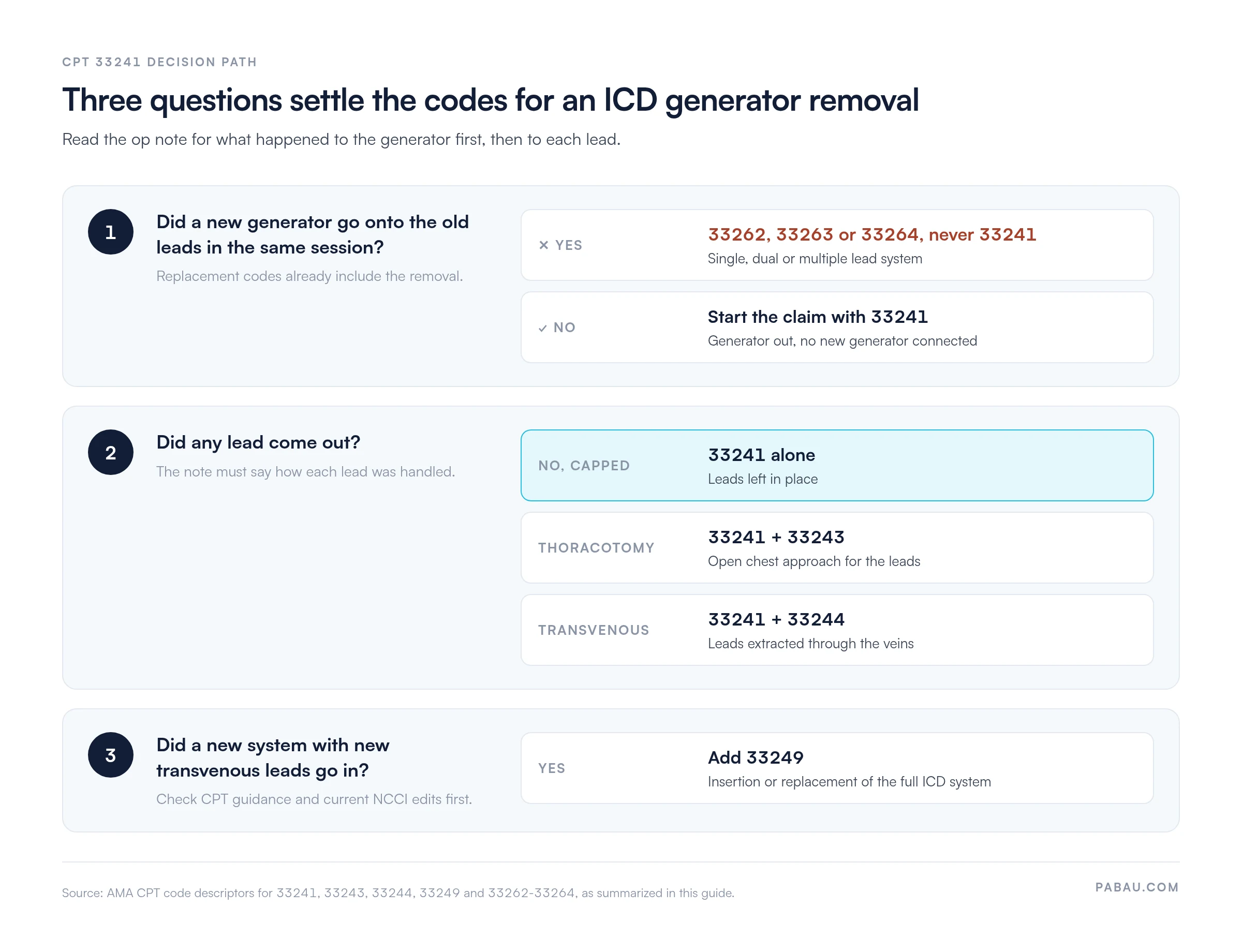
Decision path for CPT 33241
The generator question comes first, because a replacement code shuts 33241 out of the claim entirely. Code pairings follow the AMA CPT descriptors summarized in this guide.

These are the neighbors you’ll meet most often around 33241. Knowing them helps you avoid both undercoding and upcoding, and it helps you explain your choice to an auditor.

CodeDescriptor (summary)Key distinguisher
33241Removal of ICD pulse generator onlyLeads left in place, no new generator
33240Insertion of ICD pulse generator only, with existing single leadNew generator onto an existing lead
33243Removal of single or dual chamber ICD electrode(s), by thoracotomyOpen chest approach for the leads
33244Removal of single or dual chamber ICD electrode(s), by transvenous extractionReportable with 33241 when leads come out too
33249Insertion or replacement of ICD system, with transvenous lead(s), single or dual chamberFull system with new leads
33262Removal of ICD pulse generator with replacement, single lead systemGenerator swap, one lead
33263Removal of ICD pulse generator with replacement, dual lead systemGenerator swap, two leads
33264Removal of ICD pulse generator with replacement, multiple lead systemGenerator swap, three or more leads

Document these six details before you code

Good documentation justifies the code to the payer and leaves an audit trail. For 33241, look for each item below in the op note or the pre-op record.

  • Indication: Why the generator came out, such as battery ERI, infection, upgrade or advisory.
  • Device details: Manufacturer, model and serial number of the removed generator.
  • Lead status: What happened to each lead, whether left and capped or removed, and by which method.
  • Replacement status: A clear statement that no new generator was connected during the session.
  • Signature: The performing physician signs the report and confirms they did the procedure.
  • Disposition: Where the generator went, such as manufacturer return or the explant log.

If the note is vague on leads or replacement, query the physician first. Device tracking records can contradict a weak note, and that invites an audit.

How a 33241 claim moves from op note to payment

  1. Op note signed: The electrophysiologist records the indication, the device and the status of each lead.
  2. Code assignment: The coder picks 33241, adds 33243 or 33244 if leads came out, and rules out a replacement code.
  3. Diagnosis link: ICD-10-CM codes that support the indication are attached to the procedure line.
  4. Edit check: Code pairs are checked against current NCCI edits. Modifiers go on only where the note supports them.
  5. Submission: The professional claim goes out as an 837P, with a place of service that matches the facility.
  6. Remittance: The ERA comes back with payment, or with a CARC denial code to work.

Medicare judges 33241 on medical necessity

Medicare coverage for ICD procedures flows from National Coverage Determination (NCD) 20.4, maintained by the Centers for Medicare and Medicaid Services. NCD 20.4 sets the covered indications for ICD implants. Removal is then judged on documented medical necessity under your MAC’s policy.

Medicare Administrative Contractors (MACs) can add documentation rules through Local Coverage Determinations. Check your MAC’s published cardiac device policies before you submit, and follow your medical billing compliance steps for each payer.

  • Prior authorization: Medicare doesn’t routinely require it for 33241, but commercial payers often do. Check the plan before the procedure.
  • ABN: If medical necessity is in doubt, issue an Advance Beneficiary Notice to Medicare patients beforehand.
  • Setting: The procedure is almost always done in a facility, and the global surgery package applies. Match the place-of-service code to the op note.

Modifiers for 33241 follow standard surgical rules

Modifier choice follows the surgical rules in CMS Claims Processing Manual Chapter 12. These are the ones you’re most likely to need.

ModifierWhen to apply with 33241Notes
-62Two co-surgeons each perform a distinct part of the procedureRare for 33241. Each surgeon reports 33241-62.
-ASA PA, NP or clinical nurse specialist assists at surgeryThe assistant appends -AS to their own claim. Payer rules govern payment.
-80Assistant surgeon who is a physicianDifferent from -AS. Co-surgeons use -62 instead.
-59Distinct procedural service when a bundling edit doesn’t fit the caseUse only when the note shows 33241 was separate from another same-day service. Check current NCCI edits first.
-78Unplanned return to the OR for a related procedure in the post-op periodApplies when 33241 falls in the global period of a prior related surgery.

Modifiers -LT and -RT don’t apply, because a device pocket isn’t a paired body site in the CPT sense. Commercial payers set their own modifier edits, so check their policies as well.

Pro Tip

Before you add modifier -59 to a 33241 claim, check the code pair in the current NCCI edit table on CMS.gov. The edits update quarterly, so a modifier that worked last quarter may fail this one. Note the edit version you used for each claim.

Reimbursement for 33241 changes every January

Medicare pays 33241 under the Medicare Physician Fee Schedule (MPFS), using relative value units (RVUs). Payment depends on three RVU components and the geographic practice cost index (GPCI) for your locality.

Rates change each January 1, so look up current values in the CMS Physician Fee Schedule search tool or a lookup tool like FastRVU.

RVU componentWhat it measuresVerification source
Work RVU (wRVU)Physician time, skill and mental effortCMS MPFS file, current year
Practice expense RVU (PE)Clinical staff, supplies and equipment overheadFacility and non-facility values differ
Malpractice RVU (MP)Professional liability riskCMS MPFS file, current year
GPCI adjustmentGeographic cost variation by localityCMS GPCI file by MAC jurisdiction

The facility rate applies in a hospital, ambulatory surgery center or electrophysiology lab, where the facility bears equipment costs. The non-facility rate applies only in a physician office, which is unusual for this procedure. Locality matters too, so a Manhattan practice and a rural Mississippi practice get different payments for the same code.

Billing 33241 with other codes on the same day

Same-day combinations cause many 33241 denials. Check each pair against current NCCI edits and the payer’s bundling policy before the claim goes out.

Additional codeCan it be billed with 33241?Notes
33243/33244 (ICD electrode removal)Yes, when leads come outLeads and generator removed together = 33241 + 33243 or 33244. Document the lead removal method.
33262/33263/33264 (ICD generator replacement)NoReplacement codes include the removal. Billing 33241 with one on the same date is a duplicate billing error.
33249 (ICD system insertion or replacement, transvenous leads)SometimesCan apply when a new system with new leads replaces the old one. Verify against CPT guidance and current NCCI edits first.
93641/93642 (DFT testing)Generally no93641 is reported at implant or replacement. 93642 evaluates an existing system. Neither is part of generator removal alone, so confirm with the payer before billing either.
99213-99215 (E/M visit)Generally no on the same daySame-day E/M is bundled into the global package. Use modifier -25 only for a separately identifiable problem.

Pro Tip

Audit your 33241 claims each quarter against the NCCI edit files on CMS.gov. Bundling relationships change, so a pair that paid in Q1 may be bundled by Q3. Crosscheck your most-billed code pairs before each quarter starts.

A worked example: Generator out, leads kept

Picture a 78-year-old patient whose ICD has reached ERI. After a goals-of-care talk, the patient decides not to replace it. The electrophysiologist removes the generator, caps both leads and closes the pocket.

The claim carries 33241 alone, linked to Z45.02 for ICD management. The op note names the device, records the decision and confirms both leads were left in place.

Now change one detail. If a new generator had gone onto the dual-lead system, the claim would carry 33263 and no 33241. If the leads had been extracted through the veins, 33244 would join 33241.

Common mistakes that trip up 33241 claims

Denials on 33241 follow a few predictable patterns. Tracking denial codes in medical billing by code, not just by claim, brings them to the surface fast. Good denial management workflows treat each one as a process to fix.

  • Adding 33241 to a replacement code: The claim shows 33241 next to 33262, 33263 or 33264. The replacement already includes the removal, so 33241 is denied as a duplicate.
  • Missing the lead code: Leads came out, but only 33241 was billed. Add 33243 or 33244 to capture the extraction.
  • Thin op note: The note is missing or silent on leads. Query the physician before you resubmit.
  • No medical necessity: The records don’t show the indication. Send the interrogation report and pre-op notes with the claim.
  • Bundling denial: A same-day code bundles under NCCI. Appeal with -59 only when the documentation supports it.
  • Global period miss: The removal falls in a prior surgery’s global period without -78. Check whether it treats a complication of that surgery.
  • No prior authorization: A commercial payer needed one. Clinical appeals rarely work here, so fix the intake process instead.

Before you submit: A 33241 checklist

  • The op note confirms the generator came out and no new generator was connected.
  • Each lead’s status is stated in writing.
  • 33243 or 33244 is on the claim if any lead was removed.
  • No 33262, 33263 or 33264 sits on the same claim.
  • The diagnosis code supports the documented indication.
  • Code pairs pass current NCCI edits, and each modifier is backed by the note.
  • The place of service matches the facility, and the global period is checked.
  • Prior authorization is on file for commercial plans.

How Pabau keeps cardiac device claims moving

Most 33241 denials start before the claim leaves your office, in the op note or the code pair. Your coders still make those calls. Software helps by cutting the admin around them.

Pabau’s claims management tools submit claims through Claim.MD as 837P files. You run eligibility checks before the visit, and ERA remittances come back to the same system. Denials then surface quickly with their CARC codes, so a clean claim on resubmission takes less chasing.
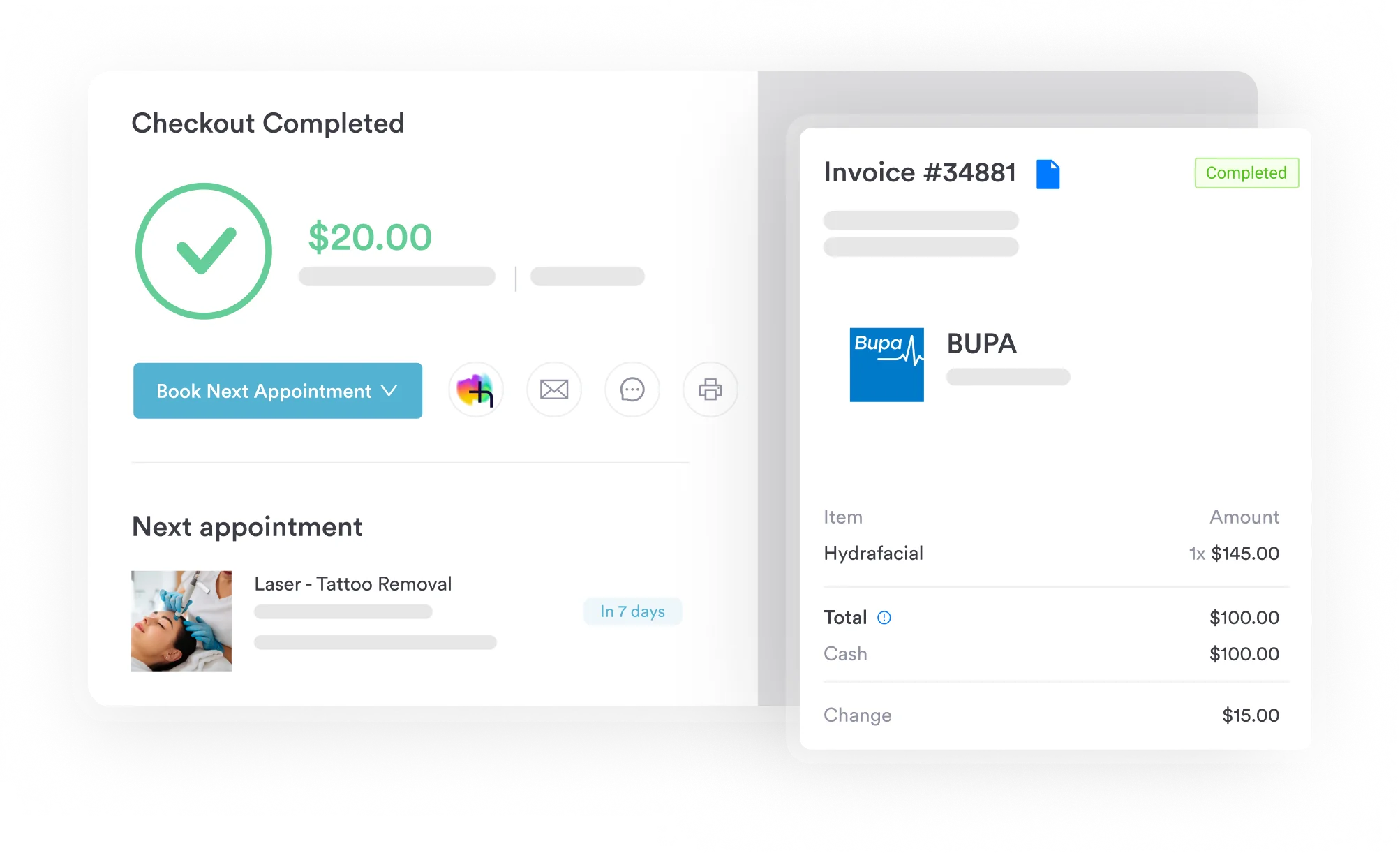

Pabau checkout screen with an invoice billed to an insurer
Pabau ties each invoice to the patient’s insurer, so you can see the payer side of a device claim next to the visit.

Streamline cardiac device billing with Pabau

Pabau submits 837P claims, runs eligibility checks and receives ERA remittances through Claim.MD. See how cardiac practices keep device claims moving.

Pabau claims management dashboard

Conclusion

Code 33241 rewards a careful read of the op note. Generator out with no replacement means 33241. A new generator in the same session means a replacement code instead, never both.

Leads are the second decision. If they came out, add 33243 or 33244 and make sure the note says how. Build those two checks into pre-claim review, and most 33241 denials never reach the payer.

Book a demo to see how Pabau handles claim submission, eligibility checks and remittances for cardiac device billing.

Continue your research

Continue your research

Need to understand how clearinghouse submission works for cardiac codes? Medical claims clearinghouse guide explains how clearinghouses validate, translate, and route electronic claims before they reach payers.

Looking for a walkthrough of the 837P file format for ICD claims? 837 EDI file guide covers the transaction set structure used for professional claims submission.

Want to understand ERA processing after a cardiac claim pays or denies? Electronic remittance advice explained covers how 835 ERA files carry payment details and CARC denial reason codes back to the practice.

Frequently asked questions

Which ICD-10-CM codes support a 33241 claim?

It depends on the indication. Z45.02 covers an encounter for adjustment and management of an automatic implantable cardiac defibrillator. T82.7XXA fits an infection due to a cardiac device.

Is pacemaker generator removal coded with 33241?

No. Code 33241 is for defibrillator generators only. Removal of a permanent pacemaker pulse generator only is CPT 33233, so confirm the device type in the op note.

Does 33241 apply to a subcutaneous ICD?

Yes. Removal of a subcutaneous ICD generator alone is also reported with 33241. If the subcutaneous electrode comes out too, add 33272.

How is a new generator coded at a later session?

Report 33241 for the removal session. When a new generator connects to the existing leads later, use 33240 for a single lead, 33230 for dual leads or 33231 for multiple leads.

Does an ICD battery change use 33241?

No. The battery is sealed inside the generator, so a battery change is a generator replacement. Report 33262, 33263 or 33264, based on the lead system.

Avatar photo
Monika Lazarevska
Content Writer

Monika Lazarevska writes content for owners and healthcare professionals who want clear, no-fluff content that actually helps them run their practice better. With a background in storytelling and SEO, she knows how to make even the driest topics worth reading. Off the clock, you'll find her in a café somewhere in Europe, probably with a good book and an even better coffee.
×