CPT code 96158: Individual health behavior intervention billing
CPT code 96158: official descriptor and clinical scope CPT code 96158 describes ...

Last Updated: Oct 15, 2026
33418 is the CPT code for transcatheter mitral valve repair, percutaneous approach, including transseptal puncture when performed, initial prosthesis.
Most denials on this code trace back to three causes. The first is missing NCD and registry documentation. The other two are choosing 33418 when an open surgical approach was used, and unbundling services the AMA includes in 33418 by default. Getting these right before submission is where medical billing workflows for structural heart programs diverge from general cardiology billing.
33418 sits in a narrow code family alongside add-on code 33419 and open-repair code 33427. Confusing any of these costs the practice a clean claim.
Let Pabau's smart automation suggest the right codes, reduce claim denials, and keep your practice compliant—effortlessly.
Automate repetitive tasks and focus on what matters most—your patients.
Reduce coding errors and ensure compliance with the latest regulations.
Clean claims, fewer denials, and faster reimbursements.
Powerful insights and reporting to help your practice thrive.
HIPAA compliant SOC 2 certified GDPR-compliant Trusted by 4,000+ clinics worldwide

CPT Code 33418 covers percutaneous transcatheter mitral valve repair with the initial prosthesis, not open surgical repair.
33419 is the add-on code for each additional prosthesis (device) in the same session, reported once per session and never alone.
Medicare covers 33418 under NCD 20.33, with heart team evaluation and TVT Registry participation required for both DMR and FMR cases.
The 2026 national average professional payment is about $1,580.86 for 33418, which carries a 90-day global period.
Pabau, our practice management platform, turns the procedure invoice into an electronic claim through Claim.MD and checks eligibility first.
CPT Code 33418 is defined by the American Medical Association as transcatheter mitral valve repair, percutaneous approach, including transseptal puncture when performed; initial prosthesis. It belongs to the cardiovascular surgery section of the CPT code set. Within that section, it sits in the cardiac valves subsection, which covers codes 33361 through 33496. Our CPT guides for coders cover its neighbors there, including the transcatheter aortic valve codes.
The AMA’s CPT code set classifies 33418 as a Category I code. That means many physicians across the US perform the procedure. Its clinical utility is established, and FDA-approved devices are in wide use.
Transcatheter mitral valve repair, also called transcatheter edge-to-edge repair (TEER), corrects mitral regurgitation (MR) through a catheter without open-chest surgery. The most widely used device is the MitraClip (Abbott), which clips the mitral valve leaflets together to reduce regurgitant flow. The PASCAL system (Edwards Lifesciences) is another FDA-approved option billed under the same code.
Coders must confirm the procedure used a transcatheter, catheter-based approach before reporting 33418. An open sternotomy or thoracotomy means a different code applies entirely (see the 33427 section below).
The AMA bundles specific services into 33418 by default. Reporting them separately constitutes unbundling and triggers payer denial or recoupment on audit.
Payers apply National Correct Coding Initiative (NCCI) edits to enforce these bundles. Payers automatically deny or bundle down a claim that pairs 33418 with a transseptal puncture code or fluoroscopy guidance code. Only a modifier that overcomes the edit would prevent that, and generally none applies here.
Before finalizing the claim, run 33418 through your NCCI edit checker against every companion code on the claim. TEE guidance, transseptal puncture, and vascular access codes are the three most common unbundling errors coders submit alongside 33418.
33419 is an add-on code, so you can only report it alongside 33418, never alone. It covers each additional prosthesis (device) placed in the same session, after the initial prosthesis billed under 33418. Still, 33419 counts once per session, however many extra devices the operator places.
33419 applies only when the operator places one or more devices after the initial prosthesis. When it does, list 33418 first on the claim and 33419 as a secondary line.
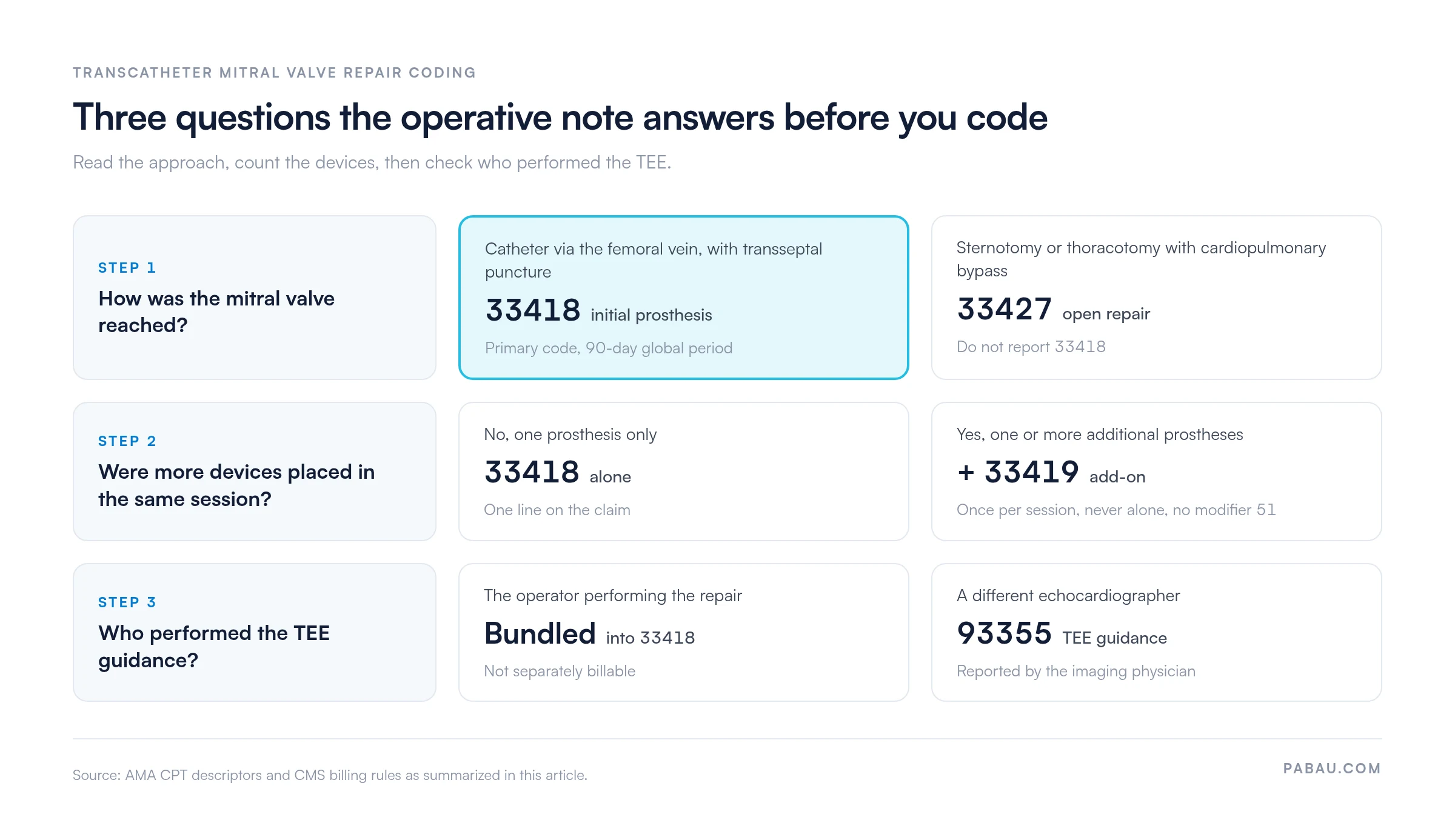
CPT Code 33418 covers a transcatheter (catheter-based, closed-chest) approach. CPT 33427, by contrast, covers open surgical mitral valve repair requiring sternotomy or thoracotomy with cardiopulmonary bypass. Selecting the wrong code based on the approach is the most common error in structural heart coding.
The operative note is the deciding document. If the surgeon accessed the mitral valve via catheter and transseptal puncture, bill 33418. If the surgeon opened the chest and started bypass, bill 33427. Never infer the approach from the procedure name. Read the operative report, then check the device count and who performed the TEE.
Medicare covers transcatheter mitral valve repair under National Coverage Determination (NCD) 20.33. The Centers for Medicare and Medicaid Services (CMS) issued it. The current version comes from decision memo CAG-00438R, effective July 31, 2023. Clinical criteria differ between degenerative and functional mitral regurgitation, but Coverage with Evidence Development (CED) applies to both.
Commercial payer coverage policies for CPT Code 33418 vary significantly. Some align with the CMS NCD criteria; others impose additional clinical requirements or restrict coverage to specific FDA-approved devices. Verify each payer’s policy before the procedure date.
CMS publishes the Medicare Physician Fee Schedule (MPFS) annually, and Medicare reimbursement for CPT Code 33418 comes from it. The 2026 national average rates below use the 2026 conversion factor of $33.4009. They reflect facility billing, which applies when the procedure takes place in a hospital outpatient department or inpatient setting.
These figures represent the physician professional fee only. 33418 carries a 90-day global period, so the payment includes related postoperative visits in that window. The facility fee (billed by the hospital under the OPPS) is substantially higher, and CMS determines it separately. The facility payment includes device costs for the MitraClip or PASCAL implant. As a result, the physician does not bill them separately.
Geographic practice cost indices (GPCIs) adjust rates by location. Use the CMS Physician Fee Schedule lookup tool to confirm locality-adjusted amounts for your practice’s zip code. For RVU-level detail, the FastRVU 2026 lookup tool offers free work, practice expense, and malpractice RVU breakdowns by code.
Modifier selection for CPT Code 33418 depends on how the practice structured the operative team. Modifiers 26 and TC do not apply, because 33418 is a global surgical code with no professional and technical split.
The co-surgery modifier 62 is common in structural heart programs. There, the interventional cardiologist leads the transcatheter approach and a cardiothoracic surgeon is present for standby or active participation. Both providers bill 33418 with modifier 62, each receiving 62.5% of the standard fee. Document each surgeon’s distinct role in the operative note. Payers often deny claims that describe the second surgeon only as “surgical standby.”
Medicare does not require prior authorization for CPT Code 33418 under the current CMS rules. However, the procedure must still meet NCD 20.33 criteria before Medicare will pay the claim. Registry enrollment is mandatory for every covered transcatheter edge-to-edge repair (TEER) case, DMR and FMR alike. It functions as a de facto precondition.
Commercial payer prior authorization requirements vary. Most major payers treat TEER as a high-cost cardiovascular procedure requiring pre-procedure approval. The typical PA submission for 33418 includes:
Submit the PA request well before the scheduled procedure date. TEER is not an urgent procedure in most cases. Payers routinely take 10 to 15 business days to process high-cost cardiac PA requests. Late submission forces rescheduling or creates a retroactive authorization risk.
CMS and commercial payers audit 33418 claims for documentation completeness. The medical record must support both the procedure code and the CED conditions under NCD 20.33. That applies to DMR and FMR cases alike. Missing any of these elements at the time of claim submission is a denial waiting to happen. Coders report nonrheumatic mitral regurgitation with I34.0, and the echocardiogram report must support that diagnosis.
A well-constructed superbill for structural heart procedures should capture all six documentation anchors above. It should also link them to the submitted CPT codes. That audit trail supports the initial claim and any later payer review. It is the core of medical billing compliance for high-value procedures.
Most 33418 denials fall into five categories. Each has a corrective action that your team can build into the pre-submission workflow instead of addressing on appeal.
Denial patterns on high-value cardiac codes like 33418 are worth tracking systematically. A structural heart billing team that logs denial reason codes by category learns which documentation element fails most often. A team handling appeals one by one rarely sees that pattern. Denial management workflows designed for high-acuity codes typically separate the NCD documentation review from the standard coding QA process. Two separate checkpoints reduce the chance that the team skips either one under time pressure.
Flag every DMR and FMR case for a TVT Registry enrollment check before the claim is generated, not after the procedure. Medicare treats registry enrollment as a coverage condition. A claim without registry confirmation will be denied however correct the coding is.
Many structural heart billing teams assemble a 33418 claim from several places. The heart team note sits in the EHR and the STS score in a spreadsheet. The registry confirmation arrives by email, and the authorization number lives on a payer portal. Each handoff is a chance for one NCD element to go missing.
Pabau’s cardiology claims management software keeps that work next to the procedure record. It turns the invoice into an electronic CMS-1500 claim and submits it through the Claim.MD clearinghouse. It also runs a real-time eligibility check before the procedure date. In addition, it brings electronic remittance advice (ERA) back into the billing workflow.
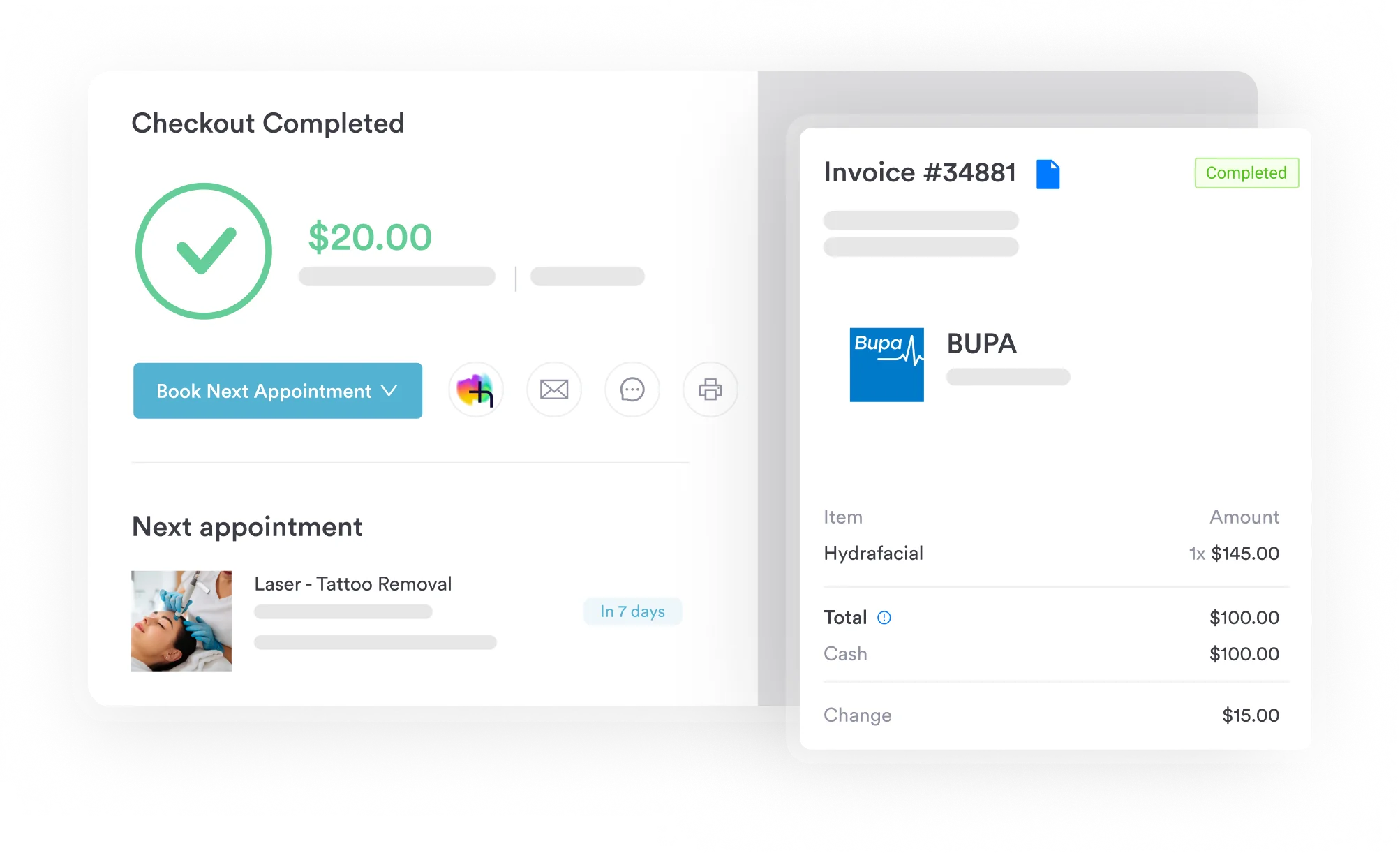
If you confirm coverage before scheduling the patient, you raise the odds of a clean claim on first submission. Claim statuses and denials show up in one dashboard, so the team can correct a rejected 33418 line quickly.

Pabau attaches 33418 to the procedure invoice, checks the patient’s coverage in real time and submits the claim electronically through Claim.MD. Claim statuses and remittances come back into the same dashboard.

A 33418 claim is won or lost before anyone opens the billing screen. Build the registry check, the heart team note and the device count into scheduling. Then coding becomes the short step at the end.
The trade-off is front-loaded work on every case, including the ones that would have paid anyway. 33418 is worth about $1,580 to the physician alone, with a 90-day global period behind it. On that code, the extra work pays for itself after one avoided denial.
Book a demo to see how Pabau keeps eligibility, claim submission and remittances for structural heart cases in one place.

Need guidance on denial code patterns for cardiac claims? Denial codes in medical billing covers CARC codes and how to respond to the most common payer rejection reasons.
Submitting 33418 claims electronically for the first time? How the 837 file works explains the EDI claim format that carries CPT codes, modifiers, and diagnosis codes to the clearinghouse.
Looking for a broader revenue cycle overview? What is revenue cycle management walks through the end-to-end process from eligibility through payment posting.
Coding the aortic side of a structural heart program? CPT code 33361 covers transfemoral transcatheter aortic valve replacement and its own NCD conditions.
Building a prior authorization workflow for high-cost procedures? The prior authorization process walks through each step from request to approval.
CPT Code 33418 covers transcatheter mitral valve repair with the initial prosthesis, performed via a percutaneous approach without open-chest surgery. It includes fluoroscopic guidance, transseptal puncture, and percutaneous vascular access, all bundled into the primary code. The MitraClip (Abbott) and PASCAL (Edwards Lifesciences) are the two FDA-approved devices most commonly billed under this code.
Yes, Medicare covers CPT Code 33418 under NCD 20.33 (CAG-00438R). Both degenerative and functional MR are covered under Coverage with Evidence Development (CED). The facility must be enrolled in the TVT Registry, and each case must be submitted to it. Degenerative MR also requires documented heart team evaluation and high or prohibitive surgical risk.
33418 is the primary code for transcatheter mitral valve repair with the initial prosthesis. 33419 is an add-on code for each additional prosthesis (device) placed in the same session. It cannot be reported without 33418 and is reported once per session. When used, list 33418 first and 33419 on a separate line.
Yes, MitraClip procedures are billed under CPT Code 33418. MitraClip (Abbott) is the most widely used FDA-approved device for transcatheter mitral valve repair. The code was written to cover edge-to-edge leaflet repair devices delivered via catheter. The PASCAL device (Edwards Lifesciences) also falls under 33418. Device costs are included in the facility fee and are not separately billable by the physician.
The most common are modifier 62 (two surgeons) and AS (assistant at surgery). Modifier 62 applies when an interventional cardiologist and a cardiothoracic surgeon each perform distinct portions. AS applies when a PA or advanced practice provider assists. Modifiers 26 and TC do not apply to 33418. Verify modifier requirements with each payer before submission, as policies differ.
The first of five common denial reasons is missing NCD documentation. That means no heart team note or STS score for DMR, or no TVT Registry confirmation for a DMR or FMR case. The others are wrong code selection (33427 instead of 33418), and unbundling transseptal puncture or the operator’s TEE guidance. Missing commercial prior authorization and a non-covered indication complete the list. All five are preventable with a structured pre-submission review process.