HCPCS Code T2032: Supported employment billing guide
HCPCS Code T2032: Definition and official descriptor HCPCS Code T2032 is the bil...

Last Updated: Nov 20, 2026
Billable Code Specific Code
99156 is the CPT code for the first 15 minutes of moderate sedation for a patient aged 5 or older. The physician or qualified health care professional who gives the sedation is not the one performing the procedure. Each further 15 minutes is reported with add-on code +99157.
Who performs the procedure decides the code family. A different provider sedating a child under 5 reports 99155. A proceduralist who also sedates the patient reports 99151 or 99152 by age, or G0500 for a Medicare GI endoscopy. An initial code needs at least 10 minutes of intraservice time.
Let Pabau's smart automation suggest the right codes, reduce claim denials, and keep your practice compliant—effortlessly.
Automate repetitive tasks and focus on what matters most—your patients.
Reduce coding errors and ensure compliance with the latest regulations.
Clean claims, fewer denials, and faster reimbursements.
Powerful insights and reporting to help your practice thrive.
HIPAA compliant SOC 2 certified GDPR-compliant Trusted by 4,000+ clinics worldwide

CPT code 99156 covers the first 15 minutes of moderate sedation for a patient aged 5 or older. The sedating physician or QHP is not the proceduralist.
A different provider sedating a child under 5 reports 99155 instead, and add-on code +99157 follows either code for each further 15 minutes.
When the proceduralist also gives the sedation, the code is 99151 or 99152 by age, or HCPCS G0500 for a Medicare GI endoscopy.
An initial sedation code needs at least 10 minutes of intraservice time, and the first unit of +99157 starts at 23 minutes.
Pabau, practice software with claims management built in, sends 99156 and 99157 claims through the Claim.MD clearinghouse. Eligibility checks run before the visit, and electronic remittance advice comes back after it.
CPT code 99156 is the procedure code for moderate sedation by a physician or other qualified health care professional (QHP) other than the proceduralist. It applies to patients aged 5 or older and covers the first 15 minutes of intraservice time. That scope comes from the official descriptor, reprinted in the American Society for Gastrointestinal Endoscopy’s 2017 CPT coding update.
Each further 15 minutes is reported with add-on code +99157. The American Medical Association maintains the CPT code set and publishes the official descriptor for 99156:
Moderate sedation services provided by a physician or other qualified health care professional other than the physician or other qualified health care professional performing the diagnostic or therapeutic service that the sedation supports; initial 15 minutes of intraservice time, patient age 5 years or older.
The sedating provider’s work before, during and right after sedation is bundled into 99156. The procedure itself and any deeper anesthesia are billed separately.
Time decides whether 99156 can be reported at all. Under 10 minutes of intraservice time, no initial sedation code is reportable. From 10 minutes, 99156 applies, and a unit of +99157 is added only once 23 minutes have passed. Approximate times cannot support either threshold on review.
Two questions pick the code. First, did the provider who gave the sedation also perform the procedure? Second, is the patient under 5 or aged 5 or older? CPT code 99156 is the answer only when the sedating provider is someone other than the proceduralist and the patient is 5 or older.
The chart below adds the third input, intraservice minutes, which sets the number of add-on units.
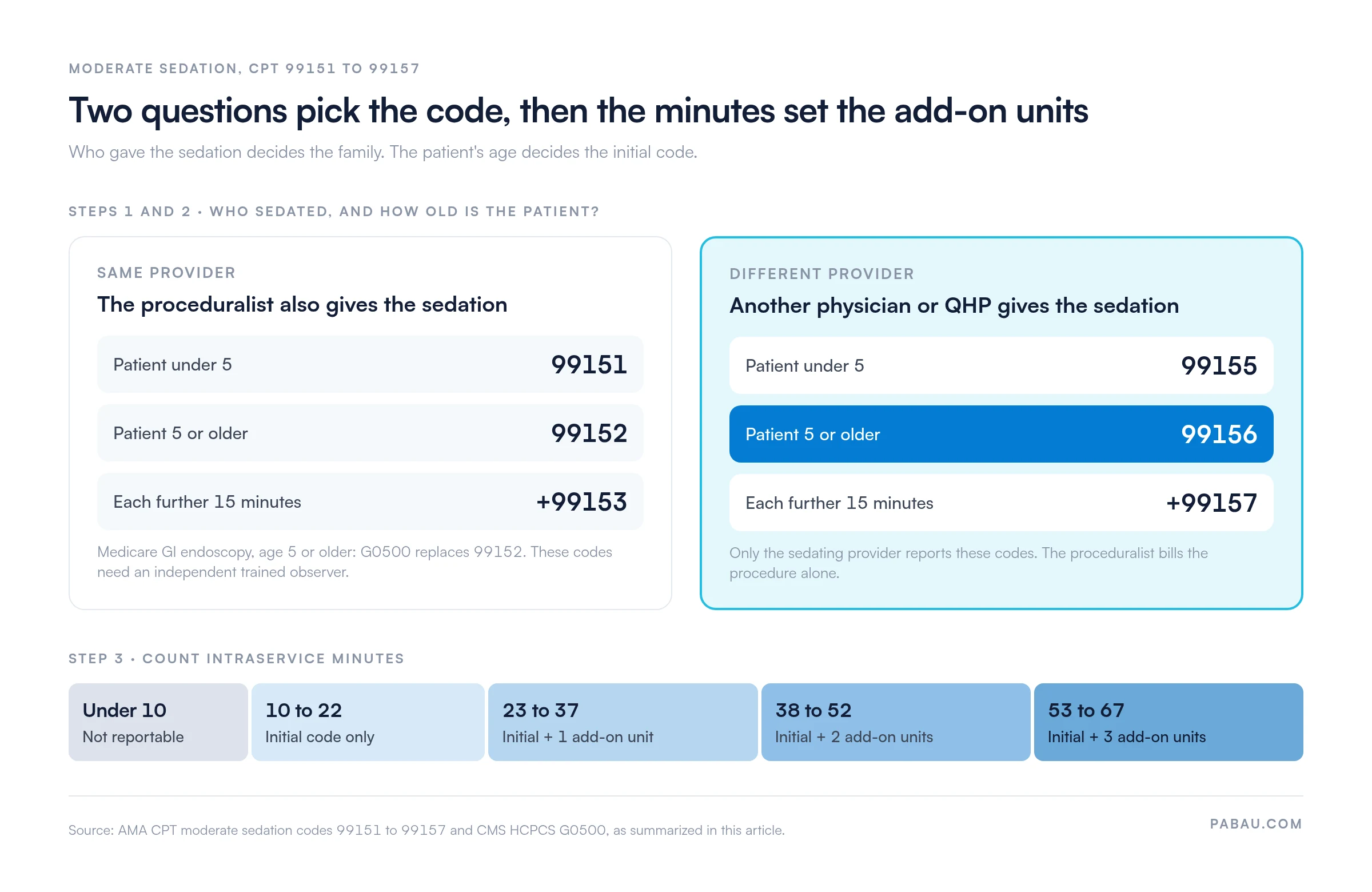
Codes 99155, 99156 and +99157 all describe sedation by a provider other than the proceduralist. 99155 and 99156 differ only by age. The same-provider codes, 99151 to +99153, are the ones that require an independent trained observer to help monitor the patient. That requirement is not part of 99155 to +99157.
Three cases show the split. A hospitalist sedates a 40-year-old while a radiologist performs the procedure, so the hospitalist reports 99156. A pediatric hospitalist sedates a 3-year-old for another physician’s procedure and reports 99155. A GI physician who sedates and performs a colonoscopy reports 99152, plus +99153 for longer cases, or G0500 for a Medicare patient.
CPT code +99157 is the add-on code for each additional 15 minutes of moderate sedation by a provider other than the proceduralist. It is never reported alone. It accompanies 99155 or 99156 on the same claim, and a unit counts once the midpoint of the next 15-minute block has passed.
A key audit point: Some practices report a single 99157 unit whatever the time on the record. That underbills once sedation reaches 38 minutes. The record must state the exact start and stop times of intraservice monitoring, so the number of 99157 units holds up on review.
Intraservice time for CPT code 99156 starts when the sedating agent is administered. It ends when the procedure is complete, the patient is stable for recovery, and the sedating provider ends continuous face-to-face time with the patient. Pre-sedation assessment and recovery time are not counted.
Time spent waiting between procedural phases, performing administrative tasks, or leaving and re-entering the room does not count. Only continuous, direct face-to-face patient monitoring time accrues toward the intraservice total.
A 99156 claim stands or falls on the sedation record. Payers auditing 99156 look for these six elements:
The superbill documentation submitted with a 99156 claim should cross-reference the sedation record. Payers request the full sedation record on audit. Different NPIs on the sedation and procedure notes support the 99155-99157 family, and the patient’s age then decides between 99155 and 99156.
Run a quarterly audit of your 99156 claims. Pull every encounter where the sedating provider’s NPI matches the proceduralist’s NPI. Those claims belong in 99151 to 99153, or G0500 for a Medicare GI endoscopy. Check patients under 5 too, since their sedation is 99155, not 99156.
Prior authorization requirements for CPT code 99156 vary by payer and by procedure setting. No universal rule applies across commercial plans. Check each payer’s policy before the encounter, since plans set their own place-of-service and authorization rules.
Pabau sends claims through Claim.MD, a US clearinghouse connected to thousands of payers, for eligibility checks, claim submission and electronic remittance advice (ERA). An eligibility check before the encounter confirms active coverage. Prior authorization codes, dates and sessions are tracked on the patient’s case, with a warning when one is missing.
A revenue cycle management process that logs authorization status at scheduling puts the number on file before the claim is built.
Medicare reimburses CPT code 99156 under the Medicare Physician Fee Schedule (MPFS) using relative value units (RVUs). The work RVUs below come from the fee schedule, while total RVUs and payment change with each annual update. Verify both in the CMS Physician Fee Schedule lookup tool for the current year before billing.
Geographic practice cost indices (GPCIs) adjust the national rate for local costs. A provider in a high-cost metro area receives a higher allowable than the national average, and rural providers typically receive less. The FastRVU 2026 RVU lookup allows free verification of location-adjusted rates before submission.
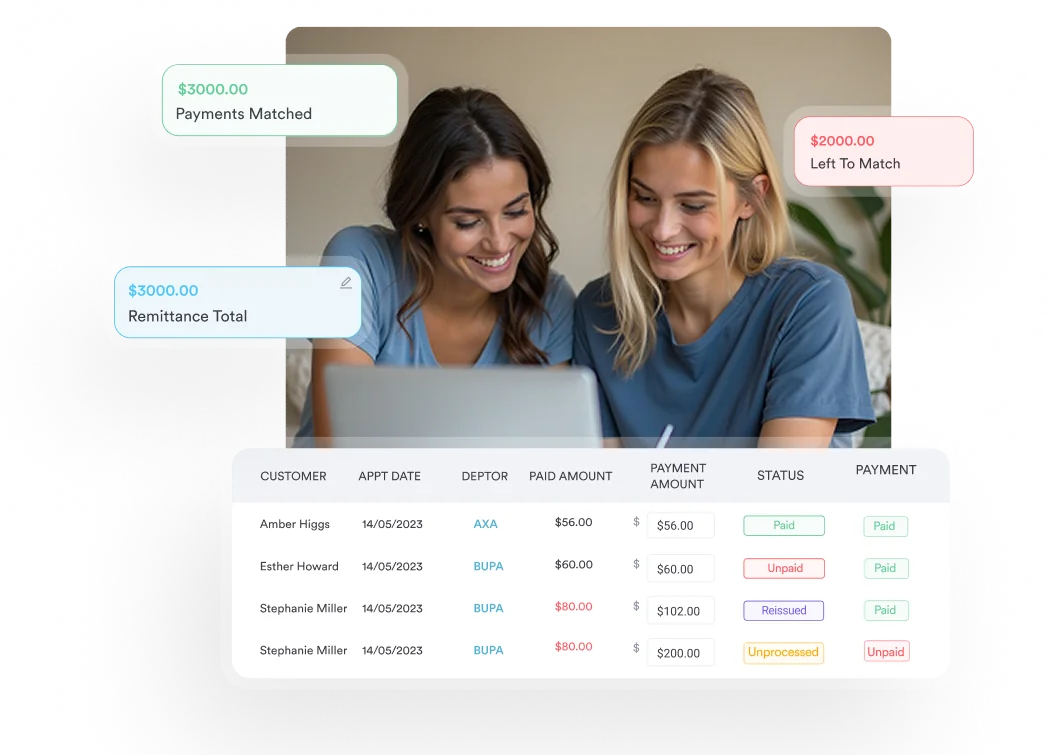
Pabau’s claims management software receives ERA remittances through Claim.MD, so you can compare each 99156 payment with the expected allowable.
CPT code 99156 denials tend to trace back to a short list of causes. Addressing them systematically as part of a denial management workflow is more effective than correcting claims one by one after the fact.
Reviewing the most common medical billing denial codes alongside your 99156 remittance data shows which denial categories repeat. Effort then goes to the fix that clears the largest share of claims. A clean claim, with all six documentation elements present, avoids the rework in the first place.
Build a five-point 99156 check into your billing workflow. Confirm the sedating provider did not perform the procedure. Confirm the patient is 5 or older. Verify exact start and stop times of at least 10 minutes. Count +99157 units from the time table. Attach the prior authorization number where the payer requires one.
CPT code 99156 covers moderate sedation only. A certified registered nurse anesthetist (CRNA), anesthesiologist, or other anesthesia provider giving general anesthesia or monitored anesthesia care (MAC) reports anesthesia codes 00100-01999 instead.
Moderate sedation and anesthesia codes are mutually exclusive for the same service. Billing 99156 when anesthesia codes apply creates an incorrect claim and will likely be identified on audit. The clinical record should note the depth of sedation achieved and the agent used. Both support the code family selected, per AAPC coding guidance on moderate sedation documentation.
Before 2017, moderate sedation was reported with 99143-99145 when the proceduralist gave the sedation and 99148-99150 when another physician did. Those codes already split by provider and by age. The initial code covered the first 30 minutes, and CPT Appendix G listed procedures with sedation built in. The AMA deleted both series in CPT 2017 and replaced them with 99151-99157.
Three changes from the 2017 revision still drive errors today:
Legacy logic still reaches claims, often from locum providers or multi-site groups trained on older workflows. The AMA’s CPT coding resources carry the current moderate sedation guidelines.
In many practices the sedation record and the claim sit in different systems. A coder reads the note, works out who sedated and who operated, checks the patient’s age and counts the minutes. Each step is a chance to land in the wrong code family.
Pabau keeps the sedation record and the claim on the same patient file. Practices can build the sedation record as a digital form, with fields for the sedating provider, the proceduralist, and the start and stop times. Claims go out through Claim.MD, with eligibility checks before the visit and ERA remittances after it.
The result is a 99156 claim built from what the record already says. Prior authorization codes are tracked on the case, with a warning when one is missing, so an authorization problem shows up before submission.

Pabau keeps the sedation record, the prior authorization and the claim on one patient file. Claims for 99156 and 99157 go out through Claim.MD to thousands of US payers, with ERA remittances posted back.

CPT code 99156 rests on three facts in the record. The first is who gave the sedation, the second is the patient’s age, and the third is the minutes between the start and stop times. A sedating proceduralist moves the claim to 99151-99153 or G0500, and a child under 5 moves it to 99155.
Record those three facts as fields the coder reads, so no one has to infer them from a narrative note. That one change turns code selection from a judgment call into a lookup.
Pabau’s claims tools connect to Claim.MD to submit 99156 and 99157 claims to thousands of US payers and receive electronic remittances. Book a demo to see how Pabau handles moderate sedation billing from the sedation record to the remittance.

Need a clearinghouse that handles 99156 and 99157 claims? Pabau’s Claim.MD clearinghouse guide explains how the integration connects your practice to thousands of US payers for eligibility checks and ERA processing.
Seeing repeat denials on moderate sedation claims? Medical billing compliance for practices covers the documentation controls and audit processes that reduce denial rates across CPT codes.
Want to understand the 837 file your clearinghouse submits? Understanding the 837 file breaks down how claim data maps from your practice management system to the EDI format payers receive.
CPT code 99156 is the code for moderate sedation given by a physician or QHP who is not performing the procedure. It covers the first 15 minutes of intraservice time for a patient aged 5 or older. Two providers are involved, one performing the procedure and another giving and monitoring the sedation.
The difference is patient age. Both codes cover the first 15 minutes of moderate sedation by a provider who is not performing the procedure. 99155 is for a patient under 5, and 99156 is for a patient aged 5 or older. When the proceduralist gives the sedation, neither applies. Use 99151 or 99152, or G0500 for a Medicare GI endoscopy.
Intraservice time starts when the sedating agent is administered. It ends when the procedure is complete, the patient is stable for recovery, and the sedating provider leaves continuous attendance. Under 10 minutes is not reportable. From 10 to 22 minutes, report 99156 alone. Add one unit of +99157 at 23 minutes, a second at 38 and a third at 53.
Yes, Medicare pays CPT code 99156 under the Physician Fee Schedule when the documentation supports it. The code carries a work RVU of 1.65, and +99157 carries 1.25. Payment varies by locality and changes each year, so check the CMS Physician Fee Schedule lookup tool for the current rate.
No. CPT code 99156 and anesthesia codes (00100-01999) are mutually exclusive. If a CRNA or anesthesiologist administers general anesthesia or monitored anesthesia care, only the anesthesia code range applies. Billing both on the same claim for the same procedure will result in denial and may trigger a compliance review.
The usual cause is the wrong code. A proceduralist bills their own sedation as 99156, or a child under 5 is coded 99156 instead of 99155. Missing or short intraservice times, miscounted +99157 units and missing prior authorization follow. A pre-claim check of provider, age, timestamps and units catches these before submission.