



CCSD code G5100: Bypass of duodenum billing guide
CCSD code G5100 bills a bypass that leaves the duodenum in place CCSD code G5100...

Last Updated: Oct 16, 2026

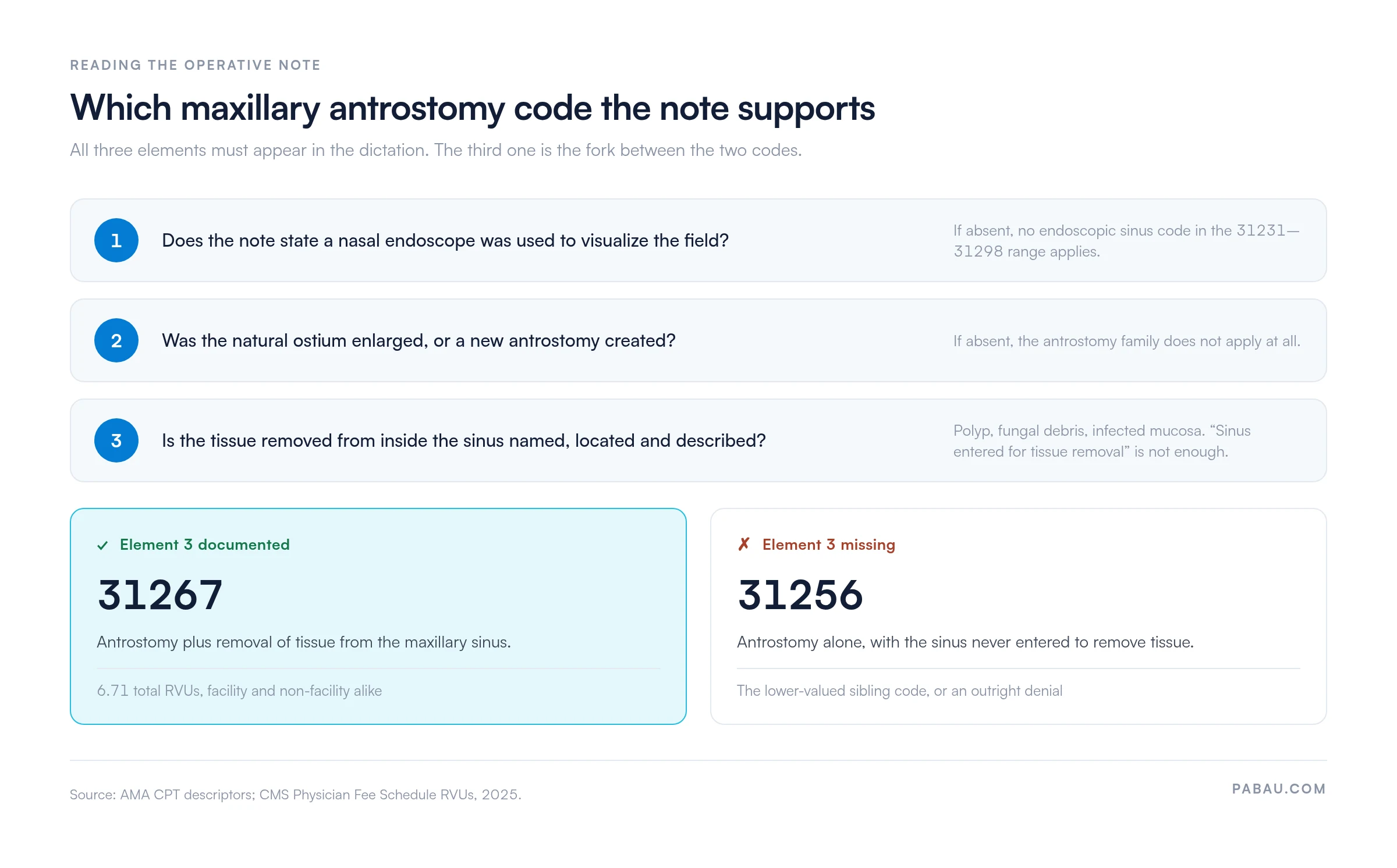
CPT Code 31267 covers a surgical nasal or sinus endoscopy with maxillary antrostomy and removal of tissue from the maxillary sinus.
31267 differs from 31256 on one point. Tissue has to come out of the maxillary sinus itself, not just the antrostomy opening.
The code carries 6.71 total RVUs in both facility and non-facility settings, of which 4.56 are work RVUs.
Modifier 50 covers bilateral procedures for Medicare, but many commercial payers want LT and RT on two separate lines instead.
Claims management software like Pabau ties each diagnosis code to the procedure code it supports and flags bundling conflicts before submission.
CPT Code 31267 is the billable code for a nasal or sinus endoscopy, surgical, with maxillary antrostomy and removal of tissue from the maxillary sinus. It is a functional endoscopic sinus surgery (FESS) code, and it pays more than its close sibling 31256.
Denials on this code cluster around a single line of dictation. The operative note confirms the endoscopic approach and the antrostomy, then never states that tissue came out of the maxillary sinus. That omission downcodes the claim to 31256 or denies it outright.
Below is the full billing picture for 31267. It covers the AMA descriptor, RVU values, modifier selection, ICD-10 pairings, NCCI bundling, and the documentation a payer expects to find.
The code describes a nasal or sinus endoscopy, surgical, with maxillary antrostomy, with removal of tissue from the maxillary sinus. It sits in the 31231-31298 range for endoscopy procedures on the accessory sinuses, as defined by the American Medical Association (AMA) CPT code set.
The surgeon passes an endoscope through the nasal passage to reach the maxillary sinus. They create or enlarge the natural ostium, which is the antrostomy itself. Then they remove diseased or obstructive tissue from inside the sinus cavity.
Tissue removal is the code’s defining element. Removal from the meatus or an adjacent structure does not count, and neither does widening the opening on its own. Coders should confirm the operative note says tissue came out of the sinus cavity before assigning 31267.
Medicare payment for 31267 varies by geographic locality, the setting of service, and the annual conversion factor in the Medicare Physician Fee Schedule (MPFS). The CMS Physician Fee Schedule lookup tool returns current figures by MAC and locality. Use it for live billing rather than any published estimate.
CMS publishes the relative value units for every code in the annual Physician Fee Schedule relative value files. The 2025 figures for 31267 are below. Check them against the current final rule before you bill.
Most 31267 procedures happen in a facility setting, either a hospital outpatient department (HOPD) or an ambulatory surgical center (ASC). The non-facility rate applies only when the procedure is done in a physician’s office, which is clinically unusual for FESS.
CMS carries the same practice expense RVU for 31267 in both settings, so the total lands at 6.71 either way. What changes is the facility payment, which the hospital or ASC bills separately under its own payment system. A multi-site ENT group should still model both, because the conversion factor and locality adjustment move the dollar figure.
Modifier selection depends on whether the procedure was bilateral, performed alongside other sinus work, or genuinely distinct from another service. The wrong modifier, or a missing one, is among the most common reasons a 31267 claim is reduced or denied.
For bilateral billing, Medicare’s standard approach is one line reporting 31267-50. Payer-specific rules vary a good deal, so confirm the current policy in the payer’s provider portal before you submit.
These modifiers describe how the procedure was performed, while a different family of modifiers decides who absorbs a denial. On K0869, modifier GA with a signed advance beneficiary notice dated before delivery moves the charge to the patient.
Before you bill modifier 50 for a bilateral 31267, check the payer’s own modifier guide. Medicare takes one line with modifier 50 at 150% of the allowed amount. Commercial plans often want LT and RT on two separate claim lines, each at 100%. The wrong format earns an automatic reduction or a denial.
Medical necessity for 31267 rests on a supporting ICD-10-CM diagnosis that explains why the maxillary sinus needed surgery. Payers check that linkage closely, and a poorly matched diagnosis is a predictable denial. The AAPC Codify CPT lookup offers crosswalk guidance for pairing.
A diagnosis code on its own does not guarantee coverage. Each payer’s Local Coverage Determination (LCD) sets which diagnoses meet medical necessity for sinus surgery. Confirm the applicable LCD before the case is scheduled, so a denial does not arrive after the patient has been treated.
31267 sits in a family of nasal and sinus endoscopy codes that run from simple to complex. Confusing it with 31256 is one of the most common FESS coding errors, and a frequent target of payer audits. A same-session concha bullosa resection is reported separately under 31240, which carries no NCCI edit with 31267. Our CPT code library covers the neighboring codes in this range.
Not every code a FESS episode touches is an endoscopy code. A post-operative sinus recheck is usually a limited follow-up CT, which is reported with 76380 rather than a complete study of the region.
31256 and 31267 describe the same procedural position, a maxillary antrostomy, with one consequential difference. 31256 covers the antrostomy alone. 31267 requires the extra step of removing tissue from inside the maxillary sinus.
If the surgeon creates the antrostomy opening but never enters the sinus to remove tissue, the correct code is 31256. If they take out polyps, infected mucosa, fungal debris, or other tissue from within the sinus, 31267 applies. Coding 31267 for an antrostomy alone is upcoding, which carries OIG audit exposure.
The National Correct Coding Initiative (NCCI) sets which codes may be billed together and which are bundled automatically. For endoscopic sinus surgery codes including 31267, those edits decide whether a claim pays. Sound denial management starts with auditing NCCI conflicts before submission rather than after.
Total ethmoidectomy is reported under CPT 31255, which treats a different sinus than the maxillary antrostomy in 31267. Both codes may be reported in one session, with modifier 59 where an NCCI edit applies.
Where only the anterior ethmoid cells come out, the ethmoidectomy is partial and reported under 31254. That code may also accompany 31267 in one session, provided the note separates the two procedures.
CMS updates the NCCI edit tables every quarter. Any pairing described here reflects the guidance available at the time of writing. Check the current quarter’s NCCI Policy Manual before you submit a claim.
An operative note that does not spell out each required element will fail payer review. The distinction between 31267 and 31256 rests entirely on the dictation, so the wording has to be unambiguous.
These are the elements a payer looks for when it reviews a 31267 claim:
Read as a sequence, those elements decide which of the two codes the note actually supports.
Practices that standardize an operative note template for their highest-volume sinus codes see far fewer documentation denials. The template is where the tissue-removal line stops being optional.
Build an operative note template for 31267 with a dedicated field labeled ‘Tissue removed from maxillary sinus: type and location’. If that field is still blank when the note reaches coding, the coder flags it there. The alternative is finding the same problem on appeal, months later.
ENT billing is dense with code-pairing rules, modifier requirements, and documentation dependencies. Every hand-off between the operative note, the coder, and the clearinghouse is a point where an error can enter. Most of those errors are catchable before the claim leaves the practice.
Practice management software like Pabau gives ENT practices cleaner claims management from the moment the encounter is documented.
It ties each ICD-10-CM diagnosis code to the CPT procedure code it supports, then flags likely NCCI bundling conflicts before submission. Claims route electronically through the Claim.MD clearinghouse, which reaches thousands of US payers.
CMS-1500 and 837P claims, real-time eligibility checks, and ERA (835) remittances all land back in the same system that holds the note. So the 31267 documentation review and the claim submission stop being two separate jobs, handled by two people looking at two screens.
For a practice billing FESS at volume, the payoff is a shorter denial list at month end. The claims that do come back arrive with a reason the billing team can act on the same week.

Pabau links CPT codes to supporting diagnosis codes, flags NCCI bundling conflicts before submission, and routes clean electronic claims to your clearinghouse. See how ENT practices cut denials and get paid sooner.

CPT Code 31267 is simple to define and easy to lose. The clinical work is well understood, but payment turns on one line of dictation. The note has to say that tissue came out of the maxillary sinus. Without it, the claim downcodes to 31256 or denies.
So the highest-value fix sits upstream of the coder. Make the tissue-removal line a required field in the operative note template, and the modifier and bundling questions become routine. Leave it optional and every bilateral 31267 stays a coin toss.
Book a demo to see how Pabau ties diagnosis codes to CPT codes and flags bundling conflicts before an ENT claim ever goes out.

Need a framework for reducing claim denials across your practice? Denial codes in medical billing covers the most common remittance advice remark codes and how to appeal them.
Want to see where the clearinghouse fits your billing workflow? Medical claims clearinghouse overview explains how 837P transactions move from practice to payer, and where errors get caught.
Billing several sinus procedures in one session? Superbill documentation covers how to structure a procedure list so modifier and bundling rules are applied before submission.
CPT Code 31267 is a nasal or sinus endoscopy, surgical, with maxillary antrostomy and removal of tissue from the maxillary sinus. It sits in the 31231-31298 endoscopy range and describes a FESS procedure on the maxillary sinus. The surgeon both creates the antrostomy opening and takes tissue from inside the sinus cavity.
Medicare payment for 31267 varies by geographic locality and changes each year with the MPFS conversion factor. The CMS Physician Fee Schedule lookup tool returns current facility and non-facility rates by MAC and locality. A published third-party estimate will not reflect your own locality adjustment.
31256 covers the maxillary antrostomy alone, where the surgeon opens the natural ostium but never enters the sinus to remove tissue. 31267 adds the removal of tissue from inside the maxillary sinus. Coding 31267 for an antrostomy alone is upcoding. The note must name the tissue removed and say where it came from.
Yes. Medicare accepts bilateral billing of 31267 with modifier 50 on a single line at 150% of the allowed amount. Many commercial payers instead want LT and RT on two separate claim lines, each at 100%. Check the payer’s bilateral policy before you submit, or expect an automatic reduction.
J32.0, chronic maxillary sinusitis, is the most common supporting diagnosis. Other frequent pairings include J33.0 (polyp of nasal cavity), J32.4 (chronic pansinusitis), and J33.8 (other polyp of sinus). Coverage still rests on the payer’s Local Coverage Determination, so confirm the applicable LCD before scheduling.
CPT 31267 carries 4.56 work RVUs, 1.49 practice expense RVUs, and 0.66 malpractice RVUs. That totals 6.71 RVUs, and the total is the same in facility and non-facility settings. Check the current CMS relative value files before billing, because the values change with each annual final rule.



