

CCSD code G5100: Bypass of duodenum billing guide
CCSD code G5100 bills a bypass that leaves the duodenum in place CCSD code G5100...

Last Updated: Oct 16, 2026
31255 is the CPT code for nasal/sinus endoscopy, surgical, with ethmoidectomy; total (anterior and posterior). It applies when the surgeon removes both the anterior and posterior ethmoid air cells on the operative side under endoscopic visualization.
CPT 31254 covers partial anterior ethmoidectomy only, so the posterior ethmoid is the whole distinction between the two codes. Code selection turns on one line in the operative note. The note must say whether the posterior cells were cleared back to the face of the sphenoid.
Let Pabau's smart automation suggest the right codes, reduce claim denials, and keep your practice compliant—effortlessly.
Automate repetitive tasks and focus on what matters most—your patients.
Reduce coding errors and ensure compliance with the latest regulations.
Clean claims, fewer denials, and faster reimbursements.
Powerful insights and reporting to help your practice thrive.
HIPAA compliant SOC 2 certified GDPR-compliant Trusted by 4,000+ clinics worldwide

CPT 31255 covers total ethmoidectomy, anterior and posterior. CPT 31254 covers anterior cells only, so document both cell groups in the operative note.
A 90-day global surgical period applies under CMS, bundling routine post-op visits into the procedure payment.
Verify the CMS bilateral payment indicator for 31255 before applying Modifier 50. Some payers require RT and LT on separate lines instead.
Practice management software like Pabau tracks 31255 claim status and denial codes, so billing staff can work rejections without leaving the platform.
CPT code 31255 is the surgical code for nasal/sinus endoscopy with total ethmoidectomy, covering both the anterior and posterior ethmoid cells. The table below gives coders the official code data at a glance. The AMA maintains the complete code set, so verify the descriptor against the current edition of the AMA’s CPT code set for your billing year.
CPT code 31255 covers surgical nasal endoscopy that removes both the anterior and posterior ethmoid air cells. That is the full ethmoid labyrinth on the operative side. The surgeon introduces the endoscope through the nasal cavity and works through both compartments with microdebriders, forceps, or curettes under direct visualization. This separates 31255 from a diagnostic endoscopy, and from the partial procedure coded as 31254.
Three elements must all be present for 31255 to apply correctly:
Functional endoscopic sinus surgery (FESS) is the broader procedural family, and CPT code 31255 is one component of a FESS session. ENT practices often bill several FESS codes for the same operative encounter when the surgeon treats additional sinuses.
Understanding the surgical sequence helps coders verify that the operative note supports the code selected. A total ethmoidectomy proceeds in three main stages, and only the third one changes which code applies.
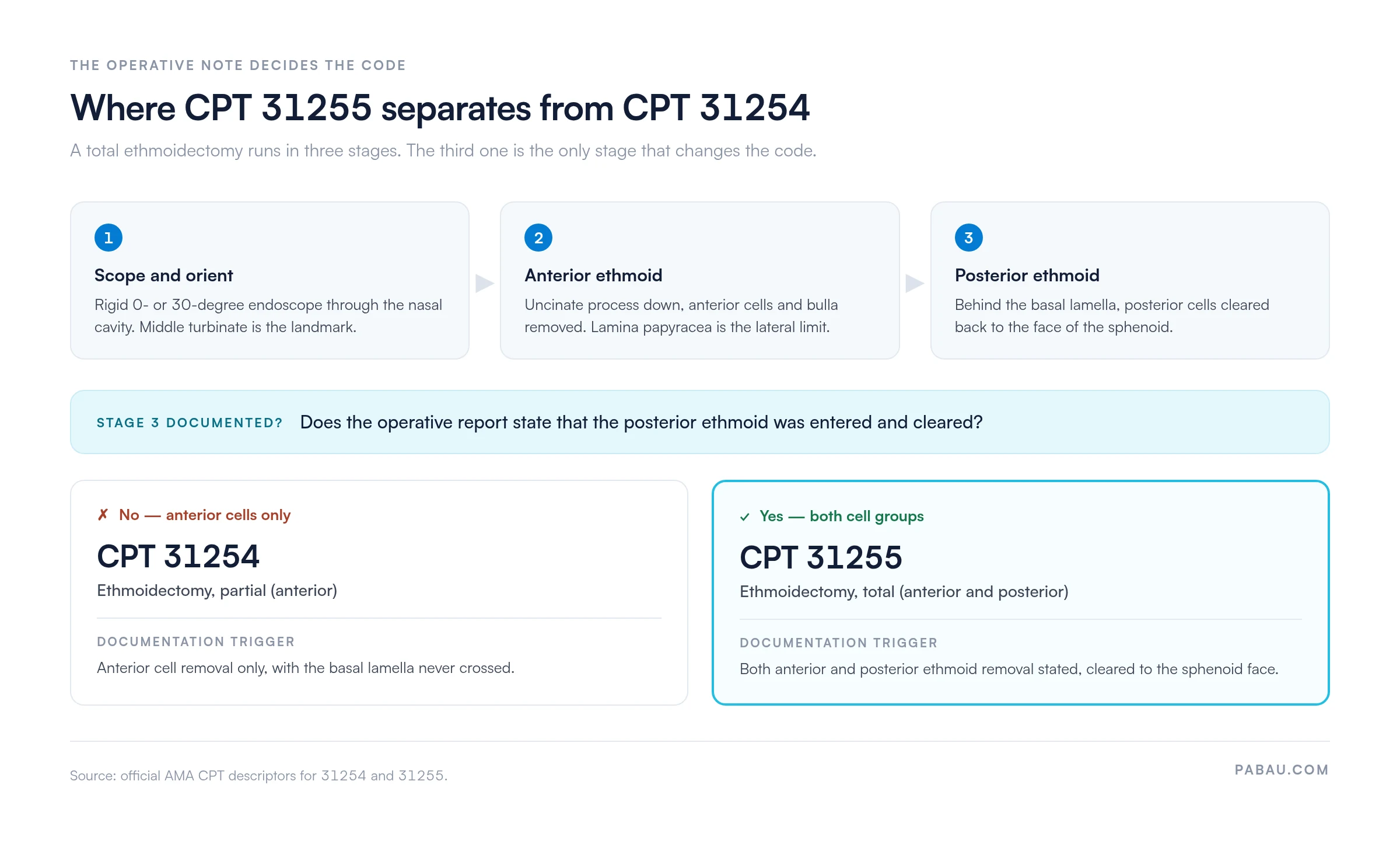
The operative note should use anatomically precise language. Phrases such as “anterior and posterior ethmoid cells removed” hold up on audit. So does “posterior ethmoid entered and cleared to the anterior face of the sphenoid.” Vague wording such as “ethmoidectomy performed,” with no statement of anterior-only or total scope, is the leading reason payers downcode 31255 to 31254.
Solid documentation is the difference between a paid claim and a denial on audit. ENT billing teams should confirm each of these elements is present in the operative report before submitting. A complete record stands on its own, without a follow-up query to the surgeon.
HIPAA mandates standardized code sets in claims submissions. Documentation that does not match the submitted code creates compliance exposure. That exposure runs through pre-pay review and retrospective audit alike.
The 31254/31255 pair is a common code-selection error in ENT surgical billing. The only anatomical distinction is the posterior ethmoid. If the surgeon does not access and clear it, 31254 applies.
Upcoding from 31254 to 31255 without operative note support is a compliance risk. Downcoding from 31255 to 31254 when the surgeon performed the full procedure leaves reimbursement on the table. The operative note is the deciding document, rather than the surgeon’s recollection after the fact.
ENT surgeons often treat multiple sinuses in a single session. Clean submission depends on knowing which FESS codes billers can charge alongside CPT code 31255. It also depends on knowing which pairs need Modifier 59 to override an NCCI edit.
CMS updates NCCI edits quarterly. Always verify current edit pairs before billing any multi-code FESS encounter. The American Academy of Otolaryngology (AAO-HNS) publishes specialty-specific CPT guidance that can supplement payer LCD review.
One more pairing sits outside the table. A concha bullosa resection done only to reach the ethmoid sinuses bundles into 31255. When removing the aerated middle turbinate is a distinct surgical objective, report CPT code 31240 separately.
Modifier selection for CPT code 31255 depends on procedure laterality, session complexity, and whether billers submit other codes in the same encounter. Incorrect modifier use is a frequent denial driver for FESS codes.
Check your payer contract before defaulting to Modifier 50. Many commercial plans and Medicare Advantage carriers require RT and LT on separate claim lines rather than a single line with Modifier 50. Submitting 50 when a payer expects RT/LT is a preventable denial that takes weeks to resolve through appeal.
Medicare reimburses CPT code 31255 under the Physician Fee Schedule. The table below lists the payment metrics that decide what the code pays, since actual payment varies by geographic adjustment factor (GAF) and practice location. Commercial payers negotiate their rates separately, and those rates often exceed Medicare’s. Use the CMS Physician Fee Schedule lookup tool to pull your locality-adjusted rates, and the FastRVU 2026 RVU lookup for quick RVU verification.
Prior authorization requirements for CPT code 31255 vary by payer, plan type, and MAC jurisdiction. No single rule applies, so check the specific plan before scheduling the surgery.
Three broad patterns hold:
Completing insurance eligibility verification before scheduling surgery confirms both coverage and any outstanding authorization requirements. An authorization that the practice obtains but does not link to the correct CPT code at submission counts as no authorization at all. Verify that the approved codes match what the claim will bill.
CPT code 31255 carries a 90-day global surgical period under the CMS Physician Fee Schedule. The single surgical payment bundles routine post-operative care for those 90 days. Billing a standard E/M visit inside that window, for follow-up related to the ethmoidectomy, will result in denial.
Several scenarios allow separate billing during the global period:
The 90-day global period covers pre-operative services on the day before and the day of surgery. It also covers the intraoperative work and all normal post-operative care. Flagging global-period encounter dates on the ENT encounter form prevents inadvertent duplicate billing.
CPT code 31255 denials cluster around a small set of documentation and coding errors. Knowing where claims fail speeds resolution and prevents the same rejection arriving again next quarter.
Review the denial codes most often attached to 31255 rejections, both CARC and RARC. The adjustment reason code the payer used tells you whether the denial is a documentation, coverage, or coding problem. That answer sets the appeal path.
The ICD-10-CM diagnosis code on the claim must reflect the condition driving the surgical need. Mismatched diagnosis codes, or codes that aren’t specific enough, are a secondary cause of 31255 medical-necessity denials. The table below shows the codes most often paired with 31255, and which best support the clinical indication for total ethmoidectomy.
Always use the most specific code available. Coders should prefer J32.2 (chronic ethmoidal sinusitis) over J32.9 (chronic sinusitis, unspecified) once they confirm ethmoid disease. That confirmation should appear on imaging and in the operative note. Unspecified codes are a soft target for medical-necessity review.
Cross-check ICD-10 codes against your governing MAC LCD before submission. LCD criteria specify which diagnoses support 31255 coverage. Submitting J32.9 when the chart documents J32.2 may technically be accurate, but it weakens the medical-necessity argument compared with the specific ethmoid code.
ENT billing teams usually track FESS claims in three places at once. The practice management system holds the appointment, a spreadsheet holds the submitted claims, and the clearinghouse portal holds the rejections. Matching those three up is where 31255 rework starts.
Practice management software like Pabau keeps the operative encounter, the claim, and the denial on one patient record. Claims go out online through Claim.MD, Pabau’s clearinghouse integration, and remittances match back against the line the practice submitted. Pabau’s claims management software then holds the rejections in a queue your billing staff work from directly.
Billing staff spot a downcoded 31255 the same day, against the note that supports it, rather than at a monthly review. Appeals go out while the operation is still fresh in the surgeon’s memory.
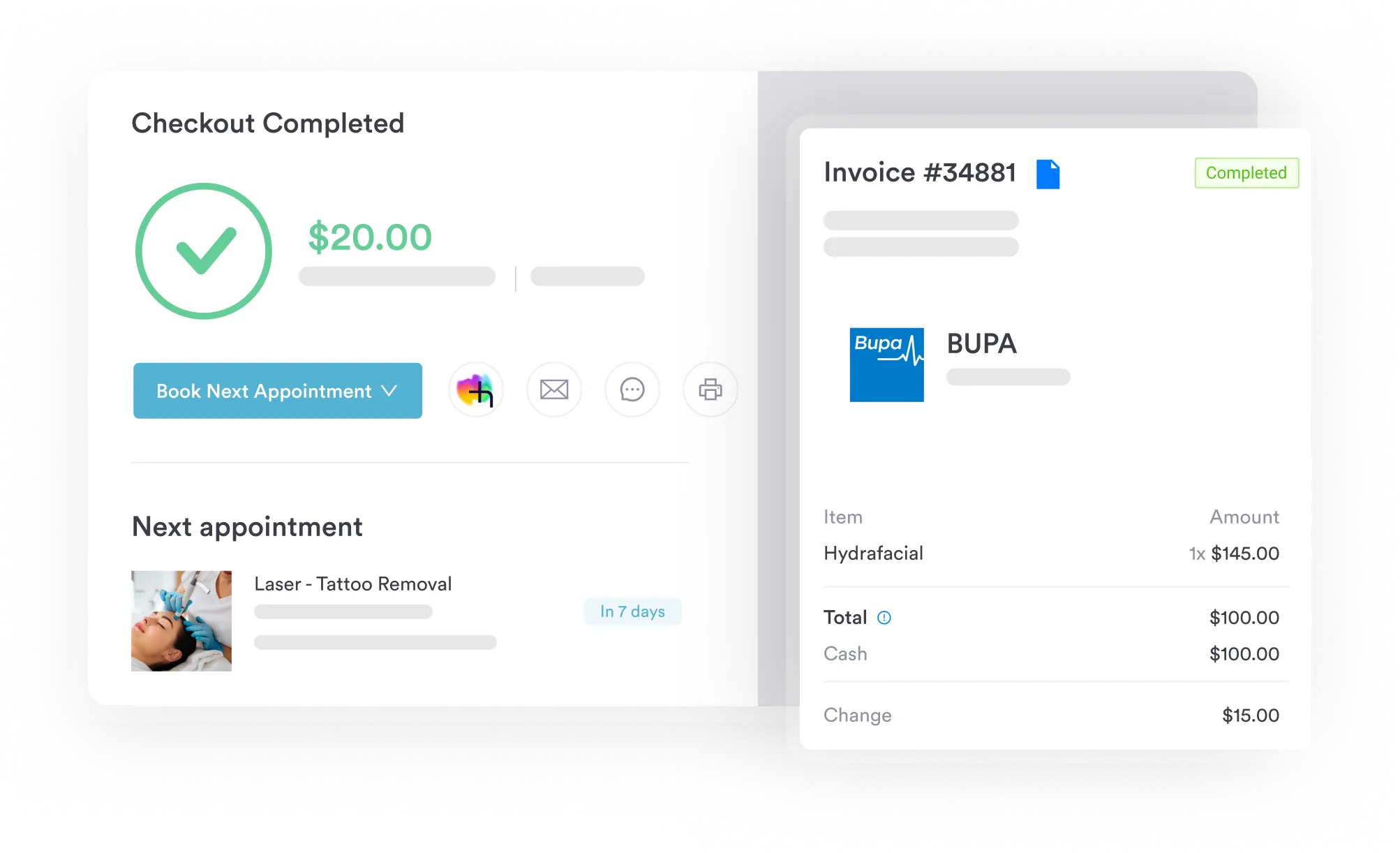

Pabau integrates scheduling, clinical documentation, and claim submission in one platform. ENT practices use Pabau to track 31255 claims, manage denial queues, and submit claims online through Claim.MD across 4,000+ US payers.

CPT code 31255 is a high-value ENT surgical code, and billing accuracy rests almost entirely on operative note precision and correct modifier use. What the operative report says settles the total versus partial distinction from CPT 31254. If it omits posterior ethmoid removal, the claim cannot support 31255.
Two habits remove most 31255 rework. Give surgeons an operative-note template that prompts for each ethmoid compartment, and confirm the payer’s bilateral preference before the claim goes out. Book a demo to see how Pabau tracks FESS claims and multi-code ENT encounters from submission through payment.

Need to understand the full medical billing process? What is medical billing walks through how claims move from procedure to payment in US healthcare.
Dealing with claim rejections across your ENT practice? Denial management in healthcare covers systematic approaches to reducing and appealing denied claims.
Want to understand how clearinghouses process FESS claims? 837 file submission explains the electronic transaction format used to send CPT codes to payers.
CPT code 31255 covers nasal/sinus endoscopy, surgical, with ethmoidectomy, total (anterior and posterior). The surgeon removes both the anterior and posterior ethmoid air cells under endoscopic visualization. Anterior-only removal maps to CPT 31254 instead.
Yes, when the surgeon performs total ethmoidectomy on both sides in the same session. Under traditional Medicare, apply Modifier 50, subject to the CMS bilateral payment indicator for 31255. Some payers require RT and LT on separate claim lines instead. Verify which format your payer accepts before submitting.
Yes, Medicare covers CPT code 31255 when the claim meets medical necessity criteria. The applicable MAC LCD specifies the clinical criteria. Those usually include failed conservative therapy and imaging evidence of chronic ethmoidal sinusitis or pansinusitis. Traditional Medicare does not usually require prior authorization, but Medicare Advantage plans often do.
CPT code 31255 carries a 90-day global surgical period under CMS. The procedure payment bundles routine post-operative care for those 90 days. Separate E/M billing during the global period requires Modifier 24 for an unrelated condition or Modifier 79 for an unrelated procedure. Billers cannot charge routine follow-up visits related to the ethmoidectomy separately.



