HCPCS code G0257: Unscheduled or emergency dialysis billing guide
HCPCS code G0257: Official descriptor and code overview HCPCS code G0257 is defi...

Last Updated: Oct 27, 2026
31240 is the CPT code for nasal/sinus endoscopy, surgical; with concha bullosa resection. It covers endoscopic removal of the lateral lamella of a pneumatized middle turbinate that narrows the middle meatus.
NCCI bundles CPT 31237 into 31240, so separate billing needs Modifier 59 or XS and distinct-site documentation. Medicare pays bilateral cases at 150% with Modifier 50, and prior authorization rules vary by payer.
Let Pabau's smart automation suggest the right codes, reduce claim denials, and keep your practice compliant—effortlessly.
Automate repetitive tasks and focus on what matters most—your patients.
Reduce coding errors and ensure compliance with the latest regulations.
Clean claims, fewer denials, and faster reimbursements.
Powerful insights and reporting to help your practice thrive.
HIPAA compliant SOC 2 certified GDPR-compliant Trusted by 4,000+ clinics worldwide

CPT code 31240 describes surgical nasal/sinus endoscopy with resection of a concha bullosa, a pneumatized middle turbinate, and differs from the polypectomy code 31237.
NCCI lists 31237 as a column 2 code of 31240 with a modifier indicator of 1. Billing both needs Modifier 59 or XS and distinct-site documentation.
Medicare gives 31240 a 000 global period and a bilateral surgery indicator of 1, so bilateral cases take Modifier 50 and pay at 150%.
In 2026, 31240 carries 2.54 work RVUs and 4.09 total RVUs, for a national unadjusted Medicare payment of about $136.61.
Pabau, the practice management platform we build, submits CPT 31240 claims through Claim.MD, checks eligibility in real time and tracks claim status.
The American Medical Association defines CPT code 31240 as Nasal/sinus endoscopy, surgical; with concha bullosa resection. The code belongs to the 31231-31298 nasal/sinus endoscopy family, and every code in it involves placing a rigid or flexible endoscope in the nasal cavity.
A concha bullosa is a pneumatized (air-filled) middle turbinate. When the air cell expands, it can narrow the middle meatus, block sinus drainage, and contribute to recurrent sinusitis or nasal airway obstruction. Resection removes the lateral lamella of the concha bullosa endoscopically, which reopens the middle meatus.
Surgeons often perform the resection during functional endoscopic sinus surgery (FESS). It is separately reportable when removing the concha bullosa is a distinct surgical objective. CPT Assistant notes that 31240 can be bundled into sinus codes such as 31255 when the resection only gives access to the sinuses.
Key clinical facts coders need: The concha bullosa must be documented on preoperative CT imaging. The operative note must specify which turbinate was pneumatized, the laterality, and the technique used. Resection of a non-pneumatized turbinate does not support CPT 31240. Neither does a resection done only to reach the ethmoid or maxillary sinus for another endoscopic code.
The operative sequence for a concha bullosa resection follows a consistent pattern, and each step maps to documentation requirements auditors look for.
Medical necessity documentation must establish symptomatic nasal obstruction and a CT-confirmed concha bullosa. It must also show that conservative treatment (nasal steroids, antihistamines) was tried and failed. Payers routinely deny CPT 31240 claims when the operative note lacks the CT correlation or laterality specification.
The 31231-31298 family shares a common base (nasal endoscopy) but diverges by the specific surgical objective. Picking a neighboring code for the wrong objective is an easy way to lose a claim in this family.
CPT 31237 covers biopsy, polyp removal and debridement, while CPT 31240 covers resection of a pneumatized middle turbinate. The targets differ, yet NCCI still pairs the two codes. Check the current CMS NCCI PTP edit tables before submitting any claim that pairs 31240 with 31237.
The National Correct Coding Initiative (NCCI) lists CPT 31237 as a column 2 code of CPT 31240 in the Q4 2026 practitioner table. The edit carries a modifier indicator of 1, so an NCCI-associated modifier can bypass it when the documentation supports a distinct service. Diagnostic endoscopy, CPT 31231, is bundled too, and its indicator of 0 means no modifier can override that edit. The table below shows where each neighboring code stands.
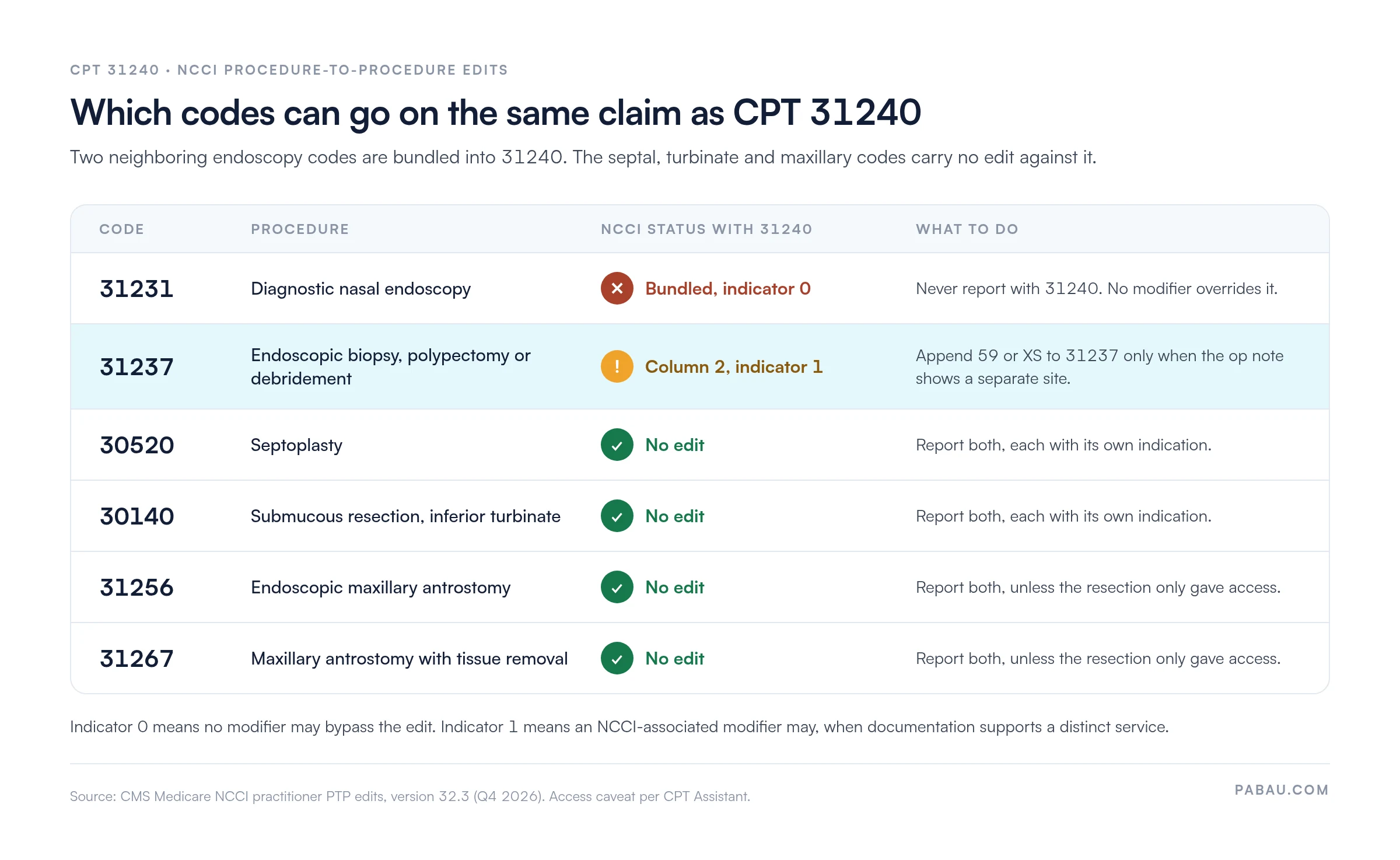
When both 31237 and 31240 are paid, Medicare applies its special endoscopy rule. Both codes carry a multiple procedure indicator of 3 and share the base code 31231. The higher-valued endoscopy pays in full, and the other pays its value minus the 31231 base.
What this means in practice: Say the surgeon resects a concha bullosa and removes a polyp at a different site in the same session. In that case, append Modifier 59 or XS to 31237. The documentation must state that the polypectomy was performed at a separate site from the concha bullosa resection. Without that detail, the 31237 line will deny. CMS updates the NCCI tables every quarter, so recheck the edit each quarter.
Yes, CPT 31240 can be billed with CPT 30520 and CPT 30140 when each procedure is clinically indicated in the same session. The Q4 2026 NCCI practitioner table carries no edit that pairs 31240 with either code. The three procedures treat anatomically distinct structures.
Correct modifier selection directly affects whether CPT code 31240 claims pay on first submission. The four modifiers ENT billing teams apply most often to this code are described below.
When concha bullosa resection is performed bilaterally, report CPT 31240 once with Modifier 50 appended. The 2026 fee schedule gives 31240 a bilateral surgery indicator of 1. Under that indicator, Medicare pays the bilateral line at 150% of the single-procedure amount (Claims Processing Manual, Chapter 12).
Some commercial payers deviate from this rule and require two line items (31240-RT and 31240-LT) instead of one line with -50. Confirm the payer’s bilateral reporting preference before submission to avoid automatic adjustment to 50% of the second unit. The operative note must document right-side and left-side findings separately and confirm a concha bullosa was present and resected on each side.
Before billing CPT 31240 bilaterally, check the payer’s provider manual or call the provider line. Confirm whether they want a single line with Modifier 50 or two line items with RT/LT modifiers. Getting this wrong results in a systematic underpayment that compounds across every bilateral case until caught.
Medicare reimbursement for CPT code 31240 is calculated from the CMS Physician Fee Schedule. The figures below are CY2026 national unadjusted values from the October 2026 CMS relative value file. Local rates vary through the Geographic Practice Cost Index and change with each annual update. Check your locality in the CMS look-up tool before setting your fee schedule.
Qualifying APM participants use the $33.5675 conversion factor instead, which gives about $137.29. Commercial payers set their own rates by contract. Because CMS lists the non-facility practice expense as NA, an office-based case carries the same 4.09 total RVUs as a facility case. In a hospital outpatient department or ambulatory surgical center, the facility bills its own claim under OPPS or the ASC payment system.
CPT 31240 carries a 000 global period in the 2026 Medicare Physician Fee Schedule, the indicator CMS uses for endoscopic and minor procedures. The global package covers only the day of the procedure, so no post-operative window follows it. Post-op care is therefore not bundled into 31240.
What the global package includes: The pre-procedure evaluation and the procedure itself on the date of surgery, plus immediate post-procedure care that day. Follow-up visits on later days, including a packing removal or debridement visit, fall outside the package and are reported on their own.
When a separate E/M is billable: A significant, separately identifiable E/M service on the same day as the procedure is reported with Modifier 25. The note must show work beyond the routine pre-procedure assessment. Modifier 24 does not apply, because it covers an unrelated E/M during a post-operative period, and 31240 has none.
Prior authorization is required for CPT 31240 by multiple commercial payers, including Ambetter (confirmed by provider policy documentation). Medicare does not require prior authorization for this procedure. Medicare Advantage plans may impose their own PA requirements, so check the specific plan’s policy rather than assuming standard Medicare rules apply.
The insurance eligibility verification step before scheduling concha bullosa resection should include a PA check alongside the benefits check. A Claim.MD eligibility request returns coverage and benefits in real time, but the PA itself is still requested from the payer.
Common PA clinical criteria for CPT 31240:
A missing CT report and undocumented conservative treatment are the two most common reasons authorization is initially denied. Many payers also require the full operative plan. If the surgeon plans septoplasty (30520) or turbinate reduction (30140) in the same session, list every planned code in the PA request.
Pairing CPT 31240 with an ICD-10-CM code that accurately describes the underlying condition is essential for establishing medical necessity. The diagnosis code must match the clinical indication documented in the operative note and supported by the CT findings.
Most CPT code 31240 denials fall into five recurring patterns. A denial management workflow that screens for them before submission saves an appeal later. Our guide to denial codes lists the remittance advice codes that signal each denial type.
Auditors reviewing CPT 31240 claims look for a specific set of operative note elements. An operative note that clearly addresses each item below will support both initial payment and any post-payment audit. Committing to consistent medical billing compliance documentation standards reduces audit exposure across the ENT practice’s full code set.
The denials described above start before the claim is built. A missed distinct-site modifier, a lapsed PA or a mis-keyed bilateral line all trace back to scheduling and charge entry.
In Pabau’s claims management software, the codes and modifiers your coder assigns go to payers as electronic CMS-1500 claims through the Claim.MD clearinghouse. Real-time eligibility checks confirm coverage before the resection is booked, which supports submitting a clean claim the first time.
After submission, claim-status tracking shows where each 31240 claim sits, so a rejected bilateral line is caught early. Your team still decides the codes, modifiers and PA requests, and Pabau keeps submission and follow-up in one place.

Pabau submits CPT 31240 claims through Claim.MD, checks eligibility in real time and tracks claim status, so ENT practices spend less time chasing denials.

CPT 31240 pays about $136.61 nationally in 2026, so one denied line takes most of the case’s professional payment with it. The decisions that protect it happen before surgery. The CT has to confirm the concha bullosa. The surgeon then has to decide whether the resection is its own objective or only access for a sinus code.
The trade-off worth remembering is 31237. Adding it with Modifier 59 or XS raises the claim’s value, but it also invites a closer look at the op note. Bill it only when the polyp site is plainly separate from the turbinate.
A claims workflow that keeps eligibility checks, submission and claim status together makes those rules easier to follow on every ENT case. Book a demo to see how Pabau handles claim submission and tracking for ENT procedures.

Need to understand how clearinghouses process ENT surgical claims? Medical claims clearinghouse guide explains how electronic claim routing works and where 31240 claims can stall in the payer pipeline.
Want to understand ERA remittance codes on denied 31240 claims? Electronic remittance advice explained breaks down how to read 835 files and identify denial reason codes from NCCI or prior auth failures.
Comparing Claim.MD clearinghouse options for your ENT practice? Claim.MD vs Office Ally covers the key differences between US clearinghouses for practices managing high-volume surgical endoscopy claims.
Billing a polypectomy in the same session? CPT code 31237 covers the descriptor, documentation and modifiers for endoscopic biopsy, polypectomy and debridement.
Did the surgeon only scope the nose? CPT code 31231 explains when diagnostic nasal endoscopy is reported on its own.
CPT code 31240 is the code for nasal/sinus endoscopy, surgical; with concha bullosa resection. The procedure removes the lateral lamella of a pneumatized middle turbinate to relieve nasal obstruction. It sits in the 31231-31298 nasal/sinus endoscopy family of the AMA’s CPT code set.
CPT 31240 has a 000 global period under the Medicare Physician Fee Schedule, so the global package covers only the day of the procedure. Follow-up visits on later days are billed separately. A significant, separately identifiable E/M on the day of the procedure takes Modifier 25.
Yes. The 2026 fee schedule gives 31240 a bilateral surgery indicator of 1, so Medicare pays a bilateral case at 150% of the single-procedure amount. Report it on one line with Modifier 50. Some commercial payers want two lines with RT and LT instead, so confirm each payer’s rule before submission.
In 2026 the national unadjusted Medicare payment for CPT 31240 is about $136.61, from 4.09 total RVUs at the $33.4009 conversion factor. The work RVU is 2.54, and the facility and non-facility totals are the same. Local rates vary through GPCI adjustments, so check the CMS look-up tool for your locality.
Yes. The Q4 2026 NCCI practitioner table carries no edit between CPT 31240 and CPT 30520, so both can be reported when each is clinically indicated. Apply Modifier 51 to the lower-valued code where the payer requires it. Document a separate indication for each: deviated septum for 30520 and concha bullosa for 31240.