

CCSD code G5100: Bypass of duodenum billing guide
CCSD code G5100 bills a bypass that leaves the duodenum in place CCSD code G5100...

Last Updated: Oct 16, 2026
K0869 is the HCPCS Level II code for power wheelchair, group 4 standard, captains chair, patient weight capacity up to and including 300 pounds.
Let Pabau's smart automation suggest the right codes, reduce claim denials, and keep your practice compliant—effortlessly.
Automate repetitive tasks and focus on what matters most—your patients.
Reduce coding errors and ensure compliance with the latest regulations.
Clean claims, fewer denials, and faster reimbursements.
Powerful insights and reporting to help your practice thrive.
HIPAA compliant SOC 2 certified GDPR-compliant Trusted by 4,000+ clinics worldwide

HCPCS code K0869 describes a power wheelchair, group 4 standard, captain’s chair, for a patient weight capacity up to and including 300 pounds
K0869 and K0868 share the same group, duty class, and 300-pound capacity. Only the seating differs, because K0868 is supplied with a sling or solid seat and back
Medicare denies group 4 power wheelchairs, K0869 included, as not reasonable and necessary for use in the home under the power mobility devices LCD
The CMS required prior authorization list covers group 3 codes K0856 through K0864, not group 4, so no prior authorization makes K0869 payable
Practice management software like Pabau keeps the order, the therapist evaluation, and the signed ABN with the patient record, so claims go out complete
HCPCS code K0869 is a Level II HCPCS code maintained by the Centers for Medicare and Medicaid Services (CMS). It identifies one configuration of durable medical equipment (DME), a group 4 standard power wheelchair supplied with a captain’s chair.
The official long descriptor reads: Power wheelchair, group 4 standard, captain’s chair, patient weight capacity up to and including 300 pounds. Three attributes in that descriptor decide whether K0869 is the right code. Those are the equipment group, the seating supplied with the chair, and the weight capacity.
The group 4 classification is what makes this code difficult. CMS uses groups 1 through 4 to describe increasing drive-wheel capability, programmability, and clinical complexity. Group 4 chairs offer more speed and range than group 3 chairs, and they are built to handle outdoor terrain. That extra capability is the reason Medicare treats them as more than a home-use device.
A captain’s chair is a one-piece seat and back with integrated armrests, closer to a car seat than to a rehab seating system. It cannot take an aftermarket seat cushion or back cushion, because there is no separate seat frame to mount one on.
That has a direct billing consequence. Under the wheelchair seating LCD, seat cushions are denied as not reasonable and necessary when the patient has a power wheelchair with a captain’s chair. A K0869 claim submitted alongside cushion codes such as E2601 or E2607 contradicts itself, and the DME MAC will catch it.
So the seating choice is a clinical decision before it is a coding one. A patient who needs skin protection or postural support needs the sling or solid seat model, which is K0868. A patient with no specialized seating need is the patient a captain’s chair suits.
K0868 and K0869 sit next to each other in the group 4 series, and billers confuse them constantly. Both codes describe a group 4 standard power wheelchair with a patient weight capacity up to and including 300 pounds. The only difference between them is the seating supplied with the chair.
Practical rule: match the code to the chair as the PDAC verified it, not to the name on the manufacturer’s brochure. The Pricing, Data Analysis and Coding contractor publishes the definitive product classification for power wheelchairs. Billing a code that disagrees with the PDAC-verified code for the chair you supplied is a standing audit trigger.
Medicare does not pay for K0869 as a home-use item. The power mobility devices LCD (L33789) states that group 4 chairs have added capabilities that are not needed in the home. Chairs in that group are denied as not reasonable and necessary when they are provided.
That is a coverage decision rather than a documentation problem, so a fuller chart note will not reverse it. Suppliers who still intend to provide a group 4 chair have three workable routes, and each one puts the charge somewhere different.
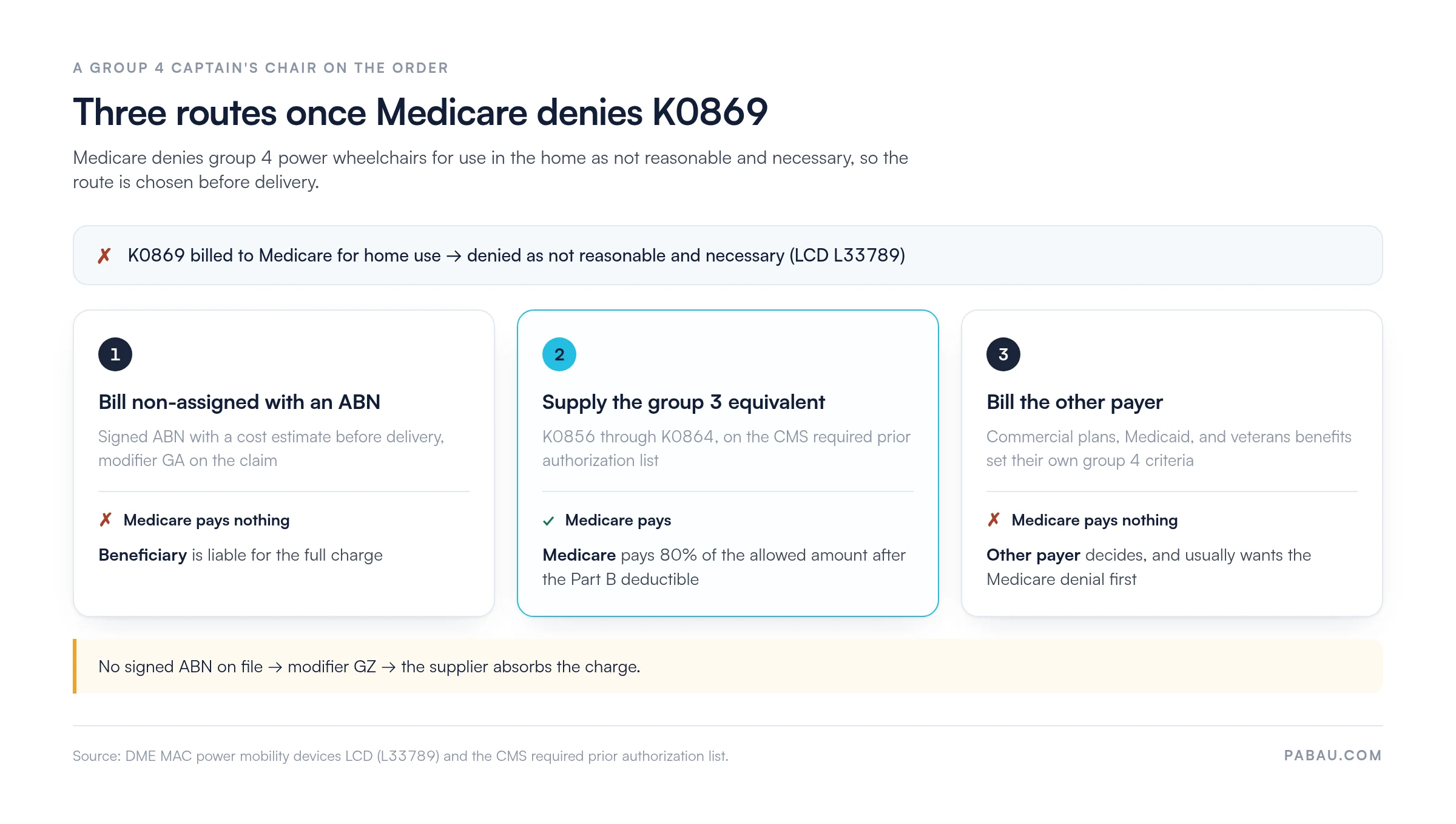
A Medicare denial still has value in the second and third routes, because a secondary payer usually wants to see it before considering the claim. Use modifier GY only for items excluded by statute, which group 4 chairs are not.
K0869 is not on the CMS required prior authorization list. That list covers the group 3 power wheelchair codes K0856 through K0864, which are the power wheelchairs Medicare does cover for home use. No prior authorization exists that makes a group 4 chair payable, so a supplier waiting on one is waiting for nothing.
Verify the beneficiary’s coverage before ordering, and check which plan is primary. CMS updates the required lists through Federal Register notices, so confirm the current version rather than a cached copy.
K0869 carries a DMEPOS fee schedule amount even though Medicare denies the item for home use. That amount still matters in two places. Commercial payers often price group 4 chairs against the Medicare fee schedule, and an ABN has to give the beneficiary a good-faith cost estimate.
The CMS fee schedule files are the authoritative source for current allowed amounts, and they change each January. Look the code up in the CMS DMEPOS fee schedule files, then confirm the amount for the beneficiary’s locality.
Put the fee schedule amount and the beneficiary’s full liability in writing on the ABN before the chair leaves the warehouse. An ABN with a blank or vague cost estimate is not valid, and an invalid ABN leaves the supplier holding the charge.
Documentation will not make a group 4 chair payable by Medicare. It still decides whether the claim processes cleanly, whether liability lands where you intended, and whether another payer will consider it. Build the file as though it will be reviewed, because a secondary payer or an audit contractor may ask to see all of it.
One item that used to sit on this list is gone. CMS discontinued certificates of medical necessity and DME information forms for dates of service on or after January 1, 2023. Claims that still carry CMN data are rejected and returned to the supplier. A workflow that still asks the physician for a CMN is holding up delivery for no reason.
The applicable DME MAC local coverage determination sets the clinical criteria, so read the current version before ordering and track each revision. Two contractors administer the DME MAC program. Noridian covers jurisdictions A and D, and CGS covers jurisdictions B and C.
The ICD-10 code on a K0869 claim has to describe a mobility limitation that powered mobility resolves. The DME MAC LCD for power mobility devices governs which diagnoses are accepted, and the covered list is revised with each update. The codes below are common examples rather than a complete list.
A supporting diagnosis does not override the group 4 coverage rule. What it does change is the shape of the denial. A denial for a non-covered diagnosis carries different appeal rights than one issued on the equipment group. Cross-reference each code against the current LCD and the AAPC HCPCS code lookup before you bill.
Modifier selection on a K0869 claim decides who ends up paying. Omitting a required modifier, or attaching the wrong liability modifier, moves the charge from the beneficiary to the supplier. Here is the framework that applies to group 4 power wheelchairs billed to Medicare.
Place of service must be the beneficiary’s home, coded as POS 12 on the CMS-1500 claim form. Billing another place of service is a routine error on DME claims. The ordering physician’s NPI and the supplier’s PTAN both have to appear. Check every required field before the claim goes out.
Group 4 power wheelchairs are coded K0868 through K0871 for the models without a power option, plus additional group 4 codes between K0877 and K0886. Group 3 chairs sit in the K0856 through K0864 range, and those are the power wheelchairs Medicare covers for home use. Matching a chair to a code means matching its PDAC-verified classification.
Read down that table and one detail stands out. No group 4 code above 300 pounds offers captain’s chair seating, because K0870 and K0871 are both sling or solid seat and back. A heavier patient who wants a one-piece seat has no group 4 code to bill. That is worth knowing before the chair is ordered rather than after.
At 300 pounds and under, a group 4 captain’s chair with multiple power options is coded K0885. K0869 covers the same seating with no power option.
Most K0869 denials come from a short list of repeat mistakes. Each one is cheaper to catch before the claim reaches the payer than to work through appeal.
Sorting denial codes by root cause shows which of these your team hits most often. Coverage, documentation, coding, and liability work well enough as buckets. Checking the file against the required elements before submission catches most of them upstream.
Audit K0869 denials monthly and sort them into coverage, documentation, coding, and liability buckets. When one bucket runs consistently ahead of the others, fix the step that produces it rather than fighting each denial at appeal.
Most DME billing teams keep the pieces of a power wheelchair claim in three different places. The clinical notes sit in the chart. The written order and the signed ABN sit in a shared drive, and the claim sits in the billing system. Someone has to check all three before submission, and that manual check is where K0869 claims slip.
Practice management software like Pabau keeps the record and the claim together. Clinical notes, signed forms, and uploaded documents attach to the patient record. Whoever prepares the claim can see at a glance whether the order, the therapist evaluation, and the ABN are on file. Pabau’s claims management software then tracks each claim from submission through payment or denial.
The result is fewer claims leaving incomplete and fewer denials the team works twice. Every Pabau subscription includes the full feature set, and onboarding is structured around your workflow, so nobody is left configuring it alone.

Pabau keeps orders, therapist evaluations, and signed ABNs with the patient record, so your team can submit clean K0869 claims and track every denial. Book a demo to see how it works.

K0869 is a narrow code. It covers a group 4 standard power wheelchair supplied with a captain’s chair for a patient weighing up to 300 pounds, and nothing else. The seating is what separates it from K0868. The equipment group is what keeps Medicare from paying for it as a home-use item.
So the work happens before the chair ships. Confirm the PDAC classification and decide whether a group 3 chair meets the mobility need at home. If the group 4 chair still goes out, get a valid signed ABN on file. To see how Pabau supports DME billing workflows, book a demo.

Want to reduce claim rejections across your billing workflows? Understanding medical billing fundamentals covers the end-to-end process from charge capture through payment posting.
Looking to strengthen compliance in your DME practice? Medical billing compliance guidance outlines the key regulatory requirements that affect DME suppliers.
Need a framework for working denied claims? Denial management in healthcare explains how to build a systematic appeals and root-cause process.
HCPCS code K0869 is a Level II HCPCS code for a group 4 standard power wheelchair. The chair is supplied with a captain’s chair, and it covers patients up to and including 300 pounds. A captain’s chair is a one-piece seat and back with integrated armrests. DME suppliers use the code when billing Medicare and other payers.
Not for use in the home. The power mobility devices LCD states that group 4 power wheelchairs have added capabilities that are not needed in the home. Medicare therefore denies them as not reasonable and necessary. Suppliers who provide the chair anyway bill non-assigned with a signed ABN and modifier GA.
No. K0869 is not on the CMS required prior authorization list, which covers the group 3 power wheelchair codes K0856 through K0864. No prior authorization exists that makes a group 4 chair payable for home use, so waiting on one only delays delivery.
K0869 has a DMEPOS fee schedule amount that varies by locality and is updated each January. Pull the current figure from the CMS DMEPOS fee schedule file. Because Medicare denies the item for home use, that amount mainly matters for ABN cost estimates and for payers that price against the Medicare schedule.
NU signals a purchase and RR signals a rental, with KH, KI, and KJ marking the rental month. GA applies when a signed ABN is on file and the supplier expects the denial. GZ applies when no ABN was obtained, which leaves the supplier liable for the charge.
The DME MAC LCD for power mobility devices defines the accepted diagnoses. Common examples include G35 for multiple sclerosis, G82.50 for quadriplegia, and G12.21 for amyotrophic lateral sclerosis. A supporting diagnosis does not override the group 4 coverage rule.
The seating is the only difference. Both codes describe a group 4 standard power wheelchair with a patient weight capacity up to and including 300 pounds. K0868 is supplied with a sling or solid seat and back, and K0869 is supplied with a captain’s chair.
Not in group 4. K0870 covers 301 to 450 pounds and K0871 covers 451 to 600 pounds, and both are limited to a sling or solid seat and back. A heavier patient who needs a one-piece seat has no group 4 code available.



