

CPT Code 52352: Ureteroscopic stone removal billing guide
CPT Code 52352: Official descriptor and procedure overview CPT Code 52352 descri...

Last Updated: Oct 30, 2026
30410 is the CPT code for a complete primary rhinoplasty on a nose that has not been operated on before. It covers work on the external parts of the nose, including the bony pyramid, the lateral and alar cartilages, and/or elevation of the nasal tip.
It sits between 30400, which stops at the cartilages and tip, and 30420, which adds a major septal repair. Revision surgery on a previously operated nose is billed with 30430, 30435 or 30450 instead.
Let Pabau's smart automation suggest the right codes, reduce claim denials, and keep your practice compliant—effortlessly.
Automate repetitive tasks and focus on what matters most—your patients.
Reduce coding errors and ensure compliance with the latest regulations.
Clean claims, fewer denials, and faster reimbursements.
Powerful insights and reporting to help your practice thrive.
HIPAA compliant SOC 2 certified GDPR-compliant Trusted by 4,000+ clinics worldwide

CPT code 30410 is a complete primary rhinoplasty, covering the bony pyramid as well as the lateral and alar cartilages and/or the nasal tip.
Bony work separates 30410 from 30400, and a major septal repair moves the case up to 30420.
A nose with any previous rhinoplasty takes a revision code instead: 30430, 30435 or 30450.
Traditional Medicare has required prior authorization for rhinoplasty in hospital outpatient departments since July 2020, and its list includes 30410 and 30520.
Pabau, the practice software we build, sends 30410 claims through Claim.MD and tracks each one until the remittance arrives.
CPT code 30410 is the code in the AMA’s CPT code set for a complete primary rhinoplasty. Its official descriptor reads “Rhinoplasty, primary; complete, external parts including bony pyramid, lateral and alar cartilages, and/or elevation of nasal tip”.
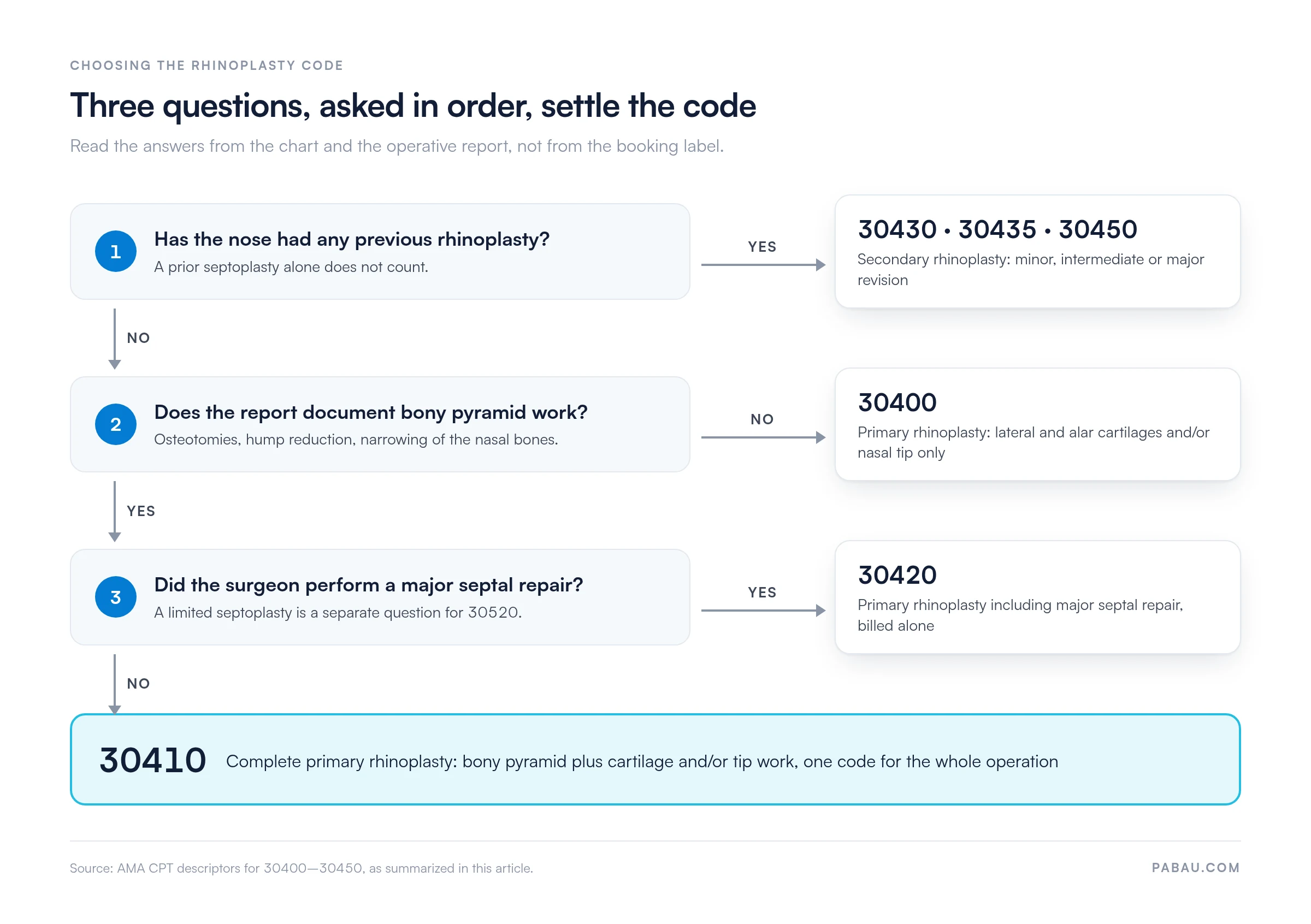
Two conditions make a case 30410. The nose has had no previous rhinoplasty, and the surgeon works on the bony pyramid as well as the cartilage. Bony work usually means osteotomies, hump reduction or narrowing of the nasal bones.
One 30410 covers the whole operation, however many structures the surgeon reshapes. Tip refinement, alar work and osteotomies in one session are still a single 30410. Septal work is the exception, and the comparison below explains why.
A complete rhinoplasty reshapes both the bony upper third of the nose and the cartilage below it. For plastic surgery practices and ENT groups alike, the operative report is what defends the code.
Typical work documented under 30410 includes:
Coders should look for the bony step in the operative note. Phrases such as “lateral osteotomies performed” or “bony hump removed” support 30410. A note that describes only tip and cartilage work supports 30400, whatever the billing sheet says.
All three codes describe a first rhinoplasty, so the choice turns on how much of the nose the surgeon reshapes. Bony work moves a case from 30400 to 30410, and a major septal repair moves it to 30420.
Prior surgery overrides all three codes. If the patient has had any previous rhinoplasty, the case is secondary and takes a revision code:
The revision codes also scale with the amount of work, but they never apply to a first operation. Check the surgical history before you weigh the operative detail.
Confirm the surgical history before you choose any rhinoplasty code. A history note that mentions earlier nasal surgery needs a follow-up question. A prior septoplasty alone does not make the case a revision, while a prior rhinoplasty does.
Put together, the checks always run in the same order. Surgical history comes first, then bony work, then the extent of any septal repair.
Rhinoplasty often shares a session with septal or turbinate work, and each pairing carries its own bundling question.
Before you report any nasal code alongside 30410, check the current National Correct Coding Initiative (NCCI) procedure-to-procedure table. Where an edit allows a modifier, 59 or XS tells the payer the second procedure was distinct. The operative report has to show a separate site or a separate problem to back it up.
The 30410 and 30520 pairing draws the most scrutiny. Document the septal deviation and the airway problem it causes separately from the structural goals of the rhinoplasty.
Payers cover 30410 only when it treats a documented functional problem. Medicare excludes cosmetic surgery, and most commercial plans follow the same line. Solid medical billing compliance means the functional indication is established before the claim goes out.
Functional indications that support a medically necessary 30410 claim include:
Appearance-driven goals do not meet the standard on their own. That includes a dorsal hump that does not affect breathing, a wide tip, or facial balance. When a case has both aims, the functional problem must lead the record and rest on objective findings.
Where the payer allows it, some practices split a combined case. The functional portion goes to the payer, and the patient pays for the cosmetic portion under a separate written financial agreement.
The ICD-10-CM code on the claim tells the payer why the nose needed surgery. Pairing 30410 with a cosmetic diagnosis, or with no diagnosis at all, is one of the fastest routes to a denial.
Use only codes the clinical record supports. An auditor will compare the diagnosis against the history and physical, the operative report and any prior authorization request. A mismatch can turn a single denial into a wider audit.
Modifier choice for 30410 depends on what else happens in the session and on the 90-day global period.
When 30410 and a second nasal code are billed together, list 30410 first. Add any distinct-service modifier to the second code, never to 30410 itself. Reversing the order is a common submission error that sends the claim back for rework.
Traditional Medicare has required prior authorization for rhinoplasty in hospital outpatient departments since July 1, 2020. The CMS list of outpatient department services names 30410 alongside 30400, 30420, the revision codes and 30520 septoplasty.
A denied hospital claim also takes related claims down with it, such as the surgeon’s and the anesthesiologist’s. Submit the request to your Medicare Administrative Contractor (MAC) before the date of service, and put the unique tracking number on the claim.
Ambulatory surgery centers now face a similar check in some states. Under a CMS demonstration, ASCs in seven states can request prior authorization for dates of service from January 19, 2026.
Those states are California, Florida, Georgia, Maryland, New York, Pennsylvania and Tennessee, and Arizona, Ohio and Texas followed on February 16, 2026. Participation is voluntary, but ASC claims that skip it face prepayment medical review.
Medicare Advantage and commercial plans set their own rules, and most require prior authorization for rhinoplasty. Front-office staff who know these rules can set expectations with patients before surgery is booked.
A standard prior authorization package for 30410 includes:
Commercial policies differ on detail, such as which photographs they want or how long conservative treatment must last. Pull the payer’s current rhinoplasty policy at scheduling rather than relying on last year’s checklist.
Medicare pays 30410 based on relative value units (RVUs) published each year in the CMS Physician Fee Schedule. The Geographic Practice Cost Index (GPCI) then adjusts the payment by location. Use the CMS lookup tool for current-year rates, because the fee schedule updates every January 1.
Key reimbursement facts for 30410:
Run eligibility verification for 30410 at least 72 hours before surgery, not at check-in. Many commercial plans set rhinoplasty pre-certification rules at the plan level, beyond the general payer policy. A failed authorization found on the day of surgery cannot be fixed in time.
Denials on 30410 follow predictable patterns. A solid denial management workflow fixes each one at the source, before the claim goes out.
The operative report is the most scrutinized document on a 30410 claim. Before submission, check the chart for each element below. Superbill documentation only works if the chart supports the codes on it, and building a clean claim starts with that chart review.
A quick self-check helps. After reading the report, could you name the bony work and confirm this was a first rhinoplasty? If not, the documentation will not defend 30410 in an audit. Use the AAPC’s CPT code reference to check the descriptor against what the record describes.
Many practices assemble a rhinoplasty claim from several places. The photos sit in one folder, the authorization letter in an inbox, and the operative note in the EHR. When a payer asks for records, someone rebuilds the file by hand.
Pabau keeps the consult notes, preoperative photos, consent forms and operative documentation on one patient record. Through Pabau’s Claim.MD clearinghouse integration, the invoice becomes an electronic CMS-1500 claim after a real-time eligibility check.
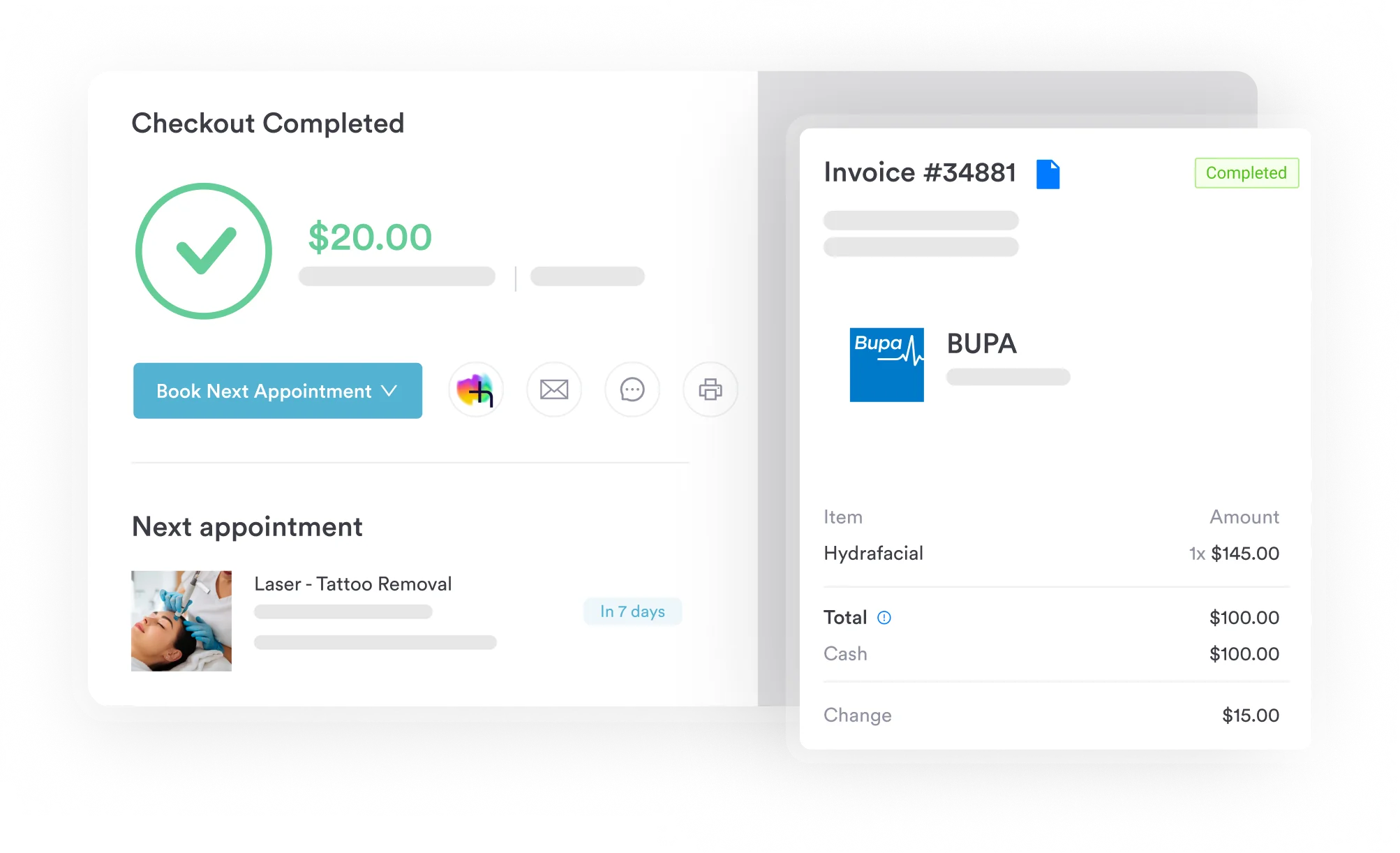
Claim statuses and electronic remittance advice flow back into the claims management software. Billing staff see a denied 30410 claim the day it lands, with the appeal documentation already on the record.

Pabau keeps photos, forms and operative notes on the patient record and sends CMS-1500 claims through Claim.MD. Your team sees which rhinoplasty claims are paid, pending or denied.

Let the operative report decide the code, whatever label the case carries on the surgical schedule. Confirm there was no prior rhinoplasty, find the bony work, then check whether the septal repair was major enough for 30420.
Settle the payer side before the surgery date. Under traditional Medicare, a hospital outpatient case without prior authorization is denied, and related claims fall with it. In the ten demonstration states, an ASC that skips the voluntary request faces prepayment medical review.
Correct coding protects the claim, and documented function protects the payment. Book a demo to see how Pabau keeps rhinoplasty documentation and claims together from consult to remittance.

Planning a primary rhinoplasty with a major septal repair? CPT code 30420 is the reference page for the code that replaces 30410 plus 30520.
Adding turbinate work to the same session? CPT code 30140 covers submucous resection of the inferior turbinate and its own billing rules.
Sending a rhinoplasty request to UnitedHealthcare? UnitedHealthcare prior authorization form gives your front office a ready template for the request.
Need to understand how clearinghouse submissions work? How a medical claims clearinghouse works explains the submission, validation, and ERA cycle that handles codes like 30410.
Want to reduce denial rates across your surgical caseload? Revenue cycle management fundamentals covers the end-to-end process from patient registration through payment posting.
CPT code 30410 covers a complete primary rhinoplasty on a nose that has not had a previous rhinoplasty. It includes work on the bony pyramid together with the lateral and alar cartilages and/or elevation of the nasal tip.
The difference is bony work. CPT 30400 covers primary rhinoplasty limited to the lateral and alar cartilages and/or the nasal tip. CPT 30410 adds work on the bony pyramid, such as osteotomies or hump removal.
Use 30420 when a primary rhinoplasty includes a major septal repair. In that case 30420 describes the whole operation, so do not report 30410 with 30520 for the same work.
No. CPT 30410 is a primary code, so it applies only to a nose that has never had rhinoplasty. Revisions take 30430 for a minor revision, 30435 for an intermediate one or 30450 for a major one.
Yes, in hospital outpatient departments, where traditional Medicare has required it since July 1, 2020. ASCs in ten states can request it under a voluntary CMS demonstration that began January 19, 2026 (February 16 in Arizona, Ohio and Texas). ASC claims that skip it face prepayment review. Medicare covers the procedure only when it treats a functional impairment.
Sometimes. If the septal work is a major septal repair, report 30420 alone instead. For a limited septoplasty, check the current NCCI edit first and document the septal deviation as a separate functional problem.
The most common denials are a cosmetic-intent finding, missing prior authorization and the wrong code. Wrong-code denials usually involve 30410 billed for a revision or without documented bony work. Unsupported diagnosis codes and unbundled septal work cause most of the rest.



